Years ago, when landlines were still common and Internet shopping was not, I got a phone call from a policeman, who said he was in Selfridges and did I know where my credit card was? Suppressing the triggered memories of It’s 10 PM. Do you know where your children are?, I said, yes, yes, I did. He pressed on. Was I sure? Because someone in Selfridges was trying to use it. Could I go look? Laziness and certainty led me to balk. I also puzzled over this unlikelihood: a policeman in central London is looking me up in the phone book? Wouldn’t he call the bank, if anyone? “I’m sure,” I said. And then, on a whim, “Which bank is it?” “Lloyds.” “Wrong! But thanks for playing.” End of call.
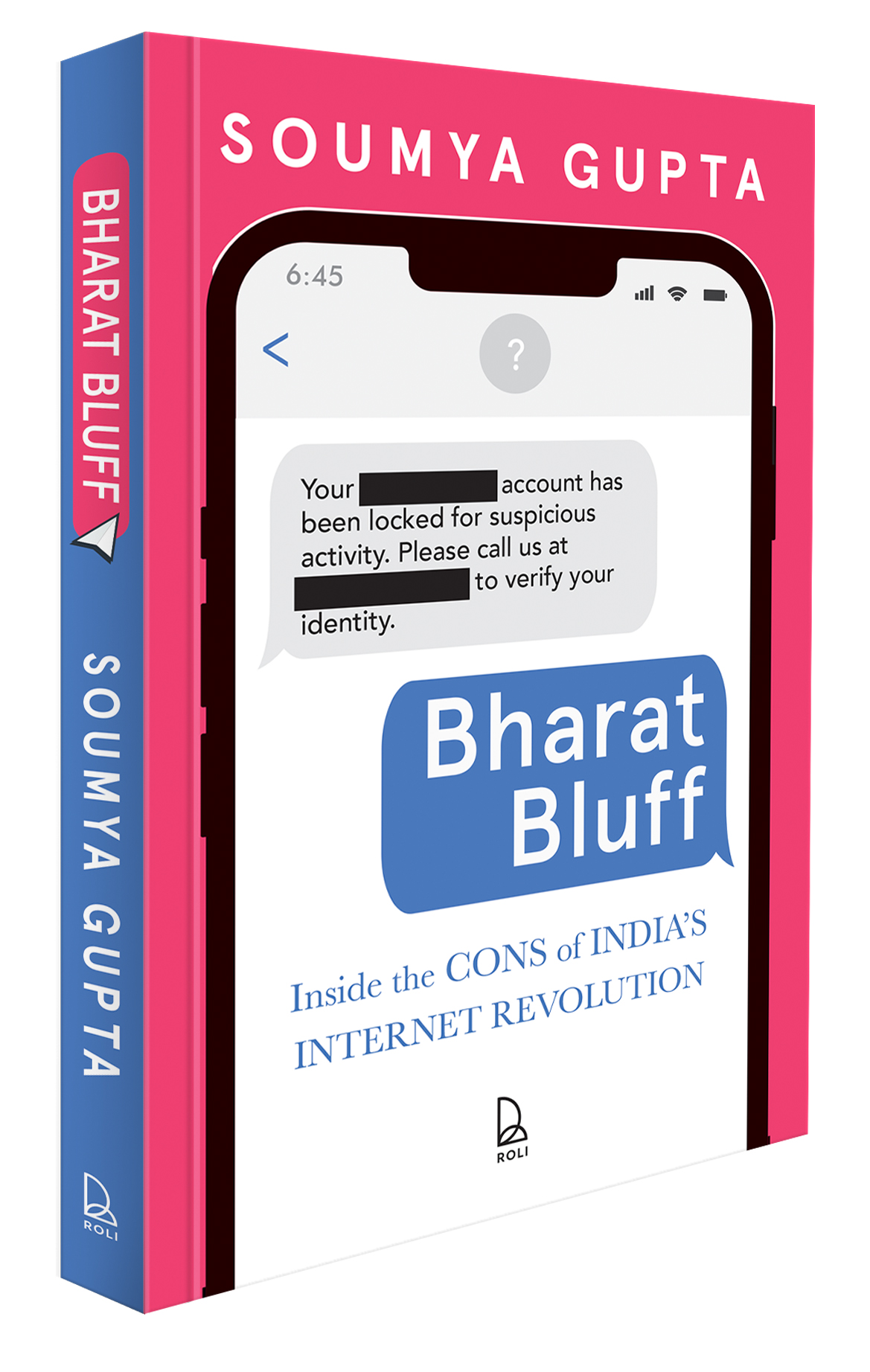
The scam with which Mumbai-based finance and technology journalist and podcaster Soumya Gupta opens her investigation of India’s scam economy, Bharat Bluff: Inside the Cons of India’s Internet Revolution also starts with a call from a “policeman” but heads rapidly for terrifying. The policeman who calls a 20-something male software engineer claims to have a parcel he sent containing illegal goods, and says he’s under investigation. Trying to prove they have the wrong guy, he gives them his correct identity information when what they read out is wrong. The calls escalate to add threats and the accusations become more serious. Fortunately, the panicked victim gets his mom, who calls their bluff: if it’s so serious, come arrest us. Nothing happens. His mother has saved him about $10,000. (So much for the cluelessness of mothers.)
The enabler of many of these scams, Gupta says, is the personal data everyone scatters freely, on which scammers – like magicians or psychic claimants doing cold readings – can build to intimidate their victims into supplying even more information and execute the scam. India’s Internet Freedom Foundation tracks the country’s data breaches, and reports that almost every Indian’s data has been sold online following many repeated data breaches – including the government’s Aadhaar database.
As Gupta writes, anyone can be a victim if caught at the wrong time. In a more elaborate digital arrest scam in 2024 that used WhatsApp, Skype, and a deepfake video of a well-known judge, the 80-plus-year-old businessman S.P. Oswal lost about $727,000 and spent several days locked in his house under video monitoring, believing he was being investigated for money laundering. After he brought himself to tell someone, the police retrieved most of the money. Common to all these scams: props, clothing, official looking badges and cards, and backgrounds meant to signal officialdom and generate fear that overwhelms rational decision making.
Gupta places digital arrest scams in the book’s section on “fear”. She devotes further sections to two more categories: “money” (cryptocurrency Ponzi schemes, fake loan apps, hijacked legitimate businesses) and “belief” (crowdfunding by fake charities and lying social influencers, young men lured to scam call centers by the promise of good jobs). In Gupta’s view, the first two – fear and money – are old scams reimagined but that belief is a largely-new creation of the “post-Internet society”. She studies all three with a combination of interviewees’ stories and background research.
In the book’s final section, Gupta goes on to consider the underlying enabling conditions. Only 0.5% of the population used credit cards in 2007, when Indian Amazon-equivalent, Flipkart (now owned by Walmart), launched, leading the company to embrace shipping COD, so people could be sure they received their goods before paying. India moved directly from cash to online payments, bypassing the West’s intermediate steps and its legacy thicket of institutions and regulations. Unemployment, particularly among young, educated men is high. Platforms are largely indifferent – or worse, profit. Gupta highlights Apple and Google’s failure to purge their app stores of fake loan apps, which often rank higher than legitimate ones, and the 2025 Reuters report that Meta’s own internal projects expected 10% of its 2024 revenues to come from scam ads. The trust people award these platforms is a problem, too; Gupta herself was taken in by a false number that turned up in a Google search for her local wine shop. The ease of looking online and trust in Google overrode their own local knowledge.
Gupta finds other factors besides the many leaks and breaches of Indians’ data. India has digitized rapidly through the adoption of the Aadhaar identity system and the Unified Payments Interface, the source of more than two million reported cases of fraud worth more than $112 million in 2024. Indians’ “Internet” is a highly centralized handful of apps and platforms, mostly from US Big Tech companies. Social media has normalized interacting with and trusting strangers. The covid pandemic turned courts virtual, and impoverished many while opening people’s hearts and wallets to the needs of those strangers. And, she writes, India’s culture of shame leads many victims to try to save face rather than seek redress.
None of these have easy fixes. Gupta doesn’t seem to think it will have much effect to pass laws or regulate platforms, especially with the prospect of AI generating scams at scale. For self-protection, she recommends learning to pause and reconsider, and identify moments of vulnerability and suggests crossing India’s many divisions to educate those who who lack online experience, such as older rural women. And: “Build a more just society.”
Illustrations: Bharat Bluff.
Also this week: TechGrumps episode 3.42, Three thefts don’t make a right.
Wendy M. Grossman is an award-winning journalist. Her Web site has an extensive archive of her books, articles, and music, and an archive of earlier columns in this series. She is a contributing editor for the Plutopia News Network podcast. Follow on Mastodon or Bluesky.