“They listen to us,” a character observes late in Alan Ayckbourn’s 92nd play, The Trial of Romeo Oscar. “They” are androids, and “we” are humans, and the character’s point is that while we’ve stopped listening to each other and to our heritage, androids are still learning us up. Which is all why – SPOILER ALERT! – when the search is on for an actor who can play Juliet the humans auditioning are all terrible and the only decent actress to be found is android Hermione Quinque (Olivia Woodhouse) currently serving drinks in the bar upstairs, lured to the performance by a promise that a top agent will be present. Actors!
The play is, in other words, a plea for the arts.
The plot, working from (possibly flawed) memory: it’s 2194, and soldier robot RSDO83 – Romeo Sierra Delta Oscar (Richard Stacey) – has been found severely water-damaged alongside a 13-year-old girl who has been stabbed to death on the otherwise desolate 11th moon of Uranus. Since the robot is somewhat functional – its audio system produces random selections from its memory that include recordings of orchestral classical music, nursery rhymes in a female voice, lines from Shakespeare – the presumption is that the robot must have murdered the girl and (human) engineer Devaney Dyer (Elizabeth Boag) is tasked with repairing it. A court is being assembled.
We meet Arbiter Jeffries (human, played by Russell Richardson), Assistant Arbiter Octo (android, Leigh Symonds), and defense lawyer Allistra Clay (Frances Marshall), who’s been jetted in from her home planet of Titan. She is second-generation on Titan, which in turn means she’s human, but a replicant, somehow “made” in a lab. So the characters trying to piece together what happened represent four distinct cultures: Jeffries nostalgically remembers prewar Earth; Devaney is a younger Earth-grown human for whom that’s all forgotten, Allistra is an exoplanet-created human for whom culture lives but history is censored, and Octo is an Earth-developed android who shares culture with Devaney but synthetic origins with Allistra.
Through their efforts to fill in each other’s gaps we learn the back story. A war on Earth saw many leave to colonize other planets and moons while the rest burrowed underground for safety. There is little left of the natural world, judging from the awe with which Allistra describes her visit to a tree museum. Government has collapsed in favor of big business ownership (as seen in smaller projects outlined in some parts of last week’s books.
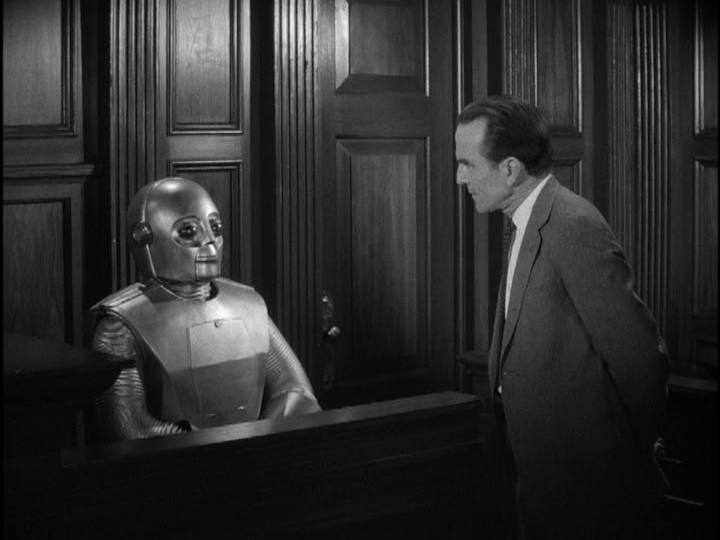
Within the confines of the play, Romeo Oscar’s trial is the first time in history that a robot has been tried for murder. In science fiction, of course, there is a long and rich history such as the 1964 The Outer Limits episode, I, Robot. In Ayckbourn’s play, an uprising has won androids workers’ rights and full citizenship. Hence RSDO83 must have a trial. So: did Romeo Oscar commit murder? Or, as Allistra contends, were he and 13-year-old Juliet, whom he raised from a baby, acting out Shakespeare’s play?
Ayckbourn’s play extensively quotes Shakespeare. It’s less easy to identify science fiction influences, though Octo cites a rule built into androids that rewords Isaac Asimov’s First Law of Robotics. The murder puzzle of the first act also evokes Asimov – his science fiction murder mysteries. Ayckbourn himself has long used science fictional elements: in 1987’s Henceforward, an exploitative artist adapts an android to his purposes in a dystopian future in which gangs dominate; in 1994’s Communicating Doors the door between two hotel rooms takes characters back and forward 20 years.
In a question-and-answer session after the performance, someone asked Ayckbourn if the play might see production elsewhere: “Straight theater in London is dead.” The West End now is a “bank of musicals” and the exceptions are “stunt casting” and/or runs limited to eight weeks. The open-ended runs that were once afforded to new work are gone, even in the theaters that do produce new straight plays. Yet live theater – especially in intimate in-the-round settings, small and regional theaters, or produced by amateurs in local communities – offers the connection many people say they crave after a decade and a half of staring at phones.
London’s West End is also suffering from the exclusionary effect of prices and corporate consolidation. In his 1968 book, The Season, the screenwriter William Goldman documented the beginning of this same change on Broadway, as costs spiraled and theater owners shifted from showmen to business managers. In 1976, you could sit at the back of the top balcony at a West End theater for £1; today that seat may cost £85. The shows sell out but it’s a very different audience. In an interview with Dominic Cavendish at the Telegraph two years ago, Ayckbourn blamed prices for making straight plays seem like poor value for money.
It’s more than 20 years since Ayckbourn’s plays routinely followed up their premieres in Scarborough with rims in London, even though his most famous earlier works see revivals such as this summer’s Old Vic eight-week production of 1969’s How the Other Half Loves. This explains why, when I read that his latest play was about a robot on trial for murder, I got on a train to Scarborough. It will tour in Bowness on Windermere and Stoke-on-Trent this month. And then that may be it.
Illustrations: District Attorney Thomas Coyle (Ford Rainey) questions robot Adam Link in the 1964 “I, Robot” episode of The Outer Limits.
Also this week:
– At the Plutopia podcast, we talk to Cory Doctorow about his latest book on corporate power and “reverse centaurs”.
– Also at the Plutopia podcast, we talk to Paulina Borsook about the reissue of her book, Cyberselfish.
Wendy M. Grossman is an award-winning journalist. Her Web site has an extensive archive of her books, articles, and music, and an archive of earlier columns in this series. She is a contributing editor for the Plutopia News Network podcast. Follow on Mastodon or Bluesky.