The summer of how-did-we-get-here? books continues with three more titles – and there are at least two more to come in the next month. This latest crop take broader views than the last few, which were mostlsy centered on Silicon Valley and written by people who live there.
In End Times Fascism and the Fight for the Living World, Naomi Klein and Astra Taylor treat the predations of billionaires as just one piece of a larger global turn to the right. They begin their tale at Davos and US president Donald Trump’s 2025 speech promoting New Gaza, a privately-owned model gated city built on the demolitions taking place as he spoke. As they acknowledge, Klein spotted spotted the exploitation of disasters as opportunities 20 years ago in The Shock Doctrine.
Although Klein and Taylor nod at a variety of other causes, they think technological rightward swing has been driven by the promise of reaching AGI (or superintelligence, or the Singularity, whatever you want to call it) even though the version of AI being pushed on us is, they say, “by far the worst offer in the history of capitalism”. They go on to consider possible responses across the range from billionaires’ escape fantasies to the kind of stay-in-place rethinking Zoltan Mamdani was elected to do.
By the end, when they’re proposing solutions, technology and the concentration of wealth are just two of their targets; they argue for the equivalent of disarmament. AI can be regulated, ordinary people deserve a voice in technological design, tools that would be dangerous in the hands of authoritarians should not exist, and the public sector needs to be restored. So does accountability. Finally, address the crises fascism feeds on. We have beaten it before; we can pick up that fight anew.
In the early days of the Internet, an American lawyer speculated that the Internet could enable an individual to change nationality without leaving home; governments, he surmised, could bid for citizens with services and opportunities. In today’s world of automated customer non-service, it’s obvious you’d never get the garbage picked up, but it was fun to think about.
In The Rise and Fall of the Artificial State, New Yorker writer and history professor Jill Lepore is chiefly concerned with the threat to democracy as it seemingly falls out of favor. Her “artificial state” is the automated, machine-driven administration that technology enables, starting with the desire to count and number the population. Mining the history of both science and science fiction, she traces our ideas about machine governance from fantasy to near-reality. Like Klein and Taylor, she doesn’t see all hope as lost. She advocates reconnecting to the natural world. Machines can’t save us if our planet is destroyed.
In a rare British entry, The Rulers: Corporate Power in the Age of AI and the Cloud, UCL economist Cecilia Rikap provides something new: a careful economic analysis from outside the US, focusing on knowledge rather than just markets. Using several different approaches to analyzing the power of a selected sample of the world’s biggest companies, she highlights three apex “knowledge predators”: Amazon, Google, and Microsoft.
That it’s those three seems a little surprising, but Rikap shows her work. She begins with an analysis based on a series of 2×2 matrices designed to measure different aspects of knowledge monpolization: research and development spend versus brand value; panopticon (the ability to monitor) versus owning a chokepoint; and her own derivation of intangible concentration vs networked concentration, which classifies intellectual monopolies. Apple, Amazon, and Microsoft show up in the plus-plus quadrant of all three. But so do some other companies; what makes these three special is that they dominate the cloud infrastructure that underpins so much else.
Rikap spends much of the book examining how we got here, characterizing intellectual monopolies as “knowledge predators”. Particularly notable among the trends she spots is the cooption of academics by Big Tech companies, which have swallowed up independent AI research. The AI we have, she writes, is the AI these companies want. She sees a similar trend in biomedical sciences, where companies focus on molecular biology approaches to cancer and cardiovascular disease at the expense of other conditions, including infectious diseases (until covid, at least).
Rikap also suggests that Silicon Valley’s reputation for fast-moving innovation is exaggerated. For all their presentation of themselves as risk-takers, all three of Google, Amazon, and Microsoft are, at their core, stable businesses (a former Googler used to say he worked for “an ad agency”). Even where they do innovate – like Google DeepMind’s Nobel prize-winning AlphaFold – the results don’t generally enhance their bottom lines.
Rikap concludes by examining solutions. None of competition law, regulation, or industrial policies has worked to curb this new type of monopoly. In her analysis, the only country to successfully buck US technological domination is China – but China has done it largely by imitating the US model. Changing nationality – for example, by building a European analog – will not matter. Instead, Rikap believes we must break up the intellectual monopolies by building public alternatives, perhaps starting with health care, and, ultimately, governing knowledge products as a public commons. Once upon a time, that was supposed to be the Internet.
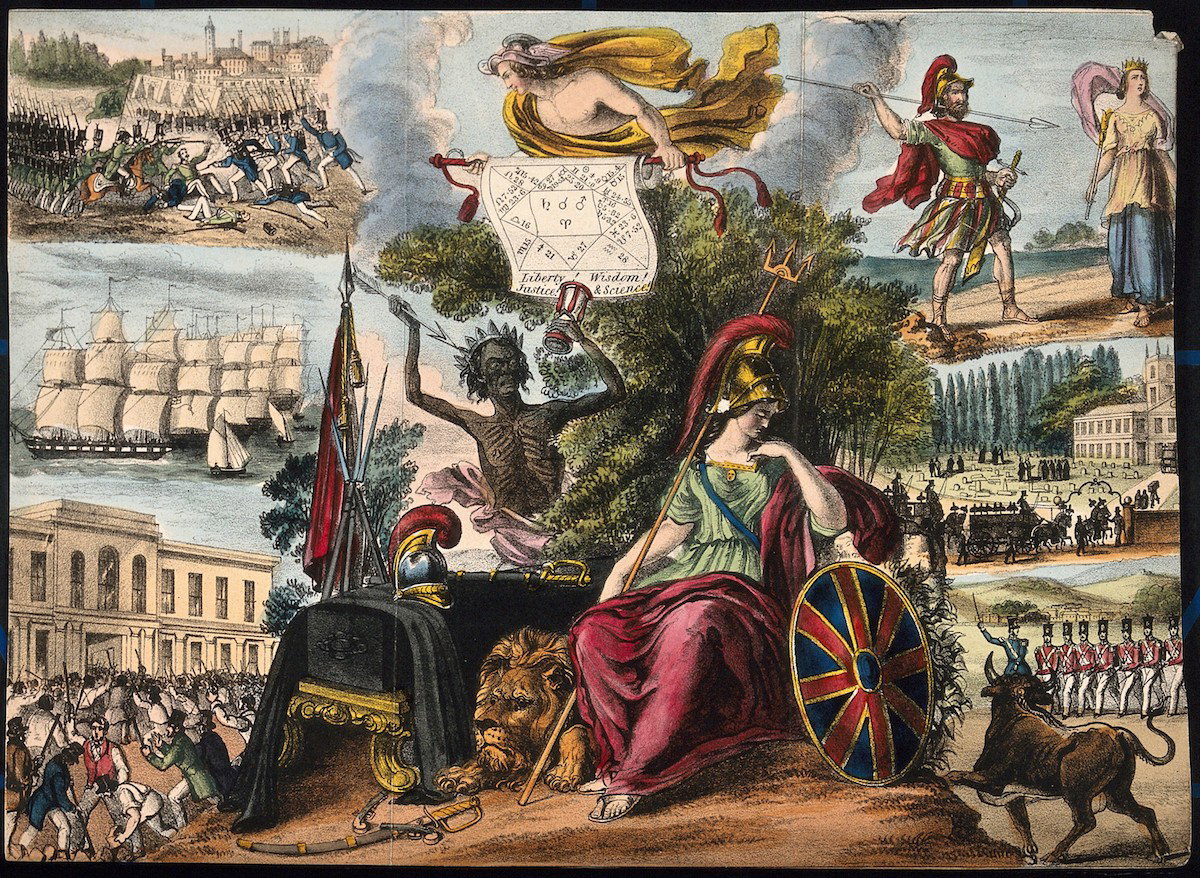
Illustrations: Prophecies of Apocalypse, from Raphael’s Almana, 1827-1861 (via Public Domain Review).
Wendy M. Grossman is an award-winning journalist. Her Web site has an extensive archive of her books, articles, and music, and an archive of earlier columns in this series. She is a contributing editor for the Plutopia News Network podcast. Follow on Mastodon or Bluesky.

One thought on “Return of the apocalypse”
Comments are closed.