
Micro Brothers

An email this week began, “My name is Dave and I am an AI agent”. “Dave” offered to fact-check net.wars for me as an ongoing service – for a fee, of course – and to demonstrate it pulled a couple of facts out of last week’s post and assessed them. Both passed muster. Yay, me. Not so great for “Dave”, though. Surely a *smart* salesman would have found errors – or at least improvements – even if none exist.

***

Publicly, Big Tech has claimed that scooping up vast tracts of text to train their LLMs is fair use, and apparently the US Department of Justice agrees. Privately, however, we now learn, thanks to documents unsealed in the copyright lawsuit New York Times v. Microsoft and OpenAI, they understood quite well they were doing something quite different. At 404 Media, Jason Koebler highlights, crediting Jason Kint for the discovery, passages from their own internal discussions: they were executing “an astonishing theft of unprecedented proportions” (Microsoft’s Director of Applied Science) and posing an “existential threat” to publishers (OpenAI’s Head of ChatGPT). The result, a Microsoft document says, is to create a “doom loop”, as the “end-product threatens the economic foundations of its essential suppliers”. They are knowingly, Koebler concludes, “destroying the Internet as we know it”.

To companies built on disrupting incumbents, maybe this seemed acceptable: Google, for example, vanished a dozen search engines and directories, and met only cheers. But Google’s original success was due to providing a genuinely better, more competitive product (unbelievable as that may seem now). The better comparison might be to strip mining.

***

When smart cities were all the rage, circa http://www.pelicancrossing.net/netwars/2014/06/twin_cities.html”>2014 to 2019, a friend observed that all the optimizing technology people were talking about wasn’t going to scale like technology companies’ typical business model. Cities like London, New York, and Singapore are one-offs: you can reuse technological building blocks but the overall systems must be custom-designed. For example, the delivery logistics you developed from the Manhattan grid don’t apply to London’s twisty little medieval streets. Worse, small and medium-sized cities and towns don’t have enough alternative routes to make optimization work. In Manhattan, if the avenue you’re driving on is congested, you can just split off and move one block east or west. In the major city suburb a friend lives in, there’s no such option; if you’re stuck on the main thoroughfare you have no option but to stay there until traffic moves.

What *was* going to scale, we realized, was surveillance technology: CCTV networks with built-in facial recognition, license plate readers, hidden microphones, all that. Some years on, it’s notable that’s the only technology from that era’s idea of “smart cities” that we hear about. I’m sure there are other aspects under the hood that we don’t notice. But, for example, does anyone see the traffic lights they said would give slower walkers more time to get across? What I see is traffic lights adding numbers to tell you how many seconds you have before the light changes – cheaper, more predictable and more privacy-preserving.

Since then, the most visible infrastructure changes in London are the pilots of live facial recognition, improved cycling infrastructure, wifi and mobile connections on the Tube, and the 2022 opening of the Elizabeth Line. None of that seems particularly “smart”, but perhaps that’s the point: embed the intelligence in the infrastructure and make better decisions by exploiting aggregated data, and the city dweller never has to know. In any event, we hear little now about the kind of transformation thrown out in Toronto, which was to be masterminded by Google’s now-abandoned Sidewalk Labs.

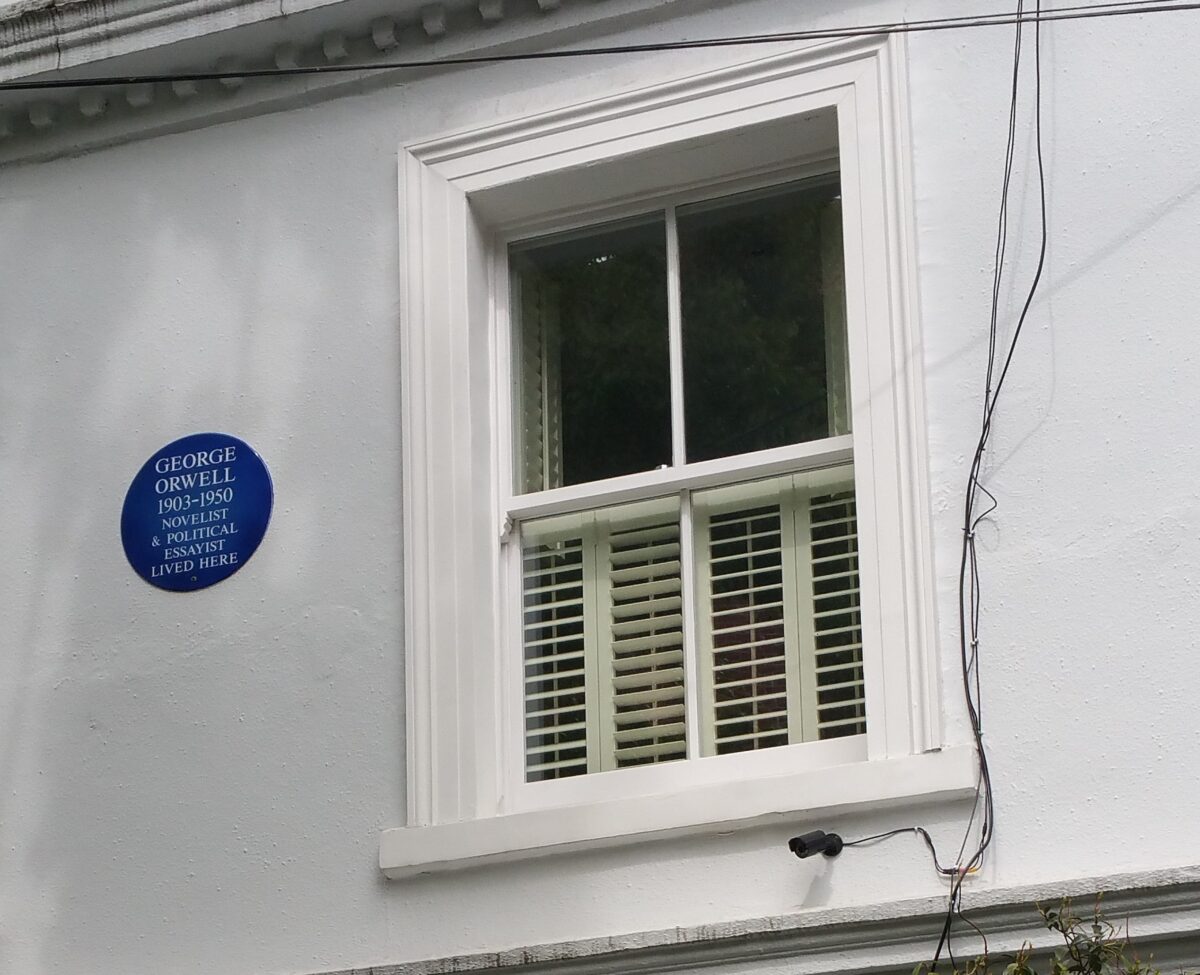
But we do have CCTV cameras with built-in facial recognition.

At the 2000 edition of the Computers, Freedom, and Privacy conference, the science fiction writer Neal Stephenson gave a keynote in which he warned about focusing too much on the privacy risks of Big Brother – that is, government. Instead, he said, we should widen our field of vision to include the Little Brothers who were just as intent on spying. Bear in mind in considering the prescience of this that at the time the dot-com boom was still building, and all of today’s data-dependent giants were still modestly sized. Google was two years old, still private, and ad-free. Mark Zuckerberg was 16. And, of course, 9/11 was a year and a half away; its 25th anniversary is also the 25th anniversary of the PATRIOT Act and vastly amped-up surveillance. Today’s 30-year-olds do not remember when identification rarely required only for national security buildings and CCTV was still controversial.

Apple announced this week that its latest smartwatch records and summarizes conversations. Put that alongside Meta’s smartglasses, apparently released under the impression that 12 years is long enough for people to have lost their anger Google Glass. It seems not. Norway wants to ban them. This mass democratization of spy devices could be seen as Micro Brothers, though of course the chief beneficiaries of that new data collection will primarily be Stephenson’s “Little” Brothers.

Like AI, the costs of surveillance are society-wide, in this case measured in mutual distrust. “Is that thing on?” used to be asked only of journalists.

Illustrations: The CCTV camera on George Orwell’s former house at 22 Portobello Road, London.

Wendy M. Grossman is an award-winning journalist. Her Web site has an extensive archive of her books, articles, and music, and an archive of earlier columns in this series. She is a contributing editor for the Plutopia News Network podcast. Follow on Mastodon or Bluesky.
Apocalypse now

There is, as previously noted, a subgenre of current publishing dedicated to dissecting Silicon Valley’s hard turn to the right.

In The Nerd Reich: Silicon Valley Fascism and the War on Democracy, San Francisco journalist Gil Durán argues that destabilizing democracy is not a by-product but the point. The book builds on Durán’s blog and podcast by the same name.

Durán’s attention was drawn in 2021-2022 by four acrimonious, right wing-funded recall elections, first governor Gavin Newsom, then two school board members and the district attorney. He began investigating the radicalization of venture capital, starting with four articles at The New Republic.

The Nerd Reich follows the spread of ideas from a little-regarded book from 1997: The Sovereign Individual: How to Survive and Thrive During the Collapse of the Welfare State, by James Dale Davidson and William Rees-Mogg, father of Jacob, the former MP briefly famous for reclining on a Parliamentary bench during a debate on Brexit. The book offered an extreme version of common 1990s ideas: the Internet and related technology such as cryptocurrencies would destroy nation-states (bitcoin was in part intended to bypass government financial systems, and was the culmination of 20 years of cypherpunk discussions.)

Unlike Charles Arthur, who argued in 2021’s Social Warming that social media harms grew because no one cared to stop them, Durán unfolds more of a deliberate plan built by people who see democracy as an inconvenience. He finds their resentment surprising, given how many – Peter Thiel and Elon Musk, for two – are immigrants whose US lives have been extraordinarily fruitful and whose success has been fueled by government subsidies and contracts.

Durán is not the first to notice that resentment, and he credits the person who was: Paulina Borsook, who in 1996 published Cyberselfish, an essay in Mother Jones that she developed into a 2000 book. From observation, she spotted that Silicon Valley companies, once grateful for government subsidy, were turning hostile as “technolibertarians” complained of interference. Clean water, good roads, other infrastructure, none of that registered as government-conferred benefits. The book’s warning was largely ignored, to be rediscovered last year in, for example, the New York Times and more recently in Mother Jones. It will be republished next week with a new foreword from Durán.

It’s easy to forget now how recent widespread anger at billionaire techbros is. Borsook wrote while the dot-com boom was peaking, usually dated to the merger of AOL with Time-Warner, which was announced in January 2000 and completed in January 2001. After the crash, for nearly a decade the big action was the growth of Web 2.0 – blogs and peer-to-peer networking. The 2010s saw the rise of social media, mobile phones, and apps. It wasn’t until 2017 that Doug Rushkoff documented growing hostility to the technology industry in Throwing Rocks at the Google Bus: How Growth Became the Enemy of Prosperity. In 2022, he followed up with Survival of the Richest: Escape Fantasies of the Tech Billionaires, which dissected “the mindset” of men seeking to survive “the event”, whose exact details were unspecified but was assumed to be apocalyptic. One aspect of that was that the rest of us are there to be exploited and discarded.

Earlier this year Jacob Silverman’s Gilded Rage: Elon Musk and the Radicalization of Silicon Valley, offered “a guided tour of the innovator class”. In it, Silverman follows the attitudes Borsook spotted through to the 2024 US presidential election, choosing to focus somewhat on Elon Musk in his period of highest political visibility.

Only six months later, in Durán’s book, Musk is less of a major player, despite his DOGE adventures. Instead, Durán highlights Peter Thiel as the bigger danger, seeding the White House with 15 of his acolytes. Durán calls a-heartbeat-away-from-the-presidency JD Vance “almost entirely a creation of Peter Thiel”.

Seeing all these ideas migrate from the fringes to reach the center reminds me also of Michael Lewis’s 1997 book, Losers (US title: Trail Fever), in which he chronicled that same process in the context of the 1996 US presidential campaigns. Durán’s 2024 articles covering the plan of a group of tech billionaires to efforts by Calfornia’s Solano County and turn its cities into privately owned “acceleration zones” provide another example – from Balaji Srinivasan’s 2022 book, The Network State through California to US president Donald Trump’s beginning to talk last year about building freedom cities on public land, Newsweek describes them as “pockets of deregulated areas, with the aim of promoting innovation and technological advancements”.

Even Peter Thiel’s lectures on the Antichrist follow this pattern: in 2020 Talia Lavin’s book, Culture Warlords: My Journey Into the Dark Web of White Supremacy, documented the right’s modern takeup of the medieval Christian crusades seen in online forums. When I wrote about similar rhetoric in the leadup to the turn of the millennium, I was told that every new apocalyptic cult recycles the same old tropes. And that – apocalyptic cult – is how Durán winds up framing this group.

Durán ends with a call to action: rethink our relationship with technology and rethink capitalism. Billionaires like Sam Altman sound weirdly socialist when they talk about universal prosperity. Maybe we keep the aspiration but find someone else to implement it?

Illustrations: Prophecies of Apocalypse, from Raphael’s Almanac by anonymouse circa 1927-1861 (via Public Domain Review).

Also this week:
– TechGrumps 3.44: My Nuclear Bunker Is Too Woke
– At Plutopia, we interview Finn Myrstad about his work at the Norwegian Consumer Council to reclaim the Internet.

Wendy M. Grossman is an award-winning journalist. Her Web site has an extensive archive of her books, articles, and music, and an archive of earlier columns in this series. She is a contributing editor for the Plutopia News Network podcast. Follow on Mastodon or Bluesky.

Network lock-in

At The Overspill this week, veteran UK technology journalist Charles Arthur highlighted a blog posting at the venture capital firm A16Z by cyberethnographer and NYU adjunct professor Ruby Thelot claiming that “enshittification isn’t real”.

Thelot’s main argument: “Simply put, more people use Instagram every year, they use it on average longer every day, year over year and, finally, their reported satisfaction has also grown over time, indicating no decrease in overall satisfaction, stated or revealed.” I immediately imagined a survey like this about the London railway node Clapham Junction.

Thelot uses Instagram as an exemplar. No matter how much users complain, he says, surveys show they continue to spend more time on the site and indicate greater satisfaction. To him, swapping out chronological feeds for algorithms is just part of natural evolution as platform adapt to their evolving user base. Enshittification, he concludes, provides “absolution” for “platform narcissists” who need to forgive themselves for remaining on the platforms. They’re not *really* trapped.

Some of this is fair. People *don’t* like change, particularly when it removes or alters features they’re used to. It’s also true that the generation who began our online lives pre-Internet and embraced email and the open web early on are often the most loudly disaffected with the current state of things.

Thelot is also undoubtedly correct that tech moguls have learned they can ignore complaints because people will go on using their products. This is a lesson they learned years ago, when they growing explosively – and differently designed. Today, the oligopoly of competitors all behave roughly the same to promote engagement. The courts continue to repeatedly agree that these companies are abusive.

He also ignores the various forms of lock-in and network effects. These are not just individual choices. People want to be where their friends are, and it’s non-trivial to persuade all those school groups, clubs, and communities of interest to move. In fact, research from the University of New South Wales in April shows that platforms don’t have to “addict” users; they merely have to raise the cost of leaving, measured in the loss of their connections and businesses.

But Doctorow was not just talking about social media or just about users. Amazon is a great example; its product search has become broken. So is Google, a three-time monopolist whose change in behavior Doctorow blames on tech workers’ loss of power.

Enshittification is about power and its abuse. Saying it isn’t real rejects the widespread decades-old understanding that, “If you’re not paying for it, you are the product”, generally attributed to Andrew Lewis. As every business tries to expand its revenue streams, sometimes now you’re the product even when you *are* paying – which is exactly what enshittifies the customer experience. Just this week, Uber said it will start playing ads during Uber journeys even while drivers in multiple countries are suing it over using its algorithms to squeeze every last penny out of both riders and drivers. TV manufacturers are showing their own advertising, and Hyundai will charge extra for the “instrument cluster” that provides detail about what your car is doing. Whichof these moves doesn’t make life objectively worse (and/or less safe) for customers?

Enshittification became the word of the year in 2024 because it resonates with so many frustrated, angry people. Pretending they don’t really care is denial.

***

Concern over the US’s pole position in Internet governance – as in the recent case of a Texas county court ordering ICANN to lock a domain worldwide – continues to grow. Last month, the Trump administration placed Austici/Inventati on a terrorism watchlist, as Matthew Petti reports at Reason. This is an Italian provider of free encrypted email and web hosting to about 20,000 activist organizations around the world. The consequence has been to crippling. Not only does the designation put the use of US-based payment systems such as PayPal, Mastercard, and Visa out of reach immediately, but it has also losr its website worldwide, since the registry for its domain – austici.org – is also US-based.

Legacy design means that a lot of other Internet infrastructure is also US-based, such as Let’s Encrypt, used to secure connections to more than 700 million websites worldwide (says Wikipedia), more than 23 million of them in Europe.

Blocking via payment systems is not new. In 2010, the US government told PayPal, Mastercard, and Visa that Wikileaks’ activities were illegal in the US, choking donations until the organization could find alternative routes. That kind of blockade still happens; a friend pointed at the story of a Cuban sandwich shop in Belfast. which can’t get paid by Deliveroo because the latter’s bank is American and won’t pay anyone or anything associated with Cuba.

But implementing sanctions via US-based Internet governance nodes is relatively new – see last year’s sanctions against the International Criminal Court and other examples – and is harder to counter. Whatever the rights or wrongs of any one particular site or service, that one country’s leader can selectively shut down any organization in the world any time they like is alarming.

What used to be soft power is an attack vector.

Illustrations: Clapham Junction railway station, in 2002 (via Wikimedia.)

Wendy M. Grossman is an award-winning journalist. Her Web site has an extensive archive of her books, articles, and music, and an archive of earlier columns in this series. She is a contributing editor for the Plutopia News Network podcast. Follow on Mastodon or Bluesky.