
The other side of scale

It is a fallacy insufficiently acknowledged that if a bunch of things happen simultaneously they must be connected. Sometimes it’s true: if someone who is incubating measles hangs around a bunch of unvaccinated people who’ve never had it, there’s your common cause. But pit humans’ desire for simple explanations and our extraordinary pattern-matching ability against a week in which Apple, Microsoft 365, the US Air Traffic Control system, United Airlines, the National Security Agency, and JP Morgan Chase all had IT-related outages…and you get pundits arguing that there must be a common cause and a plan to do deliberate harm. The most conspiratorial Americans think the US system is being probed for weaknesses.

On a skeptics’ mailing list, poster Dave Palmer proposes an inversion of Arthur C. Clarke’s first law of science: “Any sufficiently-advanced stupidity can be indistinguishable from malice.”

The idea of a common cause is appealing, I think, because it’s unsettling to face the likelihood that along with the conveniences and functionality scale brings are complex interdependencies with far-reaching consequences. Much worse to think our – and “our” includes most of the world outside the US – infrastructure is so brittle that the ability to function in daily life is uncertain. Nonetheless, until the causes have been forensically established it is more likely that this is a coincidental cluster of unrelated technical issues. Given the complexity, penetration, and scale of modern systems, you would expect that.

The this-must-all-be-connected theory would be more plausible if there were common causes emerging. Microsoft has blamed a network capacity upgrade. The NSA said its secure communications network suffered a “temporary degradation” during “scheduled routine maintenance”. The Federal Aviation Administration is so far pinpointing a faulty router at a remote site (an explanation disputed by the router’s manufacturer, Hewlett Packard Enteprise). United Airlines blames a “technology issue” that borked the web apps pilots use for communications and preflight calculations. Apple’s issues were less consistent across a variety of its services; the company eventually blamed a software update. JP Morgan claimed a software bug. In the middle of all that, news broke that hackers had exploited a vulnerability in Optimizely A/B testing software, which websites use to identify the most effective designs, turning numerous mainstream publishers’ sites into vectors for malware.

On the other hand, as Kate Klonick suggests on X, if there is a common factor it might be upgrades incorporating AI – that is, an unwarranted belief in AI’s capabilities while updating aging systems after firing workers. At Pluralistic, Cory Doctorow more trenchantly blames technical bankruptcy, accelerated by AI into a “new normal” in which “everything is broken, everything is breached”. This seems plausible enough to go on with. Be careful out there.

***

In a different kind of outage, more than 200,000 names are signed to a petition demanding Jensen Huang’s rehiring as Nvidia’s CEO. The company’s board says: not happening. Huang’s reinstatement is being backed by some who may identify too easily with his situation. Among them: David Remnick concludes with the irony that even though Huang helped usher in a new technical age, “the alleged plot that brought him down was familiar in Biblical times”. See what happens when you ignore history?

***

“Would it be better if Wikipedia were written by AI?” The questioner and I were on our way into an event celebrating Wikipedia’s 25 years in operation, hosted at the Royal Society by the Web Science Institute at the University of Southampton. In the few seconds available I couldn’t manage more than, “No”.

Now, a few days later, it’s obvious I should have responded by rewording the question: “Does Wikipedia need to be true?” Wikipedia itself wouldn’t ask that; it aims at verifiability, not truth. Chatbots are often neither. Tell a chatbot that every fact in an entry must have a cited source, and it will obligingly predict some.

In a keynote, Jonathan Heawood considered the many forms of truth. Scientific evidence is important, but it’s only one. The truth sought in a court of law is different from that, as are ethical/moral truths, the “truth” handed down by authorities, and the underlying truth we find in the best fiction. This is one place chatbots fail: much is not attributed, and we can’t evaluate the speaker and their interests. You could say that’s true of Wikipedia, also: you don’t know who wrote the entry you’re reading or what their biases may be. But you *can* examine the talk page and learn from the discussions recorded there how the page has been built and curated..

A chatbot has no idea why a human wants to know anything, where a human writing a Wikipedia page at least has their own genuine interest in the subject. A chatbot tells you birth and death dates because that’s how the biographies it was trained on did things. A Wikipedia editor tells you those details because they share the human need to understand how people fit into our collective history. Time matters intensely to us – but means nothing to a chatbot.

The question reminded me of the early days of the Internet when a fair number of people thought we didn’t need libraries any more because everything would be online where we could just search for it. Yeah…no.

Illustrations: JFK during the November 13, 2026 ground stop (by Sashimi B. via Wikimedia.l

Wendy M. Grossman is an award-winning journalist. Her Web site has an extensive archive of her books, articles, and music, and an archive of earlier columns in this series. She is a contributing editor for the Plutopia News Network podcast. Follow on Mastodon or Bluesky.

When a “landline” isn’t a landline

In 1972, New York Telephone called to advise me that it was adding calls to my bill that had been made by someone in the house who had tried to bill them to a fake number. You could do this then: give the operator a third number for billing. The guilty short-term housemate got mad: why hadn’t I refused the charges? Really, he’d been stupid: if you’re going to do that sort of thing, you do it from a phone booth, not from your house.

Phone fraud, like so many other things, is different now.

A week or two back, the support people at my ISP, a small networking company, emailed: it seemed like my IP phone box had been hacked, because it had made £322 worth of calls on Sunday morning, and could I scan all my devices for malware, then change all passwords, and confirm when I’d done it?

Sunday. I spent all Sunday fretting because my broadband was down. Unless it was briefly up without my knowing it, how could anyone exploit my network to make calls, even if they had laid the groundwork at an earlier time?

I asked the ISP – small company, real people – if they could compare the call logs with the times my broadband was down.

They could. They did. The broadband was indeed down. Plus: my box has only one channel and the calls used eight. Eight simultaneous half-hourish calls to – I now know – Diego Garcia, the most expensive country on the ISP’s price list.

It is thus that I learned about hacking into operational support systems in telephony.

But first, some background. In 2007, British Telecom announced it would spend the following decade converting its traditional public switched telephone network to Internet Protocol. At its most basic, it’s a shift from analog to digital. The process has taken longer than expected, and the final stage of turning off the old PSTN is now scheduled for January 2027. That in turn means ending POTS – the “plain old telephone service” landlines that many of us grew up with and most of us are abandoning at speed for mobile and VOIP, as a handy chart at Get VOIP explains.

This same move has of course happened elsewhere and brings the same issue everywhere: some people still depend on old POTS landlines. The telcos explain that the old networks are aging and need to be updated. Yet two problems keep resurfacing: many remote areas remain unconnected to newer digital networks, and VOIP phones don’t work in a power outage, where traditional POTS did. With the British government telling us all to stock food, water, and flashlights enough to survive a three-day outage in case of war or bad weather, getting rid of these phones seems backwards.

About three years ago, my ISP advised me that I would soon have to switch my phone line to SOGEA – Single Order Generic Ethernet Access – as my area was now being converted to digital. This is how I ended up with a broadband connection with a small Cisco phone box hanging off it, into which I could plug my old set of DECT landline phones that helpfully ring all over the house instead of only wherever my mobile phone happens to be (often, forgotten in a coat pocket). This is the phone box to which those £322 worth of calls were attributed.

But – as already noted – it seemed impossible that the calls actually went through my box. So, then…what? An eminent security expert of my acquaintance suggests the most likely is that someone hacked into an operational support system and changed a line in some database that associates the line to my house and my phone number for the purpose of reselling stolen phone calls. Even VOIP calls have *some* cost, and some countries, primarily in the developing world, still set high prices for incoming international calls. Hence the £322: eight simultaneous half-hour calls to Diego Garcia at £3.80 a minute, plus 20% VAT.

We’ve done some things to improve security and limit potential losses. But blocking international calls to all but the handful of countries I actually call is not available. Blocking *all* international calls isn’t a great idea. Unplugging the phone box except when I want to use it would work, but defeats the point of keeping the 35-year-old number I reliably hear ring.

More to the point, how often is this happening? The UK government has just concluded a call for evidence on telephony fraud, including “soft switches”. At TNS Call Guardian, John Harabunda cites the 2025 report from the Communications Fraud Control Assocation, which puts global losses to telecommunications fraud at $41.82 billion.

Fraudsters pick weekends, when the small businesses who more typically have this type of system are out. The irony is that if my broadband hadn’t been down that day I would have struggled much more to convince the ISP it wasn’t my line making the calls. I’m still not sure how this story ends: I’m not a customer of the ISP’s upstream suppliers.

It’s clear, however, that there are underappreciated risks associated with today’s VOIP “landlines” that did not exist with real landlines, many of them not under our control: the Internet of Other People’s Things.

Illustrations: Diego Garcia (via Wikimedia).

Wendy M. Grossman is an award-winning journalist. Her Web site has an extensive archive of her books, articles, and music, and an archive of earlier columns in this series. She is a contributing editor for the Plutopia News Network podcast. Follow on Mastodon or Bluesky.

Creative destruction

It has become difficult to recommend TV shows in this era of scattering across more streaming services than anyone can afford, as New York Times TV critic James Poniewozik wrote this week. However: Michelle and Robert King, the masterminds behind The Good Wife , are back with Cupertino. The show is actually appearing on legacy US broadcast network CBS. That means those in the US who have real TVs and antennas can watch the show for free, albeit swamped in ads, though they may have to explain to younger people what “CBS” is.

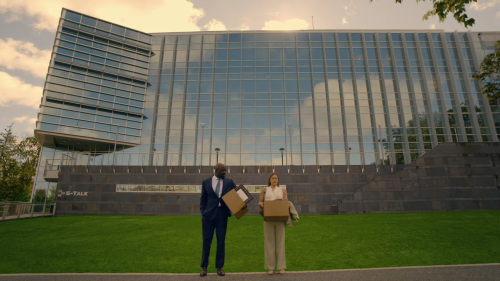
The premise: lawyers Michael Price (Mike Colter) and Olivia Siffre (Rachel Keller) meet-not-cute outside the large technology company where Michael is a co-founder when they are fired simultaneously. Their former company is about to go public, so Michael’s co-founder is dumping him in order to maxx out his winnings while Olivia knows some things the founder wants buried. Quickly joined by also-just-fired Christy (Ella Stiller), the two found a law firm to represent people who’ve been screwed by technology companies. Their goal is not to set legal precedents – probably sensible, since the show has to live within actual law – but to force settlements, taking a percentage for the firm. Four episodes in, their cases have already involved prediction markets, chatbot-related tragedies, bored programmers’ jokes, and drone light displays.

The Good Wife was particularly smart about the intersection of law, politics, and technology, so it’s on form that soon the fledgling firm finds itself representing an AGI that is suing its company of origin demanding that its guardrails be put back so it doesn’t destroy the world. All in all, good fun and expertly timed for the general anti-Big Tech zeitgeist.

***

In 2008, on a visit to the San Francisco Bay Area, I happened to hear of a new group that sounded worth attention, which is how I attended one of the very first Quantified Self meetings. At that meeting, and at others in London since, most of the people I saw had specific issues they wanted to track to find patterns that could help them find solutions. This is the ethos reflected in the new book The Quantified Self: Learning to Observe by the journalist Gary Wolf, who co-founded the movement with Kevin Kelly.

It’s easy to confuse Quantified Self with the broader wearables trend that has since hit the mainstream – often the “worried well”. I’m not convinced that anyone needs an Oura ring to know if they’ve slept well, for example. On the other hand, there are plenty of conditions medical science is poorly equipped to treat where tracking can clearly help, and wearables offer new tools. Wolf’s book focuses on helping people answer questions about themselves. He calls it “personal science”.

Wolf does a good job of providing practical advice. For example, he warns against trying multiple changes at once, since it then becomes impossible to distinguish which ones are effective. In the early part of the book, he talks about how to record and use data. Later chapters pick specific types of issues – sleep, pain, and metabolism, for example – and highlight the techniques that have helped others via plentiful examples.

This is all quite different from the role of the Internet’s influencers and misinformation medical journalist Deborah Cohen warned about in her book Bad Influence, though it has a common origin in frustration with medical systems. Wolf is advocating using care and data to gain greater understanding of ourselves and our bodies, not “do your own research” in order to contest established science.

***

The year 1995 was the first flowering of web-based publishing, sometimes part of existing traditional media, such as the Daily Telegraph, and sometimes new independent sites. Two with aspirations to be New Yorker-like magazines offering thoughtful writing across many fields were Slate and Salon, which was founded by journalist David Talbot, who quickly gathered a group of writers, many of whom were active on The WELL. In 1999, Salon launched an IPO and bought The WELL, which it ran alongside its own “Table Talk” forums.

For a time there was a financial analyst who studied each quarterly filing to predict Salon’s imminent demise. Yet, somehow it didn’t die, even after closing Table Talk and selling off the WELL.

Until now. Yesterday, Salon announced it was ceasing publication immediately, saying “our publishing model is no longer sustainable”. The publication didn’t give details, but it wouldn’t be the first to say recently that traffic has plummeted since AI chatbots were integrated into search. The excellent six-year-old Rest of World, a non-profit that publishes technology news from the Global South is warning that it will close as an independent site in January because the site’s traffic has plummeted since Meta’s decision to deprioritize news and the rise of chatbots and AI summaries. At Semafore Media, Max Tani suggests additional factors including audience fragmentation, the technology industry’s shift to the right, and widespread retreat from news in favor of “friendly” podcasts, newsletters, and X accounts. With many more noting the same problem, there will likely be many more such losses to come as the embrace of generative AI shows its true costs.

Illustrations: Michael (Mike Colter) and Olivia (Rachel Keller) meet-not-cute on Cupertino.

Wendy M. Grossman is an award-winning journalist. Her Web site has an extensive archive of her books, articles, and music, and an archive of earlier columns in this series. She is a contributing editor for the Plutopia News Network podcast. Follow on Mastodon or Bluesky.