
The Arizona way of death

Sometime in the late 1990s, I was asked to be a token skeptic on a TV show featuring three people who claimed they were immortal.

The production team didn’t take them very seriously. Probably no one did, but the three – all Americans – nonetheless managed a tour of the UK media. One producer mentioned salaciously that the trio had requested a hotel room with one large bed. The sanest part of the resulting discussion asked if they were leading a cult.

Usually, my goal would have been to avoid arguing about beliefs and say something humorous that might stick in the minds of doubting viewers. But this was one you hoped the audience would mock without prompting.

I think it was the medical journalist Caroline Richmond who suggested that if they were so sure they were never going to die they should write wills in her favor. They were oddly resistant to this proposal.

Time passed. I forgot all about them.

Meanwhile, on the technology scene you began running into people who believed technology could solve aging and, yes, maybe even death. First as comedy, in Ed Regis’s 1991 book, Great Mambo Chicken and the Transhuman Condition: Science Slightly Over the Edge. In the Arizona desert, Regis found people hoping to upload their brains to make backup copies that could live on, even if only in a simulation. Regis also checked into cryonics, the hope that preservation at a sufficiently low temperatures would allow you to be “reanimated” someday when medical science had learned how to cure whatever killed you (and how to repair the damage caused by cryopreservation). Today we call Regis’s clutch of topics TESCREAL, a mash-up of Transhumanism, Extropianism, Singularitarianism, Cismism, Rationalism, Effective Altruism, and Longtermism.

At a 2007 conference, I met people who had actually signed up for cryonics (which requires signing gruesomely detailed documents in advance). The conference was on “responsible” nanotechnology, which then occupied the hype-and-hope position AI has today. An organizer explained the connection: developing molecular tools was essential for repairing the “whole-body frostbite” problem – that is, the damage caused by cryopreservation. In 2008, when I visited Arizona-based Alcor, the leading cryonics organization, 79 people were stored in dewars awaiting these advances. Judging from its recent newsletters, the organization remains optimistic.

At the same time, other ideas were taking shape, that treating aging as an engineering problem and figuring out the right things to fix would lead to radical life extension, even immortality, without taking an extended and uncertain timeout immersed in liquid nitrogen. The name that surfaced most was the UK’s Aubrey de Grey, but there were others.

The engineering approach to human bodies is a perfect match for the dominant Silicon Valley culture. Only now it’s not so funny, as Adam Becker showed in last year’s More Everything Forever

All this is back story for Aleks Krotoski‘s new book, The Immortalists: The Death of Death and the Race for Eternal Life. While her focus is specifically on mortality, she investigates all these links. Long-termism features as a justification for almost anything – that is, the misery of today’s billions is unimportant compared to making trillions of our descendants better off. Writing that reminds of Joe Hill’s song The Preacher and the Slave, except it won’t be you getting the pie in the sky but your great-great-whatever-grandchildren.

The desire for immortality is as old as humanity. Krotoski starts her story in 1992, when the scientist Cynthia Kenyon found a life-extending molecule in the nematode C. Elegans. The discovery offered hope, which led everyone from scientists to biohackers to billionaires to con artists to investigate further. Krotoski talks to many of these as she chronicles the rise of geroscience.

As trippy and Regis-like as some of her stories are – her visit to the longevity conference RAADfest for example – the book turns serious as some of these elements coalesce, attract familiar names like Peter Thiel. turn to politics and lobbying, and gain a foothold in the second Trump White House. Part of this may be good, as politicians adopt policies intended to extend “healthspan” and encourage independent living. Others maybe not so much, such as the push to extend the Right to Try to include the latest in untested anti-aging ideas. Particularly interesting is Krotoski’s note on World Health Organization classifications: had it classed aging itself as a cause of death, which it considered in the early 2020s, then anti-aging efforts become a cure for a disease that merit the right to try – but society’s ageism and ableism becomes much worse. Plus, the costs of this approach raises critical questions about exclusion. Side note: no one believes how pervasive ageism is until they’re old enough that no one is listening to them any more.

A third of the way into the book those crazy immortals from the 1990s appeared: Charles, Bernadeane, and James, who claimed the source of their immortality was a “cellular awakening” and you, too, could have one. They renamed their Eternal Flame Foundation People Unlimited and co-founded RAADfest, both based in Arizona. The “J” in CBJ – “anti-death activist” James Strole – is the director. Charles and Bernadeane have died. Bernadeane has been cryopreserved.

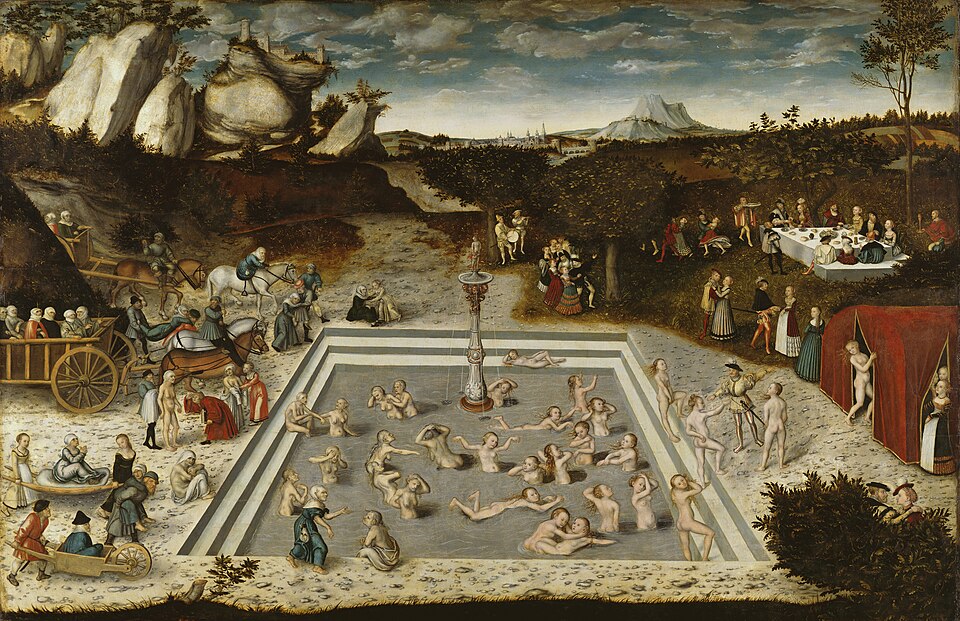
Illustrations: The Fountain of Youth, painted by Lucas Cranach the Elder, 1546 (via Wikimedia).

Also this week:
– TechGrumps episode 3.40, Teletubbies vision of Judge Dredd.
– At the Plutopia podcast, we talk to Nathan Schneider, author of Governable Spaces: Democratic Design for Online Life.

Wendy M. Grossman is an award-winning journalist. Her Web site has an extensive archive of her books, articles, and music, and an archive of earlier columns in this series. She is a contributing editor for the Plutopia News Network podcast. Follow on Mastodon or Bluesky.

Dorothy Parker was wrong

Goldie Hawn squinted into the lights. “I can’t read that,” she said to her co-presenter. “Cataracts.”

It was the 2025 Academy Awards. She was wearing a pale gold gown, and her hair and makeup did their best to evoke the look she’s had ever since she became a star in the 1960s. She is, in fact, 79. But Hollywood 79. Except for the cataracts. I know people who cheered when she said that bit of honesty about her own aging.

Doubtless soon Hawn will join the probably hundreds of millions who’ve had cataract surgery, and at her next awards outing she’ll be able to read the Teleprompter just fine. Because, let’s face it, although the idea of the surgery is scary and although the tabloids painted Hawn’s “condition” as “tragic”, if you’re going to have something wrong with you at 79, cataracts are the least worst. They’re not life-threatening. There’s a good, thoroughly tested treatment that takes less than half an hour. Recovery is short (a few weeks). Side effects, immediate or ongoing, are rare and generally correctable. Treatment vastly improves your quality of life and keeps you independent. Even delaying treatment is largely benign: the cataract may harden and become more complicated to remove, but doesn’t do permanent damage.

Just don’t see the 1929 short experimental film Un Chien Andalou when you’re 18. That famous opening scene with the razor and the eyeball squicks out *everybody*. Thank you, Luis Bunuel and Salvador Dali.

I have cataracts. But: I also have a superpower. Like lots of people with extreme myopia, even at 71 I can read the smallest paragraph on the Jaeger eye test in medium-low lighting conditions. I have to hold it four and a half inches from my face, but close-up has always been the only truly reliable part of my vision.

Eye doctors have a clear, shared understanding of what constitutes normal vision, which involves not needing glasses to see at a distance and needing reading glasses around the time you turn 40. So when it comes time for cataract surgery they see it as an opportunity to give you the vision that normal people have.

In the entertainment world, this attitude was neatly summed up in 1926 by the famed acerbic wisecrack and New Yorker writer Dorothy Parker: “Men seldom make passes at girls who wear glasses.” It’s nonsense. Women who wear glasses know it’s nonsense. There was even a movie – How to Marry a Millionaire (1953) – which tackled this silliness by having Marilyn Monroe’s Pola wander around bumping into walls and getting onto wrong planes until she meets Freddie (David Wayne), who tells her to put her glasses on and that he thinks she looks better wearing them. Of course she does. Restoring the ability to see in focus removes the blank cluelessness from her face.

“They should put on your tombstone ‘She loved myopia’,” joked the technician drawing up a specification for the lens they were going to implant. We all laughed. But it’s incorrect, since what I love is not myopia but the intimate feeling of knowing I can read absolutely anything in most lighting conditions.

But kudos: whatever their preferences, they are doing their best to accommodate mine – all credit to the NHS and Moorfields. The first eye has healed quickly, and while the full outcome is still uncertain (it’s too soon) the results look promising.

So, some pointers, culled by asking widely what people wished they’d known beforehand or asked their surgeon.

– Get a diving mask or swimming goggles to wear in the shower because for the first couple of weeks they don’t want all that water (or soap) to get in your eye. (This was the best tip I got, from my local postmaster.)

– A microwaveable heated mask, which I didn’t try, might help if you’re in discomfort (but ask your doctor).

– Plan to feel frustrated for the first week because your body feels fine but you aren’t supposed to do anything strenuous that might raise the pressure in your eye and disrupt its healing. Don’t do sports, don’t lift weights, don’t power walk, don’t bend over with your eyes below your waist, and avoid cooking or anything else that might irritate your eyes and tempt you to scratch or apply pressure. The bright side: you can squat to reach things. And you can walk gently.

– When you ask people what they wish they’d known, many will say “How easy it was” and “I wish I’d done it years earlier”. In your panicked pre-surgery state, this is not helpful. It is true that the operation didn’t hurt (surgeons are attentive to this, because they don’t want you to twitch). It is true that the lights shining on your eye block sight of what they’re doing. I saw a lot of magenta and blue lights. I heard machine sounds, which my surgeon kindly explained as part of fulfilling my request to talk me through it. Some liquid dripped into my hair.

– Take the time you need to prepare, because there’s no undo button.

Think of it as a very scary dental appointment.

Illustrations: Pola (Marilyn Monroe) finding out that glasses can be an asset in How to Marry a Millionaire (1953).

Wendy M. Grossman is the 2013 winner of the Enigma Award. Her Web site has an extensive archive of her books, articles, and music, and an archive of earlier columns in this series. She is a contributing editor for the Plutopia News Network podcast. Follow on Mastodon or Bluesky.

This perfect day

To anyone remembering the excitement over DNA testing just a few years ago, this week’s news about 23andMe comes as a surprise. At CNN, Allison Morrow reports that all seven board members have resigned to protest CEO Anne Wojcicki’s plan to take the company private by buying up all the shares she doesn’t already own at 40 cents each (closing price yesterday was 0.3301. The board wanted her to find a buyer offering a better price.

In January, Rolfe Winkler reported at the Wall Street Journal ($) that 23andMe is likely to run out of cash by next year. Its market cap has dropped from $6 billion to under $200 million. He and Morrow catalogue the company’s problems: it’s never made a profit nor had a sustainable business model.

The reasons are fairly simple: few repeat customers. With DNA testing, as Winkler writes, “Customers only need to take the test once, and few test-takers get life-altering health results.” 23andMe’s mooted revolution in health care instead was a fad. Now, the company is pivoting to sell subscriptions to weight loss drugs.

This strikes me as an extraordinarily dangerous moment: the struggling company’s sole unique asset is a pile of more than 10 million DNA samples whose owners have agreed they can be used for research. Many were alarmed when, in December 2023, hackers broke into 1.7 million accounts and gained access to 6.9 million customer profiles<, though. The company said the hacked data did not include DNA records but did include family trees and other links. We don't think of 23andMe as a social network. But the same affordances that enabled Cambridge Analytica to leverage a relatively small number of user profiles to create a mass of data derived from a much larger number of their Friends worked on 23andMe. Given the way genetics works, this risk should have been obvious.

In 2004, the year of Facebook’s birth, the Australian privacy campaigner Roger Clarke warned in Very Black “Little Black Books” that social networks had no business model other than to abuse their users’ data. 23andMe’s terms and conditions promise to protect user privacy. But in a sale what happens to the data?

The same might be asked about the data that would accrue from Oracle CEO Larry Ellison‘s surveillance-embracing proposals this week. Inevitably, commentators invoked George Orwell’s 1984. At Business Insider, Kenneth Niemeyer was first to report: “[Ellison] said AI will usher in a new era of surveillance that he gleefully said will ensure ‘citizens will be on their best behavior.'”

The all-AI-surveillance all-the-time idea could only be embraced “gleefully” by someone who doesn’t believe it will affect him.

Niemeyer:

“Ellison said AI would be used in the future to constantly watch and analyze vast surveillance systems, like security cameras, police body cameras, doorbell cameras, and vehicle dashboard cameras.

“We’re going to have supervision,” Ellison said. “Every police officer is going to be supervised at all times, and if there’s a problem, AI will report that problem and report it to the appropriate person. Citizens will be on their best behavior because we are constantly recording and reporting everything that’s going on.”

Ellison is twenty-six years behind science fiction author David Brin, who proposed radical transparency in his 1998 non-fiction outing, The Transparent Society. But Brin saw reciprocity as an essential feature, believing it would protect privacy by making surveillance visible. Ellison is claiming that *inscrutable* surveillance will guarantee good behavior.

At 404 Media, Jason Koebler debunks Ellison point by point. Research and other evidence shows securing schools is unlikely to make them safer; body cameras don’t appear to improve police behavior; and all the technologies Ellison talks about have problems with accuracy and false positives. Indeed, the mayor of Chicago wants to end the city’s contract with ShotSpotter (now SoundThinking), saying it’s expensive and doesn’t cut crime; some research says it slows police 911 response. Worth noting Simon Spichak at Brain Facts, who finds with AI tools humans make worse decisions. So…not a good idea for police.

More disturbing is Koebler’s main point: most of the technology Ellison calls “future” is already here and failing to lower crime rates or solve its causes – while being very expensive. Ellison is already out of date.

The book Ellison’s fantasy evokes for me is the less-known This Perfect Day, by Ira Levin, written in 1970. The novel’s world is run by a massive computer (“Unicomp”) that decides all aspects of individuals’ lives: their job, spouse, how many children they can have. Enforcing all this are human counselors and permanent electronic bracelets individuals touch to ubiquitous scanners for permission.

Homogeneity rules: everyone is mixed race, there are only four boys’ and girls’ names, they eat “totalcakes”, drink cokes, wear identical clothing. For the rest, regularly administered drugs keep everyone healthy and docile. “Fight” is an abominable curse word. The controlled world over which Unicomp presides is therefore almost entirely benign: there is no war, crime, and little disease. It rains only at night.

Naturally, the novel’s hero rebels, joins a group of outcasts (“the Incurables”), and finds his way to the secret underground luxury bunker where a few “Programmers” help Unicomp’s inventor, Wei Li Chun, run the world to his specification. So to me, Ellison’s plan is all about installing himself as world ruler. Which, I mean, who could object except other billionaires?

Illustrations: The CCTV camera on George Orwell’s Portobello Road house.

Wendy M. Grossman is the 2013 winner of the Enigma Award. Her Web site has an extensive archive of her books, articles, and music, and an archive of earlier columns in this series. She is a contributing editor for the Plutopia News Network podcast. Follow on Mastodon.