Sometime in the late 1990s, I was asked to be a token skeptic on a TV show featuring three people who claimed they were immortal. (Update: The Skeptic has republished my my contemporaneous account (2026-07-11).)
The production team didn’t take them very seriously. Probably no one did, but the three – all Americans – nonetheless managed a tour of the UK media. One producer mentioned salaciously that the trio had requested a hotel room with one large bed. The sanest part of the resulting discussion asked if they were leading a cult.
Usually, my goal would have been to avoid arguing about beliefs and say something humorous that might stick in the minds of doubting viewers. But this was one you hoped the audience would mock without prompting.
I think it was the medical journalist Caroline Richmond who suggested that if they were so sure they were never going to die they should write wills in her favor. They were oddly resistant to this proposal.
Time passed. I forgot all about them.
Meanwhile, on the technology scene you began running into people who believed technology could solve aging and, yes, maybe even death. First as comedy, in Ed Regis’s 1991 book, Great Mambo Chicken and the Transhuman Condition: Science Slightly Over the Edge. In the Arizona desert, Regis found people hoping to upload their brains to make backup copies that could live on, even if only in a simulation. Regis also checked into cryonics, the hope that preservation at a sufficiently low temperatures would allow you to be “reanimated” someday when medical science had learned how to cure whatever killed you (and how to repair the damage caused by cryopreservation). Today we call Regis’s clutch of topics TESCREAL, a mash-up of Transhumanism, Extropianism, Singularitarianism, Cosmism, Rationalism, Effective Altruism, and Longtermism.
At a 2007 conference, I met people who had actually signed up for cryonics (which requires signing gruesomely detailed documents in advance). The conference was on “responsible” nanotechnology, which then occupied the hype-and-hope position AI has today. An organizer explained the connection: developing molecular tools was essential for repairing the “whole-body frostbite” problem – that is, the damage caused by cryopreservation. In 2008, when I visited Arizona-based Alcor, the leading cryonics organization, 79 people were stored in dewars awaiting these advances. Judging from its recent newsletters, the organization remains optimistic.
At the same time, other ideas were taking shape, that treating aging as an engineering problem and figuring out the right things to fix would lead to radical life extension, even immortality, without taking an extended and uncertain timeout immersed in liquid nitrogen. The name that surfaced most was the UK’s Aubrey de Grey, but there were others.
The engineering approach to human bodies is a perfect match for the dominant Silicon Valley culture. Only now it’s not so funny, as Adam Becker showed in last year’s More Everything Forever
All this is back story for Aleks Krotoski‘s new book, The Immortalists: The Death of Death and the Race for Eternal Life. While her focus is specifically on mortality, she investigates all these links. Long-termism features as a justification for almost anything – that is, the misery of today’s billions is unimportant compared to making trillions of our descendants better off. Writing that reminds of Joe Hill’s song The Preacher and the Slave, except it won’t be you getting the pie in the sky but your great-great-whatever-grandchildren.
The desire for immortality is as old as humanity. Krotoski starts her story in 1992, when the scientist Cynthia Kenyon found a life-extending molecule in the nematode C. Elegans. The discovery offered hope, which led everyone from scientists to biohackers to billionaires to con artists to investigate further. Krotoski talks to many of these as she chronicles the rise of geroscience.
As trippy and Regis-like as some of her stories are – her visit to the longevity conference RAADfest for example – the book turns serious as some of these elements coalesce, attract familiar names like Peter Thiel. turn to politics and lobbying, and gain a foothold in the second Trump White House. Part of this may be good, as politicians adopt policies intended to extend “healthspan” and encourage independent living. Others maybe not so much, such as the push to extend the Right to Try to include the latest in untested anti-aging ideas. Particularly interesting is Krotoski’s note on World Health Organization classifications: had it classed aging itself as a cause of death, which it considered in the early 2020s, then anti-aging efforts become a cure for a disease that merit the right to try – but society’s ageism and ableism becomes much worse. Plus, the costs of this approach raises critical questions about exclusion. Side note: no one believes how pervasive ageism is until they’re old enough that no one is listening to them any more.
A third of the way into the book those crazy immortals from the 1990s appeared: Charles, Bernadeane, and James, who claimed the source of their immortality was a “cellular awakening” and you, too, could have one. They renamed their Eternal Flame Foundation People Unlimited and co-founded RAADfest, both based in Arizona. The “J” in CBJ – “anti-death activist” James Strole – is the director. Charles and Bernadeane have died. Bernadeane has been cryopreserved.
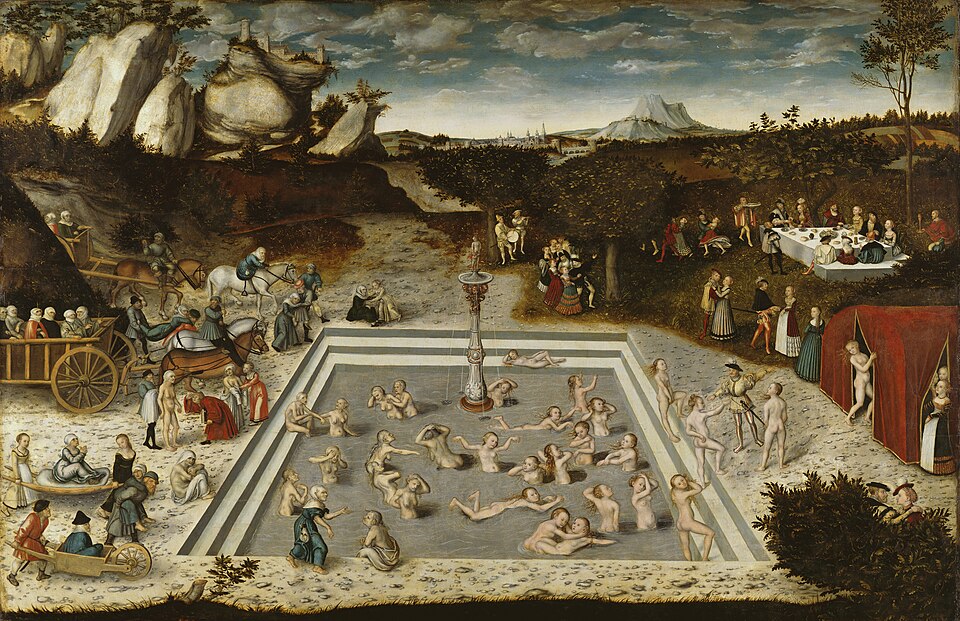
Illustrations: The Fountain of Youth, painted by Lucas Cranach the Elder, 1546 (via Wikimedia).
.jpg)
Also this week:
– TechGrumps episode 3.40, Teletubbies vision of Judge Dredd.
– At the Plutopia podcast, we talk to Nathan Schneider, author of Governable Spaces: Democratic Design for Online Life.
Wendy M. Grossman is an award-winning journalist. Her Web site has an extensive archive of her books, articles, and music, and an archive of earlier columns in this series. She is a contributing editor for the Plutopia News Network podcast. Follow on Mastodon or Bluesky.