Intimacy capitalism

Many non-human characteristics make AI attractive, Sue-Anne Teo said to open this year’s We Robot: endless patience, long and detailed memory, and sycophancy. I’m less certain about the last of those; lots of us react poorly to undisguised flattery. And yet: Stanford researchers agree with her that this is a thing. The AIs are certainly programmed to *try* to human-wash themselves: they use the perpendicular pronoun, “apologize” for errors, and type “you’re right”. And the Stanford folks’ research shows that users respond by becoming “more self-centered, more morally dogmatic”. Probably it’s easier for that to happen if you’re consulting the AI on a personal matter than if you’re just asking it to find an article you read once based on a few hazy memories of what it’s about. No chatbot has yet congratulated me on my choice of half-remembered reading material.

Teo’s vision of the business potential of AIs is part of a long-running theme at We Robot: the subscription service that terminates your relationship when you stop paying. The potential for emotional manipulation by a company that is programmed to maximize profits as if they were paperclips is as great as that of a spirit medium over a client who believes their only link to a beloved deceased person is through their belief in that medium’s ability to establish contact. When I suggest this, Teo says mediums don’t scale. True. But the potential for emotional dependence and manipulation for those individuals seems psychologically similar.

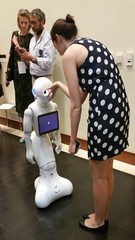
A couple of months ago, Kate Devlin, a professor of AI and society at Kings College London, talked more positively about human-AI relationships, arguing that those engaging in them are often not the archetypal lonely and isolated people we all imagine. Some are married – happily, they tell her. Still, she frequently reminds people “your AI does not love you back”. The same can be true in reverse. Here, a Japanese researcher with three Peppers at home is asked if she misses them when she’s away. “No.”

As a psychologist, Devlin’s job is not business models. But they drive the AI’s design. Companies spend money in time and effort to make robots humanoid – or at least cute – to make them successful in the marketplace. The same is true of chatbots programmed to appear conscious. Cue (again) James Boyle: “For the first time in history…sentences do not mean sentience.” We are some way from having adapted to that.

Teo has a name for the peculiarly toxic mix of anthropomorphism, cold-eyed profit, data collection, and dark patterns that she’s ruminating on: “intimacy capitalism”. New to me, but instantly compelling.

I can see where an academic must rigorously untangle this into a solidly-founded theory; Teo is still working out fully what it means. But the phrase resonates without that depth: the rapaciousness described by surveillance capitalism and surveillance pricing crossed with the new ability to exploit personal vulnerabilities exposed by those same non-human characteristics of infinite patience and a long, detailed memory. Ugh.

I wish I could say that people do not respond as well to the blandishments of synthetic pretend-humans, but the statistics are against me. Worse, a study referenced in discussion found that people award authority to AI companions’ pronouncements because they trust them – which sounds to me like exactly the same as trusting an online “influencer” on subjects where they have no expertise because they’re familiar and maybe got some random things right in the past. As skeptics found in studying years of psychic predictions, people remember the hits and forget the misses.

So while you or I might say, make the chatbot act like a chatbot instead of dolling it up in human signage, the business model, fed by popular preference, is against us. Related, Gizem Gültekin-Várkonyi, who presented a discussion of “robot literacy”, wants people to stop saying “the algorithm” is discriminatory or “the algorithm” makes a decision. “It is us,” she said, reminding me of Pogo.

The presumption is that loading these various toxicities into robots will be worse. I’m less sure; I think the cute but less human ones ought to have a better chance because the more humanoid ones are so obviously *not* human and more likely to fall into the Uncanny Valley.

But for how long? In the lunch break, someone was running a series of “pick the AI” image tests. Two breakfasts, side by side. One had perfectly presented fried eggs, a fruit medley with strawberries, and I think some potatoes. The other had frazzled fried eggs, baked beans, and, nestled next to them, a dead giveaway. What AI knows from black pudding?

By next year, or soon after, AI chatbots and image generators will have been fed data about black pudding (without ever tasting one). Similarly, someday in the future, crude robots will be both cuter and, possibly, more lifelike.

Would you trust your baby with one of those robots? Who is liable if it puts the baby in the washing machine? At that moment, as multiple legal opinions awaited voicing, the actual two-month-old baby in the room howled. Can robots have such exquisite comic timing?

Illustrations: Pepper, as seen at We Robot 2016.

Also this week: At Gathering4Gardner’s YouTube channel, mathematician and juggler Colin Wright and I talk about skepticism.

Wendy M. Grossman is an award-winning journalist. Her Web site has an extensive archive of her books, articles, and music, and an archive of earlier columns in this series. She is a contributing editor for the Plutopia News Network podcast. Follow on Mastodon or Bluesky.

Long Island AI

The peak of dot-com mania was identifiable even at the time: it was in January 2000, when AOL bought Time Warner for $183 billion. Peak podcast mania arguably came in 2020 when Spotify paid Joe Rogan $100 million (per rumor). It’s now time to call the peak of AI mania: Allbirds, which was loved a few years back for making sustainable wool shoes …has sold off all stock and assets, and is rebranding as Newbird AI to sell “AI compute infrastructure”. At The Overspill, Charles Arthur compares this to 2017, when Long Island Iced Tea renamed itself Long Blockchain, arguably the peak of bitcoin mania. His theory that all Newbird AI has left is a bunch of empty warehouses, so hopes someone will put data centers in them is the only possibility that makes any sense.

Most of those bits of history led to more financial silliness and then a crash. The AOL-TimeWarner marriage was notoriously catastrophic. AOL, which was supposed to modernize old, slow Time-Warner, in fact was already becoming obsolete as users shifted to new technology (broadband) and the wider Internet. By 2003, the company was selling itself off in pieces. Long Island Blockchain cratered; a year later it had abandoned its plans to buy bitcoin mining equipment. Its delisting by NASDAQ was accompanied by the SEC’s charging three people with insider trading. Joe Rogan of course remains hugely popular and Spotify is doing fine, but it’s certainly not controlling the business of podcasting as it appeared to hope it would.

The day following the announcemenet, Newbird AI’s shares rose as much as 700% (briefly), partly on the additional news that it will close a funding round of $50 million in the second quarter of 2026. Even CNBC calls this “pivot” bizarre.

For our purposes, it doesn’t matter if this wacky strategy works (pick your definition of “works”), because when the share price of a basically assetless company goes up 700% because it’s added “AI” to its name we have reached the absurdity that marks the peak of every bubble.

It’s not the only sign (or the only absurdity). In the UK, last month Aisha Down reported at the Guardian that many of the efforts prime minister Keir Starmer – and Rishi Sunak before him – has announced to “mainline AI into the veins” of the British economy are based on what she calls “phantom investments”. She reported faithfully that the Department of Science, Innovation, and Technology said it “rejected these assertions”, but this week we learned that at least one piece of her reporting was absolutely correct.

This week’s news revolves around a project called Stargate, announced in September 2025 and involving the UK-headquartered AI infrastructure provider Nscale, Microsoft, Nvidia, and OpenAI. This week, OpenAI announced it was putting the project – for which it was supposed to build a data center – on hold. OpenAI blames energy prices and, as Joseph Bambridge reports at Politico, the government’s decision last month to shelve proposals to allow data miners to use copyrighted content unless its owner opts out. The proposal was widely opposed by the UK’s creative industry, and was indefinitely delayed in a report issued on March 18 (ReedSmith has a useful legal summary)..

The loss – or delay – of Stargate is a rounding error to companies the size of Microsoft and Nvidia. It’s more significant for Nscale, which according to CNBC raised $2 billion in a funding round just last month with investments from Nvidia, Dell, Lenovo, and other much less famous names; at the same time, it added former Google and Facebook ad business builder Sheryl Sandberg and former Facebook global policy head Nick Clegg to its board. The new funding raised Nscale’s valuation to $14.6 billion. At his blog, Ed Zitron calls the ability to raise funding for a data center that doesn’t exist “weird“, and suggests that AI companies should admit that their chatbots are just “regular old software”.

Meta king Mark Zuckerberg, last seen losing money on the former next-big-thing metaverse, is, Megan Bobrowsky reports at the Wall Street Journal, building an AI agent to get him information and answers faster. This comes on top of last month’s announcement that Meta is buying the AI agent network Moltbook, seemingly mostly in order to hire its two founders for Meta’s Superintelligence Labs. This week, Zuckerberg also announced he was building an AI clone of himself to interact with staff so they can feel more connected to him. Seems like in reality it would make corporate management feel like automated customer service.

The question about bubbles is always: is this one like railroads or like tulips? Tulips left nothing of value behind while railroads went on to be transformative. In 2001, almost everyone knew the Internet would go on growing in size and importance. In the AI case, despite the current silliness, over time we will learn how to use these new capabilities and limit the downsides. But first, we will have to deal with the fallout of the fact that the finances do not add up.

Illustrations: Tulips, (via Wikimedia).

Also this week:
At Skeptical Inquirer, I go to this year’s Gathering 4 Gardner.
At the Plutopia podcast, we interview Tereza Pultarova, who reports on developing military technology in Ukraine.

Wendy M. Grossman is an award-winning journalist. Her Web site has an extensive archive of her books, articles, and music, and an archive of earlier columns in this series. She is a contributing editor for the Plutopia News Network podcast. Follow on Mastodon or Bluesky.

References for “What We Talk About When We Talk About AI”

By slide number as presented at Greenwich Skeptics, 2026-04-13:

3 – Ofcom, Adults’ Media Use and Attitudes Report, April 2, 2026.

4 – What is “AI”? Clockwise from top left: Eliza (1966), by Joseph Weizenbaum, which simulated a psychotherapist; a modern data center; Sidney Harris’s 1977 cartoon, “Then a miracle occurs”; protein folding by DeepMind’s Alphafold in 2024; Privacy International‘s mockup of an AI-assisted surveillance dashboard.

6 – Automata: Ancient Greek automata; mechanical singing birds and other musical machines.

7 – Companions, clockwise from top left: Wilson, Tom Hanks’ basketball in the 2000 movie Cast Away; a Roomba (2002); C3PO and R2D2 from Star Wars; Furbys (1998); a Tamagotchi pet (1996).

9 – Helpers: Mickey Mouse’s enchanted broom in “The Sorcerer’s Apprentice” from the 1940 movie Fantasia; Rosey the Robot in the 1962 TV series The Jetsons.

10 – Guardians: a Golem; a guardian angel; HAL, from the 1968 movie 2001: A Space Odyssey.

11 – Killers: The Price of Privacy: Re-evaluating the NSA, 2014; the Terminator; IEEE Spectrum.

12 – Frauds: The Mechanical Turk; automata by Jacques de Vauconson; Clever Hans.

13 – Asimov’s Laws of Robotics, formulated in his first robot short story, “Runaround”, in 1942.

14 – Arthur C. Clarke’s three laws, first formulated in “The Hazards of Prophecy” in 1962, revised in 1973.

15 – Alan Turing, Computing Machinery and Intelligence, 1950.

16 – The Turing test, from “Computing Machinery and Intelligence”.

17 – The Unperson of the Year by James Boyle at TechDirt.

18 – The eight scientists who assembled in Dartmouth for the first workshop on artificial intelligence in 1956: Oliver Selfridge, Nathaniel Rochester, Ray Solomonoff, Marvin Minsky, Trenchard More, John McCarthy, and Claude Shannon.

19 – Personal conversation with John McCarthy, 2006.

20 – Your A.I. Radiologist Will Not Be With You Soon by Steve Lohr at the New York Times”; Ed Zitron.

23 – Demis Hassabis, quoted in the Guardian as DeepMind’s mission at its founding in 2010.

24 – Ken MacLeod, The Cassini Division, 1998.

25 – Nick Bostrom, Superintelligence: Paths, Dangers, Strategies, 2014.

26 – Charles Stross, Dude, You Broke the Future, 2017.

27 – Turing, “Computing Machinery and Intelligence”.

28 – Games: chess, Jeopardy, Go (2016).

29 – Clockwise from top left: protesters freeze a Cruise robotaxi by placing a traffic cone on its hood; Microsoft services agreement; BBC; Nature; Hacker Noon; Red Dog Security; Waymos Freeze in Place, Snarl Traffic En Masse During Saturday’s Citywide Power Outage; The Register.

30 – Cory Doctorow, at Pluralistic.

31 – 404 Media

32 – Books: Ghost Work, by Mary L. Gray and Siddharth Suri (2019); Behind the Screen, by Sarah T. Roberts (2019); The Costs of Connection, by Nick Couldry and Ulises A. Meijas (2020); Atlas of AI, by Kate Crawford (2021).

33 – Books: Automating Inequality, by Virginia Eubanks (2019); Black Software, by Charlton R. McIlwain (2019); Unmasking AI, by Joy Buolamwini (2023); Algorithms of Oppression: Why Search Engines Reinforce Racism, by Safia Umoja Noble (2018).

34 – Chart showing the flow of money in the LLM ecosystem. Drawn by Edward Hasbrouck for the (US) National Writers Union.

35 – Good ongoing coverage of behind-the-scenes human workers at Rest of World.

36 – 1X’s Neo robot home servant, launched 2025.

38 – London’s Ringways: The first map of the capital’s unbuilt motorways.

39 – Ringways.

41 – Exponential future: Ray Kurzweil’s projection of the “law of accelerating returns”; Mickey Mouse drowns in exponential growth in “The Sorcerer’s Apprentice” in Fantasia, 1940.

42 – Turbli.

43 – Present harm, clockwise from top left: Kings College London; Ars Technica; Bureau of Investigative Journalism; Anadolu Ajansi; Toronto Star; NBC News; Guardian.

44 – Madeleine Claire Elish, Moral Crumple Zones: Cautionary Tales in Human-Robot Interaction (2019).

45 – Hildebrandt, Mireille, keynote at Computers, Privacy, and Data Protection 2025.

46 – Replace by Clawd.

Further reading:

Becker, Adam, More Everything Forever: AI Overlords, Space Empires, and Silicon Valley’s Crusade to Control the Fate of Humanity (2025).

Bender, Emily M., and Alex Hanna, The AI Con: How to Fight Big Tech’s Hype and Create the Future We Want, 2025.

Booth, Robert, at the Guardian: Number of AI chatbots ignoring human instructions increasing, study says.

Broussard, Meredith, Artificial Unintelligence: How Computers Misunderstand the World (2018) and More Than a Glitch: Confronting Race, Gender, and the Ability Bias in Tech (2024).

Couldry, Nick, and Ulises A. Meijas, Data Grab: The New Colonialism of Big Tech (and How to Fight Back, 2024.

Darling, Kate, The New Breed, 2021.

Grossman, Wendy M., Finding the gorilla.

Jones, Phil, Work Without the Worker (2021).

Marx, Paris, the Tech Won’t Save Us podcast.

O’Neil, Cathy, Weapons of Math Destruction: How Big Data Increases Inequality and Threatens Democracy (2017).

Shane, Janelle M., You Look Like a Thing and I Love You: How Artificial Intelligence Works and Why It’s Making the World a Weirder Place (2019).

Standage, Tom, The Turk: The Life and Times of the Famous Eighteenth-Century Chess-Playing Machine (2003)

Strengers, Yolanda, and Jenny Kennedy, The Smart Wife (2020).

Stross, Charles, Shaping the Future, 2007.

Waste management

This week, Amazon announced it would cripple a bunch of older Kindle models. Users will be able to go on reading the books that are already stored on their devices, but they won’t be able to add anything new, whether it’s borrowed, bought, or downloaded. The switch will be toggled on May 20, and applies to Kindle ereaders and Kindle Fires released in or before 2012. These devices had already been locked out of the store in 2022.

There is no benefit to consumers from doing this, even though Amazon is offering a substantial discount on newer devices for those who want to switch. There are presumably benefits to Amazon – namely, that it can update its store and other software without having to cater to older devices, plus sell an extra bunch of new ones. But overall, it’s a globally hostile move that creates a new pile of electronic waste composed of functioning hardware. One of these days, that’s going to be your car when some auto manufacturer decides that a “legacy” model isn’t worth supporting any more.

One option is to stop buying devices whose manufacturers demand that you surrender ownership in favor of their ongoing control. The other main possibility is to continue spreading right to repair laws so that a company like Amazon (or John Deere) wishing to shed itself of the responsibility of supporting older devices would be required to open them up to their users and the third-party ecosystem around them that would doubtless form. As the population of Internet of Things devices continues to grow around the world there will be much more of this – when we need much less. It’s absolutely maddening. Try a Kobo and the Gutenberg project.

***

It came out this week that language added in October 2025 to Microsoft’s terms of use says: “Copilot is for entertainment purposes only. It can make mistakes, and it may not work as intended. Don’t rely on Copilot for important advice. Use Copilot at your own risk.”

This is like the disclaimers that psychics and mediums in the UK issue to prospective customers to prevent exploitation of the credulous. A software company, though…if it’s going to admit up front that the service it’s providing can’t be relied on, why force it on people in the first place?

Obviously, the point here is to cover the company’s ass in case of lawsuits. It fits right in with companies’ general refusal to accept liability for problems created by the software they make. I’m glad the company is warning people, but the better solution – if the company can’t bring itself to discontinue it altogether – would be to either remove Copilot and let people download it if they want it or leave it turned off by default, warning people up front instead of in terms of use that normally wouldn’t have been read. Instead, what we have to do is search for instructions to remove it and hope Microsoft hasn’t made following them impossible.

***

In the midst of a lot of science fictional hype-scares about “AI” along come some more real concerns. We’ll start “small”: The New York Times has done a study that finds that Google’s AI Overviews are right 90% of the time. Sounds not-so-bad, until you remember the Law of Truly Large Numbers. That “90%” success rate when the remaining 10% is applied to trillions means the overall result is, as Ryan Whitwam puts it in summarizing the story for Ars Technica, “hundreds of thousands of lies going out every minute of the day”. That’s automation for you. Used to be you needed an army of bots to disseminate misinformation at any sort of scale, and even then it was less effective since it wasn’t backed by an apparently authoritative name (see also Microsoft, above).

More alarming are the reports surfacing about generative AI’s effectiveness at aiding and amplifying online crime. In November, Google announced internal researchers had found hackers experimenting with a script that interacts with Gemini’s API to create just-in-time modifications. Last month, at Hacker Noon polymorphic viruses, but again, this appears to be a step up in sophistication and speed.

At the same time, Casey Newton reports at Platformer, Anthropic’s latest model is likely the first of many that can find and exploit vulnerabilities in software in “ways that far outpace the efforts of defenders”. The announcement, which appears to have been inadvertent, was quickly followed by another, formally launching the new model, Claude Mythos, and Project Glasswing. The latter, per Newton, gives more than 40 of the biggest technology companies early access so they can use the model to find and patch vulnerabilities in both their own systems and open source systems that underpin digital infrastructure.

Unlike most AI-related scare stories, this one is backed by people who are usually sensible, such as Alex Stamos, formerly chief security officer at Facebook and Yahoo, and other security practitioners. These warnings are not coming from AI company CEOs with a concept to sell .

So: on the one hand, (hopefully) better software; on the other, (potentially) newer, more dangerous attacks. Ugh. To restore calm, I recommend Terry Godier’s essay The Last Quiet Thing.

Illustrations: Bill Steele, who in 1970 wrote the environmental anthem Garbage!.

Wendy M. Grossman is an award-winning journalist. Her Web site has an extensive archive of her books, articles, and music, and an archive of earlier columns in this series. She is a contributing editor for the Plutopia News Network podcast. Follow on Mastodon or Bluesky.

The Silicon Valley chronicles

We should have seen this coming. At Platformer, Casey Newton reports that Meta has discussed pulling funding for the Oversight Board after 2028 after already reducing it “significantly” this year. Who needs fripperies like independent governance after reporting billions of losses in its Reality Labs unit, the bit responsible for the seemingly now-abandoned metaverse, the smartglasses, and, of course, AI? Per Newton, there are ongoing discussions about continuing the Oversight Board somehow, perhaps by opening it up to adjudicate for other platforms.

The reality is the Oversight Board’s moment has probably passed. In 2018, creating it was an effective public relations response to a series of scandalous revelations, beginning in 2017 with Carole Cadwalladr‘s work exposing Cambridge Analytica‘s use of Facebook to collect personal data to target political advertising. Its biggest moment was probably in January 2021, when the Oversight Board backed Facebook‘s decision to ban then-“former guy” Donald Trump for two years following the January 6 insurrection. Twitter banned him, too, and there was a brief crackdown on postings calling for violence. Much public criticism followed from whistleblowers such as Frances Haugen and Sarah Wynn Williams (2025), and the Netflix documentary The Great Hack..

Today, though,the big technology companies seem not to care. Maybe they will again if usage shrinks enough – the BBC reports an Ofcom study showing that UK adults are actively posting 61% less than last year. But defunding the Oversight Board seems consistent with the general decline of content moderation on Facebook and elsewhere. Neither fines, nor spreading age verification laws, nor other constraints can be remedied by funding an Oversight Board that is already rarely mentioned.

Besides, the years since 2018 have seen the “billionaire class” take a hard turn to the libertarian right; they show little inclination to be constrained personally or corporately by national laws or governments.

In a January 2025 interview, Netscape creator and venture capitalist Marc Andreessen provided this explanation: US Democrats “broke the deal”. That is, Silicon Valley supported Democrats as long as they left technology companies free of regulation. (Democrats might reply that they were responding on behalf of the public to changes in Silicon Valley companies’ behavior.)

In addition, Connie Loizos reports at TechCrunch that the billionaires who signed Warren Buffett’s and Bill Gates’s Giving Pledge would now like it forgotten. At Current Affairs, Nathan J. Robinson fears most Anduril CEO Palmer Luckey’s enthusiasm for incorporating AI and robotics into more and bigger weapons. Anduril was founding in 2017, the year before Google employees petitioned the company to exit its contract with Project Maven, the Pentagon’s effort to harness machine learning and automatic targeting. By 2021, Tom Simonite was reporting at Wired that Google was bidding on military contracts. A few weeks back, at the Financial Times, Jemima Kelly called Silicon Valley billionaires “enablers, keeping us distracted and dumb”, citing a recent podcast interview in which Andreessen said he never engages in introspection.

Available to link all this together is Jacob Silverman’s new book, Gilded Rage: Elon Musk and the Radicalization of Silicon Valley. Musk is not the sole focus of Silverman’s “guided tour through America’s self-designated innovator class” and its resentment of government and power to change it. Much of the book, which Silverman began researching in 2023, focuses on other high-dollar funders such as David Sacks and DOGE co-mastermind Vivek Ramaraswamy (whom Silverman introduces as the boss who fired him from an early job), as well as members of the “Paypal Mafia” including Peter Thiel and David Sacks. Silverman also includes chapters on Musk’s acquisition of Twitter, Saudi Arabia’s growing connections to Silicon Valley, the cryptocurrency boom, the fight over TikTok’s US presence, a so-far failed plan to take over California’s Solano County, Sam Bankman-Fried’s rise and fall, and the choice of JD Vance as Trump’s running mate. The book ends with the donors’ success – that is, Trump’s election in 2024.

With Gilded Rage, Silverman revives a formerly niche publishing subgenre , which documented the beginnings of this shift. First on the scene in the US, to the best of my knowledge, was northern California native Paulina Borsook with a 1996 essay for Mother Jones, Cyberselfish. In it, and in the subsequent 2000 book, she laid out Silicon Valley’s refusal to recognize the government assistance and military funding that enabled its wealth and growth. To Borsook, who described herself in the 1998 book Wired Women as the “token hippie feminist writing for Wired“, Silicon Valley’s turn to the right and distaste for government were already visible even then. In November, David Streitfeld profiled Borsook at the New York Times and noted the price she paid for her contrarian view.

In a 1995 essay The Californian Ideology, Richard Barbrook and Andy Cameron pushed Europe to take a different path.

Silverman’s most recent predecessor is Douglas Rushkoff’s 2022 skewing of “The Mindset” in Survival of the Richest. In Rushkoff’s telling, these high-wealth individuals are planning their safety and/or escape during and after “the incident” – that is, whatever catastrophe is going to wipe us all out.

So Silverman is less documenting a shift than he is describing an outcome: a political wave whose emergence into the mainstream only seems sudden.

Illustrations: Political cartoon from 1904, showing Standard Oil’s stranglehold on US industry (via Wikimedia).

Also this week:
At Plutopia, we interview Paulina Borsook.

Wendy M. Grossman is an award-winning journalist. Her Web site has an extensive archive of her books, articles, and music, and an archive of earlier columns in this series. She is a contributing editor for the Plutopia News Network podcast. Follow on Mastodon or Bluesky.