Many non-human characteristics make AI attractive, Sue-Anne Teo said to open this year’s We Robot: endless patience, long and detailed memory, and sycophancy. I’m less certain about the last of those; lots of us react poorly to undisguised flattery. And yet: Stanford researchers agree with her that this is a thing. The AIs are certainly programmed to *try* to human-wash themselves: they use the perpendicular pronoun, “apologize” for errors, and type “you’re right”. And the Stanford folks’ research shows that users respond by becoming “more self-centered, more morally dogmatic”. Probably it’s easier for that to happen if you’re consulting the AI on a personal matter than if you’re just asking it to find an article you read once based on a few hazy memories of what it’s about. No chatbot has yet congratulated me on my choice of half-remembered reading material.
Teo’s vision of the business potential of AIs is part of a long-running theme at We Robot: the subscription service that terminates your relationship when you stop paying. The potential for emotional manipulation by a company that is programmed to maximize profits as if they were paperclips is as great as that of a spirit medium over a client who believes their only link to a beloved deceased person is through their belief in that medium’s ability to establish contact. When I suggest this, Teo says mediums don’t scale. True. But the potential for emotional dependence and manipulation for those individuals seems psychologically similar.
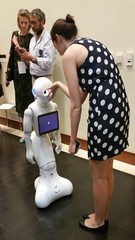
A couple of months ago, Kate Devlin, a professor of AI and society at Kings College London, talked more positively about human-AI relationships, arguing that those engaging in them are often not the archetypal lonely and isolated people we all imagine. Some are married – happily, they tell her. Still, she frequently reminds people “your AI does not love you back”. The same can be true in reverse. Here, a Japanese researcher with three Peppers at home is asked if she misses them when she’s away. “No.”
As a psychologist, Devlin’s job is not business models. But they drive the AI’s design. Companies spend money in time and effort to make robots humanoid – or at least cute – to make them successful in the marketplace. The same is true of chatbots programmed to appear conscious. Cue (again) James Boyle: “For the first time in history…sentences do not mean sentience.” We are some way from having adapted to that.
Teo has a name for the peculiarly toxic mix of anthropomorphism, cold-eyed profit, data collection, and dark patterns that she’s ruminating on: “intimacy capitalism”. New to me, but instantly compelling.
I can see where an academic must rigorously untangle this into a solidly-founded theory; Teo is still working out fully what it means. But the phrase resonates without that depth: the rapaciousness described by surveillance capitalism and surveillance pricing crossed with the new ability to exploit personal vulnerabilities exposed by those same non-human characteristics of infinite patience and a long, detailed memory. Ugh.
I wish I could say that people do not respond as well to the blandishments of synthetic pretend-humans, but the statistics are against me. Worse, a study referenced in discussion found that people award authority to AI companions’ pronouncements because they trust them – which sounds to me like exactly the same as trusting an online “influencer” on subjects where they have no expertise because they’re familiar and maybe got some random things right in the past. As skeptics found in studying years of psychic predictions, people remember the hits and forget the misses.
So while you or I might say, make the chatbot act like a chatbot instead of dolling it up in human signage, the business model, fed by popular preference, is against us. Related, Gizem Gültekin-Várkonyi, who presented a discussion of “robot literacy”, wants people to stop saying “the algorithm” is discriminatory or “the algorithm” makes a decision. “It is us,” she said, reminding me of Pogo.

The presumption is that loading these various toxicities into robots will be worse. I’m less sure; I think the cute but less human ones ought to have a better chance because the more humanoid ones are so obviously *not* human and more likely to fall into the Uncanny Valley.
But for how long? In the lunch break, someone was running a series of “pick the AI” image tests. Two breakfasts, side by side. One had perfectly presented fried eggs, a fruit medley with strawberries, and I think some potatoes. The other had frazzled fried eggs, baked beans, and, nestled next to them, a dead giveaway. What AI knows from black pudding?
By next year, or soon after, AI chatbots and image generators will have been fed data about black pudding (without ever tasting one). Similarly, someday in the future, crude robots will be both cuter and, possibly, more lifelike.
Would you trust your baby with one of those robots? Who is liable if it puts the baby in the washing machine? At that moment, as multiple legal opinions awaited voicing, the actual two-month-old baby in the room howled. Can robots have such exquisite comic timing?
Illustrations: Pepper, as seen at We Robot 2016.
Also this week: At Gathering4Gardner’s YouTube channel, mathematician and juggler Colin Wright and I talk about skepticism.
Wendy M. Grossman is an award-winning journalist. Her Web site has an extensive archive of her books, articles, and music, and an archive of earlier columns in this series. She is a contributing editor for the Plutopia News Network podcast. Follow on Mastodon or Bluesky.
