So Britain will soon wave off yet another prime minister; they’ve been dropping like flies ever since the 2016 Brexit vote. At the Guardian, John Crace snarks that come Remembrance Sunday they’ll need more space around the Cenotaph for all the former prime ministers (nine, plus whoever’s next).
I had hoped for two things from the Labour government elected in 2024: 1) an end to the Conservative psychodrama, and 2) that as a former human rights lawyer. Starmer would modulate the government’s approach to surveillance, AI, and Internet regulation. Instead, he has continued seamlessly the line taken by the Conservative governments before him – and reinvented failed policies from the Labour government of the 1990s.
The last almost-two years have seen Starmer’s government plan digital IDs, pursue implementing the 2023 Online Safety Act including age verification, continue awarding contracts to Palantir, embrace AI for government services despite known flaws undermining fairness and accuracy, increase the hostility in the immigration system, tolerate the spread of police use of live facial recognition without public discussion, and continue adding restrictions on protest. With his premiership under threat, last week he announced the social media ban. It obviously didn’t save him, if that was the purpose. Now, we wait to see if it is taken up by whoever’s next.
At Index on Censorship, Sally Gimson says the ban, “bypasses the benefits of the Internet for children without actually tackling the risks”. She goes on to note that many teens, having grown up with this technology, are more privacy-conscious than their parents and less likely to spread scams than their grandparents.
The UK government’s relationship with technology needs a rethink, preferably away from former prime minister Tony Blair and his AI advocacy. We could start where Starmer could have: with rights-based values. And by recognizing that if you can’t solve tough social and economic problems by randomly throwing new technologies at them, you can’t solve them with random restrictions either.
While Starmer was resigning, Dan Robinson reports at The Register, the Department for Culture, Media, and Sport issued a green paper proposing to require social media and video platforms to promote trustworthy media over other sources. In “trustworthy”, the paper includes the UK’s traditional public service broadcasters, plus…well, who?
The green paper says the criteria will be “decided in an open and transparent manner with regard to protecting media freedom”. It then suggests that the definition of news publishers in the Online Safety Act provides a useful starting point: “both broadcasters and UK based entities whose primary purpose is publishing news-related material, created by different persons, subject to editorial control, a standards code, and with a mechanism for resolving complaints”.
Under that definition, it seems like the Daily Mail, which Wikipedia editors deem unreliable, is in, and personal blogs are out. Probably so are independent sites like LondonCentric, which is run by a single highly experienced journalist but pays freelances and does prize-winning investigative work. News podcasts can just wonder if they exist. In the reactions summarized at Nieman Lab, public service broadcasters love it, publishers like it if they’re included, and platforms say it’s unfair. Public comments are open.
Two things are interesting about the Wikipedia list. First, it is an ongoing collaborative effort. Second, the record of its construction shows that the contributors understand that an outlet may be trustworthy on some subjects and not others, deserve reevaluation over time, and vary according to topic and means of creation (see for example the comment about BusinessInsider’s AI-generated and syndicated content). Of course, Wikipedia is different. DCMS wants to improve the nation’s information diet. Wikipedia is merely trying to ensure that the sources cited for facts in the encyclopedia are reliable.
While I understand the dangers of a world choked with misinformation and disinformation, this definition sounds like an attempt to return to the old world of gatekeepers who, even if they couldn’t be trusted to keep the government’s secrets, were *familiar*. The Internet and other technologies have brought, for good and ill, the ability to publish and distribute to people who were previously unheard.
As the 2024 report from the Reuters Insitute says, news has no single trust problem (and therefore no single solution). Misinformation and disinformation are only a part.
For its report, Reuters convened 41 focus groups across Brazil, India, the UK, and the US, drawing participants from audiences who have been historically underserved, marginalized, or harmed by reporting. Previous work had already found generalized suspicion of all news media; the focus groups showed that these participants’r distrust was based in their history and the price was personal.
In last week’s 2026 report Reuters found that use of all media for news, even online news and social media, is declining, but at different rates – newspapers are fading faster than TV, for example. Reuters also found that in every country a “small but significant” minority say they use no news sources at all.
Starmer did some good things, as Jonathan Freedland writes at the Guardian, and none of this is what brought him down. But it’s an opportunity for the next guy.
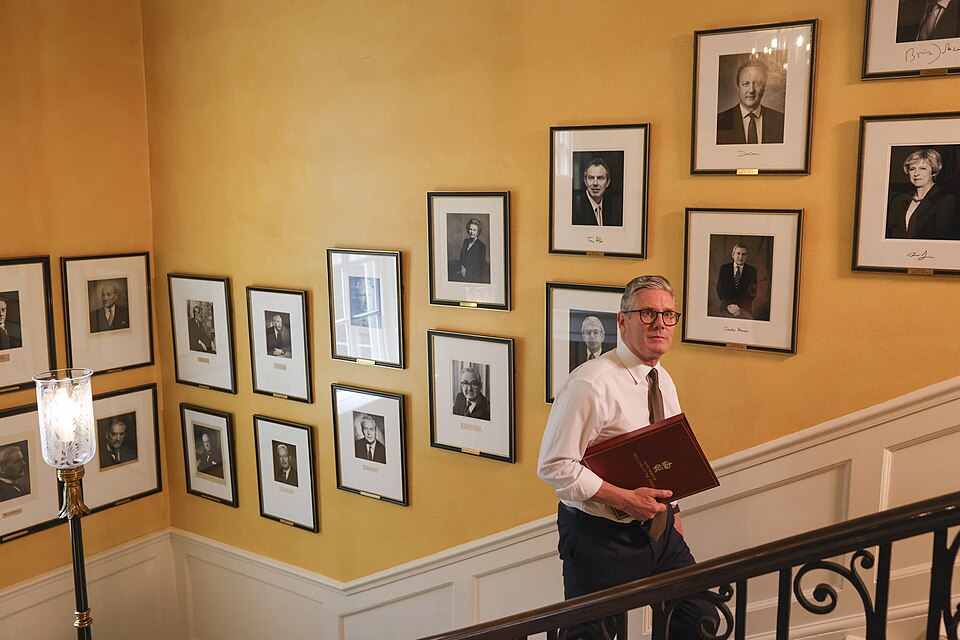
Illustrations: Keir Starmer, passing the photographs of former prime ministers he is about to join (via Wikimedia.
Wendy M. Grossman is an award-winning journalist. Her Web site has an extensive archive of her books, articles, and music, and an archive of earlier columns in this series. She is a contributing editor for the Plutopia News Network podcast. Follow on Mastodon or Bluesky.