The railway and the balloon

Is AI more like a train or a hot air balloon? Veronica Paternolli and Ryan Calo asked at this year’s We Robot. Nineteenth-century hot air balloons were notoriously uncontrollable. The US legal system assigned strict liability: it was your fault if your balloon crashed in someone’s backyard, even if you did everything you could to prevent it. Railways were far more disruptive but also far more predictable, and therefore were liable only in cases of negligence. Which regime should apply to AI is an ongoing debate.

Calo and Patornolli also wondered if agentic AI could reverse 30 years of being forced to take on busy work companies formerly did for us. This “shadow work” encompasses everything from retrieving bank statements and completing reCaptchas to pumping our own gas. Actually, more than 30 years: in 1962, Agatha Christie’s Miss Marple complained that self-service supermarkets were replacing shopkeepers who served you. If companies want a negligence regime, Patornelli and Calo argue, they should deploy agentic AI to relieve us of the “sludge” instead of displacing jobs and aggregating wealth.

But would we believe them? Technologists have promised before that their products will up-end the balance of power and simplify our lives – some of them the same people and companies. The web browsers and search engines that promised a universe of information today are faithless agents serving their owners and developers. Why should agentic AI – if it’s ever trustworthy – be any different? Many of us want a life with less demanding devices – and agentic AI sounds like even more “relationship” work.

Underlying Patornolli’s and Calo’s argument, however, is a fundamental clash. Like Mireille Hildebrandt at a 2017 Royal Society meeting, they argue that law is purposely flexible so it can adapt to unforeseen circumstances and, even more important, contestable (otherwise, Hildbrandt said, it’s just administration). Computers, even dressed in “AI”, always have hard boundaries underneath. As Bill Smart explained here in 2016, no matter how “fuzzy” its logic, no computer can evaluate standards like the “reasonable woman“. No matter how “fuzzy” its logic, a computer will issue a ticket if you are going even just the tiniest fraction of a nanometer faster than the speed limit. Anti-doping authorities have a similar problem as Neil Robinson said in a recent episode of the Anti-Doping podcast: the extreme sensitivity of modern tests is catching people with no intent to dope.

Liability wasn’t the immediate problem in Tomomi Ota’s description of everyday life with a Pepper robot at home (YouTube), which she took shopping, to restaurants, and on public transit as part of the Robot Friendly project, An account that led AJung Moon to wonder if a future filled with robots is really desirable. The inevitability narrative would say we’re going to get it anyway, begging the questions of whether we have a) the resources to make billions of robots and b) where we would put them all.

Sometimes these things fail in the simplest ways: a close-up of a Pepper that has been used as a greeter shows broken fingers because it was not robust enough for the basic social protocol of shaking hands. In studying the integration of robots into customer service situations, Elsa Concas, Stefan Larsson, and Laetitia Tanqueray found staff consultation is essential. In a staged setting such as the Japanese “ramen and robots” Pepper Parlour, the robots were a draw for customers and appreciated by the staff, who were paid more. In an unstaged airport tourist information center, they were basically useless and ignored. A commenter noted the same is often true of the robots intended for elder care in Japan: most end up in a cupboard,

This theme was also picked up by Emily LaRosa, who studied the limits of explainability in automated apple picking. In this case of “epistemic injustice”, the neglect of local knowledge and ecological tradition led her to propose a “Curated Information Framework”. She concluded that trust in AI systems is not created by transparency on its own if that means handing over large amounts of inscrutable data, but by taking lived context into account – “situated transparency”.

LaRosa’s study echoed the paper Ota co-wrote with Rikiya Yamamoto, which derives new “laws of robotics” to update Isaac Asimov’s Three Laws, which can’t be programmed and whose fixed, “top-down” nature was what he needed in a story-telling device. The real world, they argue, requires principles built bottom-up from practical experience. Their selection: mutual respect, social membership, and co-evolution.

They have lots of competition. Moon counts more than 100 sets of principles and ethical frameworks published since 2018, many of which she says make assumptions debunked in the 2025 paper The Future is Rosie?” or as Paul Ohm and David Atkinson discussed, encoded in the benchmarks – documents used to define AIs’ behavior and priorities. This “latent rulebook”, they said, is increasingly secret.

Meanwhile, like explainability, the right to repair fails for AI, which changes constantly with software updates, networking, and interacting. Ryota Akasaka argued that current legal approaches don’t work for products that aren’t fixed and will lose everything they’ve accrued when “repaired” to their original state. When Ota was offered the opportunity to upgrade her development model Pepper, she declined in shock. Replacing your robot’s head, it seems, ends a beautiful friendship.

Illustrations: “Hidden Labour of Internet Browsing”, by Anne Fehres and Luke Conroy. Via A14 Media (CC-by-4.0).

Wendy M. Grossman is an award-winning journalist. Her Web site has an extensive archive of her books, articles, and music, and an archive of earlier columns in this series. She is a contributing editor for the Plutopia News Network podcast. Follow on Mastodon or Bluesky.
Intimacy capitalism

Many non-human characteristics make AI attractive, Sue-Anne Teo said to open this year’s We Robot: endless patience, long and detailed memory, and sycophancy. I’m less certain about the last of those; lots of us react poorly to undisguised flattery. And yet: Stanford researchers agree with her that this is a thing. The AIs are certainly programmed to *try* to human-wash themselves: they use the perpendicular pronoun, “apologize” for errors, and type “you’re right”. And the Stanford folks’ research shows that users respond by becoming “more self-centered, more morally dogmatic”. Probably it’s easier for that to happen if you’re consulting the AI on a personal matter than if you’re just asking it to find an article you read once based on a few hazy memories of what it’s about. No chatbot has yet congratulated me on my choice of half-remembered reading material.

Teo’s vision of the business potential of AIs is part of a long-running theme at We Robot: the subscription service that terminates your relationship when you stop paying. The potential for emotional manipulation by a company that is programmed to maximize profits as if they were paperclips is as great as that of a spirit medium over a client who believes their only link to a beloved deceased person is through their belief in that medium’s ability to establish contact. When I suggest this, Teo says mediums don’t scale. True. But the potential for emotional dependence and manipulation for those individuals seems psychologically similar.

A couple of months ago, Kate Devlin, a professor of AI and society at Kings College London, talked more positively about human-AI relationships, arguing that those engaging in them are often not the archetypal lonely and isolated people we all imagine. Some are married – happily, they tell her. Still, she frequently reminds people “your AI does not love you back”. The same can be true in reverse. Here, a Japanese researcher with three Peppers at home is asked if she misses them when she’s away. “No.”

As a psychologist, Devlin’s job is not business models. But they drive the AI’s design. Companies spend money in time and effort to make robots humanoid – or at least cute – to make them successful in the marketplace. The same is true of chatbots programmed to appear conscious. Cue (again) James Boyle: “For the first time in history…sentences do not mean sentience.” We are some way from having adapted to that.

Teo has a name for the peculiarly toxic mix of anthropomorphism, cold-eyed profit, data collection, and dark patterns that she’s ruminating on: “intimacy capitalism”. New to me, but instantly compelling.

I can see where an academic must rigorously untangle this into a solidly-founded theory; Teo is still working out fully what it means. But the phrase resonates without that depth: the rapaciousness described by surveillance capitalism and surveillance pricing crossed with the new ability to exploit personal vulnerabilities exposed by those same non-human characteristics of infinite patience and a long, detailed memory. Ugh.

I wish I could say that people do not respond as well to the blandishments of synthetic pretend-humans, but the statistics are against me. Worse, a study referenced in discussion found that people award authority to AI companions’ pronouncements because they trust them – which sounds to me like exactly the same as trusting an online “influencer” on subjects where they have no expertise because they’re familiar and maybe got some random things right in the past. As skeptics found in studying years of psychic predictions, people remember the hits and forget the misses.

So while you or I might say, make the chatbot act like a chatbot instead of dolling it up in human signage, the business model, fed by popular preference, is against us. Related, Gizem Gültekin-Várkonyi, who presented a discussion of “robot literacy”, wants people to stop saying “the algorithm” is discriminatory or “the algorithm” makes a decision. “It is us,” she said, reminding me of Pogo.

The presumption is that loading these various toxicities into robots will be worse. I’m less sure; I think the cute but less human ones ought to have a better chance because the more humanoid ones are so obviously *not* human and more likely to fall into the Uncanny Valley.

But for how long? In the lunch break, someone was running a series of “pick the AI” image tests. Two breakfasts, side by side. One had perfectly presented fried eggs, a fruit medley with strawberries, and I think some potatoes. The other had frazzled fried eggs, baked beans, and, nestled next to them, a dead giveaway. What AI knows from black pudding?

By next year, or soon after, AI chatbots and image generators will have been fed data about black pudding (without ever tasting one). Similarly, someday in the future, crude robots will be both cuter and, possibly, more lifelike.

Would you trust your baby with one of those robots? Who is liable if it puts the baby in the washing machine? At that moment, as multiple legal opinions awaited voicing, the actual two-month-old baby in the room howled. Can robots have such exquisite comic timing?

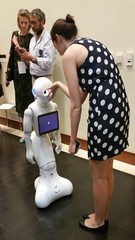
Illustrations: Pepper, as seen at We Robot 2016.

Also this week: At Gathering4Gardner’s YouTube channel, mathematician and juggler Colin Wright and I talk about skepticism.

Wendy M. Grossman is an award-winning journalist. Her Web site has an extensive archive of her books, articles, and music, and an archive of earlier columns in this series. She is a contributing editor for the Plutopia News Network podcast. Follow on Mastodon or Bluesky.

Turn left at the robot

It’s easy to forget, now that so many computer interfaces seem to be getting more inscrutable, that in the early 1990s the shift from the command line to graphical interfaces and the desire to reach the wider mass market introduced a new focus on usability. In classics like Don Norman’s The Design of Everyday Things, a common idea was that a really well-designed system should not require a manual because the design itself would tell the user how to operate it.

What is intuitive, though, is defined by what you’re used to. The rumor that Apple might replace the letters on keys with glyphs is a case in point. People who’ve grown up with smartphones might like the idea of glyphs that match those on their phones. But try doing technical support over the phone and describing a glyph; easier to communicate the letters.

Those years in which computer interfaces were standardized relied on metaphors based on familiar physical items: a floppy disk to save a file, an artist’s palette for color choices. In 1993, leading software companies like Microsoft and Lotus set up usability labs; it took watching user testing to convince developers that struggling to use their software was not a sign the users were stupid.

With that background, it was interesting to attend this year’s edition of the 20-year-old Human-Robot Interaction conference. Robots don’t need metaphors; they *are* the thing itself. Although: why shouldn’t a robot also have menu buttons for common functions?

In the paper I found most interesting and valuable, Lauren Wright examined the use of a speaking Misty robot to deliver social-emotional learning lessons. Wright’s group tested the value of deception – that is, having the robot speak in the first person of its “family”, experiences, and “emotions” – versus a more truthful presentation, in which the robot is neutral and tells its stories in the third person, refers to its programmers, and professes no humanity. The researchers were testing the widely-held assumption that kids engage more with robots programmed to appear more human. They found the opposite: while both versions significantly increased their learning, the kids who used the factual robot showed more engagement and higher scores in the sense of using concepts from the lesson in their answers. This really shouldn’t be surprising. Children don’t in general respond well to deception. Really, who does?

The children’s personal reactions to the robots were at least as interesting. In Michael F. Xu‘s paper, the researchers held co-design sessions and then installed a robot in eight family homes to act as a neutral third-party enforcer issuing timely reminders on behalf of busy parents. Some of the families did indeed report that the robot’s reminder got stuff done more efficiently. On the other hand, the experiment was short – only four days – and you have to wonder if that would still be true after the novelty wore off. There were hints of this from the kids, some of whom pushed back. One simply bypassed a robot reminding him of the limits on his TV viewing by taking the TV upstairs, where the robot couldn’t go. Another reacted like I would at any age and told the robot to “shut up”.

The fact versus fiction presentation included short video clips of some of the kids’ interaction with the robot tutor. In one, a boy placed his hands on either side of the robot’s “face” while it was talking and kept moving its head around, exploring the robot’s physical capabilities (or trying to take its head off?). The speaker ignored this entirely, but the sight hilariously made an important point: the robot’s physical form speaks even when the robot is silent.

We saw this at We Robot 2016, when a Jamaican lawyer asked Olivier Guilhem, from Aldebaran Robotics, which makes Pepper, “Why is the robot white?” His response: “It looks clean.” This week, one paper tried to tease out how “representation bias” – assumptions about gender, skin tone, dis/ability, accessibility, size, age – affect users’ reactions. In the dataset used to train an AI model, bias may be baked in through the historical record. With robots, bias can also present directly through the robot’s design, as Yolande Strengers’ and Jenny Kennedy’s showed in their 2020 book The Smart Wife. Despite its shiny, unmistakable whiteness, Pepper’s shape was ambiguous enough for its gender to be interpreted differently in different cultures. In the HRI paper, the researchers concluded that biases in robot design could perpetuate occupational stereotypes – “technological segregation”. They also found their participants consistently preferred non-skin tones – in their examples, silver and light teal.

“Who builds AI shapes what AI becomes,” said Ben Rosman, who outlined a burgeoning collaborative effort to build a machine learning community across Africa and redress its underrepresentation. The same with robots: many, many cultural norms affect how humans interact with them. That information is signal, not noise, he says, and should be captured to enable robots to operate across wide ranges of human context without relying on “brittle defaults” that interpret human variation as failures. “Turn left at the robot,” makes perfect sense once you know that in South Africa “robots” are known elsewhere as traffic lights.

Illustrations: Rosey, the still-influential “old demo model” robot maid in The Jetsons (1962-1963).

Also this week:
At the Plutopia podcast, we interview Marc Abrahams, founder of the Ig Nobel awards.
At Skeptical Inquirer, the latest Letter to America finds David Clarke conducting the English folklore survey.

Wendy M. Grossman is an award-winning journalist. Her Web site has an extensive archive of her books, articles, and music, and an archive of earlier columns in this series. She is a contributing editor for the Plutopia News Network podcast. Follow on Mastodon or Bluesky.

A short history of We Robot, 2026 edition

On the eve of We Robot 2026, here are links to my summaries of every year since 2012, the inaugural conference, except 2014, which I missed for family reasons. There was no conference in 2024 in order to move the event back to its original April schedule (covid caused its move to September in 2020). These are my personal impressions; nothing I say here should be taken as representing the conference, its founders, its speakers, or their institutions.

We Robot was co-founded by Michael Froomkin, Ryan Calo, and Ian Kerr to bring together lawyers and engineers to think early and long about the coming conflicts in robots, law, and policy.

2025: Predatory inclusion: In Windsor, Ontario, a few months into the new US administration, the sudden change in international relations highlights the power imbalances inherent in many of today’s AI systems. Catopromancy: in workshops, we hear a librarian propose useful AI completely out of step with today’s corporate offerings, and mull how to apply existing laws to new scenarios.

2024 No conference.

2023 The end of cool: after struggling to design a drone delivery service that had benefits over today’s cycling couriers, we find ourselves less impressed by robots that can do somersaults but not anything obviously useful; the future may have seemed more exciting when it was imaginary.

2022 Insert a human: following a long-held conference theme about “humans in the loop, “robots” are now “sociotechnical systems”. Coding ethics: Where Asimov’s laws were just a story device, in workshops we try to work out how to design a real ethical robot.

2021 Plausible diversions: maybe any technology sufficiently advanced to seem like magic can be well enough understood that we can assign responsibility and liability? Is the juice worth the squeeze?: In workshops, we mull how to regulate delivery robots, which will likely have no user-serviceable parts. Title from Woody Hartzog.

2020 (virtual) The zero on the phone: AI exploitation and bias embedded in historical data become what one speaker calls “unregulated experimentation on humans…without oversight or control”.

2019 Math, monsters, and metaphors. We dissect the trolley problem and find the true danger on the immediate horizon is less robots, more the “pile of math that does some stuff” we call “AI”. The Algernon problem: in workshops, new disciplines joining the We Robot family remind us that robots/AI are carrying out the commands of distant owners.

2018 Deception. We return to the question of what makes robots different and revisit Madeleine Clare Elish’s moral crumple zones after the first pedestrian death by self-driving car. Late, noisy, and wrong: in workshops, engineers Bill Smart and Cindy Grimm explain why sensors never capture what you think they’re capturing and how AI systems use their data.

2017 Have robot, will legislate: Discussion of risks this year focused on the intermediate situation, when automation and human norms must co-exist.

2016 Humans all the way down: Madeline Clare Elish introduces “moral crumple zones”, a paper that will resonate through future years. The lab and the world: in workshops, Bill Smart uses conference attendees in formation to show why getting a robot to do anything is difficult.

2015: Multiplicity: W
When in the life of a technology is the right time for regulatory intervention?

2014 Missed conference

2013 Cautiously apocalyptic: Diversity of approaches to regulation will be needed to handle the diversity of robots, and at the beginning of cloud robotics and full-scale data collection, we envision a pet robot dog that can beg its owner for an upgraded service subscription.

2012 A really fancy hammer with a gun. At the first We Robot, we try to answer the fundamental question: what difference do robots bring? Unsentimental engineer Bill Smart provided the title.

Slop

Sometimes it doesn’t pay to be first. iRobot, the maker of the Roomba, has filed for Chapter 11 bankruptcy protection and been acquired by Picea, one of its Chinese suppliers, Lauren Almeida reports at the Guardian. The company’s value has cratered since 2021.

Given the wild enthusiasm that greeted the Roomba’s release in 2002, it seems incredible. Years before then, I recall an event where a speaker whose identity I don’t remember said that ever since he had mentioned the possibility of a robot vacuum sometime like the 1960s he’d gotten thousands of letters asking when it would be ready. There was definitely customer demand. It helped that the Roomba itself was kind of cute as it banged randomly into furniture. People named them, and took them on vacation. But, as often happens, the Roomba’s success attracted lower-cost competitors, and the first mover failed to keep up.

I got one in 2003. After a great few months, I realized that Roombas are not compatible with long hair, which ties them into knots that take longer to cut out than vacuuming. I gave it away within a year and haven’t tried again.

At Mashable, Leah Stodart warns that although the Roombas people already have will continue to work “for now”, users can’t be confident that this state of affairs will continue. Like so many other things that used to be things we owned and are now things we subscribe to (but still think we “buy”), newer-model Roombas are controlled by an app that the manufacturer can change or discontinue at will. She calls it “unplanned obsolescence”. Her advice not to buy a new one this year is sound from the consumer’s point of view, but hardly likely to help the company survive.

***

If generative AI is so great, why is everyone forcing it on us? The latest example, Luke James reports at Tom’s Hardware, is LG “smart” TVs whose users woke up the other day to find a new update had installed “CoPilot: Your AI Companion” without asking permission and that there was no option to remove it. The most you can do to disable it, James says, is keep your TV disconnected from the Internet.

There are of course many more, the automated summaries popping up everywhere being the most obvious. Then, Matthew Gault reports at 404 Media, a Discord moderator and an Anthropic executive added Anthropic’s Claude chatbot to a community for queer gamers, who had voted to restrict Claude to its own channel. Result: major exodus. Duh.

And, of course, as Lance Ulanoff reminds at TechRadar, there is “AI slop” everywhere – music playlists, YouTube videos, ebooks – threatening people’s livelihood even though, as Cory Doctorow has written, “AI can’t do your job. But an AI salesman can convince your boss to fire you and replace you with a chatbot that can’t do your job.” For a while, anyway: Microsoft is halving its sales targets for AI.

And thus we get “slop” as the word of the year, per Merriam-Webster. Any time companies are this intent on foisting something on us – chatbots, ads – you have to know that they’re intent on favoring their interests, not ours.

***

Last week, Customs and Borders Patrol published a notice in the Federal Register proposing new rules for foreigners traveling to the US on an ESTA (“Electronic System for Travel Authorization”) as part of the visa waiver program. It has drawn a lot of discussion in the UK, which is one of the 42 affected countries. Under the new rules, applicants must install CBP’s app, into which they must submit a massive load of “high-value” personal information. The list is long, allows for a so-far-imaginary future of DNA sampling, and expects you to be able to give five years’ worth of family members’ residences, phone numbers, and places of birth, and all the email addresses you’ve used for ten years. CBP thinks the average applicant should be able to complete on their smartphone in 22 minutes. I think it would take hours of painful, resentful typing on a stupid touch keyboard, and even then I doubt I could fill it out with any certainty that the information I supplied was complete or accurate. Data collection at this scale makes it easy to find an error to use as an excuse to deny entry to or deport someone you want to get rid of. As Edward Hasbrouck writes at Papers, Please, “Welcome to the 2026 World Cup”.

“They have to be planning to use AI on all that data,” a friend commented last week. Probably – to build social graphs and find connections deemed suspicious. Privacy International predicts that the masses of data being demanded will in fact enable the AI tools necessary to implement automated decision making and calls the proposals “disproportionate for “a family’s visit to Disney World”,

One of the problems Hasbrouck highlights while opposing this level of suspicionless data collection is that CBP has not provided any way for would-be respondents to the Federal Register notice to examine the app’s source code. What other data might it be collecting?

As Hasbrouck adds in a follow-up, the rules the US imposes on visitors are often adopted by other countries as requirements for US travelers. In this game of ping-pong escalation, no one wins.

The panopticon in your home

In a series of stories, Lisa O’Carroll at the Guardian finds that His Majesty’s Revenue and Customs has had its hand in the cookie jar of airline passenger records. In hot pursuit of its goal of finding £350 million in benefit fraud, it’s been scouring these records to find people who have left the country for more than a month and not returned, so are no longer eligible.

In one case, a family was turned away at the gate when one of the children had an epileptic seizure; their child benefit was stopped because they had “emigrated” though they’d never left. A similar accusation was leveled at a women who booked a flight to Oslo even though she never checked in or flew.

These families can provide documentation proving they remained in the UK, but as one points out, the onus is on them to clean up an error they didn’t make. There are many others. Many simply traveled and returned by different routes. As of November 1, HMRC had reinstated 1,979 of the families affected but sticks to its belief that the rest have been correctly identified. HMRC also says it will check its PAYE records first for evidence someone is still here and working. This would help, but it’s not the only issue.

It’s unclear whether HMRC has the right to use this data in this way. The Guardian reports that the Information Commissioner’s Office, the data protection authority, has contacted HMRC to ask questions.

For privacy advocates, the case is disturbing. It is a clear example of the way data can mislead when it’s moved to a new context. For the people involved, it’s a hostage situation: there is no choice about providing the data siphoned from airlines to Home Office nor the financial information held by HMRC and no control over what happens next.

The essayist and former software engineer Ellen Ullman warned 20 years ago that she had never seen an owner of multiple databases who didn’t want to link them together. So this sort of “sharing” is happening all over the place.

In the US, Pro Publica reported this week that individual states have begun using a system provided by the Department of Homeland Security to check their voter rolls for non-citizens that has incorporated information from the Social Security Administration. Here again, data collected by one agency for one purpose is being shared with another for an entirely different one.

In both cases, data is being used for a purpose that wasn’t envisioned when it was collected. An airline collecting booking data isn’t checking it for errors or omissions that might cost a passenger their benefits. Similarly, the Social Security Administration isn’t normally concerned with whether you’re a citizen for voting purposes, just whether you qualify for one or another program – as it should be. Both changes of use fail to recognize the change in the impact of errors that goes along with them, especially at national scale.

I assume that in this age of AI-for-government-efficiency the goal for the future is to automate these systems even further while pulling in more sources of data.

Privacy advocates are used to encountering pushback that takes this form: “They know everything about me anyway.” I would dispute that. “They” certainly *can* collect a lot of uncorrelated data points about you if “they” aggregate the many available sources of data. But until recently, doing that was effortful enough that it didn’t happen unless you were suspected of something. Now, we’re talking sharing data and mining at scale as a matter of routine.

***

One of the most important lessons learned from 14 years of We, Robot conferences is that when someone shows a video clip of a robot doing something one should always ask how much it’s been speeded up.

This probably matters less in a home robot doing chores, as long as you don’t have to supervise. Leave a robot to fold laundry, and it can’t possibly matter if it takes all night.

From reports by Erik Kain at Forbes and Nilesh Christopher at the LA Times, it appears that 1X’s new Neo robot is indeed slow, even in its promotional video clips. The company says it has layers of security to prevent it from turning “murderous”, which seems an absurd bit of customer reassurance. However, 1X also calls it “lightweight”. The Neo is five foot six and weighs 66 pounds (30 kilos), which seems quite enough to hurt someone if it falls on them, even with padding. Granting the contributory design issues, Lime bikes weigh 50 pounds and break people’s legs. 1X’s website shows the Neo hugged by an avuncular taller man; imagine it instead with a five-foot 90-year-old woman.

Can we ask about hacking risks? And what happens if, like so many others, 1X shuts it down?

More incredibly, in buying one you must agree to allow a remote human operatorto drive the robot, along the way peering into your home. This is close to the original design of the panopticon, which chilled because those under surveillance never know whether they are being watched or not.

And it can be yours for the low, low price of $20,000 or $500 a month.

Illustrations: Jeremy Bentham’s original drawing of his design for the panopticon (via Wikimedia).

Also this week:
The Plutopia podcast interviews Sophie Nightingale on her research into deepfakes and the future of disinformation.
TechGrumps 3.33 podcast, The Final Step is Removing the Consumer, discusses AI web brorwsers, the Amazon outage, Python Foundation and DEI.

Wendy M. Grossman is an award-winning journalist. Her Web site has an extensive archive of her books, articles, and music, and an archive of earlier columns in this series. She is a contributing editor for the Plutopia News Network podcast. Follow on Mastodon or Bluesky.

Predatory inclusion

The recent past is a foreign country; they view the world differently there.

At last week’s We Robot conference on technology, policy, and law, the indefatigably detail-oriented Sue Glueck was the first to call out a reference to the propagation of transparency and accountability by the “US and its allies” as newly out of date. From where we were sitting in Windsor, Ontario, its conjoined fraternal twin, Detroit, Michigan, was clearly visible just across the river. But: recent events.

As Ottawa law professor Teresa Scassa put it, “Before our very ugly breakup with the United States…” Citing, she Anu Bradford, she went on, “Canada was trying to straddle these two [US and EU] digital empires.” Canada’s human rights and privacy traditions seem closer to those of the EU, even though shared geography means the US and Canada are superficially more similar.

We’ve all long accepted that the “technology is neutral” claim of the 1990s is nonsense – see, just this week, Luke O’Brien’s study at Mother Jones of the far-right origins of the web-scraping facial recognition company Clearview AI. The paper Glueck called out, co-authored in 2024 by Woody Hartzog, wants US lawmakers to take a tougher approach to regulating AI and ban entirely some systems that are fundamentally unfair. Facial recognition, for example, is known to be inaccurate and biased, but improving its accuracy raises new dangers of targeting and weaponization, a reality Cynthia Khoo called “predatory inclusion”. If he were writing this paper now, Hartzog said, he would acknowledge that it’s become clear that some governments, not just Silicon Valley, see AI as a tool to destroy institutions. I don’t *think* he was looking at the American flags across the water.

Later, Khoo pointed out her paper on current negotiations between the US and Canada to develop a bilateral law enforcement data-sharing agreement under the US CLOUD Act. The result could allow US police to surveil Canadians at home, undermining the country’s constitutional human rights and privacy laws.

In her paper, Clare Huntington proposed deriving approaches to human relationships with robots from family law. It can, she argued, provide analogies to harms such as emotional abuse, isolation, addiction, invasion of privacy, and algorithmic discrimination. In response, Kate Darling, who has long studied human responses to robots, raised an additional factor exacerbating the power imbalance in such cases: companies, “because people think they’re talking to a chatbot when they’re really talking to a company.” That extreme power imbalance is what matters when trying to mitigate risk (see also Sarah Wynn-Williams’ recent book and Congressional testimony on Facebook’s use of data to target vulnerable teens).

In many cases, however, we are not agents deciding to have relationships with robots but what AJung Moon called “incops”, or “incidentally co-present”. In the case of the Estonian Starship delivery robots you can find in cities from San Francisco to Milton Keynes, that broad category includes human drivers, pedestrians, and cyclists who share their spaces. In a study, Adeline Schneider found that white men tended to be more concerned about damage to the robot, where others worried more about communication, the data they captured, safety, and security. Delivery robots are, however, typically designed with only direct users in mind, not others who may have to interact with it.

These are all social problems, not technological ones, as conference chair Kristen Thomasen observed. Carys Craig later modified it: technology “has compounded the problems”.

This is the perennial We Robot question: what makes robots special? What qualities require new laws? Just as we asked about the Internet in 1995, when are robots just new tools for old rope, and when do they bring entirely new problems? In addition, who is responsible in such cases? This was asked in a discussion of Beatrice Panattoni‘s paper on Italian proposals to impose harsher penalties for crime committed with AI or facilitated by robots. The pre-conference workshop raised the same question. We already know the answer: everyone will try to blame someone or everyone else. But in formulating a legal repsonse, will we tinker around the edges or fundamentally question the criminal justice system? Andrew Selbst helpfully summed up: “A law focusing on specific harms impedes a structural view.”

At We Robot 2012, it was novel to push lawyers and engineers to think jointly about policy and robots. Now, as more disciplines join the conversation, familiar Internet problems surface in new forms. Human-robot interaction is a four-dimensional version of human-computer interaction; I got flashbacks to old hacking debates when Elizabeth Joh wondered in response to Panattoni’s paper if transforming a robot into a criminal should be punished; and a discussion of the use of images of medicalized children for decades in fundraising invoked publicity rights and tricky issues of consent.

Also consent-related, lawyers are starting to use generative AI to draft contracts, a step that Katie Szilagyi and Marina Pavlović suggested further diminishes the bargaining power already lost to “clickwrap”. Automation may remove our remaining ability to object from more specialized circumstances than the terms and conditions imposed on us by sites and services. Consent traditionally depends on a now-absent “meeting of minds”.

The arc of We Robot began with enthusiasm for robots, which waned as big data and generative AI became players. Now, robots/AI are appearing as something being done to us.

Illustrations: Detroit, seen across the river from Windsor, Ontario with a Canadian Coast Guard boat in the foreground.

Wendy M. Grossman is the 2013 winner of the Enigma Award. Her Web site has an extensive archive of her books, articles, and music, and an archive of earlier columns in this series. She is a contributing editor for the Plutopia News Network podcast. Follow on Mastodon or Bluesky.

Catoptromancy

It’s a commonly held belief that technology moves fast, and law slowly. This week’s We Robot workshop day gave the opposite impression: these lawyers are moving ahead, while the technology underlying robots is moving slower than we think.

A mainstay of this conference over the years has been Bill Smart‘s and Cindy Grimm‘s demonstrations of the limitations of the technologies that make up robots. This year, that gambit was taken up by Jason Millar and AJung Moon. Their demonstration “robot” comprised six people – one brain, four sensors, and one color sensor. Ordering it to find the purple shirt quickly showed that robot programming isn’t getting any easier. The human “sensors” can receive useful information only as far as their outstretched fingertips, and even then the signal they receive is minimal.

“Many of my students program their robots into a ditch and can’t understand why,” Moon said. It’s the required specificity. For one thing, a color sensor doesn’t see color; it sends a stream of numeric values. It’s all 1s and 0s and tiny engineering decisions whose existence is never registered at the policy level but make all the difference. One of her students, for example, struggled with a robot that kept missing the croissant it was supposed to pick up by 30 centimeters. The explanation turned out to be that the sensor was so slow that the robot was moving a half-second too early, based on historical information. They had to insert a pause before the robot could get it right.

So much of the way we talk about robots and AI misrepresents those inner workings. A robot can’t “smell honey”; it merely has a sensor that’s sensitive to some chemicals and not others. It can’t “see purple” if its sensors are the usual red, green, blue. Even green may not be identifiable to an RGB sensor if the lighting is such that reflections make a shiny green surface look white. Faster and more diverse sensors won’t change the underlying physics. How many lawmakers understand this?

Related: what does it mean to be a robot? Most people attach greater intelligence to things that can move autonomously. But a modern washing machine is smarter than a Roomba, while an iPhone is smarter than either but can’t affect the physical world, as Smart observed at the very first We Robot, in 2012.

This year we are in Canada – to be precise, in Windsor, Ontario, looking across the river to Detroit, Michigan. Canadian law, like the country itself, is a mosaic: common law (inherited from Britain), civil law (inherited from France), and myriad systems of indigenous peoples’ law. Much of the time, said Suzie Dunn, new technology doesn’t require new law so much as reinterpretation and, especially, enforcement of existing law.

“Often you can find criminal law that already applies to digital spaces, but you need to educate the legal system how to apply it,” she said. Analogous: in the late 1990s, editors of the technology section at the Daily Telegraph had a deal-breaking question: “Would this still be a story if it were about the telephone instead of the Internet?”

We can ask that same question about proposed new law. Dunn and Katie Szilagyi asked what robots and AI change that requires a change of approach. They set us to consider scenarios to study this question: an autonomous vehicle kills a cyclist; an autonomous visa system denies entry to a refugee who was identified in her own country as committing a crime when facial recognition software identifies her in images of an illegal LGBTQ protest. In the first case, it’s obvious that all parties will try to blame someone – or everyone – else, probably, as Madeleine Clare Elish suggested in 2016, on the human driver, who becomes the “moral crumple zone”. The second is the kind of case the EU’s AI Act sought to handle by giving individuals the right to meaningful information about the automated decision made about them.

Nadja Pelkey, a curator at Art Windsor-Essex, provided a discussion of AI in a seemingly incompatible context. Citing Georges Bataille, who in 1929 saw museums as mirrors, she invoked the word “catoptromancy”, the use of mirrors in mystical divination. Social and political structures are among the forces that can distort the reflection. So are the many proliferating AI tools such as “personalized experiences” and other types of automation, which she called “adolescent technologies without legal or ethical frameworks in place”.

Where she sees opportunities for AI is in what she called the “invisible archives”. These include much administrative information, material that isn’t digitized, ephemera such as exhibition posters, and publications. She favors small tools and small private models used ethically so they preserve the rights of artists and cultural contexts, and especially consent. In a schematic she outlined a system that can’t be scraped, that allows data to be withdrawn as well as added, and that enables curiosity and exploration. It’s hard to imagine anything less like the “AI” being promulgated by giant companies. *That* type of AI was excoriated in a final panel on technofascism and extractive capitalism.

It’s only later I remember that Pelkey also said that catoptromancy mirrors were first made of polished obsidian.

In other words, black mirrors.

Illustrations: Divination mirror made of polished obsidian by artisans of the Aztec Empire of Mesoamerica between the 15th and 16th centuries (via Wikimedia

Wendy M. Grossman is the 2013 winner of the Enigma Award. Her Web site has an extensive archive of her books, articles, and music, and an archive of earlier columns in this series. She is a contributing editor for the Plutopia News Network podcast. Follow on Mastodon or Bluesky.
A short history of We Robot 2012-

On the eve of We Robot 2025, here are links to my summaries of previous years. 2014 is missing; I didn’t make it that year for family reasons. There was no conference in 2024 in order to move the event back to its original April schedule (covid caused its move to September in 2020). These are my personal impressions; nothing I say here should be taken as representing the conference, its founders, its speakers, or their institutions.

We Robot was co-founded by Michael Froomkin, Ryan Calo, and Ian Kerr to bring together lawyers and engineers to think early about the coming conflicts in robots, law, and policy.

2024 No conference.

2023 The end of cool. After struggling to design a drone delivery service that had any benefits over today’s cycling couriers, we find ourselves less impressed by robot that can do somersaults but not do anything useful.

2022 Insert a human. “Robots” are now “sociotechnical systems”.

Workshop day Coding ethics. The conference struggles to design an ethical robot.

2021 Plausible diversions. How will robots rehape human space?

Workshop day Is the juice worth the squeeze?. We think about how to regulate delivery robots, which will likely have no user-serviceable parts. Title from Woody Hartzog.

2020 (virtual) The zero on the phone. AI exploitation becomes much more visible.

2019 Math, monsters, and metaphors. The trolley problem is dissected; the true danger is less robots than the “pile of math that does some stuff”.

Workshop day The Algernon problem. New participants remind that robots/AI are carrying out the commands of distant owners.

2018 Deception. The conference tries to tease out what makes robots different and revisits Madeleine Clare Elish’s moral crumple zones after the first pedestrian death by self-driving car.

Workshop day Late, noisy, and wrong. Engineers Bill Smart and Cindy Grimm explain why sensors never capture what you think they’re capturing and how AI systems use their data.

2017 Have robot, will legislate. Discussion of risks this year focused on the intermediate sitaution, when automation and human norms clash.

2016 Humans all the way down. Madeline Clare Elish introduces “moral crumple zones”.

Workshop day: The lab and the world. Bill Smart uses conference attendees in formation to show why building a robot is difficult.

2015 Multiplicity. A robot pet dog begs its owner for an upgraded service subscription.

2014 Missed conference

2013 Cautiously apocalyptic. Diversity of approaches to regulation will be needed to handle the diversity of robots.

2012 A really fancy hammer with a gun. Unsentimental engineer Bill Smart provided the title.

wg

Loose ends

Privacy technologies typically fail for one of two reasons: 1) they’re too complicated and/or expensive to find widespread adoption among users; 2) sites and services ignore, undermine, or bypass them in order to preserve their business model. In the first category are numerous privacy-enhancing technologies that failed to make their case in the marketplace. Among examples of the first category are numerous encryption-related attempts to secure communications. Repeated failures in the marketplace, usually because the resulting products were too technically difficult for most users, they never found mass adoption. In the end, encrypted messaging didn’t really took off until WhatsApp built it into its service.

This week saw a category two failure: Mozilla announced it is removing the Do Not Track option from Firefox’s privacy settings. DNT is simple enough to implement if you can stand to check and change settings, but it falls on the wrong side of modern business models and, other than in California, the US has no supporting legislation to make it enforceable. Granted, Firefox is a minority browser now, but the moment feels significant for this 13-year-old technology.

As Kevin Purdy explains at Ars Technica, DNT began as an FTC proposal, based on work by Christopher Soghoian and Sid Stamm, that aimed to create a mechanism for the web similar to the “Do Not Call” list for telephone networks.

The world in which DNT seemed a hopeful possibility seems almost quaint now: then, one could still imagine that websites might voluntarily respect the signal web browsers sent indicating users’ preferences. Do Not Call, by contrast, was established by US federal legislation. Despite various efforts, the US failed to pass legislation underpinning DNT, and it never became a web standard. The closest it has come to the latter is Section 2.12 of the W3C’s Ethical Web Principles, which says, “People must be able to change web pages according to their needs.” Can I say I *need* to not be tracked?

Even at the time it seemed doubtful that web companies would comply. But it also suffered from unfortunate timing. DNT arrived just as the twin onslaught of smartphones and social media was changing the ethos that built the open web. Since then, as Cory Doctor wrote earlier this year, the incentives have aligned to push web browsers to become faithless user agents, and conventions mean less and less.

Ultimately, DNT only ever worked insofar as users could trust websites to honor their preference. As it’s become clear they can’t, ad blockers have proliferated, depriving sites of ad revenue they need to survive. Had DNT been successful, perhaps we’d have all been better off.

***

Also on the way out this week is Cruise’s San Francisco robotaxis. My last visit to San Francisco, about a year ago, was the first time I saw these in person. Most of the ones I saw were empty Waymos, perhaps in transit to a passenger, perhaps just pointlessly clogging the streets. Around then, a Cruise robotaxi ran over a pedestrian who’d been hit by another car and then dragged her 20 feet. San Francisco promptly suspended Cruise’s license. Technology critic Paris Marx thought the incident would likely be Cruise’s “death knell”. And so it’s proving. The announcement from GM, which acquired Cruise in 2016 for $1 billion, leaves just Waymo standing in the US self-driving taxi business, with Tesla saying it will enter the market late next year.

I always associate robotaxis with Vernor Vinge‘s 2006 novel Rainbows End. In it, Vinge imagined a future in which robotaxis arrived within minutes of being hailed and replaced both public transport and private car ownership. By 2012 or so, his fictional imagining had become real-life projection, and many were predicting that our streets would imminently be filled with self-driving cars, taxis or not. In 2017, the conversation was all about what ethics to program into them and reclaiming urban space. Now, that imagined future seems to be receding, as skeptics predicted it would.

***

American journalism has long operated under the presumption that the stories it produces should be “neutral”. Now, at the LA Times, CEO Patrick Soon-Shiong thinks he can enforce this neutrality by running an AI-based “bias meter” over the paper’s stories. If you remember, in the late stages of the US presidential election, Soon-Shiong blocked the paper from endorsing Kamala Harris. Reports say that the bias meter, due out next month, is meant to identify any bias the story’s source has and then deliver “both sides” of that story.

This is absurd. Few news stories have just two competing sides. A biased source can’t be countered by rewriting the story unless you include more sources and points of view, which means additional research. Most important, AI can’t think.

But readers can. And so what this story says is that Soon-Shiung doesn’t trust either the journalists who work for him or the paper’s readers to draw the conclusions he wants. If he knew more about journalism, he’d know that readers generally don’t adopt opinions just because someone tells them to. The far greater power, I recall reading years ago, lies in determining what readers *think about* by deciding what topics are important enough to cover. There’s bias there, too, but Soon-Shiong’s meter won’t show it.

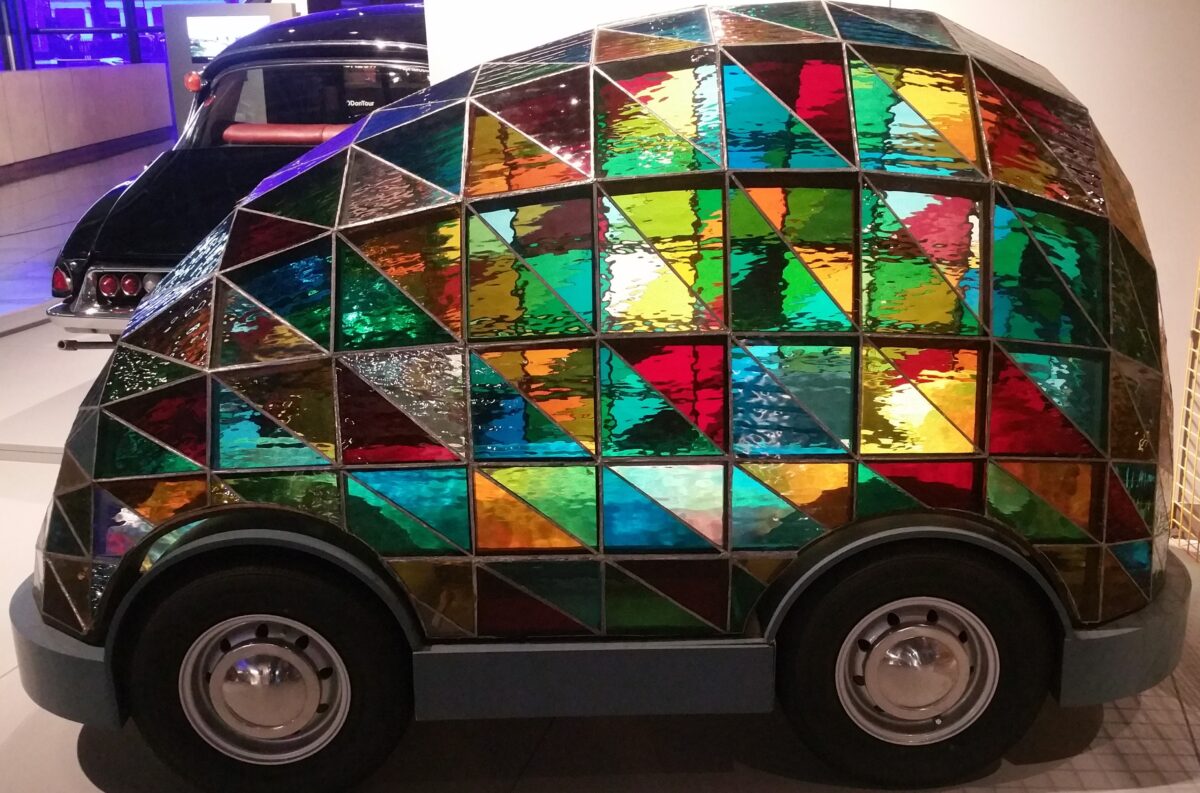
Illustrations: Dominic Wilccox‘s concept driverless sleeper car, 2014.

Wendy M. Grossman is the 2013 winner of the Enigma Award. Her Web site has an extensive archive of her books, articles, and music, and an archive of earlier columns in this series. She is a contributing editor for the Plutopia News Network podcast. Follow on Mastodon or Bluesky.