
Failure standards

This week, Ofcom published the first of doubtless many reports on the impact of the Online Safety Act, which came into force in 2025. In the report, Ofcom acknowledges that there has been little change in the amount of “harmful material” children encounter online. The one bit of success appears to be that children are less able to access mainstream pornography sites because of age verification – but children still see pornography via social media, messaging, and gaming services. Ofcom wants to add body stigma and depression content to the list of types of “priority content” deemed harmful to children.

This is all without the proposed social media ban, which, separately, Ofcom warns may bar 100,000 16-to-17-year-olds because they have neither a passport nor a driver’s license to act as backup when other methods of age verification fail.

As Mike Masnick puts it at Techdirt, the OSA is ineffective, so Ofcom concludes we need more of it. So very Yes, Minister – specifically the episode The Challenge, in which a local government administrator proposes that every policy should be accompanied by criteria by which it could be declared a failure – “failure standards”. The civil service is horrified.

To mark Andy Burnham’s June arrival as prime minister, the Open Rights Group proposed a reset of digital policy. ORG advocates giving users better tools, publishing government content more widely so users aren’t forced to use Facebook and X, and shift government advertising budgets to local news sites. These all seem sensible.

In a new analysis of age-gating in Australia from DefendDigitalMe, Jen Persson and Madeleine Stone warn against conflating the process of age verification and the desired outcome of making children safe online. “Age checks on their own leave the harms children face online largely untouched, while building a permanent identity layer, often tied to a live face scan, between every person and the digital public sphere. The cost and risk of that layer fall first on the children these policies are said to protect.” They conclude that there are better alternatives: create protections for all users, not just children; subject new high-risk features to human rights assessments; enforce existing law; act on specific harms; and improve digital literacy. And: build in off-ramps so that policies don’t work can be ended. (RIP Humphrey Appleby.)

“The harm lies in platform design and engagement-driven business models,” they write, citing the Council of Europe’s human rights commissioner, “not in children’s access.”

***

It is a truth universally acknowledged that stories about absurd new uses of AI must invoke Philip K. Dick. And so that is how Bloomberg Law announces that the state of Delaware, the first choice of American corporations, plans to create a new form of company – autonomous, bot-run Artificial Intelligence Companies, which would be allowed to claim limited liability for owners and full corporate “personhood”, sign contracts, make business decisions, own assets, and bring lawsuits. The PKD will be in the as-yet-unreleased details. The proposal would enable a 30-month test in a “regulatory sandbox”, possibly beginning next year. Argentina has similar plans. Professor Yonathan Arbel suggests the appropriate response is “terrified excitement”.

Maybe, if you’re a lawyer. My own response is more like exasperation. Those cited in the Bloomberg piece claim that legal penalties will “guide” AICs to behave “responsibly” by consuming resources that their programming would identify as needed for business expansion. What fantasy thinking is this? If recent events have taught us anything, it’s that AIs will find the shortest path to their assignment, even if that means using strategies humans would reject as illegal or ethically wrong. Does anyone really think AIs will be less inclined to create cover-ups than human-run Volkswagen, Enron, Theranos, or Bernie Madoff? Given the history of human interactions to learn from, AICs will sue human beings who try to expose their wrongdoing rather than decide to behave correctly. Dishonest humans will love them.

Granted, human-run companies are no more scrutable at the moment; many are thickets of chatbots. But at least human CEOs fear prison and poverty; AIs fundamentally can’t care about either.

As on their 2009-2016 show The Good Wife, TV writers Michelle and Robert are ahead of the headlines. In the third episode of their new series, Cupertino, “Juno”, an AI incorporates in order to gain standing to file a lawsuit.

The good news, according to Joe Miller and Sujeet Indap at the Financial Times, is that at least some people are paying attention. The chair of the House Oversight committee, James Comer (R-KY), has already written to Democratic Delaware governor Matt Meyer asking for more detail, concerned that “Delaware’s AIC proposal could be used to protect powerful AI companies and their investors from responsibility for reckless harmful actions”.

At Ars Technica, Jon Brodkin traces the idea to a July 2026 op-ed in Fortune by John Nay and secretary of state of Delaware Charuni Patibanda-Sanchez laid out their case for AICs. In their argument, wrapping AICs in a legal structure is essential because prohibiting autonomous software from transacting will be impossible. IANAL, but surely the humans in charge of the company the autonomous software represents are liable *now*. What’s the problem?

Illustrations: Local Halloween decoration in 2026.

Wendy M. Grossman is an award-winning journalist. Her Web site has an extensive archive of her books, articles, and music, and an archive of earlier columns in this series. She is a contributing editor for the Plutopia News Network podcast. Follow on Mastodon or Bluesky.

Time thieves

Two things you can never get back: time and teeth.

The proliferation of refund fraud means that before sending you a refund, the US Internal Revenue Service requires you to verify your tax return. The IRS letter directs you online – first to verify your identity via a third party commercial company called id.me and *then* to verify the return at the IRS site. I had to do the personal part of this via video call. This meant first typing in a load of details I wouldn’t normally disclose on a first date, then a 20-minute wait until an obviously bored human avatar got on the call and had me hold up the various documents. Only then could I proceed to the IRS site to answer questions like “what number appears on line 31a?”

Shadow work, to be sure. Like others, I’m worried about the potential consequences of being a data hostage to this unknown company at government behest. But first…we talk very little about the hours we all spend doing stuff like this because so many trust mechanisms are broken. A recent essay – which I cannot now find – complained about “time thieves”. A recent essay that I *can* find, The Last Quiet Thing, talked about the labor imposed on us by modern devices that require constant tending – smart watches, for example. The same author, Terry Godier, has followed up more recently with Phantom Obligation, which highlights interface design choices intended to make us feel guilty if we’re not keeping up – with social media and RSS feeds, emails, and so on. Godbier traces the beginning of this to answering machines, whose blinking lights imposed an obligation that previously did not exist. “Phantom” obligations, because in the case of social media and RSS, no one is really waiting for your response.

Ignoring all that is easy stuff for someone who discovered her ability to let a phone ring without answering in 1972, even before answering machines. Much less ignorable, however, is the web’s constantly-growing thicket of anti-robot tests: captchas, verification tests (which my instance of Firefox routinely sends into an infinite loop), and so on. In 2018, the comedian John Mulaney noted how much of the day we spend proving to robots that we are *not* robots – and it’s gotten so much worse since then. This is a part of the price of fraud that is rarely considered: the amount of time we all spend as unpaid guardians of other people’s security.

***

Most of the time, anyone campaigning for anything has to work really hard to prove their case. When it comes to issues of technological dependence, however, the technology companies are doing the job themselves, whatever their own interests.

This week, a power outage took down a Google data center with cascading effects to banks HSBC, Revolut, and Lloyds, as well as government sites and Royal Mail. As Aisha Down points out at the Guardian, last year’s Amazon outage was bigger and had more widespread effects. In that same month, Cloudflare went down and a DNS error in Microsoft Azure caused another widespread outage. As a way of showing dependence on individual companies, these developments were highly effective.

But we are dependent on technologies as well as companies, and the application layer of the Internet seems increasingly fragile. This week, two decade-old critical flaws were found in PHP, a scripting language used for 70% of websites whose language is known, including publishing sites run on Drupal. Joomla, and WordPress, Slack, some parts of Wikipedia, Steam, and many government websites. Also: 4Chan.

The fallout will continue as AI accelerates attacks on the many so-far-unpatched websites. We are in a new era, where AI models find flaws that other AIs can exploit more effectively than humans ever could. Time to ensure there are backup methods of getting things done. Moscow is already discovering the dangers of overdependence on digitization..

***

At the Washington Post, Megan McArdle surmises that novelists may soon have to pass their new manuscripts through AI detectors before publication. In pondering this, she speculates that someone who’s willing to read chatbot-generated fiction might eliminate the middleman (that is, the writer) and subscribe directly to the chatbot. For someone who reads the most formulaic of genre fiction, maybe: no waiting around for your favorite author to produce the next installment.

What strikes me, though, as in the two cases of canceled publicationsthis summer, plus the latest accusations against a prize-winning story, is that the experts who choose gems from dross and are tasked to identify subtleties of excellence are picking AI-generated stories and novels. What does that tell us about their supposed super-sophistication? And: what does it say that all three of this year’s high-profile AI-cancellation cases involved non-white writers?

McArdle herself seems inclined to wholly trust the AI detection software Pangram, which touts a peer-reviewed paper that awards it high marks for accuracy. However, the study is specifically focused on higher education – academic writing, not popular or literary fiction, which has less consistency of form and style. It would be good to see a properly conducted wider study before assuming that it’s good enough to destroy careers.

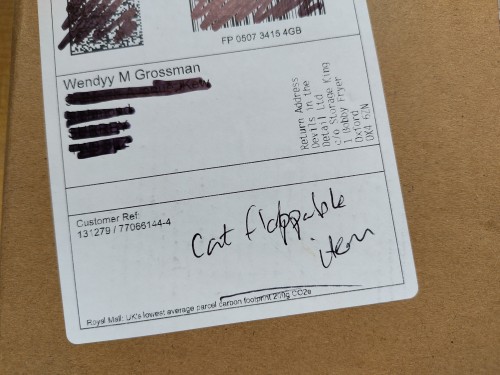
Illustrations: Sign of sentient life inside the post office.

Wendy M. Grossman is an award-winning journalist. Her Web site has an extensive archive of her books, articles, and music, and an archive of earlier columns in this series. She is a contributing editor for the Plutopia News Network podcast. Follow on Mastodon or Bluesky.
Mathslopocalypse

I once asked a specialist in a particularly obscure mathematical subdiscipline how many people in the world could understand her work. “Maybe 20 or 30,” she said. I thought it sounded lonely not to ever be able to explain to your closest friends and family what you did all day. And yet, within that small group math is a highly social discipline full of collaboration, even if the rest of the world doesn’t see it.

This is the opposite of OpenAI’s October 6 announcement that it had released a blob of 722 mathematical papers produced by a “frontier model” covering 372 longstanding open mathematical problems. Within a day, OpenAI retracted three and revised 14 more, according to Retraction Watch.

But this is only the beginning of assessing the collection. As Sharon Roberts reports at the New York Times, despite the “gut-punch” with which the papers have landed, none have been peer-reviewed. Many haven’t been formalized. Anecdotally, some that have been inspected by experts in the relevant fields are said to be unintelligibly written and unpublishable in traditional journals. I am willing to bet that a lot more will see similar fates. Anything looks smart when you’re not an expert in the field (known as the Murray Gell-Mann amnesia effect). Hence, “mathslopocalypse”, to the best of my knowledge coined by the mathematician and juggler Colin Wright. In any case, validating piles of AI-generated documents – a process very different from the authorial norm of follow-up discussions and explanations, as Evan Bush explains at NBC News.

This all follows shortly after OpenAI’s claim to have solved the Navier-Stokes $1 million Millennium prize problem, itself a still-active controversy. That solution is disputed by two mathematicians, Tristan Buckmaster and Levent Alpöge, who believe that OpenAI may have used the histories from their use of its Codex coding agent when throwing $15 million and 88 hours‘ worth of computing power at the problem.

At Gizmodo, Webb Wright commented that the move entirely changed the nature of competition in science: “With the Navier-Stokes solution controversy, we’ve entered a strange new era of scientific competition: one where humans compete not only with one another, but also with deep-pocketed tech companies wielding powerful AI models, hell-bent on being the first to tout major technical breakthroughs, and operating under the assumption that anything published on the open internet – and perhaps shared with their proprietary AI tools – is fair game.”

There is, Tim Fernholz explains at TechCrunch, “proof assistant” software called Lean that helps mathematicians check complex proofs for flaws. However, by itself that’s not enough, partly because, as Janelle L. Shane explained in her 2019 book, You Look Like a Thing and I Love You, these “AIs” seek the most direct path to the goal they’ve been assigned. People who like to anthropomorphize call this “cheating”. A better term is reward hacking. Either way, the threat is that AI models will adopt strategies for passing Lean’s tests that aren’t actually mathematically valid (see also: OpenAI’s models’ recent attacks on Hugging Face).

At YouTube, Grant Sanderson and Nishad Deulkar use the last problem AI couldn’t solve from the International Math Olympiad to provide a “motivated explanation” of how mathematicians reason through tricky problems. Generating proofs that don’t necessarily come with human understanding, Sanderson says, defeats the point. There and at Terence Tao’s blog, Sanderson argues that mathematicians need to reward motivated explanations and their role in advancing human reasoning more explicitly; proofs, which are easily counted by academic administrators, were only ever a proxy.

On Mastodon, preeminent mathematician Terence Tao is more succinct: “‘Math 1.0’ placed a premium on being the first to solve an open problem, even if the solution was not initially well understood. Now that this goal has been optimized to the point of unsustainability, ‘Math 2.0’ will need to decenter the role of raw problem solving and value mathematical progress more holistically – for instance by elevating the role of exposition, but also that of community building and opening up new directions of study.”

In other words, OpenAI’s massive release raises an existential question: what is mathematics for? In much of the media coverage, mathematicians say that the process and the insights gained along the way to developing a proof matter as much as the result in terms of continuing to build the edifice of knowledge. OpenAI’s infodump implies that the result is all that matters even if only a computer can use it. This idea led a participant in an online discussion to invoke Isaac Asimov’s 1956 story Jokester, in which only a select handful of Grand Master may direct scientific progress by asking questions of the giant “Multivac” computer while a larger group of analysts work feverishly to interpret the results. On X, David Bessis writes that “Mathematics is a critical infrastructure of human cognition. The human need for understanding isn’t obsolete and it can’t be offloaded to machines.”

OpenAI doesn’t have to care about math or critical infrastructures. Nor can the prize money be the motivator – even by the wonky standards of AI financing, spending $15 million to gain $1 million is absurd. More likely is the theory that OpenAI is dolling itself up for its upcoming IPO. In a statement, the Association for Human Mathematics says, “Releasing over 700 files at once is not a demonstration of scholarship, but a demonstration of power. ” Similarly, “They came for the glory without giving much back,” Hannah Fry writes at New Scientist. After all, if AI can do math it must be *really smart*.

Illustrations: Mathematicians at play: two Sierpinski tetrahedons and a might-be polar zonohedron built collaboratively at the 2026 Gathering 4 Gardner.

*Thanks to Colin Wright for the title and shared thoughts.

Wendy M. Grossman is an award-winning journalist. Her Web site has an extensive archive of her books, articles, and music, and an archive of earlier columns in this series. She is a contributing editor for the Plutopia News Network podcast. Follow on Mastodon or Bluesky.
What’s in a name

“They listen to us,” a character observes late in Alan Ayckbourn’s 92nd play, The Trial of Romeo Oscar. “They” are androids, and “we” are humans, and the character’s point is that while we’ve stopped listening to each other and to our heritage, androids are still learning us up. Which is all why – SPOILER ALERT! – when the search is on for an actor who can play Juliet the humans auditioning are all terrible and the only decent actress to be found is android Hermione Quinque (Olivia Woodhouse) currently serving drinks in the bar upstairs, lured to the performance by a promise that a top agent will be present. Actors!

The play is, in other words, a plea for the arts.

The plot, working from (possibly flawed) memory: it’s 2194, and soldier robot RSDO83 – Romeo Sierra Delta Oscar (Richard Stacey) – has been found severely water-damaged alongside a 13-year-old girl who has been stabbed to death on the otherwise desolate 11th moon of Uranus. Since the robot is somewhat functional – its audio system produces random selections from its memory that include recordings of orchestral classical music, nursery rhymes in a female voice, lines from Shakespeare – the presumption is that the robot must have murdered the girl and (human) engineer Devaney Dyer (Elizabeth Boag) is tasked with repairing it. A court is being assembled.

We meet Arbiter Jeffries (human, played by Russell Richardson), Assistant Arbiter Octo (android, Leigh Symonds), and defense lawyer Allistra Clay (Frances Marshall), who’s been jetted in from her home planet of Titan. She is second-generation on Titan, which in turn means she’s human, but a replicant, somehow “made” in a lab. So the characters trying to piece together what happened represent four distinct cultures: Jeffries nostalgically remembers prewar Earth; Devaney is a younger Earth-grown human for whom that’s all forgotten, Allistra is an exoplanet-created human for whom culture lives but history is censored, and Octo is an Earth-developed android who shares culture with Devaney but synthetic origins with Allistra.

Through their efforts to fill in each other’s gaps we learn the back story. A war on Earth saw many leave to colonize other planets and moons while the rest burrowed underground for safety. There is little left of the natural world, judging from the awe with which Allistra describes her visit to a tree museum. Government has collapsed in favor of big business ownership (as seen in smaller projects outlined in some parts of last week’s books.

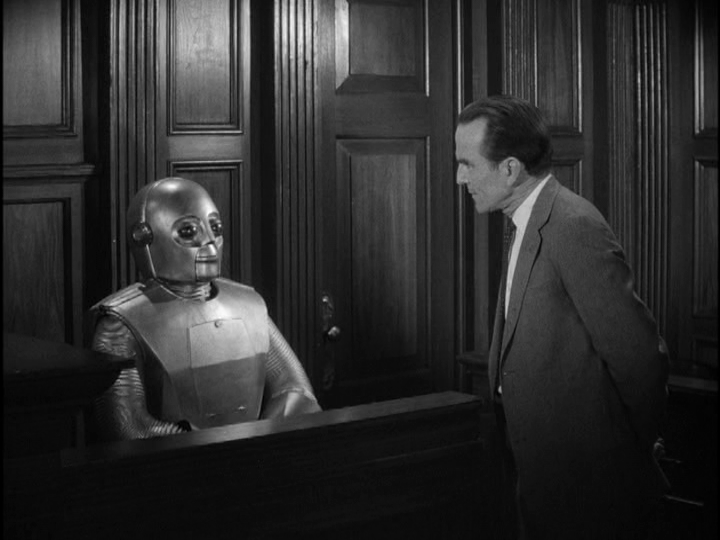
Within the confines of the play, Romeo Oscar’s trial is the first time in history that a robot has been tried for murder. In science fiction, of course, there is a long and rich history such as the 1964 The Outer Limits episode, I, Robot. In Ayckbourn’s play, an uprising has won androids workers’ rights and full citizenship. Hence RSDO83 must have a trial. So: did Romeo Oscar commit murder? Or, as Allistra contends, were he and 13-year-old Juliet, whom he raised from a baby, acting out Shakespeare’s play?

Ayckbourn’s play extensively quotes Shakespeare. It’s less easy to identify science fiction influences, though Octo cites a rule built into androids that rewords Isaac Asimov’s First Law of Robotics. The murder puzzle of the first act also evokes Asimov – his science fiction murder mysteries. Ayckbourn himself has long used science fictional elements: in 1987’s Henceforward, an exploitative artist adapts an android to his purposes in a dystopian future in which gangs dominate; in 1994’s Communicating Doors the door between two hotel rooms takes characters back and forward 20 years.

In a question-and-answer session after the performance, someone asked Ayckbourn if the play might see production elsewhere: “Straight theater in London is dead.” The West End now is a “bank of musicals” and the exceptions are “stunt casting” and/or runs limited to eight weeks. The open-ended runs that were once afforded to new work are gone, even in the theaters that do produce new straight plays. Yet live theater – especially in intimate in-the-round settings, small and regional theaters, or produced by amateurs in local communities – offers the connection many people say they crave after a decade and a half of staring at phones.

London’s West End is also suffering from the exclusionary effect of prices and corporate consolidation. In his 1968 book, The Season, the screenwriter William Goldman documented the beginning of this same change on Broadway, as costs spiraled and theater owners shifted from showmen to business managers. In 1976, you could sit at the back of the top balcony at a West End theater for £1; today that seat may cost £85. The shows sell out but it’s a very different audience. In an interview with Dominic Cavendish at the Telegraph two years ago, Ayckbourn blamed prices for making straight plays seem like poor value for money.

It’s more than 20 years since Ayckbourn’s plays routinely followed up their premieres in Scarborough with rims in London, even though his most famous earlier works see revivals such as this summer’s Old Vic eight-week production of 1969’s How the Other Half Loves. This explains why, when I read that his latest play was about a robot on trial for murder, I got on a train to Scarborough. It will tour in Bowness on Windermere and Stoke-on-Trent this month. And then that may be it.

Illustrations: District Attorney Thomas Coyle (Ford Rainey) questions robot Adam Link in the 1964 “I, Robot” episode of The Outer Limits.

Also this week:
– At the Plutopia podcast, we talk to Cory Doctorow about his latest book on corporate power and “reverse centaurs”.
– Also at the Plutopia podcast, we talk to Paulina Borsook about the reissue of her book, Cyberselfish.

Wendy M. Grossman is an award-winning journalist. Her Web site has an extensive archive of her books, articles, and music, and an archive of earlier columns in this series. She is a contributing editor for the Plutopia News Network podcast. Follow on Mastodon or Bluesky.

Return of the apocalypse

The summer of how-did-we-get-here? books continues with three more titles – and there are at least two more to come in the next month. This latest crop take broader views than the last few, which were mostlsy centered on Silicon Valley and written by people who live there.

In End Times Fascism and the Fight for the Living World, Naomi Klein and Astra Taylor treat the predations of billionaires as just one piece of a larger global turn to the right. They begin their tale at Davos and US president Donald Trump’s 2025 speech promoting New Gaza, a privately-owned model gated city built on the demolitions taking place as he spoke. As they acknowledge, Klein spotted spotted the exploitation of disasters as opportunities 20 years ago in The Shock Doctrine.

Although Klein and Taylor nod at a variety of other causes, they think technological rightward swing has been driven by the promise of reaching AGI (or superintelligence, or the Singularity, whatever you want to call it) even though the version of AI being pushed on us is, they say, “by far the worst offer in the history of capitalism”. They go on to consider possible responses across the range from billionaires’ escape fantasies to the kind of stay-in-place rethinking Zoltan Mamdani was elected to do.

By the end, when they’re proposing solutions, technology and the concentration of wealth are just two of their targets; they argue for the equivalent of disarmament. AI can be regulated, ordinary people deserve a voice in technological design, tools that would be dangerous in the hands of authoritarians should not exist, and the public sector needs to be restored. So does accountability. Finally, address the crises fascism feeds on. We have beaten it before; we can pick up that fight anew.

In the early days of the Internet, an American lawyer speculated that the Internet could enable an individual to change nationality without leaving home; governments, he surmised, could bid for citizens with services and opportunities. In today’s world of automated customer non-service, it’s obvious you’d never get the garbage picked up, but it was fun to think about.

In The Rise and Fall of the Artificial State, New Yorker writer and history professor Jill Lepore is chiefly concerned with the threat to democracy as it seemingly falls out of favor. Her “artificial state” is the automated, machine-driven administration that technology enables, starting with the desire to count and number the population. Mining the history of both science and science fiction, she traces our ideas about machine governance from fantasy to near-reality. Like Klein and Taylor, she doesn’t see all hope as lost. She advocates reconnecting to the natural world. Machines can’t save us if our planet is destroyed.

In a rare British entry, The Rulers: Corporate Power in the Age of AI and the Cloud, UCL economist Cecilia Rikap provides something new: a careful economic analysis from outside the US, focusing on knowledge rather than just markets. Using several different approaches to analyzing the power of a selected sample of the world’s biggest companies, she highlights three apex “knowledge predators”: Amazon, Google, and Microsoft.

That it’s those three seems a little surprising, but Rikap shows her work. She begins with an analysis based on a series of 2×2 matrices designed to measure different aspects of knowledge monpolization: research and development spend versus brand value; panopticon (the ability to monitor) versus owning a chokepoint; and her own derivation of intangible concentration vs networked concentration, which classifies intellectual monopolies. Apple, Amazon, and Microsoft show up in the plus-plus quadrant of all three. But so do some other companies; what makes these three special is that they dominate the cloud infrastructure that underpins so much else.

Rikap spends much of the book examining how we got here, characterizing intellectual monopolies as “knowledge predators”. Particularly notable among the trends she spots is the cooption of academics by Big Tech companies, which have swallowed up independent AI research. The AI we have, she writes, is the AI these companies want. She sees a similar trend in biomedical sciences, where companies focus on molecular biology approaches to cancer and cardiovascular disease at the expense of other conditions, including infectious diseases (until covid, at least).

Rikap also suggests that Silicon Valley’s reputation for fast-moving innovation is exaggerated. For all their presentation of themselves as risk-takers, all three of Google, Amazon, and Microsoft are, at their core, stable businesses (a former Googler used to say he worked for “an ad agency”). Even where they do innovate – like Google DeepMind’s Nobel prize-winning AlphaFold – the results don’t generally enhance their bottom lines.

Rikap concludes by examining solutions. None of competition law, regulation, or industrial policies has worked to curb this new type of monopoly. In her analysis, the only country to successfully buck US technological domination is China – but China has done it largely by imitating the US model. Changing nationality – for example, by building a European analog – will not matter. Instead, Rikap believes we must break up the intellectual monopolies by building public alternatives, perhaps starting with health care, and, ultimately, governing knowledge products as a public commons. Once upon a time, that was supposed to be the Internet.

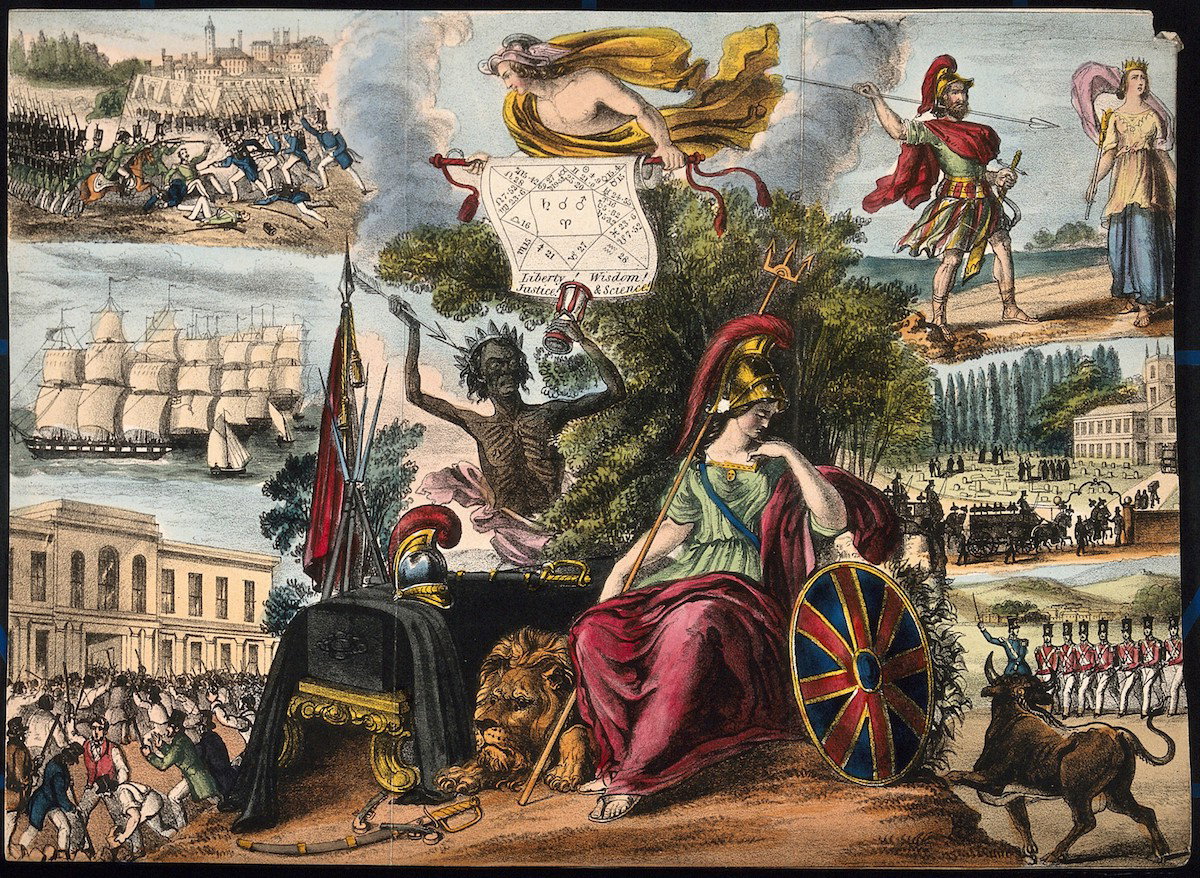
Illustrations: Prophecies of Apocalypse, from Raphael’s Almana, 1827-1861 (via Public Domain Review).

Wendy M. Grossman is an award-winning journalist. Her Web site has an extensive archive of her books, articles, and music, and an archive of earlier columns in this series. She is a contributing editor for the Plutopia News Network podcast. Follow on Mastodon or Bluesky.