Software is still forever

On October 14, a few months after the tenth anniversary of its launch, Microsoft will end support for Windows 10. That is, Microsoft will no longer issue feature or security updates or provide technical support, and everyone is supposed to either upgrade their computers to Windows 11 or, if Microsoft’s installer deems the hardware inadequate, replace them with newer models. People who “need more time”, in the company’s phrasing, can buy a year’s worth of security updates. Either way, Microsoft profits at our expense.

In 2014, Microsoft similarly end-of-lifed 13-year-old Windows XP. Then, many were unsympathetic to complaints about it; many thought it unreasonable to expect a company to maintain software for that long. Yet it was obvious even then that software lives on with or without support for far longer than people expect, and also that trashing millions of functional computers was stupidly wasteful. Microsoft is giving Windows 10 a *shorter* life, which is rather obviously the wrong direction for a planet drowning in electronic waste.

XP’s end came at a time when the computer industry was transitioning from adolescence to maturity. As long as personal computing was being constrained by the limited capabilities of hardware and research and development was improving them at a fast pace, a software company like Microsoft could count on frequent new sales. By 2014, that happy time had ended, and although computers continue to add power and speed, it’s not coming back. The same pattern has been repeated with phones, which no longer improve on an 18-month cycle as in the 2010s, and cameras.

For the vast majority, there’s no reason to replace their old machine unless a non-replaceable part is failing – and there should be less of that as manufacturers are forced to embrace repairability. Significantly, there’s less and less difference for many of us if we keep the old hardware and switch to Linux, eliminating Microsoft entirely.

Those fast-moving days were real obsolescence. What we have now is what we used to call “planned obsolescence”. That is, *forced* obsolescence that companies impose on us because it’s convenient and profitable for *them*.

This time round, people are more critical, not least because of the vast amounts of ewaste being generated. The Public Interest Research Group has written an open letter asking people to petition Microsoft to extend free support for Windows 10. As Ed Bott explains at ZDNet, you do have the option of kicking the can down the road by paying for updates for another three years.

The other antisocial side of terminating free security updates is that millions of those still-functional machines will remain in use, and will be increasingly insecure as new vulnerabilities are discovered and left unpatched.

Simultaneously, Windows is enshittifying; it’s harder to run Windows without a Microsoft login; avoid stupid gewgaws and unwanted news headlines, and turn off its “Copilot AI”. Tom Warren reports at The Verge that Microsoft wants to turn Copilot into an agent that can book restaurants and control its Edge browser. There are, it appears, ways to defeat all this in Windows 11, but for how long?

In a piece on solar technology, Doctorow outlines the process by which technology companies seize control once they can no longer rely on consumer demand to drive sales. They lock down their technology if they can, lock in customers, add advertising and block market entry claiming safety and/or security make it necessary. They write and lobby for legislation that enshrines their advantage. And they use technological changes to render past products obsolete. Many think this is the real story behind the insistence on forcing unwanted “AI” features into everything: it’s the one thing they can do to make their offerings sound new.

Seen in that light, the rush to build “AI” into everything becomes a rush to find a way to force people to buy new stuff. The problem is that – it feels like – most people don’t see much benefit in it, and go around turning off the AI features that are forced on them. Microsoft’s Recall feature, which takes a screen snapshot every few seconds, was so controversial at launch that the company rolled it back – for a while, anyway.

Carelessness about ewaste is everywhere, particularly with respect to the Internet of Things. This week: Logitech’s Pop smart home buttons. At least when Google ended support for older Nest thermostats they could go on working as “dumb” thermostats (which honestly seems like the best kind).

Ewaste is getting a whole lot worse when it desperately needs to be getting a whole lot better.

***

In the ongoing rollout of the Online Safety Act and age verification update, at 404 Media, Joseph Cox reports that Discord has become the first site reporting a hack of age verification data. Hackers have collected data pertaining to 70,000 users, including selfies, identity documents, email addresses, approximate residences, and so on, and are trying to extort Discord, which says the hackers breached one of its third-party vendors that handles age-related appeals. Security practitioners warned about this from the beginning.

In addition, Ofcom has launched a new consultation for the next round of Online Safety Act enforcement. Up next are livestreaming and algorithmic recommendations; the Open Rights Group has an explainer, as does lawyer Graham Smith. The consultation closes on October 20.

Illustrations: One use for old computers – movie stardom, as here in Brazil.

Wendy M. Grossman is an award-winning journalist. Her Web site has an extensive archive of her books, articles, and music, and an archive of earlier columns in this series. She is a contributing editor for the Plutopia News Network podcast. Follow on Mastodon or Bluesky.

Undue process

To the best of my knowledge, Imgur is the first mainstream company to quit the UK in response to the Online Safety Act (though many US news sites remain unavailable due to 2018’s General Data Protection Regulation. Widely used to host pictures for reuse on web forums and social media, Imgur shut off UK connections on Tuesday. In a statement on Wednesday, the company said UK users can still exercise their data protection rights. That is, Imgur will reply within the statutory timeframe to requests for copies of our data or for the account to be deleted.

In this case, the push came from the Information Commissioner’s Office. In a statement, the ICO explains that on September 10 it notified Imgur’s owner, MediaLab AI of its provisional findings from its previously announced investigation into “how the company uses children’s information and its approach to age assurance”. The ICO proposed to fine Imgur. Imgur promptly shut down UK access. The ICO’s statement says departure changes nothing: “We have been clear that exiting the UK does not allow an organisation to avoid responsibility for any prior infringement of data protection law, and our investigation remains ongoing.”

The ICO calls Imgur’s departure “a commercial decision taken by the company”. While that’s true, EU and UK residents have dealt for years with unwanted cookie consent banners because companies subject to data protection laws have engaged in malicious compliance intended to spark a rebellion against the law. So: wash.

Many individual users stick to Imgur’s free tier, but it profits from subscriptions and advertising. MediaLab AI bought it in 2021, and uses it as a platform to mount advertising campaigns at scale for companies like Kraft-Heinz and Alienware.

Meanwhile, UK users’ Imgur accounts are effectively hostages. We don’t want lawless companies. We also don’t want bad laws – or laws that are badly drafted and worse implemented. Children’s data should be protected – but so should everyone’s. There remains something fundamentally wrong with having a service many depend upon yanked with no notice.

Companies’ threats to leave the market rather than comply with the law are often laughable – see for example Apple’s threat to leave the EU if it doesn’t repeal the Digital Markets Act. This is the rare occasion when a company has actually done it (although presumably they can turn access back on at any time). If there’s a lesson here, it may be that without EU membership Britain is now too small for foreign companies to bother complying with its laws.

***

Boundary disputes and due process are also the subject of a lawsuit launched in the US against Ofcom. At the end of August, 4chan and Kiwi Farms filed a complaint in a Washington, DC federal court against Ofcom, claiming the regulator is attempting to censor them and using the OSA to “target the free speech rights of Americans”.

We hear less about 4chan these days, but in his book The Other Pandemic, journalist James Ball traces much of the spread of QAnon and other conspiracy theories to the site. In his account, these memes start there, percolate through other social media, and become mainstream and monetized on YouTube. Kiwi Farms is equally notorious for targeted online and offline harassment.

The argument mooted by the plaintiffs’ lawyer Preston Byrne is that their conduct is lawful within the jurisdictions where they’re based and that UK and EU countries seeking to enforce their laws should do so through international treaties and courts. There’s some precedent to the first bit, albeit in a different context. In 2010. the New York State legislature and then the US Congress passed the Libel Tourism Protection Act. Under it, US courts are prevented from enforcing British libel judgments if the rulings would not stand in a US court. The UK went on to modify its libel laws in 2013.

Any country has the sovereignty to demand that companies active within its borders comply with its laws, even laws that are widely opposed, and to punish them if they don’t, which is another thing 4chan’s lawyers are complaining about. The question the Internet has raised since the beginning (see also the Apple case and, before it the 1996 case United States v. Thomas) is where the boundary is and how it can be enforced. 4chan is trying to argue that the penalties Ofcom provisionally intends to apply are part of a campaign of targeted harassment of US technology companies. Odd to see *4chan* adopting the technique long ago advocated by staid, old IBM: when under attack, wrap yourself in the American flag.

***

Finally, in the consigned-to-history category, AOL shut down dialup on September 30. I recall traveling with a file of all of the dialup numbers the even earlier service, CompuServe maintained around the world. It was, in its time, a godsend. (Then AOL bought up the service, its biggest competitor before the web, and shut it down, seemingly out of spite.) For this reason, my sympathies are with the 124,000 US users the US Census Bureau says still rely on dial-up – only a few thousand of them were paying for AOL, per CNBC – and the uncounted others elsewhere. It’s easy to forget when you’re surrounded by wifi and mobile connections that Internet access remains hard for many people.

Elsewhere this week: Childproofing the Internet, at Skeptical Inquirer.

Illustrations: Imgur’s new UK home page.

Wendy M. Grossman is an award-winning journalist. Her Web site has an extensive archive of her books, articles, and music, and an archive of earlier columns in this series. She is a contributing editor for the Plutopia News Network podcast. Follow on Mastodon or Bluesky.

Big bang

In 2008, when the recording industry was successfully lobbying for an extension to the term of copyright to 95 years, I wrote about a spectacular unfairness that was affecting numerous folk and other musicians. Because of my own history and sometimes present with folk music, I am most familiar with this area of music, which aside from a few years in the 1960s has generally operated outside of the world of commercial music.

The unfairness was this: the remnants of a label that had recorded numerous long-serving and excellent musicians in the 1970s were squatting on those recordings and refusing to either rerelease them or return the rights. The result was both artistic frustration and deprivation of a sorely-needed source of revenue.

One of these musicians is the Scottish legend Dick Gaughan, who had a stroke in 2016 and was forced to give up performing. Gaughan, with help from friends, is taking action: a GoFundMe is raising the money to pay “serious lawyers” to get his rights back. Whether one loved his early music or not – and I regularly cite Gaughan as an important influence on what I play – barring him from benefiting from his own past work is just plain morally wrong. I hope he wins through; and I hope the case sets a precedent that frees other musicians’ trapped work. Copyright is supposed to help support creators, not imprison their work in a vault to no one’s benefit.

***

This has been the first week of requiring age verification for access to online content in the UK; the law came into effect on July 25. Reddit and Bluesky, as noted here two weeks ago, were first, but with Ofcom starting enforcement, many are following. Some examples: Spotify; X (exTwitter); Pornhub.

Two classes of problems are rapidly emerging: technical and political. On the technical side, so far it seems like every platform is choosing a different age verification provider. These AVPs are generally unfamiliar companies in a new market, and we are being asked to trust them with passports, driver’s licenses, credit cards, and selfies for age estimation. Anyone who uses multiple services will find themselves having to widely scatter this sensitive information. The security and privacy risks of this should be obvious. Still, Dan Malmo reports at the Guardian that AVPs are already processing five million age checks a day. It’s not clear yet if that’s a temporary burst of one-time token creation or a permanently growing artefact of repetitious added friction, like cookie banners.

X says it will examine users’ email addresses and contact books to help estimate ages. Some systems reportedly send referring page links, opening the way for the receiving AVP to store these and build profiles. Choosing a trustworthy VPN can be tricky, and these intermediaries are in a position to log what you do and exploit the results.

The BBC’s fact-checking service finds that a wide range of public interest content, including news about Ukraine and Gaza and Parliamentary debates, is being blocked on Reddit and X. Sex workers see adults being locked out of legal content.

Meanwhile, many are signing up for VPNs at pace, as predicted. The spike has led to rumors that the government is considering banning them. This seems unrealistic: many businesses rely on VPNs to secure connections for remote workers. But the idea is alarming; its logical extension is the war on general-purpose computation Cory Doctorow foresaw as a consequence of digital rights management in 2011. A terrible and destructive policy can serve multiple masters’ interests and is more likely to happen if it does.

On the political side, there are three camps. One wants the legislation repealed. Another wants to retain aspects many people agree on, such criminalizing cyberflashing and some other types of online abuse, and fix its flaws. The third thinks the OSA doesn’t go far enough, and they’re already saying they want it expanded to include all services, generative AI, and private messaging.

More than 466,000 people have signed a petition calling on the government to repeal the OSA. The government responded: thanks, but no. It will “work with Ofcom” to ensure enforcement will be “robust but proportionate”.

Concrete proposals for fixing the OSA’s worst flaws are rare, but a report from the Open Rights Group offers some; it advises an interoperable system that gives users choice and control over methods and providers. Age verification proponents often compare age-gating websites to ID checks in bars and shops, but those don’t require you to visit a separate shop the proprietor has chosen and hand over personal information. At Ctrl-Shift, Kirra Pendergast explains some of the risks.

Surrounding all that is noise. A US lawyer wants to sue Ofcom in a US federal court (huh?). Reform leader Nigel Farage has called for the Act’s repeal, which led technology secretary Peter Kyle to accuse him – and then anyone else who criticizes the act – of being on the side of sexual predators. Kyle told Mumsnet he apologizes to the generation of UK kids who were “let down” by being exposed to toxic online content because politicians failed to protect them all this time. “Never again…”

In other news, this government has lowered the voting age to 16.

Illustrations: The back cover of Dick Gaughan’s out-of-print 1972 first album, No More Forever.

Wendy M. Grossman is an award-winnning journalist. Her Web site has an extensive archive of her books, articles, and music, and an archive of earlier columns in this series. She is a contributing editor for the Plutopia News Network podcast. Follow on Mastodon or Bluesky.

A thousand small safety acts

“The safest place in the world to be online.”

I think I remember that slogan from Tony Blair’s 1990s government, when it primarily related to ecommerce. It morphed into child safety – for example, in 2010, when the first Digital Economy Act was passed, or 2017, when the Online Safety Act, passed in 2023 and entering into force in March 2025, was but a green paper. Now, Ofcom is charged with making it reality.

As prior net.wars posts attest, the 2017 green paper began with the idea that social media companies could be forced to pay, via a levy, for the harm they cause. The key remaining element of that is a focus on the large, dominant companies. The green paper nodded toward designing proportionately for small businesses and startups. But the large platforms pull the attention: rich, powerful, and huge. The law that’s emerged from these years of debate takes in hundreds of thousands of divergent services.

On Mastodon, I’ve been watching lawyer Neil Brown scrutinize the OSA with a particular eye on its impact on the wide ecosystem of what we might call “the community Internet” – the thousands of web boards, blogs, chat channels, and who-knows-what-else with no business model because they’re not businesses. As Brown keeps finding in his attempts to help provide these folks with tools they can use are struggling to understand and comply with the act.

First things first: everyone agrees that online harm is bad. “Of course I want people to be safe online,” Brown says. “I’m lucky, in that I’m a white, middle-aged geek. I would love everyone to have the same enriching online experience that I have. I don’t think the act is all bad.” Nonetheless, he sees many problems with both the act itself and how it’s being implemented. In contacts with organizations critiquing the act, he’s been surprised to find how many unexpectedly agree with him about the problems for small services. However, “Very few agreed on which was the worst bit.”

Brown outlines two classes of problem: the act is “too uncertain” for practical application, and the burden of compliance is “too high for insufficient benefit”.

Regarding the uncertainty, his first question is, “What is a user?” Is someone who reads net.wars a user, or just a reader? Do they become a user if they post a comment? Do they start interacting with the site when they read a comment, make a comment, or only when they comment to another user’s comment? In the fediverse, is someone who reads postings he makes via his private Mastodon instance its user? Is someone who replies from a different instance to that posting a user of his instance?

His instance has two UK users – surely insignificant. Parliament didn’t set a threshold for the “significant number of UK users” that brings a service into scope, so Ofcom says it has no answer to that question. But if you go by percentage, 100% of his user base is in Britain. Does that make Britain his “target market”? Does having a domain name in the UK namespace? What is a target market for the many community groups running infrastructure for free software projects? They just want help with planning, or translation; they’re not trying to sign up users.

Regarding the burden, the act requires service providers to perform a risk assessment for every service they run. A free software project will probably have a dozen or so – a wiki, messaging, a documentation server, and so on. Brown, admittedly not your average online participant, estimates that he himself runs 20 services from his home. Among them is a photo-sharing server, for which the law would have him write contractual terms of service for the only other user – his wife.

“It’s irritating,” he says. “No one is any safer for anything that I’ve done.”

So this is the mismatch. The law and Ofcom imagine a business with paid staff signing up users to profit from them. What Brown encounters is more like a stressed-out woman managing a small community for fun after she puts the kids to bed.

Brown thinks a lot could be done to make the act less onerous for the many sites that are clearly not the problem Parliament was trying to solve. Among them, carve out low-risk services. This isn’t just a question of size, since a tiny terrorist cell or a small ring sharing child sexual abuse material can pose acres of risk. But Brown thinks it shouldn’t be too hard to come up with criteria to rule services out of scope such as a limited user base coupled with a service “any reasonable person” would consider low risk.

Meanwhile, he keeps an In Memoriam list of the law’s casualties to date. Some have managed to move or find new owners; others are simply gone. Not on the list are non-UK sites that now simply block UK users. Others, as Brown says, just won’t start up. The result is an impoverished web for all of us.

“If you don’t want a web dominated by large, well-lawyered technology companies,” Brown sums up, “don’t create a web that squeezes out small low-risk services.”

Illustrations: Early 1970s cartoon illustrating IT project management.

Wendy M. Grossman is an award-winning journalist. Her Web site has extensive links to her books, articles, and music, and an archive of earlier columns in this series. She is a contributing editor for the Plutopia News Network podcast. Follow on Mastodon or Bluesky.

The lost Internet

As we open 2025 it would be traditional for an Old Internet Curmudgeon to rhapsodize about the good, old days of the 1990s, when the web was open, snark flourished at sites like suck.com, no one owned social media (that is, Usenet and Internet Relay Chat), and even the spam was relatively harmless.

But that’s not the period I miss right now. By “lost” I mean the late 2000s, when we shifted from an Internet of largely unreliable opinions to an Internet full of fact-based sites you could trust. This was the period during which Wikipedia (created 2001) grew up, and Open Street Map (founded 2004) was born, joining earlier sites like the Internet Archive (founded 1996) and Snopes (1994). In that time, Google produced useful results, blogs flourished, and before it killed them if you asked on Twitter for advice on where to find a post box near a point in Liverpool you’d get correct answers straight to your mobile phone.

Today, so far: I can’t get a weather app to stop showing the location I was at last week and show the location I’m at this week. Basically, the app is punishing me for not turning on location tracking. The TV remote at my friend’s house doesn’t fully work and she doesn’t know why or how to fix it; she works around it with a second remote whose failings are complementary. No calendar app works as well as the software I had 1995-2001 (it synced! without using a cloud server and third-party account!). At the supermarket, the computer checkout system locked up. It all adds up to a constant white noise of frustration.

We still have Wikipedia, Open Street Map, Snopes, and the Internet Archive. But this morning a Mastodon user posted that their ten-year-old says you can’t trust Google any more: “It just returns ‘a bunch of madeup stuff’.” When ten-year-olds know your knowledge product sucks…

If generative AI were a psychic we’d call what it does cold reading.

At his blog, Ed Zitron has published a magnificent, if lengthy, rant on the state ot technology. “The rot economy”, he calls it, and says we’re all victims of constant low-level trauma. Most of his complaints will be familiar: the technologies we use are constantly shifting and mostly for the worse. My favorite line: “We’re not expected to work out ‘the new way to use a toilet’ every few months because somebody decided we were finishing too quickly.”

Pause to remember nostalgically 2018, when a friend observed that technology wasn’t exciting any more and 2019, when many more people thought the Internet was no longer “fun”. Those were happy days. Now we are being overwhelmed with stuff we actively don’t want in our lives. Even hacked Christmas lights sound miserable for the neighbors.

***

I have spent some of these holidays editing a critique of Ofcom’s regulatory plans under the Online Safety Act (we all have our own ideas about holidays), and one thing seems clear: the splintering Internet is only going to get worse.

Yesterday, firing up Chrome because something didn’t work in Firefox, I saw a fleeting popup to the effect that because I may not be over 18 there are search results Google won’t show me. I don’t think age verification is in force in the Commonwealth of Pennsylvania – US states keep passing bills, but hit legal challenges.

Age verification has been “imminent” in the UK for so long – it was originally included in the Digital Economy Act 2017 – that it seems hard to believe it may actually become a reality. But: sites within the Act’s scope will have to complete an “illegal content risk assessment” by March 16. So the fleeting popup felt like a visitation from the Ghost of Christmas Future.

One reason age verification was dropped back then – aside from the distractions of Brexit – was that the mechanisms for implementing it were all badly flawed – privacy-invasive, ineffective, or both. I’m not sure they’ve improved much. In 2022, France’s data protection watchdog checked them out: “CNIL finds that such current systems are circumventable and intrusive, and calls for the implementation of more privacy-friendly models.”

I doubt Ofcom can square this circle, but the costs of trying will include security, privacy, freedom of expression, and constant technological friction. Bah, humbug.

***

Still, one thing is promising: the rise of small, independent media outlets wbo are doing high-quality work. Joining established efforts like nine-year-old The Ferret, ten-year-old Bristol Cable, and five-year-old Rest of World are year-and-a-half-old 404 Media and newcomer London Centric. 404Media, formed by four journalists formerly at Vice’s Motherboard, has been consistently making a splash since its founding; this week Jason Koebler reminds that Elon Musk’s proactive willingness to unlock the blown-up cybertruck in Las Vegas and provide comprehensive data on where it’s been, including video from charging stations, without warrant or court order, could apply to any Tesla customer at any time. Meanwhile, in its first three months London Centric’s founding journalist, Jim Waterson, has published pieces on the ongoing internal mess at Transport for London resulting from the August cyberattack and bicycle theft in the capital. Finally, if you’re looking for high-quality American political news, veteran journalist Dan Gillmore curates it for you every day in his Cornerstone of Democracy newsletter.

The corporate business model of journalism is inarguably in trouble, but journalism continues.

Happy new year.

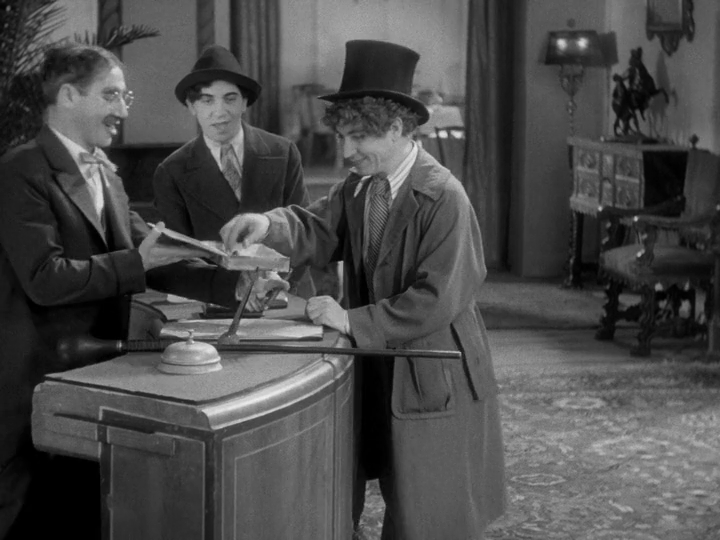
Illustrations: The Marx Brothers in their 1929 film, The Cocoanuts, newly released into the public domain.

Wendy M. Grossman is the 2013 winner of the Enigma Award. Her Web site has an extensive archive of her books, articles, and music, and an archive of earlier columns in this series. She is a contributing editor for the Plutopia News Network podcast. Follow on Mastodon or Bluesky.