Big bang

In 2008, when the recording industry was successfully lobbying for an extension to the term of copyright to 95 years, I wrote about a spectacular unfairness that was affecting numerous folk and other musicians. Because of my own history and sometimes present with folk music, I am most familiar with this area of music, which aside from a few years in the 1960s has generally operated outside of the world of commercial music.

The unfairness was this: the remnants of a label that had recorded numerous long-serving and excellent musicians in the 1970s were squatting on those recordings and refusing to either rerelease them or return the rights. The result was both artistic frustration and deprivation of a sorely-needed source of revenue.

One of these musicians is the Scottish legend Dick Gaughan, who had a stroke in 2016 and was forced to give up performing. Gaughan, with help from friends, is taking action: a GoFundMe is raising the money to pay “serious lawyers” to get his rights back. Whether one loved his early music or not – and I regularly cite Gaughan as an important influence on what I play – barring him from benefiting from his own past work is just plain morally wrong. I hope he wins through; and I hope the case sets a precedent that frees other musicians’ trapped work. Copyright is supposed to help support creators, not imprison their work in a vault to no one’s benefit.

***

This has been the first week of requiring age verification for access to online content in the UK; the law came into effect on July 25. Reddit and Bluesky, as noted here two weeks ago, were first, but with Ofcom starting enforcement, many are following. Some examples: Spotify; X (exTwitter); Pornhub.

Two classes of problems are rapidly emerging: technical and political. On the technical side, so far it seems like every platform is choosing a different age verification provider. These AVPs are generally unfamiliar companies in a new market, and we are being asked to trust them with passports, driver’s licenses, credit cards, and selfies for age estimation. Anyone who uses multiple services will find themselves having to widely scatter this sensitive information. The security and privacy risks of this should be obvious. Still, Dan Malmo reports at the Guardian that AVPs are already processing five million age checks a day. It’s not clear yet if that’s a temporary burst of one-time token creation or a permanently growing artefact of repetitious added friction, like cookie banners.

X says it will examine users’ email addresses and contact books to help estimate ages. Some systems reportedly send referring page links, opening the way for the receiving AVP to store these and build profiles. Choosing a trustworthy VPN can be tricky, and these intermediaries are in a position to log what you do and exploit the results.

The BBC’s fact-checking service finds that a wide range of public interest content, including news about Ukraine and Gaza and Parliamentary debates, is being blocked on Reddit and X. Sex workers see adults being locked out of legal content.

Meanwhile, many are signing up for VPNs at pace, as predicted. The spike has led to rumors that the government is considering banning them. This seems unrealistic: many businesses rely on VPNs to secure connections for remote workers. But the idea is alarming; its logical extension is the war on general-purpose computation Cory Doctorow foresaw as a consequence of digital rights management in 2011. A terrible and destructive policy can serve multiple masters’ interests and is more likely to happen if it does.

On the political side, there are three camps. One wants the legislation repealed. Another wants to retain aspects many people agree on, such criminalizing cyberflashing and some other types of online abuse, and fix its flaws. The third thinks the OSA doesn’t go far enough, and they’re already saying they want it expanded to include all services, generative AI, and private messaging.

More than 466,000 people have signed a petition calling on the government to repeal the OSA. The government responded: thanks, but no. It will “work with Ofcom” to ensure enforcement will be “robust but proportionate”.

Concrete proposals for fixing the OSA’s worst flaws are rare, but a report from the Open Rights Group offers some; it advises an interoperable system that gives users choice and control over methods and providers. Age verification proponents often compare age-gating websites to ID checks in bars and shops, but those don’t require you to visit a separate shop the proprietor has chosen and hand over personal information. At Ctrl-Shift, Kirra Pendergast explains some of the risks.

Surrounding all that is noise. A US lawyer wants to sue Ofcom in a US federal court (huh?). Reform leader Nigel Farage has called for the Act’s repeal, which led technology secretary Peter Kyle to accuse him – and then anyone else who criticizes the act – of being on the side of sexual predators. Kyle told Mumsnet he apologizes to the generation of UK kids who were “let down” by being exposed to toxic online content because politicians failed to protect them all this time. “Never again…”

In other news, this government has lowered the voting age to 16.

Illustrations: The back cover of Dick Gaughan’s out-of-print 1972 first album, No More Forever.

Wendy M. Grossman is an award-winnning journalist. Her Web site has an extensive archive of her books, articles, and music, and an archive of earlier columns in this series. She is a contributing editor for the Plutopia News Network podcast. Follow on Mastodon or Bluesky.

Cautionary tales

I’ve been online for nearly 34 years, and I’m thinking of becoming a child. Or at least, a child to big user-to-user social media services, which next week will start asking for proof of adulthood. On July 25, the new age verification requirements under the Online Safety Act come into effect in the UK. The regulator, Ofcom, has published a guide.

Plenty of companies aim to join this new market. Some are familiar: credit scorers Experian and Transunion. Others are new: Yoti, which we saw demonstrated back in 2016, and Sam Altman and Andreessen Horowitz-backed six-year-old startup World, which recently did a promotional tour for the UK launch of its Orb identification system. Summary: many happy privacy words, but still dubious.

Reddit picked Persona; Dearbail Jordan at the BBC says Redditors will need to upload either a selfie for age estimation or a government-issued ID. Reddit says it will not see this data, only storing each user’s verification status along with the birth date they’ve (optionally) provided.

Bluesky has chosen Kids’ Web Services from Epic Games. The announcement says KWS accepts multiple options: payment cards, ID scans, and face scans. Users who decline to supply this information will be denied access to adult content and direct messaging. How much do I care about either? Would I rather just be a child to two-year-old Bluesky?

On older sites my adulthood ought to be obvious: I joined Twitter/X in 2008 and Reddit in 2015. Do the math, guys! I suppose there is a chance I could have created the account, forgotten it, and then revived it for a child (the “older brother problem”), but I’m not sure these third-party verifiers solve that either.

Everyone wants to protect children. But it doesn’t make sense to do it by creating a system that exposes everyone, including children, to new privacy risks. In its report on how to fix the OSA, the Open Rights Group argues that interoperability and portability should be first principles, and that users should be able to choose providers and methods. Today, the social media companies don’t see age verification data; in five years will they be buying up those providers? These first steps matter, as they are setting the template for what is to come.

This is the opening of a floodgate. On June 27 the US Supreme Court ruled in Free Speech Coalition v. Paxton to uphold a law requiring pornographic websites to verify users’ ages through government-issued ID. At TechDirt, Mike Masnick called the ruling taking a chainsaw to the First Amendment.

It’s easy to predict that here will be scandals surrounding the data age verifiers collect, and others where technological failures let children access the wrong sort of content. We’ll hear less about the frustrations of people who are blocked by age verification from essential information. Meanwhile, child safety folks will continue pushing for new levels of control.

The big question is this: how will we know if it’s working? What does “success” look like?

***

At Platformer, Casey Newton covers Substack’s announcement that it has closed series C funding round of $100 million, valuing the company at $1.1 billion. The eight-year-old company gets to say it’s a unicorn.

Newton tries to understand how Substack is worth that. He predicts – logically – that its only choice to justify its venture capitalists’ investment will be rampant enshittification. These guys don’t put in that kind of money without expecting a full-bore return, which is why Newton is dubious about the founders’ promise to invest most of that newly-raised capital in creators. Recall the stages Cory Doctorow laid out: first they amass as many users as possible; then they abuse those users to amass as many business customers (advertisers) as possible; then they squeeze everyone.

Substack, which announced four months ago that it – or, more correctly, its creators – has more than 5 million paid subscriptions, is different in that its multi-sided market structure is more like Uber or Amazon Marketplace than like a social media site or traditional publisher. It has users (readers and listeners), creators (like Uber’s drivers or Amazon’s sellers), and customers (advertisers). Viewed that way, it’s easy to see Substack’s most likely path: raise prices (users and advertisers), raise thresholds and commissions (creators), and, like Amazon, force sellers (creators) into using fee-based additional services in order to stay afloat. Plus, it must crush the competition. See similar math from Anil Dash.

Less ponderable is the headwind of Substack’s controversial hospitality to extremists, noted in 2023 by Jonathan Katz at The Atlantic. Some creators – like Newton – have opted to leave for competitor Ghost, which is both open source and cheaper. Many friends refuse to pay Substack even when they want to support creators whose work they admire. At the time, Stephen Bush responded at the Financial Times that Substack should admit that it’s not a publisher but a “handy bit of infrastructure for sending newsletters”. Is that worth $1.1 billion?

Like earlier Silicon Valley companies, Substack is planning to reverse its previous disdain for advertising, as Benjamin Mullin and Jessica Testa report at the New York Times. The company is apparently also looking forward to embracing social networking.

So, no really new ideas, then?

Illustrations: Unicorn (by Pearson Scott Foresman via Wikimedia.

Wendy M. Grossman is an award-winning journalist. Her Web site has an extensive archive of her books, articles, and music, and an archive of earlier columns in this series. She is a contributing editor for the Plutopia News Network podcast. Follow on Mastodon or Bluesky.

The lost Internet

As we open 2025 it would be traditional for an Old Internet Curmudgeon to rhapsodize about the good, old days of the 1990s, when the web was open, snark flourished at sites like suck.com, no one owned social media (that is, Usenet and Internet Relay Chat), and even the spam was relatively harmless.

But that’s not the period I miss right now. By “lost” I mean the late 2000s, when we shifted from an Internet of largely unreliable opinions to an Internet full of fact-based sites you could trust. This was the period during which Wikipedia (created 2001) grew up, and Open Street Map (founded 2004) was born, joining earlier sites like the Internet Archive (founded 1996) and Snopes (1994). In that time, Google produced useful results, blogs flourished, and before it killed them if you asked on Twitter for advice on where to find a post box near a point in Liverpool you’d get correct answers straight to your mobile phone.

Today, so far: I can’t get a weather app to stop showing the location I was at last week and show the location I’m at this week. Basically, the app is punishing me for not turning on location tracking. The TV remote at my friend’s house doesn’t fully work and she doesn’t know why or how to fix it; she works around it with a second remote whose failings are complementary. No calendar app works as well as the software I had 1995-2001 (it synced! without using a cloud server and third-party account!). At the supermarket, the computer checkout system locked up. It all adds up to a constant white noise of frustration.

We still have Wikipedia, Open Street Map, Snopes, and the Internet Archive. But this morning a Mastodon user posted that their ten-year-old says you can’t trust Google any more: “It just returns ‘a bunch of madeup stuff’.” When ten-year-olds know your knowledge product sucks…

If generative AI were a psychic we’d call what it does cold reading.

At his blog, Ed Zitron has published a magnificent, if lengthy, rant on the state ot technology. “The rot economy”, he calls it, and says we’re all victims of constant low-level trauma. Most of his complaints will be familiar: the technologies we use are constantly shifting and mostly for the worse. My favorite line: “We’re not expected to work out ‘the new way to use a toilet’ every few months because somebody decided we were finishing too quickly.”

Pause to remember nostalgically 2018, when a friend observed that technology wasn’t exciting any more and 2019, when many more people thought the Internet was no longer “fun”. Those were happy days. Now we are being overwhelmed with stuff we actively don’t want in our lives. Even hacked Christmas lights sound miserable for the neighbors.

***

I have spent some of these holidays editing a critique of Ofcom’s regulatory plans under the Online Safety Act (we all have our own ideas about holidays), and one thing seems clear: the splintering Internet is only going to get worse.

Yesterday, firing up Chrome because something didn’t work in Firefox, I saw a fleeting popup to the effect that because I may not be over 18 there are search results Google won’t show me. I don’t think age verification is in force in the Commonwealth of Pennsylvania – US states keep passing bills, but hit legal challenges.

Age verification has been “imminent” in the UK for so long – it was originally included in the Digital Economy Act 2017 – that it seems hard to believe it may actually become a reality. But: sites within the Act’s scope will have to complete an “illegal content risk assessment” by March 16. So the fleeting popup felt like a visitation from the Ghost of Christmas Future.

One reason age verification was dropped back then – aside from the distractions of Brexit – was that the mechanisms for implementing it were all badly flawed – privacy-invasive, ineffective, or both. I’m not sure they’ve improved much. In 2022, France’s data protection watchdog checked them out: “CNIL finds that such current systems are circumventable and intrusive, and calls for the implementation of more privacy-friendly models.”

I doubt Ofcom can square this circle, but the costs of trying will include security, privacy, freedom of expression, and constant technological friction. Bah, humbug.

***

Still, one thing is promising: the rise of small, independent media outlets wbo are doing high-quality work. Joining established efforts like nine-year-old The Ferret, ten-year-old Bristol Cable, and five-year-old Rest of World are year-and-a-half-old 404 Media and newcomer London Centric. 404Media, formed by four journalists formerly at Vice’s Motherboard, has been consistently making a splash since its founding; this week Jason Koebler reminds that Elon Musk’s proactive willingness to unlock the blown-up cybertruck in Las Vegas and provide comprehensive data on where it’s been, including video from charging stations, without warrant or court order, could apply to any Tesla customer at any time. Meanwhile, in its first three months London Centric’s founding journalist, Jim Waterson, has published pieces on the ongoing internal mess at Transport for London resulting from the August cyberattack and bicycle theft in the capital. Finally, if you’re looking for high-quality American political news, veteran journalist Dan Gillmore curates it for you every day in his Cornerstone of Democracy newsletter.

The corporate business model of journalism is inarguably in trouble, but journalism continues.

Happy new year.

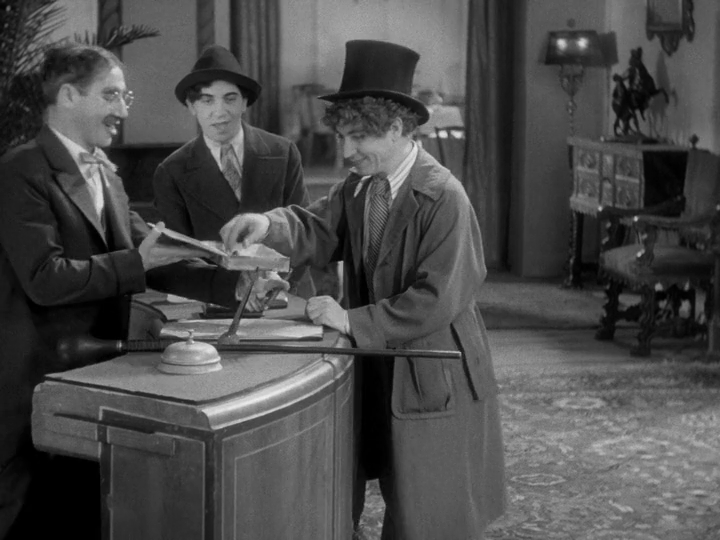
Illustrations: The Marx Brothers in their 1929 film, The Cocoanuts, newly released into the public domain.

Wendy M. Grossman is the 2013 winner of the Enigma Award. Her Web site has an extensive archive of her books, articles, and music, and an archive of earlier columns in this series. She is a contributing editor for the Plutopia News Network podcast. Follow on Mastodon or Bluesky.