Two things you can never get back: time and teeth.
The proliferation of refund fraud means that before sending you a refund, the US Internal Revenue Service requires you to verify your tax return. The IRS letter directs you online – first to verify your identity via a third party commercial company called id.me and *then* to verify the return at the IRS site. I had to do the personal part of this via video call. This meant first typing in a load of details I wouldn’t normally disclose on a first date, then a 20-minute wait until an obviously bored human avatar got on the call and had me hold up the various documents. Only then could I proceed to the IRS site to answer questions like “what number appears on line 31a?”
Shadow work, to be sure. Like others, I’m worried about the potential consequences of being a data hostage to this unknown company at government behest. But first…we talk very little about the hours we all spend doing stuff like this because so many trust mechanisms are broken. A recent essay – which I cannot now find – complained about “time thieves”. A recent essay that I *can* find, The Last Quiet Thing, talked about the labor imposed on us by modern devices that require constant tending – smart watches, for example. The same author, Terry Godier, has followed up more recently with Phantom Obligation, which highlights interface design choices intended to make us feel guilty if we’re not keeping up – with social media and RSS feeds, emails, and so on. Godbier traces the beginning of this to answering machines, whose blinking lights imposed an obligation that previously did not exist. “Phantom” obligations, because in the case of social media and RSS, no one is really waiting for your response.
Ignoring all that is easy stuff for someone who discovered her ability to let a phone ring without answering in 1972, even before answering machines. Much less ignorable, however, is the web’s constantly-growing thicket of anti-robot tests: captchas, verification tests (which my instance of Firefox routinely sends into an infinite loop), and so on. In 2018, the comedian John Mulaney noted how much of the day we spend proving to robots that we are *not* robots – and it’s gotten so much worse since then. This is a part of the price of fraud that is rarely considered: the amount of time we all spend as unpaid guardians of other people’s security.
Most of the time, anyone campaigning for anything has to work really hard to prove their case. When it comes to issues of technological dependence, however, the technology companies are doing the job themselves, whatever their own interests.
This week, a power outage took down a Google data center with cascading effects to banks HSBC, Revolut, and Lloyds, as well as government sites and Royal Mail. As Aisha Down points out at the Guardian, last year’s Amazon outage was bigger and had more widespread effects. In that same month, Cloudflare went down and a DNS error in Microsoft Azure caused another widespread outage. As a way of showing dependence on individual companies, these developments were highly effective.
But we are dependent on technologies as well as companies, and the application layer of the Internet seems increasingly fragile. This week, two decade-old critical flaws were found in PHP, a scripting language used for 70% of websites whose language is known, including publishing sites run on Drupal. Joomla, and WordPress, Slack, some parts of Wikipedia, Steam, and many government websites. Also: 4Chan.
The fallout will continue as AI accelerates attacks on the many so-far-uinpatched websites. We are in a new era, where AI models find flaws that other AIs can exploit more effectively than humans ever could. Time to ensure there are backup methods of getting things done. Moscow is already discovering the dangers of overdependence on digitization..
At the Washington Post, Megan McArdle surmises that novelists may soon have to pass their new manuscripts through AI detectors before publication. In pondering this, she speculates that someone who’s willing to read chatbot-generated fiction might eliminate the middleman (that is, the writer) and subscribe directly to the chatbot. For someone who reads the most formulaic of genre fiction, maybe: no waiting around for your favorite author to produce the next installment.
What strikes me, though, as in the two cases of canceled publicationsthis summer, plus the latest accusations against a prize-winning story, is that the experts who choose gems from dross and are tasked to identify subtleties of excellence are picking AI-generated stories and novels. What does that tell us about their supposed super-sophistication? And: what does it say that all three of this year’s high-profile AI-cancellation cases involved non-white writers?
McArdle herself seems inclined to wholly trust the AI detection software Pangram, which touts a peer-reviewed paper that awards it high marks for accuracy. However, the study is specifically focused on higher education – academic writing, not popular or literary fiction, which has less consistency of form and style. It would be good to see a properly conducted wider study before assuming that it’s good enough to destroy careers.
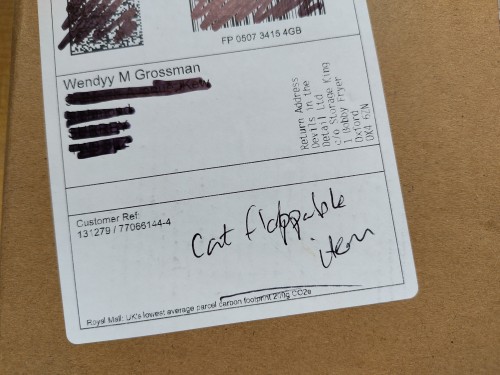
Illustrations: Sign of sentient life inside the post office.
Wendy M. Grossman is an award-winning journalist. Her Web site has an extensive archive of her books, articles, and music, and an archive of earlier columns in this series. She is a contributing editor for the Plutopia News Network podcast. Follow on Mastodon or Bluesky.