Slop

Sometimes it doesn’t pay to be first. iRobot, the maker of the Roomba, has filed for Chapter 11 bankruptcy protection and been acquired by Picea, one of its Chinese suppliers, Lauren Almeida reports at the Guardian. The company’s value has cratered since 2021.

Given the wild enthusiasm that greeted the Roomba’s release in 2002, it seems incredible. Years before then, I recall an event where a speaker whose identity I don’t remember said that ever since he had mentioned the possibility of a robot vacuum sometime like the 1960s he’d gotten thousands of letters asking when it would be ready. There was definitely customer demand. It helped that the Roomba itself was kind of cute as it banged randomly into furniture. People named them, and took them on vacation. But, as often happens, the Roomba’s success attracted lower-cost competitors, and the first mover failed to keep up.

I got one in 2003. After a great few months, I realized that Roombas are not compatible with long hair, which ties them into knots that take longer to cut out than vacuuming. I gave it away within a year and haven’t tried again.

At Mashable, Leah Stodart warns that although the Roombas people already have will continue to work “for now”, users can’t be confident that this state of affairs will continue. Like so many other things that used to be things we owned and are now things we subscribe to (but still think we “buy”), newer-model Roombas are controlled by an app that the manufacturer can change or discontinue at will. She calls it “unplanned obsolescence”. Her advice not to buy a new one this year is sound from the consumer’s point of view, but hardly likely to help the company survive.

***

If generative AI is so great, why is everyone forcing it on us? The latest example, Luke James reports at Tom’s Hardware, is LG “smart” TVs whose users woke up the other day to find a new update had installed “CoPilot: Your AI Companion” without asking permission and that there was no option to remove it. The most you can do to disable it, James says, is keep your TV disconnected from the Internet.

There are of course many more, the automated summaries popping up everywhere being the most obvious. Then, Matthew Gault reports at 404 Media, a Discord moderator and an Anthropic executive added Anthropic’s Claude chatbot to a community for queer gamers, who had voted to restrict Claude to its own channel. Result: major exodus. Duh.

And, of course, as Lance Ulanoff reminds at TechRadar, there is “AI slop” everywhere – music playlists, YouTube videos, ebooks – threatening people’s livelihood even though, as Cory Doctorow has written, “AI can’t do your job. But an AI salesman can convince your boss to fire you and replace you with a chatbot that can’t do your job.” For a while, anyway: Microsoft is halving its sales targets for AI.

And thus we get “slop” as the word of the year, per Merriam-Webster. Any time companies are this intent on foisting something on us – chatbots, ads – you have to know that they’re intent on favoring their interests, not ours.

***

Last week, Customs and Borders Patrol published a notice in the Federal Register proposing new rules for foreigners traveling to the US on an ESTA (“Electronic System for Travel Authorization”) as part of the visa waiver program. It has drawn a lot of discussion in the UK, which is one of the 42 affected countries. Under the new rules, applicants must install CBP’s app, into which they must submit a massive load of “high-value” personal information. The list is long, allows for a so-far-imaginary future of DNA sampling, and expects you to be able to give five years’ worth of family members’ residences, phone numbers, and places of birth, and all the email addresses you’ve used for ten years. CBP thinks the average applicant should be able to complete on their smartphone in 22 minutes. I think it would take hours of painful, resentful typing on a stupid touch keyboard, and even then I doubt I could fill it out with any certainty that the information I supplied was complete or accurate. Data collection at this scale makes it easy to find an error to use as an excuse to deny entry to or deport someone you want to get rid of. As Edward Hasbrouck writes at Papers, Please, “Welcome to the 2026 World Cup”.

“They have to be planning to use AI on all that data,” a friend commented last week. Probably – to build social graphs and find connections deemed suspicious. Privacy International predicts that the masses of data being demanded will in fact enable the AI tools necessary to implement automated decision making and calls the proposals “disproportionate for “a family’s visit to Disney World”,

One of the problems Hasbrouck highlights while opposing this level of suspicionless data collection is that CBP has not provided any way for would-be respondents to the Federal Register notice to examine the app’s source code. What other data might it be collecting?

As Hasbrouck adds in a follow-up, the rules the US imposes on visitors are often adopted by other countries as requirements for US travelers. In this game of ping-pong escalation, no one wins.
Trust busted

It’s hard not to be agog at the ongoing troubles of Boeing. The covid-19 pandemic was the first break in our faith in the ready availability of travel; this is the second. As one of only two global manufacturers of commercial airplanes, Boeing’s problems are the industry’s problems.

I’ve often heard cybersecurity researchers talk with envy of the aviation industry. Usually, it’s because access to data is a perennial problem; many companies don’t want to admit they’ve been hacked or talk about it when they do. By contrast, they’ve said, the aviation industry recognized early that convincing people flying was safe was crucial to everyone’s success and every crash hurt everyone’s prospects, not just those of the competitor whose plane went down. The result was industry-wide adoption of strategies designed to maximize collaboration across the industry to improve safety: data sharing, no-fault reporting, and so on. That hard-won public trust has, we now see, allowed modern industry players to coast on their past reputations. With this added irony: while airlines and governments everywhere have focused on deterring terrorists, the risks are coming from within the industry.

I’m the right age to have rarely worried about aviation safety – young enough to have missed the crashes of the early years, old enough that my first flights were taken in childhood. Isaac Asimov, born in 1920, who said he refused to fly because passengers didn’t have a “sporting” chance of survival in a crash, was actually wrong; the survival rate for airplane crashes in over 90%. Many people feel safer when they feel in control. Yet, as Bruce Schneier has frequently said, you’re at greater risk on the drive to the airport than you are on the plane.

In fact, it’s an extraordinary privilege that most of us worry more about delays, lost luggage, bad food, and cramped seating than whether our flight will land safely. The 2018 crash of a Boeing 737 MAX 8 did little to dislodge this general sense of safety, even though 189 people died, and the same was true following the 2019 crash of the same plane, which killed another 156 people. Boeing tried to sell the idea that it was inadequately trained pilots working for substandard (read: not American or European) airlines, but the reality quickly became plain: the company had skimped on testing and training and its famed safety-first engineering-led culture had disintegrated under pressure to reward shareholders and executives.

We were able to tell ourselves that it was one model plane, and that changes followed, as Bloomberg investigative reporter Peter Robison documents in Flying Blind: The 737 MAX Tragedy and the Fall of Boeing. In particular, the US Congress undid the 2020 legal change that had let Boeing self-certify and restored the Federal Aviation Administration’s obligation of direct oversight, some executives were replaced, and a test pilot went to jail. However, Robison wrote for publication in 2021, many inside the industry, not just at Boeing, thought the FAA’s 20-month grounding of the MAX was “an overreaction”. You might think – as I did – that the airlines themselves would be strongly motivated not to fly planes that could put their safety record at risk, but Robison’s reporting is not comforting about that: the MAX, he writes, is “a moneymaker” for the airlines in that it saves 15% on fuel costs per flight.

Still, the problem seemed to be confined to one model of plane. Until, on January 5, the door plug blew out of a 737 MAX 9. A day later, the FAA grounded all planes of that model for safety inspections.

On January 13, a crack was found in a cockpit window of a 737-800 in Japan. On January 19, a cargo 747-8 caught fire leaving Miami. On January 24, Alaska Airlines reported finding many loose bolts during its fleetwide inspection of 737 Max 9s. Then on January 24, the nose wheel fell off a 757 departing Atlanta. Near-simultaneously, the Seattle Times reported that Boeing itself installed the door plug that blew out, not its supplier, Spirit Aerosystems. The online booking agent and price comparison site Kayak announced that increasing use of its aircraft-specific filter had led it to add separate options to avoid 737 MAX 8s and 9s.

The consensus that formed about the source of the troubles that led to the 2018-2019 crashes is holding: blame focuses on the change in company culture brought by the 1997 merger with McDonnell Douglas, valuing profits and shareholder payouts over engineering. Boeing is in for a period of self-reinvention in which its output will be greatly slowed. As airlines’ current fleets age, this will have to mean reduced capacity; there are only two major aircraft manufacturers in the world, and the other one – Airbus – is fully booked.

As Cory Doctorow writes, that’s only one constraint going forward, at least in the US: there aren’t enough pilots, air traffic controllers, or engine manufacturers. Anti-monopolist Matt Stoller proposes to nationalize and then break up Boeing, arguing that its size and importance mean only the state can backstop its failures. Ten years ago, when the US’s four big legacy airlines consolidated to three, it was easy to think passengers would pay in fees and lost comfort; now we know safety was on the line, too.

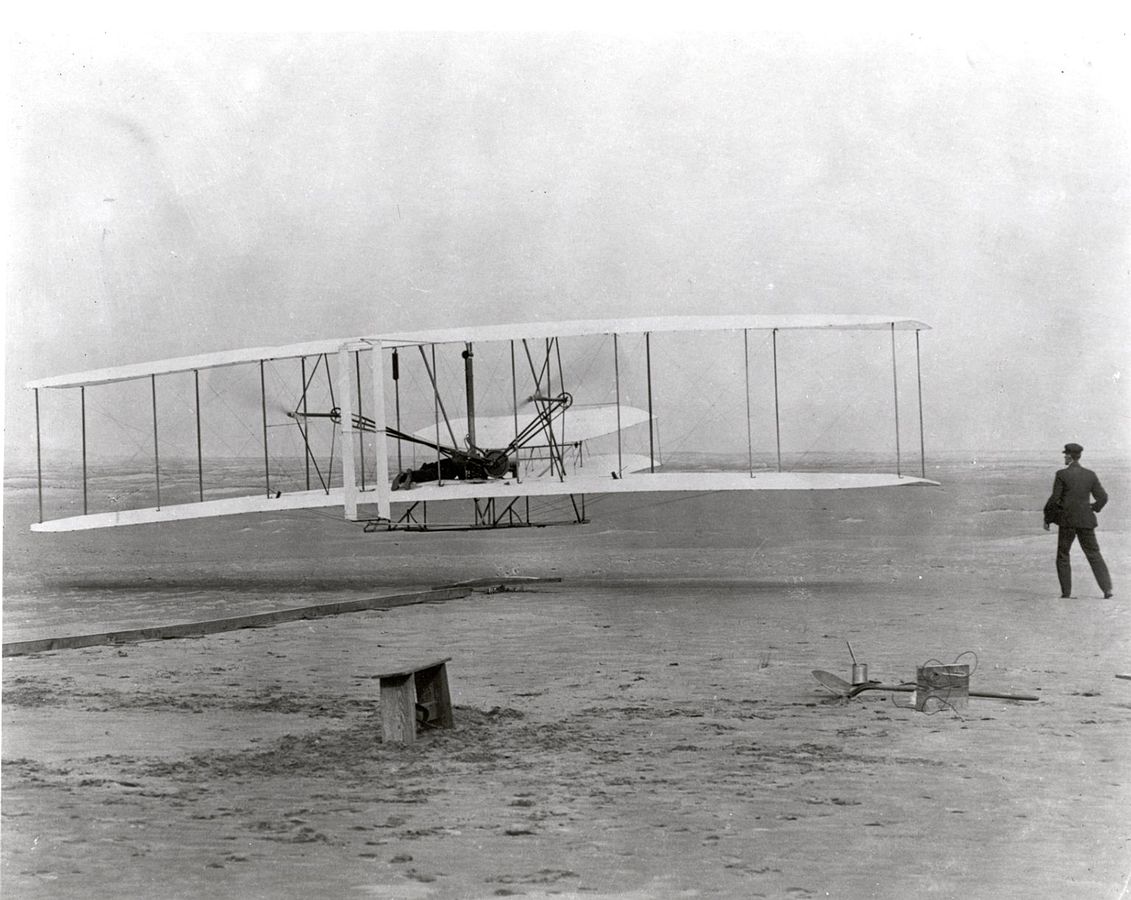
Illustrations: The Wright Brothers’ first heavier-than-air flight, in 1903 (via Wikimedia).

Wendy M. Grossman is the 2013 winner of the Enigma Award. Her Web site has an extensive archive of her books, articles, and music, and an archive of earlier columns in this series. She is a contributing editor for the Plutopia News Network podcast. Follow on Mastodon