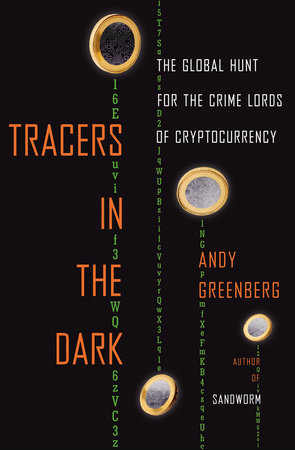
Tracers in the Dark: The Global Hunt for the Crime Lords of Cryptocurrency
By Andy Greenberg
Doubleday
ISBN: 978-0-385-548/09-0
At the 1997 Computers, Freedom, and Privacy conference, the computer scientist Timothy C. May, a co-founder of the influential Cypherpunks mailing l|ist, presented the paper Untraceable Digital Cash, Information Markets, and BlackNet. In it, he suggested that the combination of the Internet, anonymous digital cash, and the possibility that anyone could be a “mint” (in the money sense) created the conditions for BlackNet, a market in stolen secrets, assassinations, and other illegal goods and services. In trying to stop it, he said, regulators and governments would invoke the “Four Horsemen of the Infocalypse”: nuclear terrorists, child pornographers, money launderers, and drug dealers.
Like all futurists, May was building on existing trends. Digital cash already existed in an early form, and governments were already invoking the Four Horsemen in opposing widespread access to strong encryption (they still are, in debates about the UK’s Online Safety bill. Still, his paper also imagined Wikileaks.
Almost certainly the unknown creator of bitcoin, Satoshi Nakomoto, knew the cypherpunks list. In any event, at the beginning, bitcoin appeared to be – and the community surrounding it sometimes billed it as – sufficiently anonymous and untraceable to enable May’s BlackNet. Tl;dr: not for long.
In the highly readable Tracers in the Dark, veteran Wired journalist Andy Greenberg tells the story of step-by-step technical advances that enabled law enforcement, tax authorities, and others to identify and arrest the owners and users of sites dealing in illegal goods like Silk Road, AlphaBay, and Welcome to Video, and take the sites down.
The essential problem for criminals seeking secrecy is, of course, that the public blockchain indelibly records every transaction for all to see for all time. Not only that, but the bigger the pile of data gets the more useful information it yields to analysis. Following the money works.
Greenberg’s series of detective stories begins and ends with Sarah Meiklejohn, now a professor in cryptography and security at University College London. As a graduate student circa 2012, she began studying how bitcoin was being used, and developed clustering techniques that ultimately made it possible to understand what was happening inside the network and identify individual users and owners. Following in her footsteps are an array of interested detectives: the fledgling company Chainalysis, Internal Revenue Service, the Drug Enforcement Agency, and international police. She herself declined a well-paid offer to join them; she sees her role as that of an impartial researcher issuing a public advisory.
At every step the investigators had help from the criminals themselves, who over and over again were remarkably sloppy about their own security. Ross Ulbricht was identified as the administrator of Silk Road because he’d once posted his real email address to a coding forum. Alexandre Cazes, the owner of AlphaBay, was successfully arrested because he kept helpfully posting details of his many female conquests to an online forum, helping the agents following him build a detailed understanding of his whereabouts.
Each takedown has been followed by efforts to improve blockchain privacy. But even so, investigators have years’ worth of leads they can still follow up. And by then, as Danish entrepreneur Michael Gronager says toward the end of the book, referring to the then new, more resistant technologies Monero and Zcash, “Any of these systems, anything that’s developed, you always see a couple of years alter, someone finds something.” Nothing’s perfect.