Review: Data Driven

Data Driven: Truckers, Technology, and the New Workplace Surveillance
By Karen Levy
Princeton University Press
ISBN: 978-0-6911-7530-0

The strikes in Hollywood show actors and writers in an existential crisis: a highly lucrative industry used to pay them a good middle class living but now has the majority struggling just to survive. In her recent book, Data Driven, Cornell assistant professor Karen Levy finds America’s truckers in a similar plight.

Both groups have had their industries change around them because of new technology. In Hollywood, streaming came along to break the feedback loop that powered a highly successful business model for generations. In trucking, the culprit is electronic logging devices (ELDs), which are changing the profession entirely.

Levy has been studying truckers since 2011. At that point, ELDs were beginning to appear in truckers’ cabs but were purely voluntary. That changed in 2017, when the Federal Motor Carrier Safety Administration’s rule mandating their use came into force. The intention, as always, is reasonably benign: to improve safety by ensuring that truckers on the road remain alert and comply with the regulations governing the hours they’re allowed to work.

As part of this work, Levy has interviewed truckers, family members, and managers, and studied trucker-oriented media such as online forums, radio programs, and magazines. She was also able to examine auditing practices in both analog and digital formats.

Some of her conclusions are worrying. For example, she finds that taking truckers’ paper logs into an office away from the cab allowed auditors more time to study them and greater ability to ask questions about them. ELDs, by contrast, are often wired into the cab, and the auditor must inspect them in situ. Where the paper logs were simply understood, many inspectors struggle with the ELDs’ inconsistent interfaces, and being required to enter what is after all the trucker’s personal living space tends to limit the time they spend.

Truckers by and large experience the ELDs as intrusive. Those who have been at the wheel the longest most resent the devaluation of their experience the devices bring. Unlike the paper logs, which remained under the truckers’ control, ELDs often send the data they collect direct to management, who may respond by issuing instructions that override the trucker’s own decisions and on-site information.

Levy’s main point would resonate with those Hollywood strikers. ELDs are being used to correct the genuine problem of tired, and therefore unsafe, truckers. Yet the reason truckers are so tired and take the risk of overworking is the way the industry is structured. Changing how drivers are paid from purely by the mile to including the hours they spend moving their trucks around the yards waiting to unload and other periods of unavoidable delay would be far more effective. Worse, it’s the most experienced truckers who are most alienated by the ELDs’ surveillance. Replacing them with younger, less experienced drivers will not improve road safety for any of us.

The two of us

The-other-Wendy-Grossman-who-is-a-journalist came to my attention in the 1990s by writing a story about something Internettish while a student at Duke University. Eventually, I got email for her (which I duly forwarded) and, once, a transatlantic phone call from a very excited but misinformed PR person. She got married, changed her name, and faded out of my view.

By contrast, Naomi Klein‘s problem has only inflated over time. The “doppelganger” in her new book, Doppelganger: A Trip into the Mirror World, is “Other Naomi” – that is, the American author Naomi Wolf, whose career launched in 1990 with The Beauty Myth . “Other Naomi” has spiraled into conspiracy theories, anti-government paranoia, and wild unscientific theories. Klein is Canadian; her books include No Logo (1999) and The Shock Doctrine (2007). There is, as Klein acknowledges a lot of *seeming* overlap in that a keyword search might surface both.

I had them confused myself until Wolf’s 2019 appearance on BBC radio, when a historian dished out a live-on-air teardown of the basis of her latest book. This author’s nightmare is the inciting incident Klein believes turned Wolf from liberal feminist author into a right-wing media star. The publisher withdrew and pulped the book, and Wolf herself was globally mocked. What does a high-profile liberal who’s lost her platform do now?

When the covid pandemic came, Wolf embraced every available mad theory and her liberal past made her a darling of the extremist right wing media. Increasingly obsessed with following Wolf’s exploits, which often popped up in her online mentions, Klein discovered that social media algorithms were exacerbating the confusion. She began to silence herself, fearing that any response she made would increase the algorithms’ tendency to conflate Naomis. She also abandoned an article deploring Bill Gates’s stance protecting corporate patents instead of spreading vaccines as widely as possible (The Gates Foundation later changed its position.)

Klein tells this story honestly, admitting to becoming addictively obsessed, promising to stop, then “relapsing” the first time she was alone in her car.

The appearance of overlap through keyword similarities is not limited to the two Naomis, as Klein finds on further investigation. YouTube stars like Steve Bannon, who founded Breitbart and served as Donald Trump’s chief strategist during his first months in the White House, wrote this playbook: seize on under-acknowledged legitimate grievances, turn them into right wing talking points, and recruit the previously-ignored victims as allies and supporters. The lab leak hypothesis, the advice being given by scientific authorities, why shopping malls were open when schools were closed, the profiteering (she correctly calls out the UK), the behavior of corporate pharma – all of these were and are valid topics for investigation, discussion, and debate. Their twisted adoption as right-wing causes made many on the side of public health harden their stance to avoid sounding like “one of them”. The result: words lost their meaning and their power.

These are problems no amount of content moderation or online safety can solve. And even if it could, is it right to ask underpaid workers in what Klein terms the “Shadowlands” to clean up our society’s nasty side so we don’t have to see it?

Klein begins with a single doppelganger, then expands into psychology, movies, TV, and other fiction, and ends by navigating expanding circles; the extreme right-wing media’s “Mirror World” is our society’s Mr Hyde. As she warns, those who live in what a friend termed “my blue bubble” may never hear about the media and commentators she investigates. After Wolf’s disgrace on the BBC, she “disappeared”, in reality going on to develop a much bigger platform in the Mirror World. But “they” know and watch us, and use our blind spots to expand their reach and recruit new and unexpected sectors of the population. Klein writes that she encounters many people who’ve “lost” a family member to the Mirror World.

This was the ground explored in 2015 by the filmmaker Jen Senko, who found the same thing when researching her documentary The Brainwashing of My Dad. Senko’s exploration leads from the 1960s John Birch Society through to Rush Limbaugh and Roger Ailes’s intentional formation of Fox News. Klein here is telling the next stage of that same story. Mirror World is not an accident of technology; it was a plan, then technology came along and helped build it further in new directions.

As Klein searches for an explanation for what she calls “diagonalism” – the phenomenon that sees a former Obama voter now vote for Trump, or a former liberal feminist shrug at the Dobbs decision – she finds it possible to admire the Mirror World’s inhabitants for one characteristic: “they still believe in the idea of changing reality”.

This is the heart of much of the alienation I see in some friends: those who want structural change say today’s centrist left wing favors the status quo, while those who are more profoundly disaffected dismiss the Bidens and Clintons as almost as corrupt as Trump. The pandemic increased their discontent; it did not take long for early optimistic hopes of “build back better” to fade into “I want my normal”.

Klein ends with hope. As both the US and UK wind toward the next presidential/general election, it’s in scarce supply.

Illustrations: Charlie Chaplin as one of his doppelgangers in The Great Dictator (1940).

Wendy M. Grossman is the 2013 winner of the Enigma Award. Her Web site has an extensive archive of her books, articles, and music, and an archive of earlier columns in this series. She is a contributing editor for the Plutopia News Network podcast. Follow on Mastodon

Review: The Gutenberg Parenthesis

The Gutenberg Parenthesis: The Age of Print and Its Lessons for the Age of the Internet
By Jeff Jarvis
Bloomsbury Academic
ISBN: 978-1-5013-9482-9

There’s a great quote I can’t trace in which a source singer from whom Sir Walter Scott collected folk songs told him he’d killed their songs by printing them. Printing had, that is, removed the song from the oral culture of repeated transmission, often with alterations, from singer to singer. Like pinning down a butterfly.

In The Gutenberg Parenthesis, Jeff Jarvis argues that modern digital culture offers the chance of a return to the collaborative culture that dominated most of human history. Jarvis is not the first to suggest that our legacy media are an anomaly. In his 2013 book Writing on the Wall, Tom Standage calls out the last 150 years of corporate-owned for-profit media as an anomaly in the 2,000-year sweep of social media. In his analogy, the earliest form was “Roman broadband” (slaves) carrying messages back and forth. Standage finds other historical social media analogues in the coffeehouses that hatched the scientific revolution. Machines, both print and broadcast, made us consumers instead of participants. In Jarvis’s account, printing made institutions and nation-states, the same ones that now are failing to control the new paradigm.

The “Gutenberg parenthesis” of Jarvis’s title was coined by Lars Ore Sauerberg, a professor at the University of Southern Denmark, who argues (in, for example, a 2009 paper for the journal Orbis Literarum) that the arrival of the printing press changed the nature of cognition. Jarvis takes this idea and runs with it: if we are, as he believes, now somewhere in a decades- or perhaps centuries-long process of closing the parenthesis – that is, exiting the era of print bracketed by Gutenberg’s invention of the printing press and the arrival of digital media – what comes next?

To answer this question, Jarvis begins by examining the transition *into* the era of printing. The invention of movable type and printing presses by themselves brought a step down in price and a step up in scale – what had once been single copies available only to people rich enough to pay a scribe suddenly became hundreds of copies that were still expensive. It took two centuries to arrive at the beginnings of copyright law, and then the industrial revolution to bring printing and corporate ownership at today’s scale.

Jarvis goes on to review the last two centuries of increasingly centralized and commercialized publishing. The institutions print brought provided authority that enabled them to counter misinformation effectively. In our new world, where these institutions are being challenged, many more voices can be heard – good, for obvious reasons of social justice and fairness, but unfortunate in terms of the spread of misinformation, malinformation, and disinformation. Jarvis believes we need to build new institutions that can enable the former and inhibit the latter. Exactly what those will look like is left as an exercise for the reader in the times to come. Could Gutenberg have predicted Entertainment Weekly?

Review: Sorry, Sorry, Sorry

Sorry, Sorry, Sorry: The Case for Good Apologies
By Marjorie Ingalls and Susan McCarthy
Gallery Books
ISBN: 978-1-9821-6349-5

Years ago, a friend of mine deplored apologies: “People just apologize because they want you to like them,” he observed.

That’s certainly true at least some of the time, but as Marjorie Ingalls and Susan McCarthy argue at length in their book Sorry, Sorry, Sorry, well-constructed and presented apologies can make the world a better place. For the recipient, they can remove the sting of old wrongs; for the giver, they can ease the burden of old shames.

What you shouldn’t do, when apologizing, is what self-help groups sometimes describe as “plan the outcome”. That is, you present your apology and you take your chances. Follow Ingalls’ and McCarthy’s six steps to construct your apology, then hope for, but do not demand, forgiveness, and don’t mess the whole thing up by concluding with, “So, we’re good?”

Their six steps to a good apology:
1. Say you’re sorry.
2. For what you did.
3. Show you understand why it was bad.
4. Only explain if you need to; don’t make excuses.
5. Say why it won’t happen again.
6. Offer to make up for it.
Six and a half. Listen.

It’s certainly true that many apologies don’t have the desired effect. Often, it’s because the apology itself is terrible. Through their Sorry Watch blog, Ingalls and McCarthy have been collecting and analyzing bad public apologies for years (obDisclosure: I send in tips on apologies in tennis and British politics). Many of these appear in the book, organized into chapters on apologies from doctors and medical establishments, large corporations, and governments and nation-states. Alongside these are chapters on the psychology of apologies, teaching children to apologize, practical realities relating to gender, race, and other disparities. Women, for example, are more likely to apologize well, but take greater risk when they do – and are less likely to be forgiven.

Some templates for *bad* apologies when you’ve done something hurtful (do not try this at home!): “I’m sorry if…”, “I’m sorry that you felt…”, “I regret…”, and, of course, the often-used classic, “This is not who we are.”

These latter are, in Ingalls’ and McCarthy’s parlance “apology-shaped objects”, but not actually apologies. They explain this in detail with plenty of wit – and no less than five Bad Apology bingo cards.

Even for readers of the blog, there’s new information. I was particularly interested to learn that malpractice lawyers are likely wrong in telling doctors not to apologize because admitting fault invites a lawsuit. A 2006 Harvard hospital system report found little evidence for this contention – as long as the apologies are good ones. It’s the failure to communicate and the refusal to take responsibility that are much more anger-provoking. In other words, the problem there, as everywhere else, is *bad* apologies.

A lot of this ought to be common sense. But as Ingalls and McCarthy make plain, it may be sense but it’s not as common as any of us would like.

Review: Should You Believe Wikipedia?

Should You Believe Wikipedia? Online Communities and the Construction of Knowledge
By Amy S. Bruckman
Publisher: Cambridge
Print publication year: 2022
ISBN: 978-1-108780-704

Every Internet era has had its new-thing obsession. For a time in the mid-1990s, it was “community”. Every business, some industry thinkers insisted, would need to build a community of customers, suppliers, and partners. Many tried, and the next decade saw the proliferation of blogs, web boards, and, soon, multi-player online games. We learned that every such venture of any size attracts abuse that requires human moderators to solve. We learned that community does not scale. Then came Facebook and other modern social media, fueled by mobile phones, and the business model became data collection to support advertising.

Back at the beginning, Amy S. Bruckman, now a professor at Georgia Tech but then a student at MIT, set up the education-oriented MOO Crossing, in which children could collaborate on building objects as a way of learning to code. For 20 years, she has taught a course on designing communities. In Should You Believe Wikipedia?, Bruckman distills the lessons she’s learned over all that time, combining years of practical online experience with readable theoretical analysis based on sociology, psychology, and epistemology. Whether or not to trust Wikipedia is just one chapter in her study of online communities and the issues they pose.

Like pubs, cafes, and town squares, online communities are third spaces – that is, neutral ground where people can meet on equal terms. Clearly not neutral: many popular blogs, which tend to be personal or promotional, or the X formerly known as Twitter. Third places also need to be enclosed but inviting, visible from surrounding areas, and offering affordances for activity. In that sense, two of the most successful online communities are Wikipedia and OpenStreetMap, both of which pursue a common enterprise that contributors can feel is of global value. Facebook is home to probably hundreds of thousands of communities – families, activists, support groups, and so on – but itself is too big, too diffuse, and too lacking in shared purpose to be a community. Bruckman also cites as examples of productive communities open source software projects and citizen science.

Bruckman’s book has arrived at a moment that we may someday see as a watershed. Numerous factors – Elon Musk’s takeover and remaking of Twitter, debates about regulation and antitrust, increased privacy awareness – are making many people reevaluate what they want from online social spaces. It is a moment when new experiments might thrive.

Something like that is needed, Bruckman concludes: people are not being well served by the free market’s profit motives and current business models. She would like to see more of the Internet populated by non-profits, but elides the key hard question: what are the sustainable models for supporting such endeavors? Mozilla, one of the open source software-building communities she praises, is sustained by payments from Google, making it still vulnerable to the dictates of shareholders, albeit at one remove. It remains an open question if the Fediverse, currently chiefly represented by Mastodon, can grow and prosper in the long term under its present structure of volunteer administrators running their own servers and relying on users’ donations to pay expenses. Other established commercial community hosts, such as Reddit, where Bruckman is a moderator, have long failed to find financial sustainability.

Bruckman never quite answers the question in the title. It reflects the skepticism at Wikipedia’s founding that an encyclopedia edited by anyone who wanted to participate could be any good. As she explains, however, the fact that every page has its Talk page that details disputes and exposes prior versions provides transparency the search engines don’t offer. It may not be clear if we *should* believe Wikipedia, whose quality varies depending on the subject, but she does make clear why we *can* when we do.

Review: Making a Metaverse That Matters

Making a Metaverse That Matters: From Snow Crash and Second Life to A Virtual World Worth Fighting For
By Wagner James Au
Publisher: Wiley
ISBN: 978-1-394-15581-1

A couple of years ago, when “the metaverse” was the hype-of-the-month, I kept wondering why people didn’t just join 20-year-old Second Life, or a game world. Even then the idea wasn’t new: the first graphical virtual world, Habitat, launched in 1988. And even *that* was preceded by text-based MUDs that despite their limitations afforded their users the chance to explore a virtual world and experiment with personal identity.

I never really took to Second Life. The initial steps – download the software, install it, choose a user name and password, and then an avatar – aren’t difficult. The trouble begins after that: what do I do now? Fly to an island, and then…what?

I *did*, once, have a commission to interview a technology company executive, who dressed his avatar in a suit and tie to give a lecture in a virtual auditorium and then joined me in the now-empty auditorium to talk, now changedinto jeans, T-shirt, and baseball cap.

In his new book, Making a Metaverse That Matters, the freelance journalist Wagner James Au argues that this sort of image consciousness derives from allowing humanoid avatars; they lead us to bring the constraints of our human societies into the virtual world, where instead we could free our selves. Humanoid form leads people to observe the personal space common in their culture, apply existing prejudices, and so on. Au favors blocking markers such as gender and skin color that are the subject of prejudice offline. I’m not convinced this will make much difference; even on text-based systems with numbers instead of names disguising your real-life physical characteristics takes work.

Au spent Second Life’s heyday as its embedded reporter; his news and cultural reports eventually became his 1999 book, The Making of Second Life: Notes from a New World. Part of his new book reassesses that work and reports regrets. He wishes he had been a stronger critic back then instead of being swayed by his own love for the service. Second Life’s biggest mistake, he thinks, was persistently refusing to call itself a game or add game features. The result was a dedicated user base that stubbornly failed to grow beyond about 600,000 as most people joined and reacted the way I did: what now? But some of those 600,000 benefited handsomely, as Au documents: some remade their lives, and a few continue to operate million-dollar businesses built inside the service.

Au returns repeatedly to Snow Crash author Neal Stephenson‘s original conception of the metaverse, a single pervasive platform. The metaverse of Au’s dreams has community as its core value, is accessible to all, is a game (because non-game virtual worlds have generally failed), and collaborative for creators. In other words, pretty much the opposite of anything Meta is likely to build.

Book review: Beyond Measure

Beyond Measure: The Hidden History of Measurement
Author: James Vincent
Publisher: Faber and Faber
ISBN: 978-0-571-35421-4

In 2022, then-government minister Jacob Rees-Mogg proposed that Britain should return to imperial measurements – pounds, ounces, yay Brexit! This was a ship that had long since sailed; 40-something friends learned only the metric system at school. Even those old enough to remember imperial measures had little nostalgia for them.

As James Vincent explains in Beyond Measure: The Hidden History of Measurement, and as most of us assume instinctively, measuring physical objects began with comparisons to pieces of the human body: feet, hands, cubits (elbow to fingertip), fathoms (the span of outstretched arms). Other forms of measurement were functional, such as the Irish collop, the amount of land needed to graze one cow. Such imprecise measurements had their benefits, such as convenient availability and immediately understandable context-based value.

Quickly, though, the desire to trade led to the need for consistency, which in turn fed the emergence of centralized state power. The growth of science increased the pressure for more and more consistent and precise measurements – Vincent spends a chapter on the surprisingly difficult quest to pin down a number we now learn as children: the temperature at which water boils. Perversely, though, each new generation of more precise measurement reveals new errors that require even more precise measurement to correct.

The history of measurement is also the history of power. Surveying the land enabled governments to decide its ownership; the world-changing discovery of statistics and the understanding they brought of social trends, and the resulting empowerment of governments, which could afford to amass the biggest avalanches of numbers.

Perhaps the quirkiest and most unexpected material is Vincent’s chapter on Standard Reference Materials. At the US National Institute for Standards and Measurement, Vincent finds carefully studied jars of peanut butter and powdered radioactive human lung. These, it turns out, provide standards against which manufacturers can check their products.

Often, Vincent observes, changes in measurement systems accompany moments of social disruption. The metric system, for example, was born in France at the time of the revolution. Defining units of measurement in terms of official weights and measures made standards egalitarian rather than dependent on one man’s body parts. By 2018, when Vincent visits the official kilo weight and meter stick in Paris, however, even that seemed too elite. Today, both kilogram and meter are defined in terms of constants of nature – the meter, for example, is defined as the distance light travels in 1/299,792,458th of a second (itself now defined in terms of the decay of caesium-133). These are units that anyone with appropriate equipment can derive at any time without needing to check it against a single stick in a vault. Still elite, but a much larger elite.

But still French, which may form part of Rees-Mogg’s objection to it. And, possibly, as Vincent finds some US Republicans have complained, *communist* because of its global adoption. Nonetheless, and despite anti-metric sentiments expressed even by futurists like Stewart Brand, the US is still more metric than most people think. The road system’s miles and retail stores’ pounds and ounces are mostly a veneer; underneath, industry and science have voted for global compatibility – and the federal government has, since 1893, defined feet and inches by metric units.

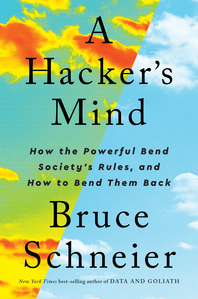
Review: A Hacker’s Mind

A Hacker’s Mind: How the Powerful Bend Society’s Rules, and How to Bend them Back
by Bruce Schneier
Norton
ISBN: 978-0-393-86666-7

One of the lessons of the Trump presidency has been how much of the US government runs on norms that have developed organically over the republic’s 247-year history. Trump felt no compunction about breaking those norms. In computer security parlance, he hacked the system by breaking those norms in ways few foresaw or thought possible.

This is the kind of global systemic hacking Bruce Scheneir explores in his latest book, A Hacker’s Mind. Where most books on this topic limit their focus to hacking computers, Schneier opts to start with computer hacking, use it to illustrate the hacker’s habit of mind, and then find that mindset in much larger and more consequential systemic abuses. In his array of hacks by the rich and powerful, Trump is a distinctly minor player.

First, however, Schneier introduces computer hacking from the 1980s onward. In this case, “hacking” is defined in the old way: active subversion of a system to make it do things its designers never intended. In the 1980s, “hacker” was a term of respect applied to you by others admiring your cleverness. It was only in the 1990s that common usage equated hacking with committing crimes with a computer. In his 1984 book Hackers, Steven Levy showed this culture in action at MIT. It’s safe to say that without hacks we wouldn’t have the Internet.

The hacker’s habit of mind can be applied to far more than just technology. It can – and is today being used to – subvert laws, social norms, financial systems, politics, and democracy itself. This is Schneier’s main point. You can draw a straight line from technological cleverness to Silicon Valley’s “disrupt” to the aphorism coined by Georgetown law professor Julie Cohen, whom Schneier quotes: “Power interprets regulation as damage, and routes around it”.

In the first parts of the book he discusses the impact of system vulnerabilities, the kinds of responses one can make, and the basic types of response. In a compact amount of space, he covers patching, hardening, and simplifying systems, evaluating threat models as they change, and limiting the damage the hack can cause. Or, the hack may be normalized, becoming part of our everyday landscape.

Then he gets serious. In the bulk of the book, he explores applications: hacking financial, legal, political, cognitive, and AI systems. Specialized AI – Schneier wisely avoids the entirely speculative hype and fear around artificial general intelligence – is both exceptionally vulnerable to hacks and an exceptional vector for them. Anthropomorphic robots especially can be designed to hack our emotional responses.

“The rich are better at hacking,” he observes. They have greater resources, more powerful allies, and better access. If the good side of hacking is innovation, the bad side is societal damage, increasing unfairness and inequality, and the subversion of the systems we used to trust. Schneier believes all of this will get worse because today’s winners have so much ability to hack what’s left. Hacking, he says, is an existential threat. Nonetheless, he has hope: we *can* build resilient governance structures. We must hack hacking.

Review: Tracers in the Dark

Tracers in the Dark: The Global Hunt for the Crime Lords of Cryptocurrency
By Andy Greenberg
Doubleday
ISBN: 978-0-385-548/09-0

At the 1997 Computers, Freedom, and Privacy conference, the computer scientist Timothy C. May, a co-founder of the influential Cypherpunks mailing l|ist, presented the paper Untraceable Digital Cash, Information Markets, and BlackNet. In it, he suggested that the combination of the Internet, anonymous digital cash, and the possibility that anyone could be a “mint” (in the money sense) created the conditions for BlackNet, a market in stolen secrets, assassinations, and other illegal goods and services. In trying to stop it, he said, regulators and governments would invoke the “Four Horsemen of the Infocalypse”: nuclear terrorists, child pornographers, money launderers, and drug dealers.

Like all futurists, May was building on existing trends. Digital cash already existed in an early form, and governments were already invoking the Four Horsemen in opposing widespread access to strong encryption (they still are, in debates about the UK’s Online Safety bill. Still, his paper also imagined Wikileaks.

Almost certainly the unknown creator of bitcoin, Satoshi Nakomoto, knew the cypherpunks list. In any event, at the beginning, bitcoin appeared to be – and the community surrounding it sometimes billed it as – sufficiently anonymous and untraceable to enable May’s BlackNet. Tl;dr: not for long.

In the highly readable Tracers in the Dark, veteran Wired journalist Andy Greenberg tells the story of step-by-step technical advances that enabled law enforcement, tax authorities, and others to identify and arrest the owners and users of sites dealing in illegal goods like Silk Road, AlphaBay, and Welcome to Video, and take the sites down.

The essential problem for criminals seeking secrecy is, of course, that the public blockchain indelibly records every transaction for all to see for all time. Not only that, but the bigger the pile of data gets the more useful information it yields to analysis. Following the money works.

Greenberg’s series of detective stories begins and ends with Sarah Meiklejohn, now a professor in cryptography and security at University College London. As a graduate student circa 2012, she began studying how bitcoin was being used, and developed clustering techniques that ultimately made it possible to understand what was happening inside the network and identify individual users and owners. Following in her footsteps are an array of interested detectives: the fledgling company Chainalysis, Internal Revenue Service, the Drug Enforcement Agency, and international police. She herself declined a well-paid offer to join them; she sees her role as that of an impartial researcher issuing a public advisory.

At every step the investigators had help from the criminals themselves, who over and over again were remarkably sloppy about their own security. Ross Ulbricht was identified as the administrator of Silk Road because he’d once posted his real email address to a coding forum. Alexandre Cazes, the owner of AlphaBay, was successfully arrested because he kept helpfully posting details of his many female conquests to an online forum, helping the agents following him build a detailed understanding of his whereabouts.

Each takedown has been followed by efforts to improve blockchain privacy. But even so, investigators have years’ worth of leads they can still follow up. And by then, as Danish entrepreneur Michael Gronager says toward the end of the book, referring to the then new, more resistant technologies Monero and Zcash, “Any of these systems, anything that’s developed, you always see a couple of years alter, someone finds something.” Nothing’s perfect.

Review: Cloudmoney

Cloudmoney: Cash, Cards, Crypto, and the War for our Wallets
By Brett Scott
Publisher: Bodley Head
ISBN: 978-1-847-92587-9

Three years ago, the area around the local tube station included a bank and four ATMs. Come the pandemic, the bank closed, never to return, and so did two of the ATMs. The loss of the bank gave a couple of the chain stores an excuse to refuse to take cash. But they’re a minority in an area full of independent local shops, who recognize that many of their customers are cash users. Journey into some parts of central London, however, and cash gets you ghosted.

We are told that the cashless future is what we want: it’s more convenient (except when the system is down, the app needs to be rebooted, or there’s no Internet connection). The reality, as “monetary anthropologist” and former broker Brett Scott points out in his book Cloudmoney, is that despite this inevitability narrative, one reason electronic/digital payments are more convenient is a deliberate effort to make cash harder to access. Often, promoters claim the cashless society is – or will be – more financially inclusive. Yet, as Scott recounts, that “inclusion” in the remote global economy often brings with it the exclusion of locally-controlled, less formal economies. Less financial inclusion, more *enclosure* and “corporate seep”.

Scott’s central thesis is simple: once the forces of Big Tech and Big Finance have merged, they will have a hitherto unimaginable amount of power over all of us. I have some sympathy with this argument. People forget that it was through the banks that Gilead was brought into being in Margaret Atwood’s The Handmaid’s Tale. All they had to do was locate all the accounts tagged “F” and turn off access until a suitable male came forward to claim them. This is the power of cloudmoney – money that exists for us only in the form of numbers that represent promises to pay. Scott is not predicting a specific dystopia; but he does want to propagate a counterbalancing narrative to the “liberation” every new fintech app pretends to promise while scarfing up all our personal data. In his campaign to protect the public system of cash, he sometimes finds himself in the company of conspiracy theorists whose other ideas he rejects.

What is less clear is where bitcoin and other cryptocurrencies fit in. They also started with rhetoric: they were digital cash, digital gold, a mechanism for bypassing the world’s banks and governments. In practice, so far, they haven’t succeeded at any of these things, and even in El Salvador, where bitcoin is legal tender, you can’t use it to buy a box of oatmeal in a supermarket.

The story technology companies tell is, of course, that they are disrupting the stodgy, antiquated world of traditional finance. Instead, what Scott sees is plain old automation that serves that world and tightens its control. Almost every new service, whatever the rhetoric it starts with, from credit cards to Paypal to Apple Pay to Facebook’s failed Libra cryptocurrency, becomes a front end for bank accounts for the same reason that robbers always focused on them: that’s where the money is. The exception is cash – slow, partially disconnected cash that enables transactions that aren’t caught in what Scott calls the “digital mesh” of corporate capitalism. No wonder they hate it.