What we talk about when we talk about computers

The climax of Nathan Englander‘s very funny play What We Talk About When We Talk About Anne Frank sees the four main characters play a game – the “Anne Frank game” – that two of them invented as children. The play is on at the Marylebone Theatre until February 15.

The plot: two estranged former best friends in a New York yeshiva have arranged a reunion for themselves and their husbands. Debbie (Caroline Catz), has let her religious attachment lapse in the secular environs of Miami, Florida, where her husband, Phil (Joshua Malina), is an attorney. Their college-age son, Trevor (Gabriel Howell), calls the action.

They host Hasidic Shosh (Dorothea Myer-Bennett) and Yuri (Simon Yadoo), formerly Lauren and Mark, whose lives in Israel and traditional black dress and, in Shosh’s case, hair-covering wig, have left them unprepared for the bare arms and legs of Floridians. Having spent her adult life in a cramped apartment with Yuri and their eight daughters, Shosh is astonished at the size of Debbie’s house.

They talk. They share life stories. They eat. And they fight: what is the right way to be Jewish? Trevor asks: given climate change, does it matter?

So, the Anne Frank game: who among your friends would hide you when the Nazis are coming? The rule that you must tell the truth reveals the characters’ moral and emotional cores.

I couldn’t avoid up-ending this question. There are people I trust and who I *think* would hide me, but it would often be better not to ask them. Some have exceptionally vulnerable families who can’t afford additional risk. Some I’m not sure could stand up to intensive questioning. Most have no functional hiding place. My own home offers nowhere that a searcher for stray humans wouldn’t think to look, and no opportunities to create one. With the best will in the world, I couldn’t make anyone safe, though possibly I could make them temporarily safer.

But practical considerations are not the game. The game is to think about whether you would risk your life for someone else, and why or why not. It’s a thought experiment. Debbie calls it “a game of ultimate truth”.

However, the game is also a cheat, in that the characters have full information about all parts of the story. We know the Nazis coming for the Frank family are unquestionably bent on evil, because we know the Franks’ fates when they were eventually found. It may be hard to tell the truth to your fellow players, but the game is easy to think about because it’s replete with moral clarity.

Things are fuzzier in real life, even for comparatively tiny decisions. In 2012, the late film critic Roger Ebert mulled what he would do if he were a Transport Security Administration agent suddenly required to give intimate patdowns to airline passengers unwilling to go through the scanner. Ebert considered the conflict between moral and personal distaste and TSA officers’ need to keep their reasonably well-paid jobs with health insurance benefits. He concluded that he hoped he’d quit rather than do the patdowns. Today, such qualms are ancient history; both scanners and patdowns have become normalized.

Moral and practical clarity is exactly what’s missing as the Department of Government Efficiency arrives in US government departments and agencies to demand access to their computer systems. Their motives and plans are unclear, as is their authority for the access they’re demanding. The outcome is unknown.

So, instead of a vulnerable 13-year-old girl and her family, what if the thing under threat is a computer? Not the sentient emotional robot/AI of techie fantasy but an ordinary computer system holding boring old databases. Or putting through boring old payments. Or underpinning the boring old air traffic control system. Do you see a computer or the millions of people whose lives depend on it? How much will you risk to protect it? What are you protecting it from? Hinder, help, quit?

Meanwhile, DOGE is demanding that staff allow its young coders to attach unauthorized servers, take control of websites. In addition: mass firings, and a plan to do some sort of inside-government AI startup.

DOGE itself appears to be thinking ahead; it’s told staff to avoid Slack while awaiting a technology that won’t be subject to FOIA requests.

The more you know about computers the scarier this all is. Computer systems of the complexity and accuracy of those the US government has built over decades are not easily understood by incoming non-experts who have apparently been visited by the Knowledge Fairy. After so much time and effort on security and protecting against shadowy hackers, the biggest attack – as Mike Masnick calls it – on government systems is coming from inside the house in full view.

Even if “all” DOGE has is read-only access as Treasury claims – though Wired and Talking Points Memo have evidence otherwise – those systems hold comprehensive sensitive information on most of the US population. Being able to read – and copy? – is plenty bad enough. In both fiction (Margaret Atwood’s The Handmaid’s Tale) and fact (IBM), computers have been used to select populations to victimize. Americans are about to find out they trusted their government more than they thought.

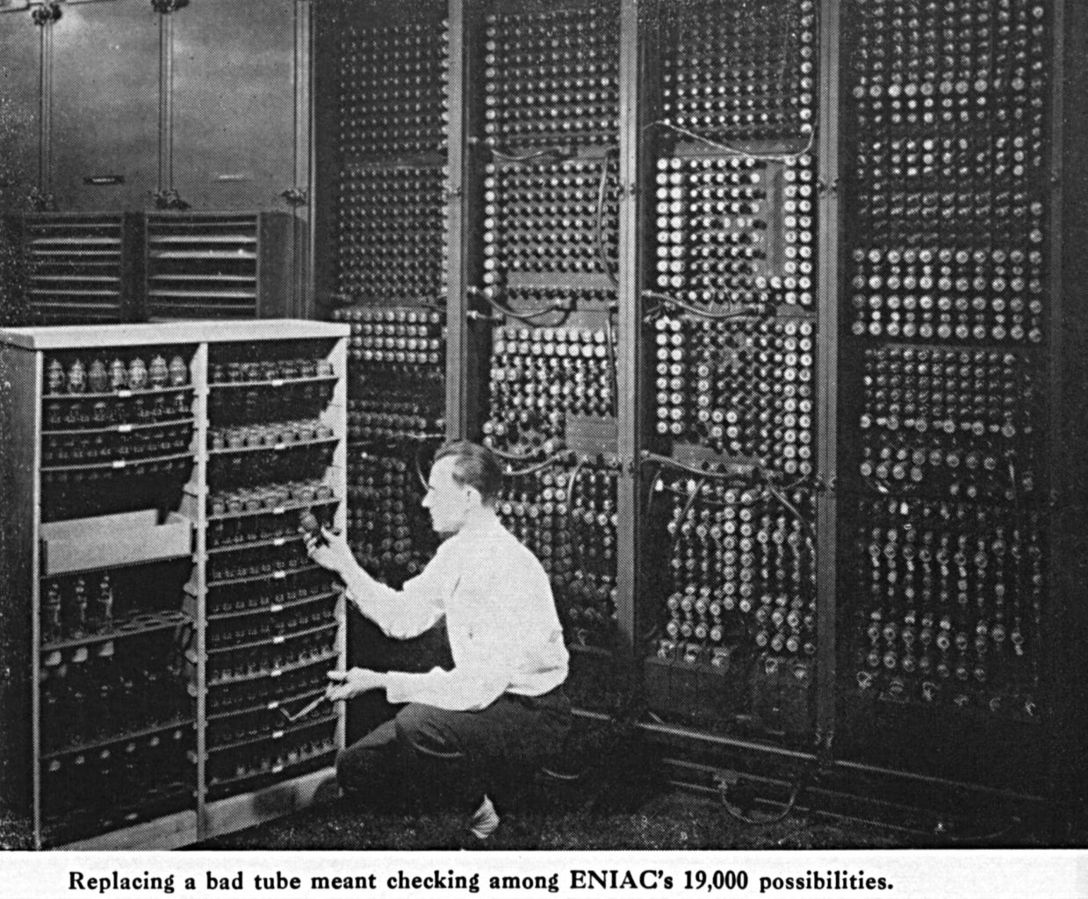
Illustration: Changing a tube in the early computer ENIAC (via Wikimedia).

Wendy M. Grossman is the 2013 winner of the Enigma Award. Her Web site has an extensive archive of her books, articles, and music, and an archive of earlier columns in this series. Stories about the border wars between cyberspace and real life are posted occasionally during the week at the net.wars Pinboard – or follow on Twitter.

Outbound

As the world and all knows by now, the UK is celebrating this year’s American Independence Day by staging a general election. The preliminaries are mercifully short by US standards, in that the period between the day it was called and the day the winners will be announced is only about six weeks. I thought the announcement would bring more sense of relief than it did. Instead, these six weeks seem interminable for two reasons: first, the long, long wait for the announcement, and second, the dominant driver for votes is largely negative – voting against, rather than voting for.

Labour, which is in polling position to win by a lot, is best served by saying and doing as little as possible, lest a gaffe damage its prospects. The Conservatives seem to be just trying not to look as hopeless as they feel. The only party with much exuberance is the far-right upstart Reform, which measures success in terms of whether it gets a larger share of the vote than the Conservatives and whether Nigel Farage wins a Parliamentary seat on his eighth try. And the Greens, who are at least motivated by genuine passion for their cause, and whose only MP is retiring this year. For them, sadly, success would be replacing her.

Particularly odd is the continuation of the trend visible in recent years for British right-wingers to adopt the rhetoric and campaigning style of the current crop of US Republicans. This week, they’ve been spinning the idea that Labour may win a dangerous “supermajority”. “Supermajority” has meaning in the US, where the balance of powers – presidency, House of Representatives, Senate – can all go in one party’s direction. It has no meaning in the UK, where Parliament is sovereign. All it means is Labour could wind up with a Parliamentary majority so large that they can pass any legislation they want. But this has been the Conservatives’ exact situation for the last five years, ever since the 2019 general election gave Boris Johnson a majority of 86. We should probably be grateful they largely wasted the opportunity squabbling among themselves.

This week saw the launch, day by day, of each party manifesto in turn. At one time, this would have led to extensive analysis and comparisons. This year, what discussion there is focuses on costs: whose platform commits to the most unfunded spending, and therefore who will raise taxes the most? Yet my very strong sense is that few among the electorate are focused on taxes; we’d all rather have public services that work and an end to the cost-of-living crisis. You have to be quite wealthy before private health care offers better value than paying taxes. But here may lie the explanation for both this and the weird Republican-ness of 2024 right-wing UK rhetoric: they’re playing to the same wealthy donors.

In this context, it’s not surprising that there’s not much coverage of what little the manifestos have to say about digital rights or the Internet. The exception is Computer Weekly, which finds the Conservatives promising more of the same and Labour offering a digital infrastructure plan, which includes building data centers and easing various business regulations but not to reintroduce the just-abandoned Data Protection and Digital Information bill.

In the manifesto itself: “Labour will build on the Online Safety Act, bringing forward provisions as quickly as possible, and explore further measures to keep everyone safe online, particularly when using social media. We will also give coroners more powers to access information held by technology companies after a child’s death.” The latter is a reference to recent cases such as that of 14-year-old Molly Russell, whose parents fought for five years to gain access to her Instagram account after her death.

Elsewhere, the manifesto also says, “Too often we see families falling through the cracks of public services. Labour will improve data sharing across services, with a single unique identifier, to better support children and families.”

“A single unique identifier” brings a kind of PTSD flashback: the last Labour government, in power from 1997 to 2010, largely built the centralized database state, and was obsessed with national ID cards, which were finally killed by David Cameron’s incoming coalition government. At the time, one of the purported benefits was streamlining government interaction. So I’m suspicious: this number could easily be backed by biometrics and checked via phone apps on the spot, anywhere and grow into…?

In terms of digital technologies, the LibDems mostly talk about health care, mandating interoperability for NHS systems and improving both care and efficiency. That can only be assessed if the detail is known. Also of interest: the LibDems’ proposed anti-SLAPP law, increasingly needed.

The LibDems also commit to advocate for a “Digital Bill of Rights”. I’m not sure it’s worth the trouble: “digital rights” as a set of civil liberties separate from human rights is antiquated, and many aspects are already enshrined in data protection, competition, and other law. In 2019, under the influence of then-deputy leader Tom Watson, this was a Labour policy. The LibDems are unlikely to have any power; but they lead in my area.

I wish the manifestos mattered and that we could have a sensible public debate about what technology policy should look like and what the priorities should be. But in a climate where everyone votes to get one lot out, the real battle begins on July 5, when we find out what kind of bargain we’ve made.

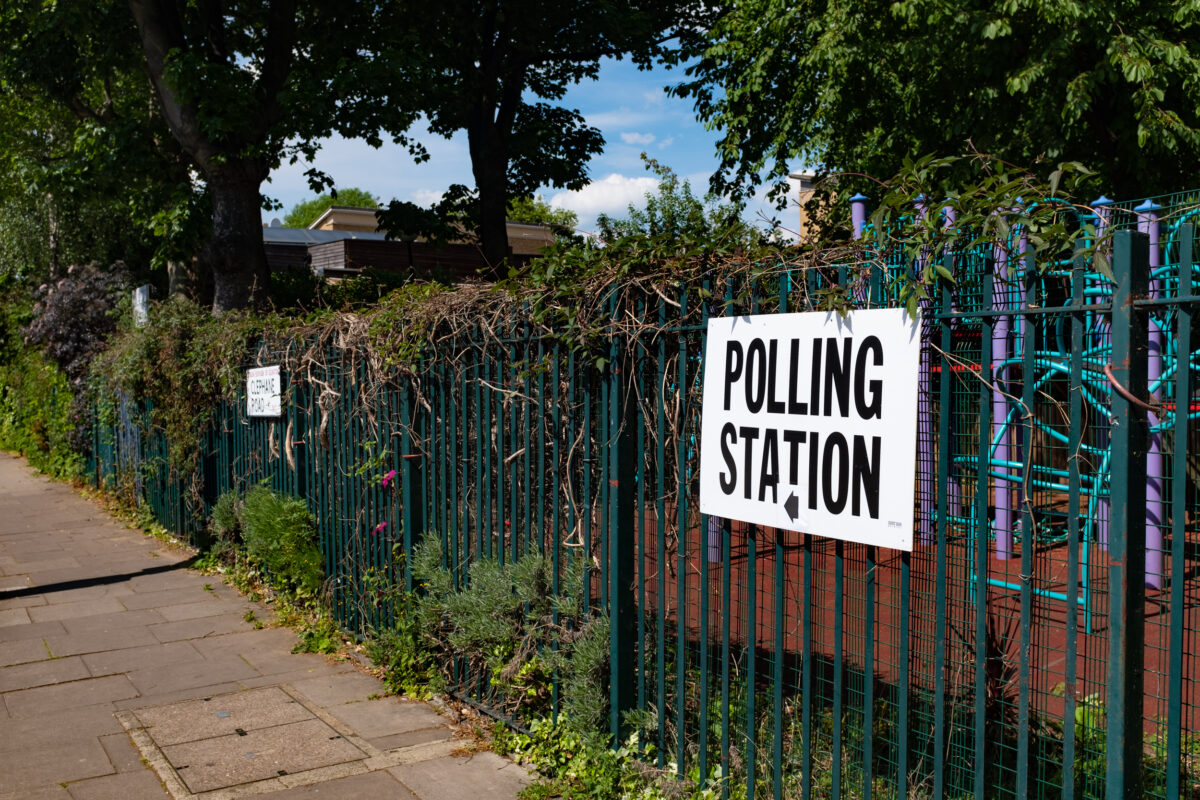
Illustrations: Polling station in Canonbury, London, in 2019 (via Wikimedia).

Wendy M. Grossman is the 2013 winner of the Enigma Award. Her Web site has an extensive archive of her books, articles, and music, and an archive of earlier columns in this series. She is a contributing editor for the Plutopia News Network podcast. Follow on Mastodon.