Nephology

For an hour yesterday (June 5, 2025), we were treated to the spectacle of the US House Judiciary Committee, both Republicans and Democrats, listening – really listening, it seemed – to four experts defending strong encryption. The four: technical expert Susan Landau and lawyers Caroline Wilson-Palow, Richard Salgado, and Gregory Nejeim.

The occasion was a hearing on the operation of the Clarifying Lawful Overseas Use of Data Act (2018), better known as the CLOUD Act. It was framed as collecting testimony on “foreign influence on Americans’ data”. More precisely, the inciting incident was a February 2025 Washington Post article revealing that the UK’s Home Office had issued Apple with a secret demand that it provide backdoor law enforcement access to user data stored using the Advanced Data Protection encryption feature it offers for iCloud. This type of demand, issued under S253 of the Investigatory Powers Act (2016), is known as a “technical capability notice”, and disclosing its existence is a crime.

The four were clear, unambiguous, and concise, incorporating the main points made repeatedly over the last the last 35 years. Backdoors, they all agreed, imperil everyone’s security; there is no such thing as a hole only “good guys” can use. Landau invoked Salt Typhoon and, without ever saying “I warned you at the time”, reminded lawmakers that the holes in the telecommunications infrastructure that they mandated in 1994 became a cybersecurity nightmare in 2024. All four agreed that with so much data being generated by all of us every day, encryption is a matter of both national security as well as privacy. Referencing the FBI’s frequent claim that its investigations are going dark because of encryption, Nojeim dissented: “This is the golden age of surveillance.”

The lawyers jointly warned that other countries such as Canada and Australia have similar provisions in national legislation that they could similarly invoke. They made sensible suggestions for updating the CLOUD Act to set higher standards for nations signing up to data sharing: set criteria for laws and practices that they must meet; set criteria for what orders can and cannot do; and specify additional elements countries must include. The Act could be amended to include protecting encryption, on which it is currently silent.

The lawmakers reserved particular outrage for the UK’s audacity in demanding that Apple provide that backdoor access for *all* users worldwide. In other words, *Americans*.

Within the UK, a lot has happened since that February article. Privacy advocates and other civil liberties campaigners spoke up in defense of encryption. Apple soon withdrew ADP in the UK. In early March, the UK government and security services removed advice to use Apple encryption from their websites – a responsible move, but indicative of the risks Apple was being told to impose on its users. A closed-to-the-public hearing was scheduled for March 14. Shortly before it, Privacy International, Liberty, and two individual claimants filed a complaint with the Investigatory Powers Tribunal seeking for the hearing to be held in public, and disputing the lawfulness, necessity, and secrecy of TCNs in general. Separately, Apple appealed against the TCN.

On April 7, the IPT released a public judgment summarizing the more detailed ruling it provided only to the UK government and Apple. Short version: it rejected the government’s claim that disclosing the basic details of the case will harm the public interest. Both this case and Apple’s appeal continue.

As far as the US is concerned, however, that’s all background noise. The UK’s claim to be able to compel the company to provide backdoor access worldwide seems to have taken Congress by surprise, but a day like this has been on its way ever since 2014, when the UK included extraterritorial power in the Data Retention and Investigatory Powers Act (2014). At the time, no one could imagine how they would enforce this novel claim, but it was clearly something other governments were going to want, too.

This Judiciary Committee hearing was therefore a festival of ironies. For one thing, the US’s own current administration is hatching plans to merge government departments’ carefully separated databases into one giant profiling machine for US citizens. Second, the US has always regarded foreigners as less deserving of human rights than its own citizens; the notion that another country similarly privileges itself went down hard.

More germane, subsidiaries of US companies remain subject to the PATRIOT Act, under which, as the late Caspar Bowden pointed out long ago, the US claims the right to compel them to hand over foreign users’ data. The CLOUD Act itself was passed in response to Microsoft’s refusal to violate Irish data protection law by fulfilling a New York district judge’s warrant for data relating to an Irish user. US intelligence access to European users’ data under the PATRIOT Act has been the big sticking point that activist lawyer Max Schrems has used to scuttle a succession of US-EU data sharing arrangements under GDPR. Another may follow soon: in January, the incoming Trump administration fired most of the Privacy and Civil Liberties Oversight board tasked to protect Europeans’ rights under the latest such deal.

But, no mind. Feast, for a moment, on the thought of US lawmakers hearing, and possibly willing to believe, that encryption is a necessity that needs protection.

Illustrations: Gregory Nejeim, Richard Salgado, Caroline Wilson-Palow, and Susan Landau facing the Judiciary Committee on June 5, 2025.

Wendy M. Grossman is the 2013 winner of the Enigma Award. Her Web site has an extensive archive of her books, articles, and music, and an archive of earlier columns in this series. She is a contributing editor for the Plutopia News Network podcast. Follow on Mastodon or Bluesky.

Review: Vassal State

Vassal State: How America Runs Britain
by Angus Hanton
Swift Press
978-1-80075390-7

Tax organizations estimate that a bit under 200,000 expatriate Americans live in the UK. It’s only a tiny percentage of the overall population of 70 million, but of course we’re not evenly distributed. In my bit of southwest London, the (recently abruptly shuttered due to rising costs) butcher has advertised “Thanksgiving turkeys” for more than 30 years.

In Vassal State, however, Angus Hanton shows that US interests permeate and control the UK in ways far more significant than a handful of expatriates. This is not, he stresses, an equal partnership, despite the perennial photos of the British prime minister being welcomed to the White House by the sitting president, as shown satirically in 1986’s Yes, Prime Minister. Hunton cites the 2020 decision to follow the US and ban Huawei as an example, writing that the US pressure at the time “demonstrated the language of partnership coupled with the actions of control”. Obama staffers, he is told, used to joke about the “special relationship”.

Why invade when you can buy and control? Hanton lists a variety of vectors for US influence. Many of Britain’s best technology startups wind up sold to US companies, permanently alienating their profits – see, for example, DeepMind, sold to Google in 2014, and Worldpay, sold to Vantiv in 2019, which then took its name. US buyers also target long-established companies, such as 176-year-old Boots, which since 2014 has been part of Walgreens and is now being bought up by the Sycamore Partners private equity fund. To Americans, this may not seem like much, but Boots is a national icon and an important part of delivering NHS services such as vaccinations. No one here voted for Sycamore Partners to benefit from that, nor did they vote for Kraft to buy Cadbury’s in 2010 and abandon its Bournville headquarters since 1824.

In addition, US companies are burrowed into British infrastructure. Government ministers communicate with each other over WhatsApp. Government infrastructure is supplied by companies like Oracle and IBM, and, lately, Palantir, which are hard to dig out once embedded. A seventh of the workforce are precariously paid by the US-dominated gig economy. The vast majority of cashless transactions pay a slice to Visa or Mastercard. And American companies use the roads, local services, and other infrastructure while paying less in tax than their UK competition. More controversially for digital rights activists, Hanton complains about the burden that US-based streamers like Netflix, Apple, and Amazon place on the telecommunications networks. Among the things he leaves out: the technology platforms in education.

Hanton’s book comes at a critical moment. Previous administrations have perhaps been more polite about demanding US-friendly policies, but now Britain, on its own outside the EU, is facing Donald Trump’s more blatant demands. Among them: that suppliers to the US government comply with its anti-DEI policies. In countries where diversity, equity, and inclusion are fundamental rights, the US is therefore demanding that its law should take precedence.

In a timeline fork in which Britain remained in the EU, it would be in a much better position to push back. In *this* timeline, Hanton’s proposed remedies – reform the tax structure, change policies, build technological independence – are much harder to implement.

What we talk about when we talk about computers

The climax of Nathan Englander‘s very funny play What We Talk About When We Talk About Anne Frank sees the four main characters play a game – the “Anne Frank game” – that two of them invented as children. The play is on at the Marylebone Theatre until February 15.

The plot: two estranged former best friends in a New York yeshiva have arranged a reunion for themselves and their husbands. Debbie (Caroline Catz), has let her religious attachment lapse in the secular environs of Miami, Florida, where her husband, Phil (Joshua Malina), is an attorney. Their college-age son, Trevor (Gabriel Howell), calls the action.

They host Hasidic Shosh (Dorothea Myer-Bennett) and Yuri (Simon Yadoo), formerly Lauren and Mark, whose lives in Israel and traditional black dress and, in Shosh’s case, hair-covering wig, have left them unprepared for the bare arms and legs of Floridians. Having spent her adult life in a cramped apartment with Yuri and their eight daughters, Shosh is astonished at the size of Debbie’s house.

They talk. They share life stories. They eat. And they fight: what is the right way to be Jewish? Trevor asks: given climate change, does it matter?

So, the Anne Frank game: who among your friends would hide you when the Nazis are coming? The rule that you must tell the truth reveals the characters’ moral and emotional cores.

I couldn’t avoid up-ending this question. There are people I trust and who I *think* would hide me, but it would often be better not to ask them. Some have exceptionally vulnerable families who can’t afford additional risk. Some I’m not sure could stand up to intensive questioning. Most have no functional hiding place. My own home offers nowhere that a searcher for stray humans wouldn’t think to look, and no opportunities to create one. With the best will in the world, I couldn’t make anyone safe, though possibly I could make them temporarily safer.

But practical considerations are not the game. The game is to think about whether you would risk your life for someone else, and why or why not. It’s a thought experiment. Debbie calls it “a game of ultimate truth”.

However, the game is also a cheat, in that the characters have full information about all parts of the story. We know the Nazis coming for the Frank family are unquestionably bent on evil, because we know the Franks’ fates when they were eventually found. It may be hard to tell the truth to your fellow players, but the game is easy to think about because it’s replete with moral clarity.

Things are fuzzier in real life, even for comparatively tiny decisions. In 2012, the late film critic Roger Ebert mulled what he would do if he were a Transport Security Administration agent suddenly required to give intimate patdowns to airline passengers unwilling to go through the scanner. Ebert considered the conflict between moral and personal distaste and TSA officers’ need to keep their reasonably well-paid jobs with health insurance benefits. He concluded that he hoped he’d quit rather than do the patdowns. Today, such qualms are ancient history; both scanners and patdowns have become normalized.

Moral and practical clarity is exactly what’s missing as the Department of Government Efficiency arrives in US government departments and agencies to demand access to their computer systems. Their motives and plans are unclear, as is their authority for the access they’re demanding. The outcome is unknown.

So, instead of a vulnerable 13-year-old girl and her family, what if the thing under threat is a computer? Not the sentient emotional robot/AI of techie fantasy but an ordinary computer system holding boring old databases. Or putting through boring old payments. Or underpinning the boring old air traffic control system. Do you see a computer or the millions of people whose lives depend on it? How much will you risk to protect it? What are you protecting it from? Hinder, help, quit?

Meanwhile, DOGE is demanding that staff allow its young coders to attach unauthorized servers, take control of websites. In addition: mass firings, and a plan to do some sort of inside-government AI startup.

DOGE itself appears to be thinking ahead; it’s told staff to avoid Slack while awaiting a technology that won’t be subject to FOIA requests.

The more you know about computers the scarier this all is. Computer systems of the complexity and accuracy of those the US government has built over decades are not easily understood by incoming non-experts who have apparently been visited by the Knowledge Fairy. After so much time and effort on security and protecting against shadowy hackers, the biggest attack – as Mike Masnick calls it – on government systems is coming from inside the house in full view.

Even if “all” DOGE has is read-only access as Treasury claims – though Wired and Talking Points Memo have evidence otherwise – those systems hold comprehensive sensitive information on most of the US population. Being able to read – and copy? – is plenty bad enough. In both fiction (Margaret Atwood’s The Handmaid’s Tale) and fact (IBM), computers have been used to select populations to victimize. Americans are about to find out they trusted their government more than they thought.

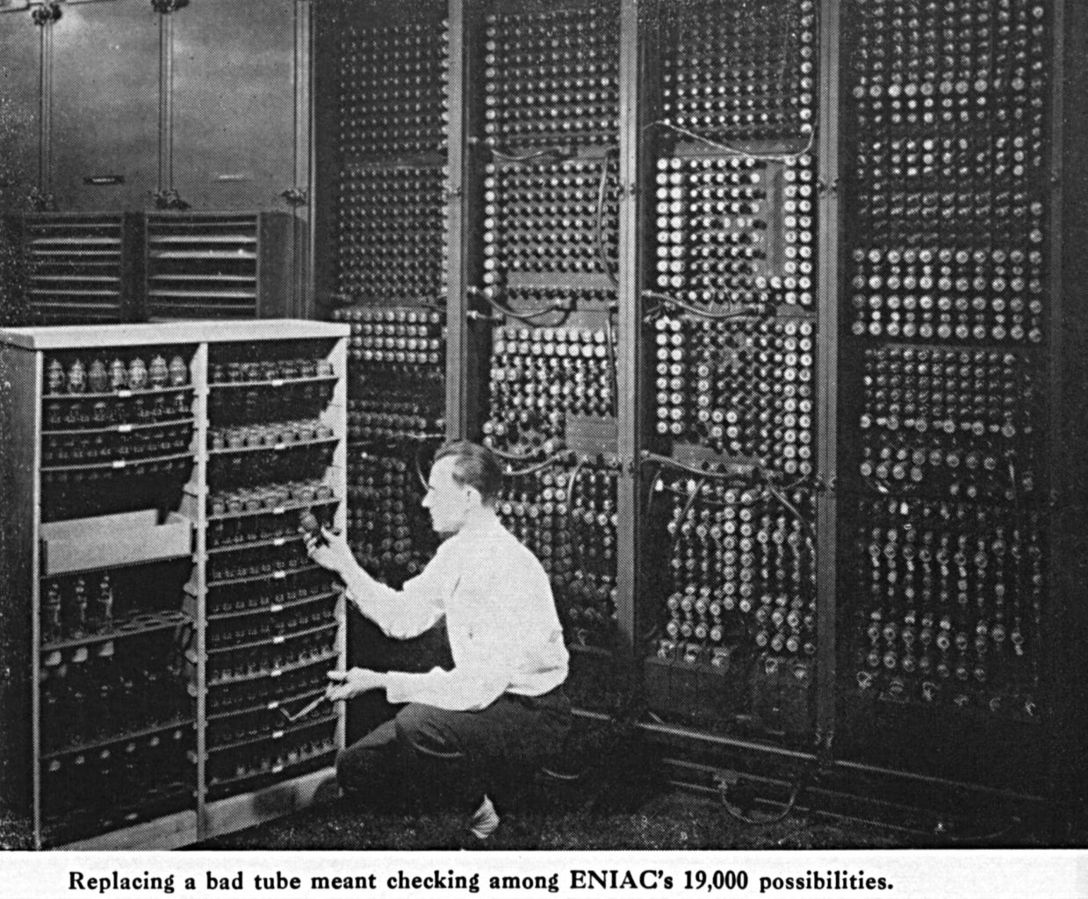
Illustration: Changing a tube in the early computer ENIAC (via Wikimedia).

Wendy M. Grossman is the 2013 winner of the Enigma Award. Her Web site has an extensive archive of her books, articles, and music, and an archive of earlier columns in this series. Stories about the border wars between cyberspace and real life are posted occasionally during the week at the net.wars Pinboard – or follow on Twitter.