Following 1998, when the Internet Corporation for Assigned Names and Numbers was established, many were concerned that it might become a force for censorship. Critics asked: would ICANN remain the neutral technical steward it was intended to be? Turns out, ICANN wasn’t the right vulnerability.
The desire to force the Internet content to conform to “local ordinances” (as John Perry Barlow once called the US First Amendment) started before the Internet. In 1994, Robert and Carleen Thomas were imprisoned for transmitting pornographic images from their California-based bulletin board over interstate telephone lines to Tennessee, where they were illegal. Today, US companies are outraged at fines and demands for compliance with the UK’s Online Safety Act requirements for age verification.
Now there’s a new twist. In Travis County, Texas, a court has ordered Verisign, the ICANN-appointed Virginia-based registry for .com, to lock a domain belonging to the streaming platform Kick Online Entertainment SA because it has not implemented age verification as required under Texas law.
The technical bit: ICANN oversees the entire domain name system, which ties human-friendly names like pelicancrossing.net to the numbers computers actually use under the hood. Each top-level domain – .com, .net, .uk – has a single registry in charge of it. Registries oversee myriad registrars, which are the companies you pay when you register a domain. Many of the world’s most valuable businesses depend on .com, and US-based Verisign is a critical point of failure for all of them.
The court issued its writ (PDF) in June, after Kick Online ignored both a September 2024 order to implement age verification and a $9 million default judgment. To get it back, Kick Online must both post a $9.14 millionbond and implement age verification. At TechTimes, Mark Rutherford details the history, noting that Dutch authorities ordered its local host to block its site for a week earlier this year when a CNN investigation found content that’s illegal in the Netherlands. It is still under criminal investigation there. The UK’s regulator, Ofcom, has fined it £800,000 for failing to implement age verification for UK users. The Dutch action blocked the site in the Netherlands; the Texas order cuts it off everywhere in the world.
Rutherford notes that the basis for the order was set last year, when the US Supreme Court upheld the Texas age verification law in Free Speech Coalition, Inc. v. Paxton. And he warns: the court has pre-authorized other cases against foreign .com operators to obtains similar writs without court proceedings. And: it opens the way for any state attorney general “with access to a Travis County-style court order” can use this same tactic against any foreign .com operator for any category of violation of civil law.
A local ordinance has gone global.
In 2005, Vernor Vinge set out to imagine how the then-prevailing technology trends could enable a society of pervasive mass surveillance. I remembered that and the resulting novel, Rainbows End, this week when reading that a New Zealand used bookstore canceled thousands of orders for niche books when the owner realized they were being bought by AI companies to scan and destroy. Part of Vinge’s setting was a campus library destructively digitizing all its holdings; this was around the time that Google Books was being compiled.
Owners of second-hand book shops care about books for the knowledge they contain, but also as artifacts. Scanning them to provide greater access is compatible. Destroying them is not. Every shredded book is a lost opportunity for someone new to unexpectedly encounter it. The same is true of giant digital collections of scanned books – but it’s not true of AI chatbots, which vanish individual works and their attribution and context under a pile of unreliable summary.
Revisiting the piece I wrote for the Guardian in 2006 about Vinge’s book and his talk at the 2006 Computers, Freedom, and Privacy, reminded that Rainbows End was set in 2025. As so often, it’s easier to be right about the direction of technology than its timing. In Vinge’s 2025, wearable computers were everywhere, live meetings included ultra-realistic remote projections, augmented reality was readily available to all, and autonomous taxis were easily summoned from any location. His basis for this projected future was an extension of then-controversial Trusted Computing, a security measure some feared would block open source software. Vinge’s imagined Secure Hardware Environment dedicated some bandwidth and a small portion of every semiconductor to regulatory use, enabling surveillance by providing convenience: speed through security checkpoints, pay taxes, cut crime. Larry Ellison would adopt it in a heartbeat. Vinge himself remained hopeful that friction would defeat the attempt to control and surveil everything.
Friction we have: the growing protests against data centers, some of them successful, are one example. Data centers are physical manifestations of everything people fear and resent about the current direction of travel: Big Tech, billionaires, government and industry conspiring to ignore public needs and preferences, and a growing surveillance infrastructure. Other forms of surveillance – live facial recognition, license plate-reading company Flock, Meta’s smartglasses – are also getting pushback (public campaigns, vandalism, calls to ban).
On the other hand, Vinge also imagined by now we’d have successful treatments for Alzheimer’s and other pernicious diseases. So, wash?
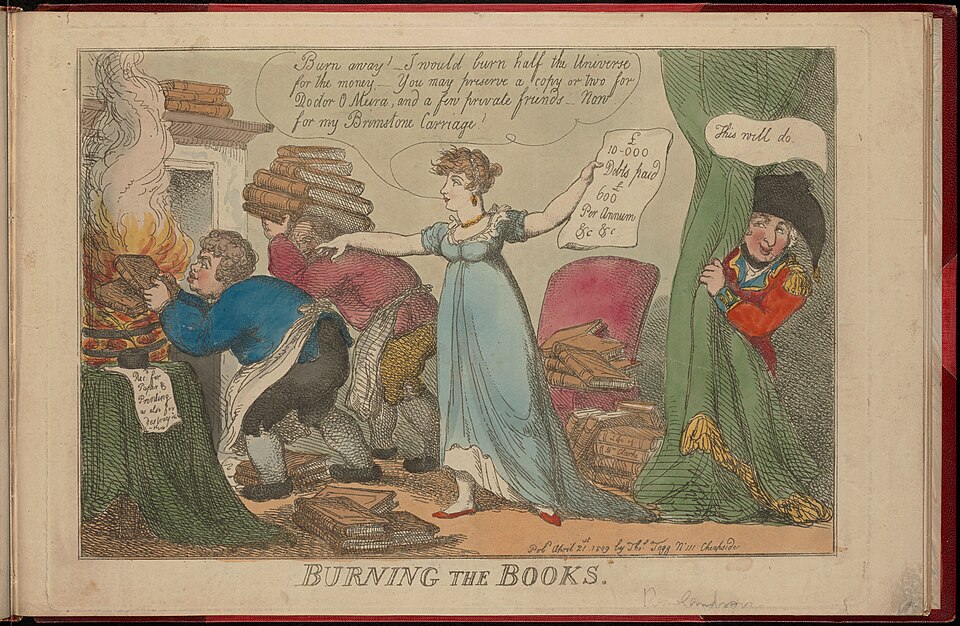
Illustrations: “Burning the books”, by Rowland Thomas (contributed to Wikimedia by Boston Public Library).
Also this week:
– At the Plutopia Network News podcast, we interview Leonie Tanczer, who researches technology abuse and domestic violence.
– TechGrumps episode 3.43: Loaded Laptops at Dawn.
Wendy M. Grossman is an award-winning journalist. Her Web site has an extensive archive of her books, articles, and music, and an archive of earlier columns in this series. She is a contributing editor for the Plutopia News Network podcast. Follow on Mastodon or Bluesky.