Revival

There appears to be media consensus: “Bluesky is dead.”

At The Commentary, James Meigs calls Bluesky “an expression of the left’s growing hypersensitivity to ideas leftists find offensive”, and says he accepts exTwitter’s “somewhat uglier vibe” in return for “knowing that right-wing views aren’t being deliberately buried”. Then he calls Bluesky “toxic” and a “hermetically sealed social-media bubble”.

At New Media and Marketing, Rich Meyer says Bluesky is in decline and engagement is dropping, and exTwitter is making a comeback.

At Slate, Alex Kirshner and Nitish Pahwa complain that Bluesky feels “empty”, say that its too-serious users are abandoning it because it isn’t fun, and compare it to a “small liberal arts college” and exTwitter to a “large state university”.

At The Spectator, Sean Thomas regrets that “Bluesky is dying” – and claims to have known it would fail from his first visit to the site, “a bad vegan cafe, full of humorless puritans”.

Many of these pieces – Mark Cuban at Fortune, for example, and Megan McArdle at the Washington Post – blame a “lack of diversity of thought”.

As Mike Masnick writes on TechDirt in its defense (Masnick is a Bluesky board member), “It seems a bit odd: when something is supposedly dying or irrelevant, journalists can’t stop writing about it.”

Have they so soon forgotten 2014, when everyone was writing that Twitter was dead?

Commentators may be missing that success for Bluesky looks different: it’s trying to build a protocol-driven ecosystem, not a site. Twitter had one, but destroyed it as its ad-based business model took over. Both Bluesky and Mastodon, which media largely ignores, aim to let users create their own experience and are building tools that give users as much control as possible. It seems to offend some commentators that one of them lets you block people you don’t want to deal with, but that’s weird, since it’s the one every social site has.

All social media have ups and downs, especially when they’re new (I really wonder how many of these commentators experienced exTwitter in its early days or have looked at Truth Social’s user numbers). Settling into a new environment and rebuilding take time – it may look like the old place, but its affordances are different, and old friends are missing. Meanwhile, anecdotally, some seem to be leaving social media entirely, driven away by privacy issues, toxic behavior, distaste for platform power and its owners, or simply distracted by life. Few of us *have* to use social media.

***

In 2002, the UK’s Financial Services Authority was the first to implement an EU directive allowing private organizations to issue their own electronic money without a banking license if they could meet the capital requirements. At the time, the idea seemed kind of cute, especially since there was a plan to waive some of the requirements for smaller businesses. Everyone wanted micropayments; here was a framework of possibility.

And then nothing much happened. The Register’s report (the first link above) said that organizations such as the Post Office, credit card companies, and mobile operators were considering launching emoney offerings. If they did, the results sank without trace. Instead, we’re all using credit/debit cards to pay for stuff online, just as we were 23 years ago. People are relucrtant to trust weird, new-fangled forms of money.

Then, in 2008, came cryptocurrencies – money as lottery ticket.

Last week, the Wall Street Journal reported that Amazon, Wal-Mart, and other multinationals are exploring stablecoins as a customer payment option – in other words, issuing their own cryptocurrencies, pegged to the US dollar. As Andrew Kassel explains at Investopedia, the result could be to bypass credit cards and banks, saving billions in fees.

It’s not clear how this would work, but I’m suspicious of the benefits to consumers. Would I have to buy a company’s stablecoin before doing business with it? And maintain a floating balance? At Axios, Brady Dale explores other possibilities. Ultimately, it sounds like a return to the 1970s, before multipurpose credit cards, when people had store cards from the retailers they used frequently, and paid a load of bills every month. Dale seems optimistic that this could be a win for consumers as well as retailers, but I can’t really see it.

In other words, the idea seems less cute now, less fun technological experiment, more rapacious. There’s another, more disturbing, possibility: the return of the old company town. Say you work for Amazon or Wal-Mart, and they offer you a 10% bonus for taking your pay in their stablecoin. You can’t spend it anywhere but their store, but that’s OK, right, because they stock everything you could possibly want? A modern company town doesn’t necessarily have to be geographical.

I’ve long thought that company towns, which allowed companies to effectively own employees, are the desired endgame for the titans. Elon Musk is heading that way with Starbase, Texas, now inhabited primarily by SpaceX employees, as Elizabeth Crisp reports at The Hill.

I don’t know if the employees who last month voted enthusiastically for the final incorporation of Starbase realize how abusive those old company towns were.

Illustrations: The Starbase sign adjoining Texas Highway 4, in 2023 (via Jenny Hautmann at Wikimedia.

Wendy M. Grossman is an award-winning journalist. Her Web site has an extensive archive of her books, articles, and music, and an archive of earlier columns in this series. She is a contributing editor for the Plutopia News Network podcast. Follow on Mastodon or Bluesky.

Blue

The inxodus onto Bluesky noted here last week continues apace: the site’s added a million users a day for more than a week, gradually slowing down from 12 new users a second, per the live counter.

These are not lurkers. Suddenly, the site feels like Twitter circa 2009/2010, when your algorithm-free feed was filled with interesting people sharing ideas, there were no ads, and abuse was in its infancy. People missing in action for the last year or two are popping up; others I’ve wished would move off exTwitter so I could stop following them there have suddenly joined. Mastodon is also seeing an uptick, and (I hear) Threads continues to add users without, for me, adding interest to match…. I doubt this diaspora is all “liberals”, as some media have it – or if they are, it won’t be long before politicians and celebrities note the action is elsewhere and rush to stay relevant.

It takes a long time for a social medium to die if it isn’t killed by a corporation. Even after this week’s bonanza, Bluesky’s entire user base fits inside 5% of exTwitter, which still has around 500 million users as of September, about half of them active daily. What matters most are *posters*, who are about 10% or less of any social site’s user base. When they leave, engagement plummets, as shown in a 2017 paper in Nature.

An example in action: at Statnews, Katie Palmer reports that the science and medical community is adopting Bluesky.

I have to admit to some frustration over this: why not Mastodon? As retro-fun as this week on Bluesky has been, the problem noted here a few weeks ago of Bluesky’s venture capital funding remains. Yes, the company is incorporated as a public benefit company – but venture capitalists want exit strategies and return on investment. That tension looms.

Mastodon is a loose collection of servers that all run the same software, which in turn is written to the open protocol Activity Pub. Gergely Orosz has deep-dive looks at Bluesky’s development and culture; the goal was to write a new open protocol, AT, that would allow Bluesky, similarly, to federate with others. There is already a third-party bit of software, Bridgy, that provides interoperability among Bluesky, any system based on Activity Pub (“the Fediverse”, of which Mastodon is a subset), and the open web (such as blogs). For the moment, though, Bluesky remains the only site running its AT protocol, so the more users Bluesky adds, the more it feels like a platform rather than a protocol. And platforms can change according to the whims of their owners – which is exactly what those leaving exTwitter are escaping. So: why not Mastodon, which doesn’t have that problem?

In an exchange on Bluesky, Palmer said that those who mentioned it said they found Mastodon “too difficult to figure out”.

It can’t be the thing itself; typing and sending varies little. The problem has to be the initial uncertainty about choosing a server. What you really want is for institutions to set up their own, and then you sign up there. For most people that’s far too much heavy lifting. Still, this is what the BBC and the German government have done, and it has a significant advantage in that posting from an address on that server automatically verifies the poster as an authentic staffer. NPR simply found a server and opened an account, like I did when I joined Mastodon in 2019.

All that said, how Mastodon administrators will cope with increasing usage and resulting costs also remains an open question as discussed here last year.

So: some advice as you settle into your new online home:

– Plan for the site’s eventual demise. “On the Internet your home will always leave you” (I have lost the source of this quote). Every site, no matter how big and fast-growing it is now, or how much you all love it…assume that at some point in the future it will either die of outmoded business model (AOL forums); get bought and closed down (Television without Pity, CompuServe, Geocities); become intolerable because of cultural change (exTwitter); or be abandoned because the owner loses interest (countless blogs and comment boards). Plan for that day. Collect alternative means of contacting the people you come to know and value. Build multiple connections.

– Watch the data you’re giving the site. No one in 2007, when I joined Twitter, imagined their thousands of tweets would become fodder for a large language model to benefit one of the world’s richest multi-billionaires.

– If you are (re)building an online community for an organization, own that community. Use social media, by all means, but use it to encourage people to visit the organization’s website, or join its fully-controlled mailing list or web board. Otherwise, one day, when things change, you will have to start over from scratch, and may not even know who your members are or how to reach them.

– Don’t worry too much about the “filter bubble”, as John Elledge writes. Studies generally agree social media users encounter more, and more varied, sources of news than others. As he says, only journalists have to read widely among people whose views they find intolerable (see also the late, great Molly Ivins).

Illustrations: A mastodon by Heinrich Harder (public domain, via Wikimedia).

Wendy M. Grossman is the 2013 winner of the Enigma Award. Her Web site has an extensive archive of her books, articles, and music, and an archive of earlier columns in this series. She is a contributing editor for the Plutopia News Network podcast. Follow on Mastodon or Bluesky.

What’s next

“It’s like your manifesto promises,” Bernard Woolley (Derek Fowldes) tells eponymous minister Jim Hacker (Paul Eddington) in Antony Jay‘s and Jonathan Lynn’s Yes, Minister. “People *understand*.” In other words, people know your election promises aren’t real.

The current US president-elect is impulsive and chaotic, and there will be resistance. So it’s reasonable to assume that at least some of his pre-election rhetoric will remain words and not deeds. There is, however, no telling which parts. And: the chaos is the point.

At Ars Technica, Ashley Belanger considers the likely impact of the threatened 60% tariffs on Chinese goods and 20% from everywhere else: laptops could double, games consoles go up 40%, and smartphones rise 26%. Friends want to stockpile coffee, tea, and chocolate.

Also at Ars Technica, Benj Edwards predicts that the new administration will quickly reverse Joe Biden’s executive order regulating AI development.

At his BIG Substack, Matt Stoller predicts a wave of mergers following three years of restrictions. At TechDirt, Karl Bode agrees, with special emphasis on media companies and an order of enshittification on the side. At Hollywood Reporter, similarly, Alex Weprin reports that large broadcast station owners are eagerly eying up local stations, and David Zaslav, CEO of merger monster Warner Brothers Discovery, tells Georg Szalai that more consolidation would provide “real positive impact”. (As if.)

Many predict that current Federal Communications Commissioner Brendan Carr will be promoted to FCC chair. Carr set out his agenda in his chapter of Project 2025: as the Benton Institute for Broadband and Society reports. His policies, Jon Brodkin writes at Ars Technica, include reforming Section 230 of the Communications Decency Act and dropping consumer protection initiatives. John Hendel warned in October at Politico that the new FCC chair could also channel millions of dollars to Elon Musk for his Starlink satellite Internet service, a possibility the FCC turned down in 2023.

Also on Carr’s list is punishing critical news organizations. Donald Trump’s lawyers began before the election with a series of complaints, as Lachlan Cartwright writes at Columbia Journalism Review. The targets: CBS News for 60 Minutes, the New York Times, Penguin Random House, Saturday Night Live, the Washington Post, and the Daily Beast.

Those of us outside the US will be relying on the EU to stand up to parts of this through the AI Act, Digital Markets Act, Digital Services Act, and GDPR. Enforcement will be crucial. The US administration may resist this procedure. The UK will have to pick a side.

***

It’s now two years since Elon Musk was forced to honor his whim of buying Twitter, and much of what he and others said would happen…hasn’t. Many predicted system collapse or a major hack. Instead, despite mass departures for sites other, the hollowed-out site has survived technically while degrading in every other way that matters.

Other than rebranding to “X”, Musk has failed to deliver many of the things he was eagerly talking about when he took over. A helpful site chronicles these: a payments system, a content moderation council, a billion more users. X was going to be the “everything app”. Nope.

This week, the aftermath of the US election and new terms of service making user data fodder for AI training have sparked a new flood of departures. This time round there’s consensus: they’re going to Bluesky.

It’s less clear what’s happening with the advertisers who supply the platform’s revenues, which the now-private company no longer has to disclose. Since Musk’s takeover, reports have consistently said advertisers are leaving. Now, the Financial Times reports (unpaywalled, Ars Technica) they are plotting their return, seeking to curry favor given Musk’s influence within the new US administration – and perhaps escaping the lawsuit he filed against them in August. Even so, it will take a lot to rebuild. The platform’s valuation is currently estimated at $10 billion, down from the $44 billion Musk paid.

This slash-and-burn approach is the one Musk wants to take to Department of Government Efficiency (DOGE, as in Dogecoin; groan). Musk’s list of desired qualities for DOGE volunteers – no pay, long hours, “super” high IQ – reminds of Dominic Cummings in January 2020, when he was Boris Johnson’s most-favored adviser and sought super-talented weirdos to remake the UK government. Cummings was gone by November.

***

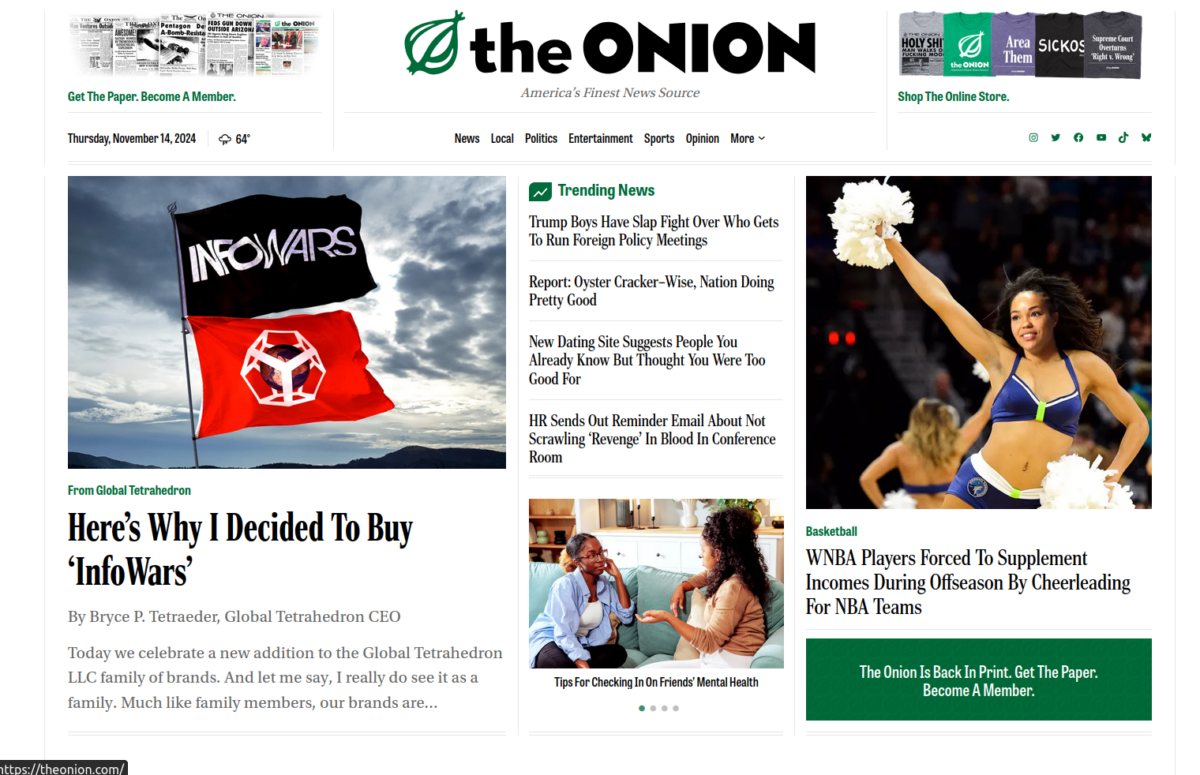
It says something about the madness of the week that the sanest development appears to be that The Onion has bought Infowars, the conspiracy theory media operation Alex Jones used to promote, alongside vitamins, supplements, and many other conspiracy theories, the utterly false claim that the Sandy Hook school shootings were a hoax. The sale was part of a bankruptcy auction held to raise funds Jones owes to the families of the slaughtered Sandy Hook children after losing to them in court in a $1.4 billion defamation case. Per the New York Times, the purchase was sanctioned by the Sandy Hook families. The Onion will relaunch the site in its own style with funding from Everytown for Gun Safety. There may not be a god, but there is an onion.

Illustrations: The front page of The Onion, showing the news about its InfoWars purchase.

Wendy M. Grossman is the 2013 winner of the Enigma Award. Her Web site has an extensive archive of her books, articles, and music, and an archive of earlier columns in this series. She is a contributing editor for the Plutopia News Network podcast. Follow on Mastodon.