
The safe place

For a long time, fear that technical decisions – new domain names ($), cooption of open standards or software, laws mandating data localization – would splinter the Internet. “Balkanize” was heard a lot.

A panel at the UK Internet Governance Forum a couple of weeks ago focused on this exact topic, and was mostly self-congratulatory. Which is when it occurred to me that the Internet may not *be* fragmented, but it *feels* fragmented. Almost every day I encounter some site I can’t reach: email goes into someone’s spam folder, the site or its content is off-limits because it’s been geofenced to conform with copyright or data protection laws, or the site mysteriously doesn’t load, with no explanation. The most likely explanation for the latter is censorship built into the Internet feed by the ISP or the establishment whose connection I’m using, but they don’t actually *say* that.

The ongoing attrition at Twitter is exacerbating this feeling, as the users I’ve followed for years continue to migrate elsewhere. At the moment, it takes accounts on several other services to keep track of everyone: definite fragmentation.

Here in the UK, this sense of fragmentation may be about to get a lot worse, as the long-heralded Online Safety bill – written and expanded until it’s become a “Frankenstein bill”, as Mark Scott and Annabelle Dickson report at Politico – hurtles toward passage. This week saw fruitless debates on amendments in the House of Lords, and it will presumably be back in the Commons shortly thereafter, where it could be passed into law by this fall.

A number of companies have warned that the bill, particularly if it passes with its provisions undermining end-to-end encryption intact, will drive them out of the country. I’m not sure British politicians are taking them seriously; so often such threats are idle. But in this case, I think they’re real, not least because post-Brexit Britain carries so much less global and commercial weight, a reality some politicians are in denial about. WhatsApp, Signal, and Apple have all said openly that they will not compromise the privacy of their masses of users elsewhere to suit the UK. Wikipedia has warned that including it in the requirement to age-verify its users will force it to withdraw rather than violate its principles about collecting as little information about users as possible. The irony is that the UK government itself runs on WhatsApp.

Wikipedia, Ian McRae, the director of market intelligence for prospective online safety regulator Ofcom, showed in a presentation at UKIGF, would be just one of the estimated 150,000 sites within the scope of the bill. Ofcom is ramping up to deal with the workload, an effort the agency expects to cost £169 million between now and 2025.

In a legal opinion commissioned by the Open Rights Group, barristers at Matrix Chambers find that clause 9(2) of the bill is unlawful. This, as Thomas Macaulay explains at The Next Web, is the clause that requires platforms to proactively remove illegal or “harmful” user-generated content. In fact: prior restraint. As ORG goes on to say, there is no requirement to tell users why their content has been blocked.

Until now, the impact of most badly-formulated British legislative proposals has been sort of abstract. Data retention, for example: you know that pervasive mass surveillance is a bad thing, but most of us don’t really expect to feel the impact personally. This is different. Some of my non-UK friends will only use Signal to communicate, and I doubt a day goes by that I don’t look something up on Wikipedia. I could use a VPN for that, but if the only way to use Signal is to have a non-UK phone? I can feel those losses already.

And if people think they dislike those ubiquitous cookie banners and consent clickthroughs, wait until they have to age-verify all over the place. Worst case: this bill will be an act of self-harm that one day will be as inexplicable to future generations as Brexit.

The UK is not the only one pursuing this path. Age verification in particular is catching on. The US states of Virginia, Mississippi, Louisiana, Arkansas, Texas, Montana, and Utah have all passed legislation requiring it; Pornhub now blocks users in Mississippi and Virginia. The likelihood is that many more countries will try to copy some or all of its provisions, just as Australia’s law requiring the big social media platforms to negotiate with news publishers is spawning copies in Canada and California.

This is where the real threat of the “splinternet” lies. Think of requiring 150,000 websites to implement age verification and proactively police content. Many of those sites, as the law firm Mischon de Reya writes may not even be based in the UK.

This means that any site located outside the UK – and perhaps even some that are based here – will be asking, “Is it worth it?” For a lot of them, it won’t be. Which means that however much the Internet retains its integrity, the British user experience will be the Internet as a sea of holes.

Illustrations: Drunk parrot in a Putney garden (by Simon Bisson; used by permission).

Wendy M. Grossman is the 2013 winner of the Enigma Award. Her Web site has an extensive archive of her books, articles, and music, and an archive of earlier columns in this series. Follow on Mastodon.

The arc of surveillance

“What is the point of introducing contestability if the system is illegal?” a questioner asked at this year’s Compiuters, Privacy, and Data Protection, or more or less.

This question could have been asked in any number of sessions where tweaks to surface problems leave the underlying industry undisturbed. In fact, the questioner raised it during the panel on enforcement, GDPR, and the newly-in-force Digital Markets Act. Maria Luisa Stasi explained the DMA this way: it’s about business models. It’s a step into a deeper layer.
.
The key question: will these new laws – the DMA, the recent Digital Services Act, which came into force in November, the in-progress AI Act – be enforced better than GDPR has been?

The frustration has been building all five years of GDPR’s existence. Even though this week, Meta was fined €1.2 billion for transferring European citizens’ data to the US, Noyb reports that 85% of its 800-plus cases remain undecided, 58% of them for more than 18 months. Even that €1.2 billion decision took ten years, €10 million, and three cases against the Irish Data Protection Commissioner to push through – and will now be appealed. Noyb has an annotated map of the various ways EU countries make litigation hard. The post-Snowden political will that fueled GDPR’s passage has had ten years to fade.

It’s possible to find the state of privacy circa 2023 depressing. In the 30ish years I’ve been writing about privacy, numerous laws have been passed, privacy has become a widespread professional practice and area of study in numerous fields, and the number of activists has grown from a literal handful to tens of thousands around the world. But overall the big picture is one of escalating surveillance of all types and by all sorts of players. At the 2000 Computers, Freedom, and Privacy conference, Neal Stephenson warned not to focus on governments. Watch the “Little Brothers”, he said. Google was then a tiny self-funded startup, and Mark Zuckerberg was 16. Stephenson was prescient.

And yet, that surveillance can be weirdly patchy. In a panel on children online, Leanda Barrington-Leach noted platforms’ selective knowledge: “How do they know I like red Nike trainers but don’t know I’m 12?” A partial answer came later: France’s CNIL has looked at age verification technologies and concluded that none are “mature enough” to both do the job and protect privacy.

In a discussion of deceptive practices, paraphrasing his recent paper, Mark Leiser pinpointed a problem: “We’re stuck with a body of law that looks at online interface as a thing where you look for dark patterns, but there’s increasing evidence that they’re being embedded in the systems architecture underneath and I’d argue we’re not sufficiently prepared to regulate that.”

As a response, Woody Hartzog and Neil Richards have proposed the concept of “data loyalty”. Similar to a duty of care, the “loyalty” in this case is owed by the platform to its users. “Loyalty is the requirement to make the interests of the trusted party [the platform] subservient to those of the trustee or vulnerable one [the user],” Hartzog explained. And the more vulnerable you are the greater the obligation on the powerful party.

The tone was set early with a keynote from Julie Cohen that highlighted structural surveillance and warned against accepting the Big Tech mantra that more technology naturally brings improved human social welfare..

“What happens to surveillance power as it moves into the information infrastructure?” she asked. Among other things, she concluded, it disperses accountability, making it harder to challenge but easier to embed. And once embedded, well…look how much trouble people are having just digging Huawei equipment out of mobile networks.

Cohen’s comments resonate. A couple of years ago, when smart cities were the hot emerging technology, it became clear that many of the hyped ideas were only really relevant to large, dense urban areas. In smaller cities, there’s no scope for plotting more efficient delivery routes, for example, because there aren’t enough options. As a result, congestion is worse in a small suburban city than in Manhattan, where parallel routes draw off traffic. But even a small town has scope for surveillance, and so some of us concluded that this was the technology that would trickle down. This is exactly what’s happening now: the Fusus technology platform even boasts openly of bringing the surveillance city to the suburbs.

Laws will not be enough to counter structural surveillance. In a recent paper, Cohen wrote, “Strategies for bending the arc of surveillance toward the safe and just space for human wellbeing must include both legal and technical components.”

And new approaches, as was shown by an unusual panel on sustainability, raised by the computational and environmental costs of today’s AI. This discussion suggested a new convergence: the intersection, as Katrin Fritsch put it, of digital rights, climate justice, infrastructure, and sustainability.

In the deception panel, Roseamunde van Brakel similarly said we need to adopt a broader conception of surveillance harm that includes social harm and risks for society and democracy and also the impact on climate of use of all these technologies. Surveillance, in other words, has environmental costs that everyone has ignored.

I find this convergence hopeful. The arc of surveillance won’t bend without the strength of allies..

Illustrations: CCTV camera at 22 Portobello Road, London, where George Orwell lived.

Wendy M. Grossman is the 2013 winner of the Enigma Award. Her Web site has an extensive archive of her books, articles, and music, and an archive of earlier columns in this series. Follow on Mastodon or Twitter.

Cryptocurrency winter

There is nowhere in the world, Brett Scott says in his recent book, Cloudmoney, that supermarkets price oatmeal in bitcoin. Even in El Salvador, where bitcoin became legal tender in 2021, what appear to be bitcoin prices are just the underlying dollar price refracted through bitcoin’s volatile exchange rate.

Fifteen years ago, when bitcoin was invented, its adherents thought by now it would be a mainstream currency instead of a niche highly speculative instrument of financial destruction and facilitator of crime. Five years ago, the serious money people thought it important enough to consider fighting back with central bank digital currencies (CBDCs).

In 2019, Facebook announced Libra, a consortium-backed cryptocurrency that would enable payments on its platform, apparently to match China’s social media messaging system WeChat, which are used by 1 billion users monthly. By 2021, when Facebook’s holding company renamed itself Meta, Libra had become “Diem”. In January 2022 Diem was sold to Silvergate Bank, which announced in February 2023 it would wind down and liquidate its assets, a casualty of the FTX collapse.

As Dave Birch writes in his 2020 book, The Currency Cold War, it was around the time of Facebook’s announcement that central banks began exploring CBDCs. According to the Atlantic Council’s tracker, 114 countries are exploring CDBCs, and 11 have launched one. Two – Ecuador and Senegal – have canceled theirs. Plans are inactive in 15 more.
politico

The tracker marks the EU, US, and UK as in development. The EU is quietly considering the digital euro. In the US, in March 2022 president Joe Biden issued an executive order including instructions to research a digital dollar. In the UK the Bank of England has an open consultation on the digital pound (closes June 7). It will not make a decision until at least 2025 after completing technical development of proofs of concept and the necessary architecture. The earliest we’d see a digital pound is around 2030.

But first: the BoE needs a business case. In 2021, the House of Lords issued a report (PDF) calling the digital pound a “solution in search of a problem” and concluding, “We have yet to hear a convincing case for why the UK needs a retail CBDC.” Note “retail”. Wholesale, for use only between financial institutions, may have clearer benefits.

Some of the imagined benefits of CBDCs are familiar: better financial inclusion, innovation, lowered costs, and improved efficiency. Others are more arcane: replicating the role of cash to anchor the monetary system in a digital economy. That’s perhaps the strongest argument, in that today’s non-cash payment options are commercial products but cash is public infrastructure. Birch suggests that the digital pound could allow individuals to hold accounts at the BoE. These would be as risk-free as cash and potentially open to those underserved by the banking system.

Many of these benefits will be lost on most of us. People who already have bank accounts or modern financial apps are unlikely to care about a direct account with the BoE, especially if, as Birch suggests, one “innovation” they might allow is negative interest rates. More important, what is the difference between pounds as numbers in cyberspace and pounds as fancier numbers in cyberspace? For most of us, our national currencies are already digital, even if we sometimes convert some of it into physical notes and coins. The big difference – and part of what they’re fighting over – is who owns the transaction data.

At Rest of World, Temitayo Lawal recounts the experience in Nigeria., the first African country to adopt a CBDC. Launched 18 months ago, the eNaira has been tried by only 0.5% of the population and used for just 1.4 million transactions. Among the reasons Lawal finds, Nigeria’s eNaira doesn’t have the flexibility or sophistication of independent cryptocurrencies, younger Nigerians see little advantage to the eNaira over the apps they were already using, 30 million Nigerians (about 13% of the population) lack Internet access, and most people don’t want to entrust their financial information to their government. By comparison, during that time Nigerians traded $1.16 billion in bitcoin on the peer-to-peer platform Paxful.

Many of these factors play out the same way elsewhere. From 2014 to 2018, Ecuador operated Dinero Electrónico, a mobile payment system that allowed direct transfer of US dollars and aimed to promote financial inclusion. In a 2020 paper, researchers found DE never reached critical mass because it didn’t offer enough incentive for adoption, was opposed by the commercial banks, and lacked a sufficient supporting ecosystem for cashing in and out. In China, which launched its CBDC in August 2020, the e-CNY is rarely used because, the Economist reports Alipay and We Chat work well enough that retailers don’t see the need to accept it. The Bahamanian sand dollar has gained little traction. Denmark and Japan have dropped the idea entirely, as has Finland, although it supports the idea of a digital euro.

The good news, such as it is, is that by the time Western countries are ready to make a decision either some country will have found a successful formula that can be adapted, or everyone who’s tried it will have failed and the thing can be shelved until it’s time to rediscover it. That still leaves the problem that Scott warns of: a cashless society will give Big Tech and Big Finance huge power over us. We do need an alternative.

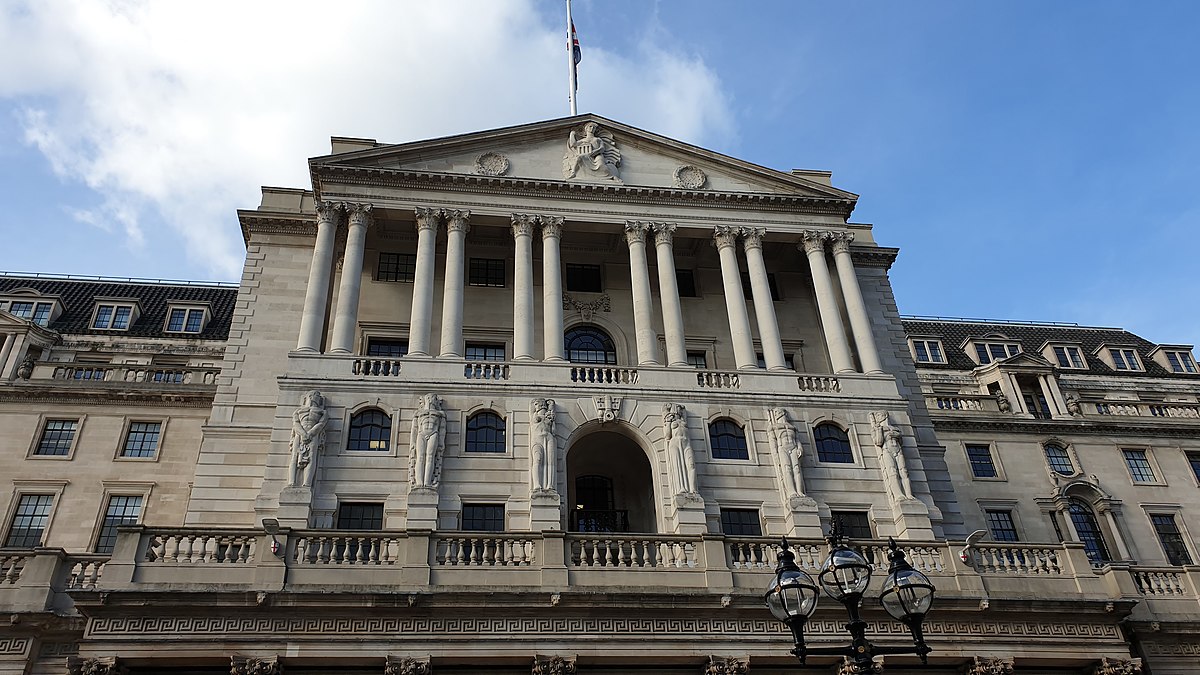
Illustrations: Bank of England facade.

Wendy M. Grossman is the 2013 winner of the Enigma Award. Her Web site has an extensive archive of her books, articles, and music, and an archive of earlier columns in this series. Follow on Mastodon or Twitter.