Disconnexion

One thing we left out in last week’s complaint is generative AI’s undoubted ability to magnify the worst of human online behavior. A few days ago, the world discovered that X’s chatbot, Grok, can be commanded to “nudify” images of women and children – that is, digitally remove their clothes without their consent. A number of commenters also note that some of the same British politicians who are calling out X and Grok about this and who more broadly insist on increasing restrictions in the name of online safety nonetheless continue to post there. Even Ashley St. Clair, the mother of one of Elon Musk’s sons, is unable to get these images taken down. Some ministers have called for banning this form of deepfake software.

Among those calling for Elon Musk to act “urgently” are technology secretary Liz Kendall and prime minister Keir Starmer. The BBC reported this morning (January 9) that the government is calling on Ofcom to use “all its powers”. At Variety, Naman Rathandran reports that X has moved AI image editing behind a paywall.

On January 2, at the National Observer, Jimmy Thompson calls on the Canadian government to delete their accounts. On Wednesday, the Commons women and equalities committee announced it would stop using X. As of January 8, both Kendall and Starmer are still posting on X, along with the UK’s Supreme Court and the Regulatory Policy committee and doubtless many others. Ofcom, the regulatory agency in charge of enforcing the Online Safety Act, posted a statement on January 5 saying it has contacted X and plans a “swift assessment to determine whether there are potential compliance issues that warrant investigation”. At the Online Safety Act Network, Lorna Woods explains the relevant law.

My guess is that few politicians manage their own social media – an extreme form of mental compartmentalization – and their aides are schooled in the belief that “we must meet the audience where they are”. In that sense, these accounts are not ordinary users, who use social media to connect to their friends and other interesting people. Politicians, like many others who are paid to show off in public, use social media to broadcast, not so much to participate. But much depends on whether you think that Grok’s behavior is one piece of a fundamental structural problem with X and its ownership or whether you believe it’s an isolated ill-thought-out feature to be solved by tweaking software, a distinction Jason Koebler explores at 404 Media.

The politicians’ accounts doubtless predate Musk’s takeover. Twitter was – and X is – small compared to other social media. But the short-burst style perfectly suited journalists, who gave it far more coverage than it probably deserved. Politicians go where they perceive the public to be, which is often signaled by media coverage.

It’s not necessarily wrong for politicians and government agencies to argue that they should be on X to serve their constituents who use it. But to legitimize that claim they should also be cross-posting on every significant platform, especially the open web. We can then argue about the threshold for “significant”. At a guess, it’s bigger than a blog but smaller than Mastodon, where politicians are notoriously absent.

***

The early 2020s’ exciting future of cryptocurrencies has gotten lost in the distraction of the last couple of years’ excitement over our new future of technologies pretending to be “smart”. In 2023’s “crypto winter”, we thought anyone still interested was either an early booster or thought they could smell profit. As Molly White wrote this week, they’ve spent the last two years nourishing grudges and building a political machine that could sink large parts of the economy.

More quietly, as Dave Birch predicted in 2017 (and repeated in his 2020 book, The Currency Cold War) “serious people” were considering their approach. Among them, Birch numbered banks, governments, and communities.

Now, governments are hatching proposals. As 2025 ended, the European Council backed the European Central Bank’s digital euro plan; the European Parliament will vote on it this year. The Financial Times reports that this electronic alternative to cash could help European central bankers pull back some control over electronic retail payments from the US organizations that dominate the field. The ECB hopes to start issuing the currency in 2029. In the UK, the Bank of England is mulling the design of the digital pound. The International Monetary Fund sees the digital euro as a continuation of financial stability.

Birch dates government interest to Facebook’s now-defunct 2019 cryptocurrency plan. Today, I imagine new motives: the US’s diminishing reliability as an ally raises the desirability of lessening reliance on its infrastructure generally. Visa, Mastercard, and other payment mechanisms largely transit US systems, a reality the FT says European banks are already working to change. In March, ECB board member Philip R. Lane argued that the digital euro will foster monetary autonomy.

We’ll see. The Economist writes that many countries are recognizing cash’s greater resilience, and are rethinking plans to go all-digital.

It remains hard to know how much central bank digital currencies will matter. As I wrote in 2023, there are few obvious benefits to individuals. For most of us the problem isn’t the mechanism for payments, it’s finding the money.

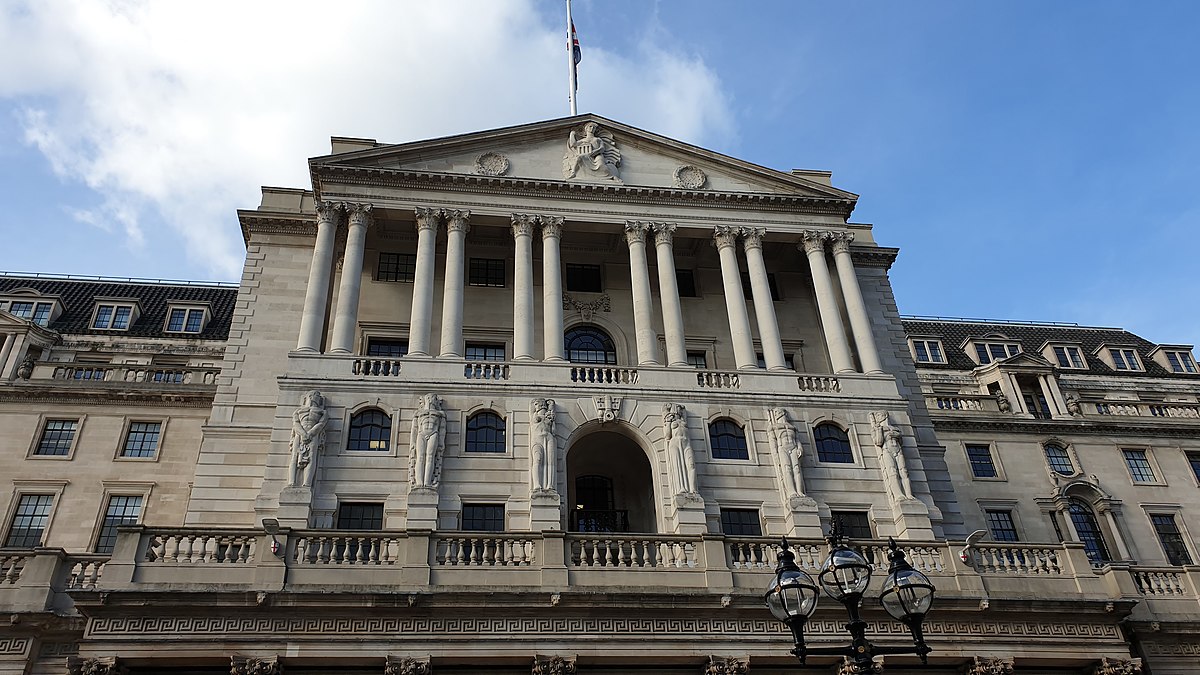
Illustrations: Bank of England facade.

Wendy M. Grossman is an award-winning journalist. Her Web site has an extensive archive of her books, articles, and music, and an archive of earlier columns in this series. She is a contributing editor for the Plutopia News Network podcast. Follow on Mastodon or Bluesky.

Cryptocurrency winter

There is nowhere in the world, Brett Scott says in his recent book, Cloudmoney, that supermarkets price oatmeal in bitcoin. Even in El Salvador, where bitcoin became legal tender in 2021, what appear to be bitcoin prices are just the underlying dollar price refracted through bitcoin’s volatile exchange rate.

Fifteen years ago, when bitcoin was invented, its adherents thought by now it would be a mainstream currency instead of a niche highly speculative instrument of financial destruction and facilitator of crime. Five years ago, the serious money people thought it important enough to consider fighting back with central bank digital currencies (CBDCs).

In 2019, Facebook announced Libra, a consortium-backed cryptocurrency that would enable payments on its platform, apparently to match China’s social media messaging system WeChat, which are used by 1 billion users monthly. By 2021, when Facebook’s holding company renamed itself Meta, Libra had become “Diem”. In January 2022 Diem was sold to Silvergate Bank, which announced in February 2023 it would wind down and liquidate its assets, a casualty of the FTX collapse.

As Dave Birch writes in his 2020 book, The Currency Cold War, it was around the time of Facebook’s announcement that central banks began exploring CBDCs. According to the Atlantic Council’s tracker, 114 countries are exploring CDBCs, and 11 have launched one. Two – Ecuador and Senegal – have canceled theirs. Plans are inactive in 15 more.
politico

The tracker marks the EU, US, and UK as in development. The EU is quietly considering the digital euro. In the US, in March 2022 president Joe Biden issued an executive order including instructions to research a digital dollar. In the UK the Bank of England has an open consultation on the digital pound (closes June 7). It will not make a decision until at least 2025 after completing technical development of proofs of concept and the necessary architecture. The earliest we’d see a digital pound is around 2030.

But first: the BoE needs a business case. In 2021, the House of Lords issued a report (PDF) calling the digital pound a “solution in search of a problem” and concluding, “We have yet to hear a convincing case for why the UK needs a retail CBDC.” Note “retail”. Wholesale, for use only between financial institutions, may have clearer benefits.

Some of the imagined benefits of CBDCs are familiar: better financial inclusion, innovation, lowered costs, and improved efficiency. Others are more arcane: replicating the role of cash to anchor the monetary system in a digital economy. That’s perhaps the strongest argument, in that today’s non-cash payment options are commercial products but cash is public infrastructure. Birch suggests that the digital pound could allow individuals to hold accounts at the BoE. These would be as risk-free as cash and potentially open to those underserved by the banking system.

Many of these benefits will be lost on most of us. People who already have bank accounts or modern financial apps are unlikely to care about a direct account with the BoE, especially if, as Birch suggests, one “innovation” they might allow is negative interest rates. More important, what is the difference between pounds as numbers in cyberspace and pounds as fancier numbers in cyberspace? For most of us, our national currencies are already digital, even if we sometimes convert some of it into physical notes and coins. The big difference – and part of what they’re fighting over – is who owns the transaction data.

At Rest of World, Temitayo Lawal recounts the experience in Nigeria., the first African country to adopt a CBDC. Launched 18 months ago, the eNaira has been tried by only 0.5% of the population and used for just 1.4 million transactions. Among the reasons Lawal finds, Nigeria’s eNaira doesn’t have the flexibility or sophistication of independent cryptocurrencies, younger Nigerians see little advantage to the eNaira over the apps they were already using, 30 million Nigerians (about 13% of the population) lack Internet access, and most people don’t want to entrust their financial information to their government. By comparison, during that time Nigerians traded $1.16 billion in bitcoin on the peer-to-peer platform Paxful.

Many of these factors play out the same way elsewhere. From 2014 to 2018, Ecuador operated Dinero Electrónico, a mobile payment system that allowed direct transfer of US dollars and aimed to promote financial inclusion. In a 2020 paper, researchers found DE never reached critical mass because it didn’t offer enough incentive for adoption, was opposed by the commercial banks, and lacked a sufficient supporting ecosystem for cashing in and out. In China, which launched its CBDC in August 2020, the e-CNY is rarely used because, the Economist reports Alipay and We Chat work well enough that retailers don’t see the need to accept it. The Bahamanian sand dollar has gained little traction. Denmark and Japan have dropped the idea entirely, as has Finland, although it supports the idea of a digital euro.

The good news, such as it is, is that by the time Western countries are ready to make a decision either some country will have found a successful formula that can be adapted, or everyone who’s tried it will have failed and the thing can be shelved until it’s time to rediscover it. That still leaves the problem that Scott warns of: a cashless society will give Big Tech and Big Finance huge power over us. We do need an alternative.

Illustrations: Bank of England facade.

Wendy M. Grossman is the 2013 winner of the Enigma Award. Her Web site has an extensive archive of her books, articles, and music, and an archive of earlier columns in this series. Follow on Mastodon or Twitter.