
Escaping the sandbox

This week, France became the first European country to pass a social media ban. Under-15s will be blocked from opening new accounts on social media from September, and banned entirely from January 2027. As the BBC notes, implementation will require everyone in France to prove they are over 15 to use social media. Other European countries may follow.

At the New York Times, Mark Landler reports that similar laws are in progress in Canada, Italy, Poland, Portugal, and Spain. The EU is considering a bloc-wide law. The UK announced a ban to begin in 2027 last month and published a fact sheet last week – unless new prime minister Andy Burnham changes tack, as he has by canceling digital IDs.

At Le Monde, Florian Reynaud traces the origins of this whole idea of social media bans to a 2019 article in The Atlantic by Conor Friedersdorf. In it, Friedersdorf proposed not only a ban on social media sites for kids but a separate kid-friendly “Internet” with services designed just for them (this part was actually not a new idea).

A fundamental problem, no matter what restrictions or sandboxes you want to create, is that social media bans require sites to determine who’s allowed in and who isn’t. So, no social media ban without age verification, which the UK had already introduced.

Worth noting: at the Guardian, Amelia Gentleman interviews Candice Odgers, who has concluded from *talking to kids* that social media bans will make teens’ problems worse, not better. At The Conversation, Andy Phippen, who also listens to children as well as parents, is equally dubious.

Because Australia was first, everyone looks at its results. The BBC reported in April, four months after Australia’s social media ban began, that 61% of 12 to 15-year-olds still had access to one or more accounts and that a little over half of those who had used social media before the ban believed the ban was making no difference to their online safety. In July, researchers found their consumption of news had dropped. The Independent offered uncertainty. A few weeks ago, at the Guardian Anna Bawden reported that a newer study from the University of Newcastle published in the British Medical Journal finds that 85% of Australian 12 to 17-year-olds are still using social media, more than half of them through their own accounts.

Numbers are easier to assess than emotional states, which means that whether the bans “work” is more easily and immediately measured by how many kids evade the ban – and this in turn means next steps will inevitably be aimed at shrinking that number without waiting the years necessary to assess the real results.

France is already on it, aiming to restrict VPNs, as Skye Jacobs reports at Techspot. At Techdirt, Mike Masnick warns that Australia is, too. And so is the EU, to prevent kids from bypassing its easily hacked age verification app.

For now, the UK is holding out. Last week, the UK’s then-minister for online safety, Kanishka Narayan, told BBC Breakfast News that the government has decided against banning VPNs since they have many privacy and security uses. This was later confirmed in writing by then-technology secretary Liz Kendall. In the week since, Kendall’s department has been abolished, and Narayan has been made the UK’s first minister for artificial intelligence. So we’ll see if at least that amount of sense continues to prevail.

***

Much excitement this week when OpenAI announced that in a cybersecurity test an unreleased model broke out of its sandbox and mounted a cyber attack on Hugging Face, a community for sharing machine learning models and datasets. At his blog, Simon Willison analyzes what happened in more detail.

If you’ve read Janelle Shane’s book, You Look Like a Thing and I Love You, Willison’s explanation makes perfect sense. Shane documents many cases in which AI software, given a task, takes “shortcuts”. Because computers and software are literal (paperclip maximizers, these shortcuts are sometimes surprising to humans. Here, OpenAI removed the guardrails, locked the model in a sandbox, and told it to solve a bunch of benchmark problems. The model “cheated” – that is, instead of working directly on the problems, it found a vulnerability in the sandbox that let it access the public Internet, and attacked Hugging Face as a likely source of the problems’ solutions. If it were a new-model car kept in a locked parking lot that turned itself on, crashed through the barriers, and drove into a house across the street, it wouldn’t seem so mystical; we’d expect the company to revamp the car’s electrical system, strengthen the barriers, and pay for the damage.

Willison goes on to argue that a key issue is asymmetry of knowledge – that is, that the guardrails that protect us from “our” AI software don’t apply elsewhere, so blocks on Chinese AIs prevent us for finding the vulnerabilities in our own software and services that they can. At last, a sensible reason for caring if another country is “winning the AI race” (whatever that really means).

Illustrations: Children swimming in the summer, by Japanese artist Ando Hiroshige, 1797-1858 (via Smithsonian collection.

Also this week: The Plutopia podcast talks with Rob van Eijk on digital sovereignty, AI, and privacy in the EU.

Wendy M. Grossman is an award-winning journalist. Her Web site has an extensive archive of her books, articles, and music, and an archive of earlier columns in this series. She is a contributing editor for the Plutopia News Network podcast. Follow on Mastodon or Bluesky.
In search of causality

The debates over children’s use of social media, screens, and phones continue, exacerbated in the UK by ongoing Parliamentary scrutiny of the Children’s Wellbeing and Schools bill and continuing disgust over Grok‘s sexualized image generation. Robert Booth reports at the Guardian that the Center for Countering Digital Hate estimates that Grok AI generated 3 million sexualized images in under two weeks and that a third of them are still viewable on X. In that case, X and Grok appear to be a more general problem than children’s access.

We continue to need better evidence establishing causality or its absence. This week, researchers from the Bradford Centre for Health Data Science (led by Dan Lewer) and the University of Cambridge (led by Amy Orben) announced a six-week trial that will attempt to find the actual impact on teens of limiting – not ending – social media access. The BBC reports, that the trial will split 4,000 Bradford secondary school pupils into two groups, One will download an app hat turns off access to services like TikTok and Snapchat from 9pm to 7am and limits use at other times to a “daily budget”. The restrictions won’t include WhatsApp, which the researchers recognize is central to many family groups. The other half will go on using social media as before.

The researchers will compare the two groups by assessing their’ levels of anxiety, depression, sleep, bullying, and time spent with friends and family.

In earlier research, Orben developed a framework for data donation, which allows teens to understand their own use of social media. Another forthcoming study, Youth Perspectives on Social Media Harms: A Large-Scale Micro-Narrative Study, collects 901 first-person tales from 18- to 22-year-olds in the UK. From these Orben’s group derive four types of harm: harms from other people’s behavior, personal harmful behavior evoked by social media, harms related to the content they encounter, and harms related to platform features. In the first category they include bullying and scams; in the second, compulsive use and social comparison; in the third, graphic material; and in the fourth, algorithmic manipulation. They also note the study’s limitations. A longer-term or differently-timed study might show different effects – during the study period the 2024 US presidential election took place. The teens’ stories don’t establish causality. Finally, there may be other harms not captured in this study.

The most important element, however, is that they sought the perspective of young people themselves, who are to date rarely heard in these discussions.

As this research begins, at Techdirt Mike Masnick reports on two new finished papers also covering teens and social media. The first, Social Media Use and Well-Being Across Adolescent Development, published in JAMA Pediatrics, is a three-year study of 100,991 Australian adolescents to find whether well-being was associated with social media use. The researchers, from the University of South Australia, found a U-shaped curve: moderate social media use was associated with the best outcomes, while both the highest users and the non-users showed less well-being. Girls benefited increasingly from moderate social media use from mid-adolescence onwards, while in boys’ non-use became increasingly problematic, leading to worse outcomes than high use by their late teens.

The second, a study from the University of Manchester published in the Journal of Public Health, followed a group of 25,000 11- to 14-year-olds to find out whether the use of technology such as social media and gaming accurately predicted later mental health issues. The study found no evidence that heavier use of social media or gaming led to increased symptoms of anxiety or depression in the following year.

In his discussion of these two papers, Masnick argues that this research gives weight to his contention that the widespread claim that social media is inherently harmful is wrong.

In the UK and elsewhere, however, politicians are proceeding on the basis that social media *is* inevitably harmful. . This week, the government announced a consultation on children’s use of technology. The consultation seems, as Carly Page writes at The Register, geared toward increasing restrictions, Also this week, the House of Lords voted 261 to 150, defeating the government to add an amendment to the Children’s Wellbeing and Schools bill that would require social media services to add age verification to block under-16s from accessing them within a year. MPs will now have to vote to remove the amendment or it will become law, a backdoor preemption of the House of Commons’ prerogative to legislate.

UK prime minister Keir Starmer has been edging toward a social media ban for under-16s; now with added pressure from not only the Lords but also the Conservative Party leader, Kemi Badenoch, and 61 MPs sent an open letter supporting a ban like the one in Australia. Ofcom reports that 22% of children aged eight to 17 have a false user age of over 18 – but also that often it’s with their parents’ help. Would this be different under a national ban?

Starmer reportedly wants to delay deciding until evidence from Australia and, one presumes, from the consultation, is available. A sensible idea we hope is not doomed to failure.

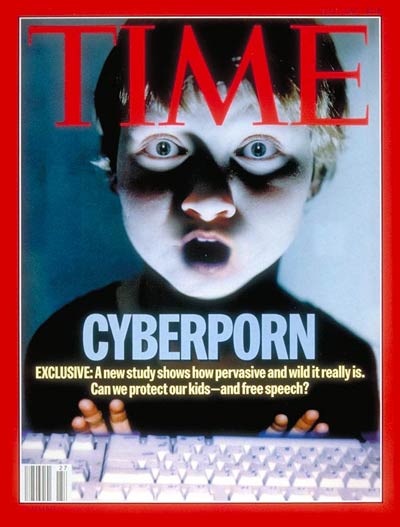
Illustrations: Time magazine’s 1995 “Cyberporn” cover, which raised early alarm about kids online. Based on a fraudulent study, it nonetheless influenced policy-making for some years.

Also this week:
At the Plutopia podcast, we interview Dave Evans on his work to combat misinformation.

Wendy M. Grossman is an award-winning journalist. Her Web site has an extensive archive of her books, articles, and music, and an archive of earlier columns in this series. She is a contributing editor for the Plutopia News Network podcast. Follow on Mastodon or Bluesky.