A short history of We Robot 2012-

On the eve of We Robot 2025, here are links to my summaries of previous years. 2014 is missing; I didn’t make it that year for family reasons. There was no conference in 2024 in order to move the event back to its original April schedule (covid caused its move to September in 2020). These are my personal impressions; nothing I say here should be taken as representing the conference, its founders, its speakers, or their institutions.

We Robot was co-founded by Michael Froomkin, Ryan Calo, and Ian Kerr to bring together lawyers and engineers to think early about the coming conflicts in robots, law, and policy.

2024 No conference.

2023 The end of cool. After struggling to design a drone delivery service that had any benefits over today’s cycling couriers, we find ourselves less impressed by robot that can do somersaults but not do anything useful.

2022 Insert a human. “Robots” are now “sociotechnical systems”.

Workshop day Coding ethics. The conference struggles to design an ethical robot.

2021 Plausible diversions. How will robots rehape human space?

Workshop day Is the juice worth the squeeze?. We think about how to regulate delivery robots, which will likely have no user-serviceable parts. Title from Woody Hartzog.

2020 (virtual) The zero on the phone. AI exploitation becomes much more visible.

2019 Math, monsters, and metaphors. The trolley problem is dissected; the true danger is less robots than the “pile of math that does some stuff”.

Workshop day The Algernon problem. New participants remind that robots/AI are carrying out the commands of distant owners.

2018 Deception. The conference tries to tease out what makes robots different and revisits Madeleine Clare Elish’s moral crumple zones after the first pedestrian death by self-driving car.

Workshop day Late, noisy, and wrong. Engineers Bill Smart and Cindy Grimm explain why sensors never capture what you think they’re capturing and how AI systems use their data.

2017 Have robot, will legislate. Discussion of risks this year focused on the intermediate sitaution, when automation and human norms clash.

2016 Humans all the way down. Madeline Clare Elish introduces “moral crumple zones”.

Workshop day: The lab and the world. Bill Smart uses conference attendees in formation to show why building a robot is difficult.

2015 Multiplicity. A robot pet dog begs its owner for an upgraded service subscription.

2014 Missed conference

2013 Cautiously apocalyptic. Diversity of approaches to regulation will be needed to handle the diversity of robots.

2012 A really fancy hammer with a gun. Unsentimental engineer Bill Smart provided the title.

wg

Optioned

The UK’s public consultation on creating a copyright exception for AI model training closed on Tuesday, and it was profoundly unsatisfying.

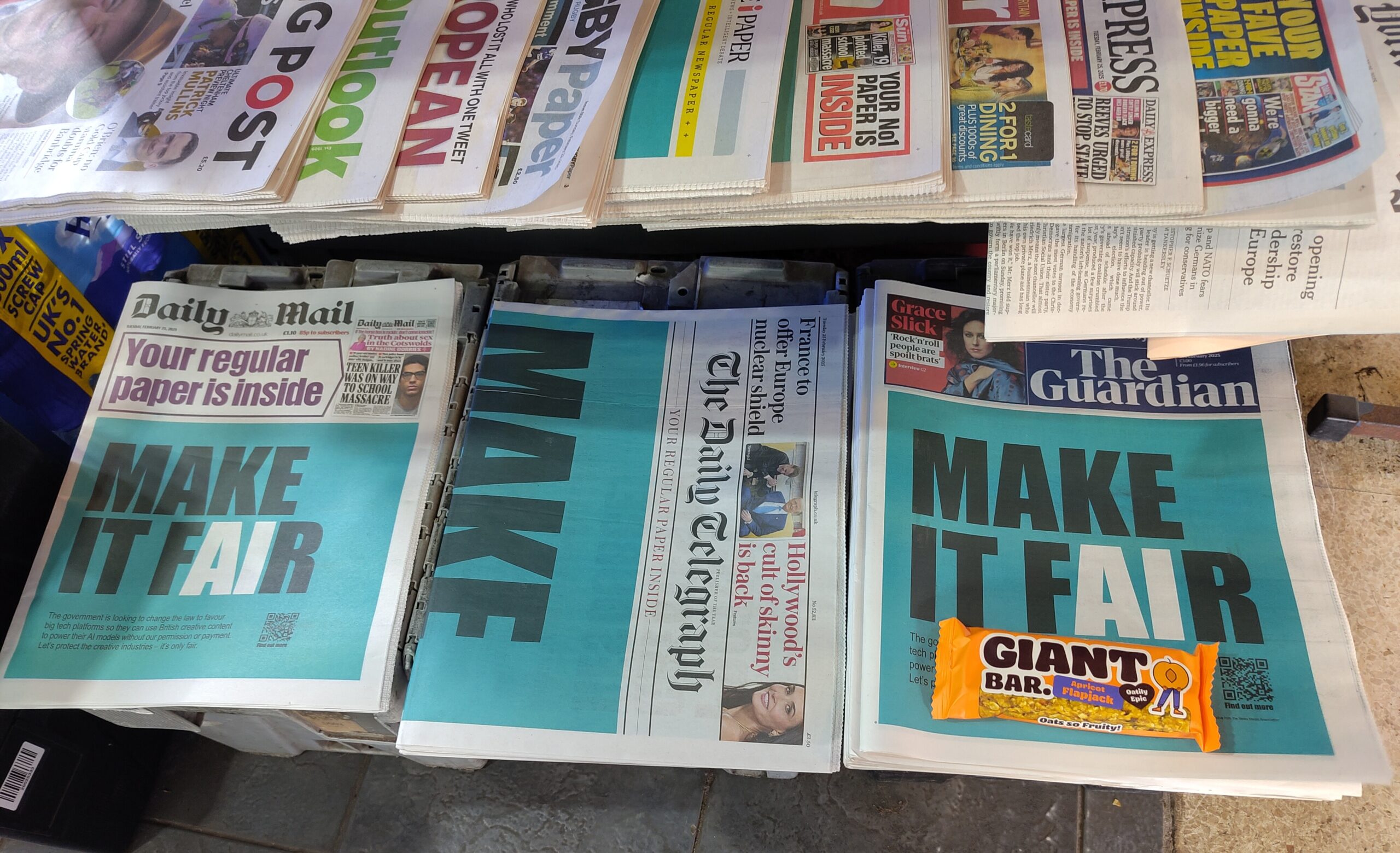
Many, many creators and rights holders (who are usually on opposing sides when it comes to contract negotiations) have opposed the government’s proposals. Every national newspaper ran the same Make It Fair front page opposing them; musicians released a silent album. In the Guardian, the peer and independent filmmaaker Beeban Kidron calls the consultation “fixed” in favor of the AI companies. Kidron’s resume includes directing Bridget Jones: The Edge of Reason (2004) and the meticulously researched 2013 study of teens online, InRealLife, and she goes on to call the government’s preferred option a “wholesale transfer of wealth from hugely successful sector that invests hundreds of millions in the UK to a tech industry that extracts profit that is not assured and will accrue largely to the US and indeed China.”

The consultation lists four options: leave the situation as it is; require AI companies to get licenses to use copyrighted work (like everyone else has to); allow AI companies to use copyrighted works however they want; and allow AI companies to use copyrighted works but grant rights holders the right to opt out.

I don’t like any of these options. I do believe that creators will figure out how to use AI tools to produce new and valuable work. I *also* believe that rights holders will go on doing their best to use AI to displace or impoverish creators. That is already happening in journalism and voice acting, and was a factor in the 2023 Hollywood writers’ strike. AI companies have already shown that won’t necessarily abide by arrangements that lack the force of law. The UK government acknowledged this in its consultation document, saying that “more than 50% of AI companies observe the longstanding Internet convention robots.txt.” So almost half of them *don’t*.

At Pluralistic, Cory Doctorow argued in February 2023 that copyright won’t solve the problems facing creators. His logic is simple: after 40 years of expanding copyright terms (from a maximum of 56 years in 1975 to “author’s life plus 70” now), creators are being paid *less* than they were then. Yes, I know Taylor Swift has broken records for tour revenues and famously took back control of her own work. but millions of others need, as Doctorow writes, structural market changes. Doctorow highlights what happened with sampling: the copyright maximalists won, and now musicians are required to sign away sampling rights to their labels, who pocket the resulting royalties.

For this sort of reason, the status quo, which the consultation calls “option 0”, seems likely to open the way to lots more court cases and conflicting decisions, but provide little benefit to anyone. A licensing regime (“option 1”) will likely go the way of sampling. If you think of AI companies as inevitably giant “pre-monopolized” outfits, like Vladen Joler at last year’s Computers, Privacy, and Data Protection conference, “Option 2” looks like simply making them richer and more powerful at the expense of everyone else in the world. But so does “option 3”, since that *also* gives AI companies the ability to use anything they want. Large rights holders will opt out and demand licensing fees, which they will keep, and small ones will struggle to exercise their rights.

As Kidron said, the government’s willingness to take chances with the country’s creators’ rights is odd, since intellectual property is a sector in which Britain really *is* a world leader. On the other hand, as Moody says, all of it together is an anthill compared to the technology sector.

None of these choices is a win for creators or the public. The government’s preferred option 3 seems unlikely to achieve its twin goals of making Britain a world leader in AI and mainlining AI into the veins of the nation, as the government put it last month.

China and the US both have complete technology stacks *and* gigantic piles of data. The UK is likely better able to matter in AI development than many countries – see for example DeepMind, which was founded here in 2010. On the other hand, also see DeepMind for the probable future: Google bought it in 2014, and now its technology and profits belong to that giant US company.

At Walled Culture, Glyn Moody argued last May that requiring the AI companies to pay copyright industries makes no sense; he regards using creative material for training purposes as “just a matter of analysis” that should not require permission. And, he says correctly, there aren’t enough such materials anyway. Instead, he and Mike Masnick at Techdirt propose that the generative AI companies should pay creators of all types – journalists, musicians, artists, filmmakers, book authors – to provide them with material they can use to train their models, and the material so created should be placed in the public domain. In turn it could become new building blocks the public can use to produce even more new material. As a model for supporting artists, patronage is old.

I like this effort to think differently a lot better than any of the government’s options.

Illustrations:: Tuesday’s papers, unprecedentedly united to oppose the government’s copyright plan.

Wendy M. Grossman is the 2013 winner of the Enigma Award. Her Web site has an extensive archive of her books, articles, and music, and an archive of earlier columns in this series. She is a contributing editor for the Plutopia News Network podcast. Follow on Mastodon or Bluesky.

Cognitive dissonance

The annual State of the Net, in Washington, DC, always attracts politically diverse viewpoints. This year was especially divided.

Three elements stood out: the divergence between the only remaining member of the Privacy and Civil Liberties Oversight Board (PCLOB) and a recently-fired colleague; a contentious panel on content moderation; and the yay, American innovation! approach to regulation.

As noted previously, on January 29 the days-old Trump administration fired PCLOB members Travis LeBlanc, Ed Felten, and chair Sharon Bradford Franklin; the remaining seat was already empty.

Not to worry, remaining member Beth Williams, said. “We are open for business. Our work conducting important independent oversight of the intelligence community has not ended just because we’re currently sub-quorum.” Flying solo she can greenlight publication, direct work, and review new procedures and policies; she can’t start new projects. A review is ongoing of the EU-US Privacy Framework under Executive Order 14086 (2022). Williams seemed more interested in restricting government censorship and abuse of financial data in the name of combating domestic terrorism.

Soon afterwards, LeBlanc, whose firing has him considering “legal options”, told Brian Fung that the outcome of next year’s reauthorization of Section 702, which covers foreign surveillance programs, keeps him awake at night. Earlier, Williams noted that she and Richard E. DeZinno, who left in 2023, wrote a “minority report” recommending “major” structural change within the FBI to prevent weaponization of S702.

LeBlanc is also concerned that agencies at the border are coordinating with the FBI to surveil US persons as well as migrants. More broadly, he said, gutting the PCLOB costs it independence, expertise, trustworthiness, and credibility and limits public options for redress. He thinks the EU-US data privacy framework could indeed be at risk.

A friend called the panel on content moderation “surreal” in its divisions. Yael Eisenstat and Joel Thayer tried valiantly to disentangle questions of accountability and transparency from free speech. To little avail: Jacob Mchangama and Ari Cohn kept tangling them back up again.

This largely reflects Congressional debates. As in the UK, there is bipartisan concern about child safety – see also the proposed Kids Online Safety Act – but Republicans also separately push hard on “free speech”, claiming that conservative voices are being disproportionately silenced. Meanwhile, organizations that study online speech patterns and could perhaps establish whether that’s true are being attacked and silenced.

Eisenstat tried to draw boundaries between speech and companies’ actions. She can still find on Facebook the sme Telegram ads containing illegal child sexual abuse material that she found when Telegram CEO Pavel Durov was arrested. Despite violating the terms and conditions, they bring Meta profits. “How is that a free speech debate as opposed to a company responsibility debate?”

Thayer seconded her: “What speech interests do these companies have other than to collect data and keep you on their platforms?”

By contrast, Mchangama complained that overblocking – that is, restricting legal speech – is seen across EU countries. “The better solution is to empower users.” Cohn also disliked the UK and European push to hold platforms responsible for fulfilling their own terms and conditions. “When you get to whether platforms are living up to their content moderation standards, that puts the government and courts in the position of having to second-guess platforms’ editorial decisions.”

But Cohn was talking legal content; Eisenstat was talking illegal activity: “We’re talking about distribution mechanisms.” In the end, she said, “We are a democracy, and part of that is having the right to understand how companies affect our health and lives.” Instead, these debates persist because we lack factual knowledge of what goes on inside. If we can’t figure out accountability for these platforms, “This will be the only industry above the law while becoming the richest companies in the world.”

Twenty-five years after data protection became a fundamental right in Europe, the DC crowd still seem to see it as a regulation in search of a deal. Representative Kat Cammack (R-FL), who described herself as the “designated IT person” on the energy and commerce committee, was particularly excited that policy surrounding emerging technologies could be industry-driven, because “Congress is *old*!” and DC is designed to move slowly. “There will always be concerns about data and privacy, but we can navigate that. We can’t deter innovation and expect to flourish.”

Others also expressed enthusiasm for “the great opportunities in front of our country”, compared the EU’s Digital Markets Act to a toll plaza congesting I-95. Samir Jain, on the AI governance panel, suggested the EU may be “reconsidering its approach”. US senator Marsha Blackburn (R-TN) highlighted China’s threat to US cybersecurity without noting the US’s own goal, CALEA.

On that same AI panel, Olivia Zhu, the Assistant Director for AI Policy for the White House Office of Science and Technology Policy, seemed more realistic: “Companies operate globally, and have to do so under the EU AI Act. The reality is they are racing to comply with [it]. Disengaging from that risks a cacophony of regulations worldwide.”

Shortly before, Johnny Ryan, a Senior Fellow at the Irish Council for Civil Liberties posted: “EU Commission has dumped the AI Liability Directive. Presumably for “innovation”. But China, which has the toughest AI law in the world, is out innovating everyone.”

Illustrations: Kat Cammack (R-FL) at State of the Net 2025.

Wendy M. Grossman is the 2013 winner of the Enigma Award. Her Web site has an extensive archive of her books, articles, and music, and an archive of earlier columns in this series. She is a contributing editor for the Plutopia News Network podcast. Follow on Mastodon or Bluesky.

The Gulf of Google

In 1945, the then mayor of New York City, Fiorello La Guardia signed a bill renaming Sixth Avenue. Eighty years later, even with street signs that include the new name, the vast majority of New Yorkers still say things like, “I’ll meet you at the southwest corner of 51st and Sixth”. You can lead a horse to Avenue of the Americas, but you can’t make him say it.

US president Donald Trump’s order renaming the Gulf of Mexico offers a rarely discussed way to splinter the Internet (at the application layer, anyway; geography matters!), and on Tuesday Google announced it would change the name for US users of its Maps app. As many have noted, this contravenes Google’s 2008 policy on naming bodies of water in Google Earth: “primary local usage”. A day later, reports came that Google has placed the US on its short list of sensitive countries – that is, ones whose rulers dispute the names and ownership of various territories: China, Russia, Israel, Saudi Arabia, Iraq.

Sharpieing a new name on a map is less brutal than invading, but it’s a game anyone can play. Seen on Mastodon: the bay, now labeled “Gulf of Fragile Masculinity”.

***

Ed Zitron has been expecting the generative AI bubble to collapse disastrously. Last week provided an “Is this it?” moment when the Chinese company DeepSeek released reasoning models that outperform the best of the west at a fraction of the cost and computing power. US stock market investors: “Let’s panic!”

The code, though not the training data, is open source, as is the relevant research. In Zitron’s analysis, the biggest loser here is OpenAI, though it didn’t seem like that to investors in other companies, especially Nvidia, whose share price dropped 17% on Tuesday alone. In an entertaining sideshow, OpenAI complains that DeepSeek stole its code – ironic given the history.

On Monday, Jon Stewart quipped that Chinese AI had taken American AI’s job. From there the countdown started until someone invoked national security.

Nvidia’s chips have been the picks and shovels of generative AI, just as they were for cryptocurrency mining. In the latter case, Nvidia’s fortunes waned when cryptocurrency prices crashed, ethercoin, among others, switched to proof of stake, and miners shifted to more efficient, lower-cost application-specific integrated circuits. All of these lowered computational needs. So it’s easy to believe the pattern is repeating with generative AI.

There are several ironies here. The first is that the potential for small language models to outshine large ones has been known since at least 2020, when Timnit Gebru, Emily Bender, Margaret Mitchell, and Angelina McMillan-Major published their stochastic parrots paper. Google soon fired Gebru, who told Bloomberg this week that AI development is being driven by FOMO rather than interesting questions. Second, as an AI researcher friend points out, Hugging Face, which is trying to replicate DeepSeek’s model from scratch, said the same thing two years ago. Imagine if someone had listened.

***

A work commitment forced me to slog through Ross Douthat’s lengthy interview with Marc Andreessen at the New York Times. Tl;dr: Andreessen says Silicon Valley turned right because Democrats broke The Deal under which Silicon Valley supported liberal democracy and the Democrats didn’t regulate them. In his whiny victimhood, Andreessen has no recognition that changes in Silicon Valley’s behavior – and the scale at which it operates – are *why* Democrats’ attitudes changed. If Silicon Valley wants its Deal back, it should stop doing things that are obviously exploitive. Random case in point: Hannah Ziegler reports at the Washington Post that a $1,700 bassinet called a “Snoo” suddenly started demanding $20 per month to keep rocking a baby all night. I mean, for that kind of money I pretty much expect the bassinet to make its own breast milk.

***

Almost exactly eight years ago, Donald Trump celebrated his installation in the US presidency by issuing an executive order that risked up-ending the legal basis for data flows between the EU, which has strict data protection laws, and the US, which doesn’t. This week, he did it again.

In 2017, Executive Order 13768 dominated Computers, Privacy, and Data Protection. The deal in place at the time, Privacy Shield, eventually survived until 2020, when it was struck down in lawyer Max Schrems’s second such case. It was replaced by the Transatlantic Data Privacy Framework, which established the five-member Privacy and Civil Liberties Oversight Board to oversee surveillance and, as Politico explains, handle complaints from Europeans about misuse of their data.

This week, Trump rendered the board non-operational by firing its three Democrats, leaving just one Republican-member in place.*

At Techdirt, Mike Masnick warns the framework could collapse, costing Facebook, Instagram, WhatsApp, YouTube, exTwitter, and other US-based services (including Truth Social) their European customers. At his NGO, noyb, Schrems himself takes note: “This deal was always built on sand.”

Schrems adds that another Trump Executive Order gives 45 days to review and possibly scrap predecessor Joe Biden’s national security decisions, including some the framework also relies on. Few things ought to scare US – and, in a slew of new complaints, Chinese – businesses more than knowing Schrems is watching.

Illustrations: The Gulf of Mexico (NASA, via Wikimedia).

*Corrected to reflect that the three departing board members are described as Democrats, not Democrat-appointed. In fact, two of them, Ed Felten and Travis LeBlanc, were appointed by Trump in his original term.

Wendy M. Grossman is the 2013 winner of the Enigma Award. Her Web site has an extensive archive of her books, articles, and music, and an archive of earlier columns in this series. She is a contributing editor for the Plutopia News Network podcast. Follow on Mastodon or Bluesky.

The AI moment

“Why are we still talking about digital transformation?” The speaker was convening a session at last weekend’s UK Govcamp, an event organized by and for civil servants with an interest in digital stuff.

“Because we’ve failed?” someone suggested. These folks are usually *optimists*.

Govcamp is a long-running tradition that began as a guerrilla effort in 2008. At the time, civil servants wanting to harness new technology in the service of government were so thin on the ground they never met until one of them, Jeremy Gould, convened the first Govcamp. These are people who are willing to give up a Saturday in order to do better at their jobs working for us. All hail.

It’s hard to remember now, nearly 15 years on, the excitement in 2010 when David Cameron’s incoming government created the Government Digital Service and embedded it into the Cabinet Office. William Heath immediately ended the Ideal Government blog he’d begun writing in 2004 to press insistently for better use of digital technologies in government. The government had now hired all the people he could have wanted it to, he said, and therefore, “its job is done”.

Some good things followed: tilting government procurement to open the way for smaller British companies, consolidating government publishing, other things less visible but still important. Some data became open. This all has improved processes like applying for concessionary travel passes and other government documents, and made government publishing vastly more usable. The improvement isn’t universal: my application last year to renew my UK driver’s license was sent back because my signature strayed outside the box provided for it.

That’s just one way the business of government doesn’t feel that different. The whole process of developing legislation – green and white papers, public consultations, debates, and amendments – marches on much as it ever has, though with somewhat wider access because the documents are online. Thoughts about how to make it more participatory were the subject of a teacamp in 2013. Eleven years on, civil society is still reading and responding to government consultations in the time-honored way, and policy is still made by the few for the many.

At Govcamp, the conversation spread between the realities of their working lives and the difficulties systems posed for users – that is, the rest of us. “We haven’t removed those little frictions,” one said, evoking the old speed comparisons between Amazon (delivers tomorrow or even today) and the UK government (delivers in weeks, if not months).

“People know what good looks like,” someone else said, in echoing that frustration. That’s 2010-style optimism, from when Amazon product search yielded useful results, search engines weren’t spattered with AI slime and blanketed with ads, today’s algorithms were not yet born, and customer service still had a heartbeat. Here in 2025, we’re all coming up against rampant enshittification, with the result that the next cohort of incoming young civil servants *won’t* know any more what “good” looks like. There will be a whole new layer of necessary education.

Other comments: it’s evolution, not transformation; resistance to change and the requirement to ask permission are embedded throughout the culture; usability is still a problem; trying to change top-down only works in a large organization if it sets up an internal start-up and allows it to cannibalize the existing business; not enough technologists in most departments; the public sector doesn’t have the private sector option of deciding what to ignore; every new government has a new set of priorities. And: the public sector has no competition to push change.

One suggestion was that technological change happens in bursts – punctuated equilibrium. That sort of fits with the history of changing technological trends: computing, the Internet, the web, smartphones, the cloud. Today, that’s “AI”, which prime minister Keir Starmer announced this week he will mainline into the UK’s veins “for everything from spotting potholes to freeing up teachers to teach”.

The person who suggested “punctuated equilibrium” added: “Now is a new moment of change because of AI. It’s a new ‘GDS moment’.” This is plausible in the sense that new paradigms sometimes do bring profound change. Smartphones changed life for homeless people. On the other hand, many don’t do much. Think audio: that was going to be a game-changer, and yet after years of loss-making audio assistants, most of us are still typing.

So is AI one of those opportunities? Many brought up generative AI’s vast consumption of energy and water and rampant inaccuracy. Starmer, like Rishi Sunak before him, seems to think AI can make Britain the envy of other major governments.

Complex systems – such as digital governance – don’t easily change the flow of information or, therefore, the flow of power. It can take longer than most civil servants’ careers. Organizations like Mydex, which seeks to up-end today’s systems to put users in control, have been at work for years now. The upcoming digital identity framework has Mydex chair Alan Mitchell optimistic that the government’s digital identity framework is a breakthrough. We’ll see.

One attendee captured this: “It doesn’t feel like the question has changed from more efficient bureaucracy to things that change lives.” Said another in response, “The technology is the easy bit.”

Illustrations: Sir Humphrey Appleby (Nigel Hawthorne), Bernard Woolley (Derek Fowldes), and Jim Hacker (Paul Eddington) arguing over cultural change in Yes, Minister.

Wendy M. Grossman is the 2013 winner of the Enigma Award. Her Web site has an extensive archive of her books, articles, and music, and an archive of earlier columns in this series. She is a contributing editor for the Plutopia News Network podcast. Follow on Mastodon Bluesky.

The lost Internet

As we open 2025 it would be traditional for an Old Internet Curmudgeon to rhapsodize about the good, old days of the 1990s, when the web was open, snark flourished at sites like suck.com, no one owned social media (that is, Usenet and Internet Relay Chat), and even the spam was relatively harmless.

But that’s not the period I miss right now. By “lost” I mean the late 2000s, when we shifted from an Internet of largely unreliable opinions to an Internet full of fact-based sites you could trust. This was the period during which Wikipedia (created 2001) grew up, and Open Street Map (founded 2004) was born, joining earlier sites like the Internet Archive (founded 1996) and Snopes (1994). In that time, Google produced useful results, blogs flourished, and before it killed them if you asked on Twitter for advice on where to find a post box near a point in Liverpool you’d get correct answers straight to your mobile phone.

Today, so far: I can’t get a weather app to stop showing the location I was at last week and show the location I’m at this week. Basically, the app is punishing me for not turning on location tracking. The TV remote at my friend’s house doesn’t fully work and she doesn’t know why or how to fix it; she works around it with a second remote whose failings are complementary. No calendar app works as well as the software I had 1995-2001 (it synced! without using a cloud server and third-party account!). At the supermarket, the computer checkout system locked up. It all adds up to a constant white noise of frustration.

We still have Wikipedia, Open Street Map, Snopes, and the Internet Archive. But this morning a Mastodon user posted that their ten-year-old says you can’t trust Google any more: “It just returns ‘a bunch of madeup stuff’.” When ten-year-olds know your knowledge product sucks…

If generative AI were a psychic we’d call what it does cold reading.

At his blog, Ed Zitron has published a magnificent, if lengthy, rant on the state ot technology. “The rot economy”, he calls it, and says we’re all victims of constant low-level trauma. Most of his complaints will be familiar: the technologies we use are constantly shifting and mostly for the worse. My favorite line: “We’re not expected to work out ‘the new way to use a toilet’ every few months because somebody decided we were finishing too quickly.”

Pause to remember nostalgically 2018, when a friend observed that technology wasn’t exciting any more and 2019, when many more people thought the Internet was no longer “fun”. Those were happy days. Now we are being overwhelmed with stuff we actively don’t want in our lives. Even hacked Christmas lights sound miserable for the neighbors.

***

I have spent some of these holidays editing a critique of Ofcom’s regulatory plans under the Online Safety Act (we all have our own ideas about holidays), and one thing seems clear: the splintering Internet is only going to get worse.

Yesterday, firing up Chrome because something didn’t work in Firefox, I saw a fleeting popup to the effect that because I may not be over 18 there are search results Google won’t show me. I don’t think age verification is in force in the Commonwealth of Pennsylvania – US states keep passing bills, but hit legal challenges.

Age verification has been “imminent” in the UK for so long – it was originally included in the Digital Economy Act 2017 – that it seems hard to believe it may actually become a reality. But: sites within the Act’s scope will have to complete an “illegal content risk assessment” by March 16. So the fleeting popup felt like a visitation from the Ghost of Christmas Future.

One reason age verification was dropped back then – aside from the distractions of Brexit – was that the mechanisms for implementing it were all badly flawed – privacy-invasive, ineffective, or both. I’m not sure they’ve improved much. In 2022, France’s data protection watchdog checked them out: “CNIL finds that such current systems are circumventable and intrusive, and calls for the implementation of more privacy-friendly models.”

I doubt Ofcom can square this circle, but the costs of trying will include security, privacy, freedom of expression, and constant technological friction. Bah, humbug.

***

Still, one thing is promising: the rise of small, independent media outlets wbo are doing high-quality work. Joining established efforts like nine-year-old The Ferret, ten-year-old Bristol Cable, and five-year-old Rest of World are year-and-a-half-old 404 Media and newcomer London Centric. 404Media, formed by four journalists formerly at Vice’s Motherboard, has been consistently making a splash since its founding; this week Jason Koebler reminds that Elon Musk’s proactive willingness to unlock the blown-up cybertruck in Las Vegas and provide comprehensive data on where it’s been, including video from charging stations, without warrant or court order, could apply to any Tesla customer at any time. Meanwhile, in its first three months London Centric’s founding journalist, Jim Waterson, has published pieces on the ongoing internal mess at Transport for London resulting from the August cyberattack and bicycle theft in the capital. Finally, if you’re looking for high-quality American political news, veteran journalist Dan Gillmore curates it for you every day in his Cornerstone of Democracy newsletter.

The corporate business model of journalism is inarguably in trouble, but journalism continues.

Happy new year.

Illustrations: The Marx Brothers in their 1929 film, The Cocoanuts, newly released into the public domain.

Wendy M. Grossman is the 2013 winner of the Enigma Award. Her Web site has an extensive archive of her books, articles, and music, and an archive of earlier columns in this series. She is a contributing editor for the Plutopia News Network podcast. Follow on Mastodon or Bluesky.
Loose ends

Privacy technologies typically fail for one of two reasons: 1) they’re too complicated and/or expensive to find widespread adoption among users; 2) sites and services ignore, undermine, or bypass them in order to preserve their business model. In the first category are numerous privacy-enhancing technologies that failed to make their case in the marketplace. Among examples of the first category are numerous encryption-related attempts to secure communications. Repeated failures in the marketplace, usually because the resulting products were too technically difficult for most users, they never found mass adoption. In the end, encrypted messaging didn’t really took off until WhatsApp built it into its service.

This week saw a category two failure: Mozilla announced it is removing the Do Not Track option from Firefox’s privacy settings. DNT is simple enough to implement if you can stand to check and change settings, but it falls on the wrong side of modern business models and, other than in California, the US has no supporting legislation to make it enforceable. Granted, Firefox is a minority browser now, but the moment feels significant for this 13-year-old technology.

As Kevin Purdy explains at Ars Technica, DNT began as an FTC proposal, based on work by Christopher Soghoian and Sid Stamm, that aimed to create a mechanism for the web similar to the “Do Not Call” list for telephone networks.

The world in which DNT seemed a hopeful possibility seems almost quaint now: then, one could still imagine that websites might voluntarily respect the signal web browsers sent indicating users’ preferences. Do Not Call, by contrast, was established by US federal legislation. Despite various efforts, the US failed to pass legislation underpinning DNT, and it never became a web standard. The closest it has come to the latter is Section 2.12 of the W3C’s Ethical Web Principles, which says, “People must be able to change web pages according to their needs.” Can I say I *need* to not be tracked?

Even at the time it seemed doubtful that web companies would comply. But it also suffered from unfortunate timing. DNT arrived just as the twin onslaught of smartphones and social media was changing the ethos that built the open web. Since then, as Cory Doctor wrote earlier this year, the incentives have aligned to push web browsers to become faithless user agents, and conventions mean less and less.

Ultimately, DNT only ever worked insofar as users could trust websites to honor their preference. As it’s become clear they can’t, ad blockers have proliferated, depriving sites of ad revenue they need to survive. Had DNT been successful, perhaps we’d have all been better off.

***

Also on the way out this week is Cruise’s San Francisco robotaxis. My last visit to San Francisco, about a year ago, was the first time I saw these in person. Most of the ones I saw were empty Waymos, perhaps in transit to a passenger, perhaps just pointlessly clogging the streets. Around then, a Cruise robotaxi ran over a pedestrian who’d been hit by another car and then dragged her 20 feet. San Francisco promptly suspended Cruise’s license. Technology critic Paris Marx thought the incident would likely be Cruise’s “death knell”. And so it’s proving. The announcement from GM, which acquired Cruise in 2016 for $1 billion, leaves just Waymo standing in the US self-driving taxi business, with Tesla saying it will enter the market late next year.

I always associate robotaxis with Vernor Vinge‘s 2006 novel Rainbows End. In it, Vinge imagined a future in which robotaxis arrived within minutes of being hailed and replaced both public transport and private car ownership. By 2012 or so, his fictional imagining had become real-life projection, and many were predicting that our streets would imminently be filled with self-driving cars, taxis or not. In 2017, the conversation was all about what ethics to program into them and reclaiming urban space. Now, that imagined future seems to be receding, as skeptics predicted it would.

***

American journalism has long operated under the presumption that the stories it produces should be “neutral”. Now, at the LA Times, CEO Patrick Soon-Shiong thinks he can enforce this neutrality by running an AI-based “bias meter” over the paper’s stories. If you remember, in the late stages of the US presidential election, Soon-Shiong blocked the paper from endorsing Kamala Harris. Reports say that the bias meter, due out next month, is meant to identify any bias the story’s source has and then deliver “both sides” of that story.

This is absurd. Few news stories have just two competing sides. A biased source can’t be countered by rewriting the story unless you include more sources and points of view, which means additional research. Most important, AI can’t think.

But readers can. And so what this story says is that Soon-Shiung doesn’t trust either the journalists who work for him or the paper’s readers to draw the conclusions he wants. If he knew more about journalism, he’d know that readers generally don’t adopt opinions just because someone tells them to. The far greater power, I recall reading years ago, lies in determining what readers *think about* by deciding what topics are important enough to cover. There’s bias there, too, but Soon-Shiong’s meter won’t show it.

Illustrations: Dominic Wilccox‘s concept driverless sleeper car, 2014.

Wendy M. Grossman is the 2013 winner of the Enigma Award. Her Web site has an extensive archive of her books, articles, and music, and an archive of earlier columns in this series. She is a contributing editor for the Plutopia News Network podcast. Follow on Mastodon or Bluesky.

Playing monopoly

If you were going to carve up today’s technology giants to create a more competitive landscape, how would you do it? This time the game’s for real. In August, US District Judge Amit Mehta ruled that, “Google is a monopolist and has acted as one to maintain its monopoly.” A few weeks ago, the Department of Justice filed preliminary proposals (PDF) for remedies. These may change before the parties reassemble in court next April.

Antitrust law traditionally aimed to ensure competition in order to create both a healthy business ecosystem and better serve consumers. “Free” – that is, pay-with-data – online services have been resistant to antitrust analysis through decades of focusing on lowered prices to judge success.

It’s always tempting to think of breaking monopolists up into business units. For example, a key moment in Meta’s march to huge was its purchase of WhatsApp (2014) and Instagram (2012), turning baby competitors into giant subsidiaries. In the EU, that permission was based on a promise, which Meta later broke, not to merge the three companies’ databases. Separating them back out again to create three giant privacy-invading behemoths in place of one is more like the sorceror’s apprentice than a win.

In the late 1990s case against Microsoft, which ended in settlement, many speculated about breaking it up into Baby Bills. The key question: create clones or divide up the Windows and office software?

In 2013, at ComputerWorld Gregg Keizer asked experts to imagine the post-Microsoft-breakup world. Maybe the office software company ported its products onto the iPad. Maybe the clones eventually diverged and one would have dominated search. Keizer’s experts generally agree, though, that the antitrust suit itself had its effects, slowing the company’s forward progress by making it fear provoking further suits, like IBM before it.

In Google’s case, the key turning point was likely the 2007-2008 acquisition of online advertising pioneer DoubleClick. Google was then ten years old and had been a public company for almost four years. At its IPO Wall Street pundits were dismissive, saying it had no customer lock-in and no business model.

Reading Google’s 2008 annual report is an exercise in nostalgia. Amid an explanation of contextual advertising, Google says it has never spent much on marketing because the quality of its products generated word of mouth momentum worldwide. This was all true – then.

At the time, privacy advocates opposed the DoubleClick merger. Both FTC and EU regulators raised concerns, but let it go ahead to become the heart of the advertising business Susan Wojcicki and Sheryl Sandberg built for Google. Despite growing revenues from its cloud services business, most of Google’s revenues still come from advertising.

Since then, Mehta ruled, Google cemented its dominance by paying companies like Apple, Samsung, and Verizon to make its search engine the default on the devices they make and/or sell. Further, Google’s dominance – 90% of search – allows it to charge premium rates for search ads, which in turn enhances its financial advantage. OK, one of those complaining competitors is Microsoft, but others are relative minnows like 15-year-old DuckDuckGo, which competes on privacy, buys TV ads, and hasn’t cracked 1% of the search market. Even Microsoft’s Bing, at number two, has less than 4%. Google can insist that it’s just that good, but complaints that its search results are degrading are everywhere.

Three aspects of the DoJ’s proposals seized the most attention: forcing Google to divest itself of the Chrome browser; second, if that’s not enough, to divest the Android mobile operating system; and third a block on paying other companies to make Google search the default. The latter risks crippling Mozilla and Firefox, and would dent Apple’s revenues, but not really harm Google. Saving $26.3 billion (2021 number) can’t be *all* bad.

At The Verge, Lauren Feiner summarizes the DoJ’s proposals. At the Guardian, Dan Milmo notes that the DoJ also wants Google to be barred from buying or investing in search rivals, query-based AI, or adtech – no more DoubleClicks.

At Google’s blog, chief legal officer Kent Walker calls the proposals “a radical interventionist agenda”. He adds that it would chill Google’s investment in AI like this is a bad thing, when – hello! – a goal is ensuring a competitive market in future technologies. (It could even be a good thing generally.)

Finally, Walker claims divesting Chrome and/or Android would endanger users’ security and privacy and frets that it would expose Americans’ personal search queries to “unknown foreign and domestic companies”. Adapting a line from the 1980 movie Hopscotch, “You mean, Google’s methods of tracking are more humane than the others?” While relaying DuckDuckGo’s senior vice-president’s similar reaction, Ars Technica’s Ashley Belanger dubs the proposals “Google’s nightmare”.

At Techdirt, Mike Masnick favors DuckDuckGo’s idea of forcing Google to provide access to its search results via an API so competitors can build services on top, as his company does with Bing. Masnick wants users to become custodians and exploiters of their own search histories. Finally, at Pluralistic, Cory Doctorow likes spinning out – not selling – Chrome. End adtech surveillance, he writes, don’t democratize it.

It’s too early to know what the DoJ will finally recommend. If nothing is done, however, Google will be too rich to fear future lawsuits.

Illustration: Mickey Mouse as the sorceror’s apprentice in (1940).

Wendy M. Grossman is the 2013 winner of the Enigma Award. Her Web site has an extensive archive of her books, articles, and music, and an archive of earlier columns in this series. She is a contributing editor for the Plutopia News Network podcast. Follow on Mastodon or Bluesky.

Review: Supremacy

Supremacy: AI, ChatGPT, and the Race That Will Change the World
By Parmy Olson
Macmillan Business
ISBN: 978-1035038220

One of the most famous books about the process of writing software is Frederick Brooks’ The Mythical Man Month. The essay that gives the book its title makes the point that you cannot speed up the process by throwing more and more people at it. The more people you have, the more they have to all communicate with each other, and the pathways multiply exponentially. Think of it this way: 500 people can’t read a book faster than five people can.

Brooks’ warning immediately springs to mind when Parmy Olson reports, late in her new book, Supremacy, that Microsoft CEO Sadya Nadella was furious to discover that Microsoft’s 5,000 direct employees working on AI lagged well behind the rapid advances being made by the fewer than 200 working working at OpenAI. Some things just aren’t improved by parallel processing.

The story Olson tells is a sad one: two guys, both eager to develop an artificial general intelligence in order to save, or least help, humanity, who both wind up working for large commercial companies whose primary interests are to 1) make money and 2) outcompete the other guy. For Demis Hassabis, the company was Google, which bought his DeepMind startup in 2014. For Sam Altman, founder of OpenAI, it was Microsoft. Which fits: Hassabis’s approach to “solving AI” was to let them teach themselves by playing games, hoping to drive science discovery; Altman sought to solve real-world problems and bring everyone wealth. Too late for Olson’s book, Hassabis has achieved enough of a piece of his dream to have been one of three awarded the 2024 Nobel Prize in chemistry for using AI to predict how proteins will fold.

For both the reason was the same: the resources they sought to work in AI – data, computing power, and high-priced personnel – are too expensive for either traditional startup venture capital funding or for academia. (Cure Vladen Joler, at this year’s Computers, Privacy, and Data Protection, noting that AI is arriving “pre-monopolized”.) As Olson tells the story, they both tried repeatedly to keep the companies they founded independent. Yet, both have wound up positioned to run the companies whose money they took apparently believing, like many geek founders with more IQ points than sense, that they would not have to give up control.

In comparing and contrasting the two founders, Olson shows where many of today’s problems came from. Allying themselves with Big Tech meant giving up on transparency. The ethicists who are calling out these companies over real and present harms caused by the tools they’ve built, such as bias, discrimination, and exploitation of workers performing tasks like labeling data, have 1% or less of the funding of those pushing safety for superintelligences that may never exist.

Olson does a good job of explaining the technical advances that led to the breakthroughs of recent years, as well as the business and staff realities of their different paths. A key point she pulls out is the extent to which both Google and Microsoft have become the kind of risk-averse, slow-moving, sclerotic company they despised when they were small, nimble newcomers.

Different paths, but ultimately, their story is the same: they fought the money, and the money won.

Blown

“This is a public place. Everyone has the right to be left in peace,” Jane (Vanessa Redgrave) tells Thomas (David Hemmings), whom she’s just spotted photographing her with her lover in the 1966 film Blow-Up, by Michelangelo Antonioni. The movie, set in London, proceeds as a mystery in which Thomas’s only tangible evidence is a grainy, blown-up shot of a blob that may be a murdered body.

Today, Thomas would probably be wielding a latest-model smartphone instead of a single lens reflex film camera. He would not bother to hide behind a tree. And Jane would probably never notice, much less challenge Thomas to explain his clearly-not-illegal, though creepy, behavior. Phones and cameras are everywhere. If you want to meet a lover and be sure no one’s photographing you, you don’t go to a public park, even one as empty as the film finds Maryon Park. Today’s 20-somethings grew up with that reality, and learned early to agree some gatherings are no-photography zones.

Even in the 1960s individuals had cameras, but taking high-quality images at a distance was the province of a small minority of experts; Antonioni’s photographer was a professional with his own darkroom and enlarging equipment. The first CCTV cameras went up in the 1960s; their proliferation became public policy issue in the 1980s, and was propagandized as “for your safety without much thought in the post-9/11 2000s. In the late 2010s, CCTV surveillance became democratized: my neighbor’s Ring camera means no one can leave an anonymous gift on their doorstep – or (without my consent) mine.

I suspect one reason we became largely complacent about ubiquitous cameras is that the images mostly remained unidentifiable, or at least unidentified. Facial recognition – especially the live variant police seem to feel they have the right to set up at will – is changing all that. Which all leads to this week, when Joseph Cox at 404 Media reports ($) (and Ars Technica summarizes) that two Harvard students have mashed up a pair of unremarkable $300 Meta Ray-Bans with the reverse image search service Pimeyes and a large language model to produce I-XRAY, an app that identifies in near-real time most of the people they pass on the street, including their name, home address, and phone number.

The students – AnhPhu Nguyen and Caine Ardayfio – are smart enough to realize the implications, imagining for Cox the scenario of a random male spotting a young woman and following her home. This news is breaking the same week that the San Francisco Standard and others are reporting that two men in San Francisco stood in front of a driverless Waymo taxi to block it from proceeding while demanding that the female passenger inside give them her phone number (we used to give such males the local phone number for time and temperature).

Nguyen and Ardayfio aren’t releasing the code they’ve written, but what two people can do, others with fewer ethics can recreate independently, as 30 years of Black Hat and Def Con have proved. This is a new level of democratizated surveillance. Today, giant databases like Clearview AI are largely only accessible to governments and law enforcement. But the data in them has been scraped from the web, like LLMs’ training data, and merged with commercial sources

This latest prospective threat to privacy has been created by the marriage of three technologies that were developed separately by different actors without regard to one another and, more important, without imagining how one might magnify the privacy risks of the others. A connected car with cameras could also run I-XRAY.

The San Francisco story is a good argument against allowing cars on the roads without steering wheels, pedals, and other controls or *something* to allow a passenger to take charge to protect their own safety. In Manhattan cars waiting at certain traffic lights often used to be approached by people who would wash the windshield and demand payment. Experienced drivers knew to hang back at red lights so they could roll forward past the oncoming would-be washer. How would you do this in a driverless car with no controls?

We’ve long known that people will prank autonomous cars. Coverage focused on the safety of the *cars* and the people and vehicles surrounding them, not the passengers. Calling a remote technical support line for help is never going to get a good enough response.

What ties these two cases together – besides (potentially) providing new ways to harass women – is the collision between new technologies and human nature. Plus, the merger of three decades’ worth of piled-up data and software that can make things happen in the physical world.

Arguably, we should have seen this coming, but the manufacturers of new technology have never been good at predicting what weird things their users will find to do with it. This mattered less when the worst outcome was using spreadsheet software to write letters. Today, that sort of imaginative failure is happening at scale in software that controls physical objects and penetrates the physical world. The risks are vastly greater and far more unsettling. It’s not that we can’t see the forest for the trees; it’s that we can’t see the potential for trees to aggregate into a forest.

Illustrations: Jane (Vanessa Redgrave) and her lover, being photographed by Thomas (David Hemmings) in Michelangelo Antonioni’s 1966 film, Blow-Up.

Wendy M. Grossman is the 2013 winner of the Enigma Award. Her Web site has an extensive archive of her books, articles, and music, and an archive of earlier columns in this series. She is a contributing editor for the Plutopia News Network podcast. Follow on Mastodon.