Return of the Four Horsemen

The themes at this week’s Scrambling for Safety, hosted by the Foundation for Information Policy Research, are topical but not new since the original 1997 event: chat control; the online safety act; and AI in government decision making.

The EU proposal chat control would require platforms served with a detection order to scan people’s phones for both new and previously known child sexual abuse materialclient-side scanning. Robin Wilton prefers to call this “preemptive monitoring” to clarify that it’s an attack.

Yet it’s not fit even for its stated purpose, as Claudia Peersman showed, based on research conducted at REPHRAIN. They set out to develop a human-centric evaluation framework for the AI tools needed at the scale chat control would require. Their main conclusion: AI tools are not ready to be deployed on end-to-end-encrypted private communications. This was also Ross Anderson‘s argument in his 2022 paper on chat control (PDF) showing why it won’t meet the stated goals. Peersman also noted an important oversight: none of the stakeholder groups consulted in developing these tools include the children they’re supposed to protect.

This led Jen Persson to ask: “What are we doing to young people?” Children may not understand encryption, she said, but they do know what privacy means to them, as numerous researchers have found. If violating children’s right to privacy by dismantling encryption means ignoring the UN Convention on the Rights of the Child, “What world are we leaving for them? How do we deal with a lack of privacy in trusted relationships?”

All this led Wilton to comment that if the technology doesn’t work, that’s hard evidence that it is neither “necessary” nor “proportionate”, as human rights law demands. Yet, Persson pointed out, legislators keep passing laws that technologists insist are unworkable. Studies in both France and Australia have found that there is no viable privacy-preserving age verification technology – but the UK’s Online Safety Act (2023) still requires it.

In both examples – and in introducing AI into government decision making – a key element is false positives, which swamp human adjudicators in any large-scale automated system. In outlining the practicality of the Online Safety Act, Graham Smith cited the recent case of Marieha Hussein, who carried a placard at a pro-Palestinian protest that depicted former prime minister Rishi Sunak and former home secretary Suella Braverman as coconuts. After two days of evidence, the judge concluded the placard was (allowed) political satire rather than (criminal) racial abuse. What automated system can understand that the same image means different things in different contexts? What human moderator has two days? Platforms will simply remove content that would never have led to a conviction in court.

Or, asked Monica Horten suggested, how does a platform identify the new offense of coercive control?

Lisa Sugiura, who campaigns to end violence against women and girls, had already noted that the same apps parents install so they can monitor their children (and are reluctant to give up later) are openly advertised with slogans like “Use this to check up on your cheating wife”. (See also Cindy Southworth, 2010, on stalker apps.) The dots connect into reports Persson heard at last week’s Safer Internet Forum that young women find it hard to refuse when potential partners want parental-style monitoring rights and then find it even harder to extricate themselves from abusive situations.

Design teams don’t count the cost of this sort of collateral damage, just as their companies have little liability for the human cost of false positives, and the narrow lens of child safety also ignores these wider costs. Yet they can be staggering: the 1990s US law requiring ISPs to facilitate wiretapping, CALEA, created the vulnerability that enabled widescale Chinese spying in 2024.

Wilton called laws that essentially treat all of us as suspects “a rule to make good people behave well, instead of preventing bad people from behaving badly”. Big organized crime cases like the Silk Road, Encrochat, and Sky ECC, relied on infiltration, not breaking encryption. Once upon a time, veterans know, there were four horsemen always cited by proponents of such laws: organized crime, drug dealers, terorrists, and child abusers. We hear little about the first three these days.

All of this will take new forms as the new government adopts AI in decision making with the same old hopes: increased efficiency, lowered costs. Government is not learning from the previous waves of technoutopianism, which brought us things like the Post Office Horizon scandal, said Gavin Freeguard. Under data protection law we were “data subjects”; now we are becoming “decision subjects” whose voices are not being heard.

There is some hope: Swee Leng Harris sees improvements in the reissued data bill, though she stresses that it’s important to remind people that the “cloud” is really material data centers that consume energy (and use water) at staggering rates (see also Kate Crawford’s book, Atlas of AI). It’s no help that UK ministers and civil servants move on to other jobs at pace, ensuring there is no accountability. As Sam Smith said, computers have made it possible to do things faster – but also to go wrong faster at a much larger scale.

Illustrations: Time magazine’s 1995 “Cyberporn” cover, the first children and online pornography scare, based on a fraudulent study.

Wendy M. Grossman is the 2013 winner of the Enigma Award. Her Web site has an extensive archive of her books, articles, and music, and an archive of earlier columns in this series. She is a contributing editor for the Plutopia News Network podcast. Follow on Mastodon.

What’s next

“It’s like your manifesto promises,” Bernard Woolley (Derek Fowldes) tells eponymous minister Jim Hacker (Paul Eddington) in Antony Jay‘s and Jonathan Lynn’s Yes, Minister. “People *understand*.” In other words, people know your election promises aren’t real.

The current US president-elect is impulsive and chaotic, and there will be resistance. So it’s reasonable to assume that at least some of his pre-election rhetoric will remain words and not deeds. There is, however, no telling which parts. And: the chaos is the point.

At Ars Technica, Ashley Belanger considers the likely impact of the threatened 60% tariffs on Chinese goods and 20% from everywhere else: laptops could double, games consoles go up 40%, and smartphones rise 26%. Friends want to stockpile coffee, tea, and chocolate.

Also at Ars Technica, Benj Edwards predicts that the new administration will quickly reverse Joe Biden’s executive order regulating AI development.

At his BIG Substack, Matt Stoller predicts a wave of mergers following three years of restrictions. At TechDirt, Karl Bode agrees, with special emphasis on media companies and an order of enshittification on the side. At Hollywood Reporter, similarly, Alex Weprin reports that large broadcast station owners are eagerly eying up local stations, and David Zaslav, CEO of merger monster Warner Brothers Discovery, tells Georg Szalai that more consolidation would provide “real positive impact”. (As if.)

Many predict that current Federal Communications Commissioner Brendan Carr will be promoted to FCC chair. Carr set out his agenda in his chapter of Project 2025: as the Benton Institute for Broadband and Society reports. His policies, Jon Brodkin writes at Ars Technica, include reforming Section 230 of the Communications Decency Act and dropping consumer protection initiatives. John Hendel warned in October at Politico that the new FCC chair could also channel millions of dollars to Elon Musk for his Starlink satellite Internet service, a possibility the FCC turned down in 2023.

Also on Carr’s list is punishing critical news organizations. Donald Trump’s lawyers began before the election with a series of complaints, as Lachlan Cartwright writes at Columbia Journalism Review. The targets: CBS News for 60 Minutes, the New York Times, Penguin Random House, Saturday Night Live, the Washington Post, and the Daily Beast.

Those of us outside the US will be relying on the EU to stand up to parts of this through the AI Act, Digital Markets Act, Digital Services Act, and GDPR. Enforcement will be crucial. The US administration may resist this procedure. The UK will have to pick a side.

***

It’s now two years since Elon Musk was forced to honor his whim of buying Twitter, and much of what he and others said would happen…hasn’t. Many predicted system collapse or a major hack. Instead, despite mass departures for sites other, the hollowed-out site has survived technically while degrading in every other way that matters.

Other than rebranding to “X”, Musk has failed to deliver many of the things he was eagerly talking about when he took over. A helpful site chronicles these: a payments system, a content moderation council, a billion more users. X was going to be the “everything app”. Nope.

This week, the aftermath of the US election and new terms of service making user data fodder for AI training have sparked a new flood of departures. This time round there’s consensus: they’re going to Bluesky.

It’s less clear what’s happening with the advertisers who supply the platform’s revenues, which the now-private company no longer has to disclose. Since Musk’s takeover, reports have consistently said advertisers are leaving. Now, the Financial Times reports (unpaywalled, Ars Technica) they are plotting their return, seeking to curry favor given Musk’s influence within the new US administration – and perhaps escaping the lawsuit he filed against them in August. Even so, it will take a lot to rebuild. The platform’s valuation is currently estimated at $10 billion, down from the $44 billion Musk paid.

This slash-and-burn approach is the one Musk wants to take to Department of Government Efficiency (DOGE, as in Dogecoin; groan). Musk’s list of desired qualities for DOGE volunteers – no pay, long hours, “super” high IQ – reminds of Dominic Cummings in January 2020, when he was Boris Johnson’s most-favored adviser and sought super-talented weirdos to remake the UK government. Cummings was gone by November.

***

It says something about the madness of the week that the sanest development appears to be that The Onion has bought Infowars, the conspiracy theory media operation Alex Jones used to promote, alongside vitamins, supplements, and many other conspiracy theories, the utterly false claim that the Sandy Hook school shootings were a hoax. The sale was part of a bankruptcy auction held to raise funds Jones owes to the families of the slaughtered Sandy Hook children after losing to them in court in a $1.4 billion defamation case. Per the New York Times, the purchase was sanctioned by the Sandy Hook families. The Onion will relaunch the site in its own style with funding from Everytown for Gun Safety. There may not be a god, but there is an onion.

Illustrations: The front page of The Onion, showing the news about its InfoWars purchase.

Wendy M. Grossman is the 2013 winner of the Enigma Award. Her Web site has an extensive archive of her books, articles, and music, and an archive of earlier columns in this series. She is a contributing editor for the Plutopia News Network podcast. Follow on Mastodon.

Digital distrust

On Tuesday, at the UK Internet Governance Forum, a questioner asked this: “Why should I trust any technology the government deploys?”

She had come armed with a personal but generalizable anecdote. Since renewing her passport in 2017, at every UK airport the electronic gates routinely send her for rechecking to the human-staffed desk, even though the same passport works perfectly well in electronic gates at airports in other countries. A New Scientist article by Adam Vaughan that I can’t locate eventually explained: the Home Office had deployed the system knowing it wouldn’t work for “people with my skin type”. That is, as you’ve probably already guessed, dark.

She directed her question to Katherine Yesilirmak, director of strategy in the Responsible Tech Adoption Unit, formerly the Centre for Data Ethics and Innovation, a subsidiary of the Department for Skills, Innovation, and Technology.

Yesirlimak did her best, mentioning the problem of bias in training data, the variability of end users, fairness, governmental responsibility for understanding the technology it procures (since it builds very little itself these days) and so on. She is clearly up to date, even referring to the latest study finding that AIs used by human resources consistently prefer résumés with white and male-presenting names over non-white and female-presenting names. But Yesirlimak didn’t really answer the questioner’s fundamental conundrum. Why *should* she trust government systems when they are knowingly commissioned with flaws that exclude her? Well, why?

Pause to remember that 20 years ago, Jim Wayman, a pioneer in biometric identification told me, “People never have what you think they’re going to have where you think they’re going to have it.” Biometrics systems must be built to accommodate outliers – and it’s hard. For more, see Wayman’s potted history of third-party testing of modern biometric systems in the US (PDF).

Yesirlimak, whose LinkedIn profile indicates she’s been at the unit for a little under three years, noted that the government builds very little of its own technology these days. However, her group is partnering with analogues in other countries and international bodies to build tools and standards that she believes will help.

This panel was nominally about AI governance, but the connection that needed to be made was from what the questioner was describing – technology that makes some people second-class citizens – to digital exclusion, siloed in a different panel. Most people describe the “digital divide” as a binary statistical matter: 1.7 million households are not online, and 40% of households don’t meet the digital living standard, per the Liberal Democrat peer Timothy Clement-Jones, who ruefully noted the “serious gap in knowledge in Parliament” regarding digital inclusion.

Clement-Jones, who is the co-chair of the All Party Parliamentary Group on Artificial Intelligence, cited the House of Lords Communications and Digital Committee’s January 2024 report. Another statistic came from Helen Milner: 23% of people with long-term illness or disabilities are digitally excluded.

The report cites the annual consumer digital index Lloyds Bank releases each year; the last one found that Internet use is dropping among the over-60s, and for the first time the percentage of people offline in the previous three months had increased, to 4%. Fifteen percent of those offline are under 50, and overall about 4.7 million people can’t connect to wifi. Ofcom’s 2023 report found that 7% of households (disproportionately poor and/or elderly) have no Internet access, 20% of them because of cost.

“We should make sure the government always provides an analog alternative, especially as we move to digital IDs” Clement-Jones said. In 2010, when Martha Lane Fox was campaigning to get the last 10% online, one could push back: why should they have to be? Today, parying parking meters requires an app and, as Royal Holloway professor Lizzie Coles-Kemp noted, smartphones aren’t enough for some services.

Milner finds that a third of those offline already find it difficult to engage with the NHS, creating “two-tier public services”. Clement-Jones added another example: people in temporary housing have to reapply weekly online – but there is no Internet provision in temporary housing.

Worse, however, is thinking technology will magically fix intractable problems. In Coles-Kemp’s example, if someone can’t do their prescribed rehabilitation exercises at home because they lack space, support, or confidence, no app will fix it. In her work on inclusive security technologies, she has long pushed for systems to be less hostile to users in the name of preventing fraud: “We need to do more work on the difference between scammers and people who are desperate to get something done.”

In addition, Milner said, tackling digital exclusion has to be widely embraced – by the Department of Work and Pensions, for example – not just handed off to DSIT. Much comes down to designers who are unlike the people on whom their systems will be imposed and whose direct customers are administrators. “The emphasis needs to shift to the creators of these technologies – policy makers, programmers. How do algorithms make decisions? What is the impact on others of liking a piece of content?”

Concern about the “digital divide” has been with us since the beginning of the Internet. It seems to have been gradually forgotten as online has become mainstream. It shouldn’t be: digital exclusion makes all the other kinds of exclusion worse and adds anger and frustration to an already morbidly divided society.

Illustrations: Martha Lane Fox in 2011 (via Wikimedia.

Wendy M. Grossman is the 2013 winner of the Enigma Award. Her Web site has an extensive archive of her books, articles, and music, and an archive of earlier columns in this series. She is a contributing editor for the Plutopia News Network podcast. Follow on Mastodon.

The master switch

In his 2010 book, The Master Switch, Columbia law professor Tim Wu quotes the television news pioneer Fred W. Friendly, who said in a 1970 article for Saturday Review that before any question of the First Amendment and free speech, is “who has exclusive control of the master switch. In his 1967 memoir, Due to Circumstances Beyond Our Control, Friendly tells numerous stories that illustrate the point, beginning with his resignation of the presidency of CBS News after the network insisted on showing a rerun of I Love Lucy rather than carry live the first Senate hearings on the US involvement in Vietnam.

This is the switch that Amazon founder Jeff Bezos flipped this week when he blocked the editorial board of the Washington Post, which he owns, from endorsing Kamala Harris and Tim Walz in the US presidential election. At that point, every fear people had in 2013, when Bezos paid $250 million to save the struggling 76-time Pulitzer prize-paper famed for breaking Watergate, came true. Bezos, like William Randolph Hearst, Rupert Murdoch, and others before him, exerted his ownership control. (See also the late, great film critic Roger Ebert on the day Rupert Murdoch took over the Chicago Sun-Times.)

If you think of the Washington Post as just a business, as opposed to a public service institution, you can see why Bezos preferred to hedge his bets. But, as former Post journalist Dan Froomkin called it in February 2023, ten years post-sale, the newspaper had reverted to its immediately pre-Bezos state, laying off staff and losing money. Then, Froomkin warned that Bezos’ newly-installed “lickspittle” publisher, editor, and editorial editor lacked vision and suggested Bezos turn it into a non-profit, give it an endowment, and leave it alone.

By October 2023, Froomkin was arguing that the Post had blown it by failing to cover the decade’s most important story, the threat to the US’s democratic system posed by “the increasingly demented and authoritarian Republican Party”. As of yesterday, more than 250,000 subscribers had canceled, literally decimating its subscriber base, though barely, as Jason Koebler writes at 404 Media, a rounding error in Bezos’ wealth.

Almost simultaneously, a similar story was playing out 3,000 miles across the country at the LA Times. There, owner Patrick Soon-Shiong overrode the paper’s editorial board’s intention to endorse Harris/Walz. Several board members have since resigned, along with editorials editor Mariel Garza.

At Columbia Journalism Review, Jeff Jarvis uses Timothy Snyder’s term, “anticipatory obedience” to describe these situations.

On his Mea Culpa podcast, former Trump legal fixer Michael Cohen has frequently issued a hard-to-believe warning that if Trump is elected he will assemble the country’s billionaires and take full control of their assets, Putin-style. As unAmerican as that sounds, Cohen has been improbably right before; in 2019 Congressional testimony he famously predicted that Trump would never allow a peaceful transition of power. If Trump wins and proves Cohen correct, anticipatory obedience won’t save Bezos or any other billionaire.

The Internet was supposed to provide an escape from this sort of control (in the 1990s, pundits feared The Drudge Report!). Into this context, several bits of social media news also dropped. Bluesky announced $15 million in venture capital funding and a user base of 13 million. Reddit announced its first-ever profit, apparently solely due to the deals the 19-year-old service signed to give Google and OpenAI to access user postings and use AI to translate users’ posts into multiple languages. Finally, the owner of the Mastodon server botsin.space, which allows users to run bots on Mastodon, is shutting down, ending new account signups and shifting to read-only by December. The owner blames unsustainably increasing costs as the user base and postings continue to grow.

Even though Bluesky is incorporated as a public benefit LLC, the acceptance of venture capital gives pause: venture capital always looks for a lucrative exit rather than value for users. Reddit served tens of millions of users for 19 years without ever making any money; it’s only profitable now because AI developers want its data.

Bluesky’s board includes the notable free speech advocate Techdirt’s Mike Masnick, who this week blasted the Washington Post’s decision in scathing terms. Masnick’s paper proposing promoting free speech by developing protocols rather than platforms serves as a sort of founding document. Platforms centralize user data and share it back out again; protocols are standards anyone can use to write compliant software to enable new connections. Think proprietary (Apple) versus open source (Linux, email, the web).

The point is this: platforms either start with or create billionaire owners; protocols allow participation by both large and small owners. That still leaves the long-term problem of how to make such services sustainable. Koebler writes of the hard work of going independent, but notes that the combination of new technology and the elimination of layers of management and corporate executives makes it vastly cheaper than before. Bluesky so far has no advertising, but plans to offer higher-level features by subscription, still implying a centralized structure. Mastodon instances survive on user donations and volunteer administrators. Its developers should target making it much easier and more efficient to run their instances: democratize the master switch.

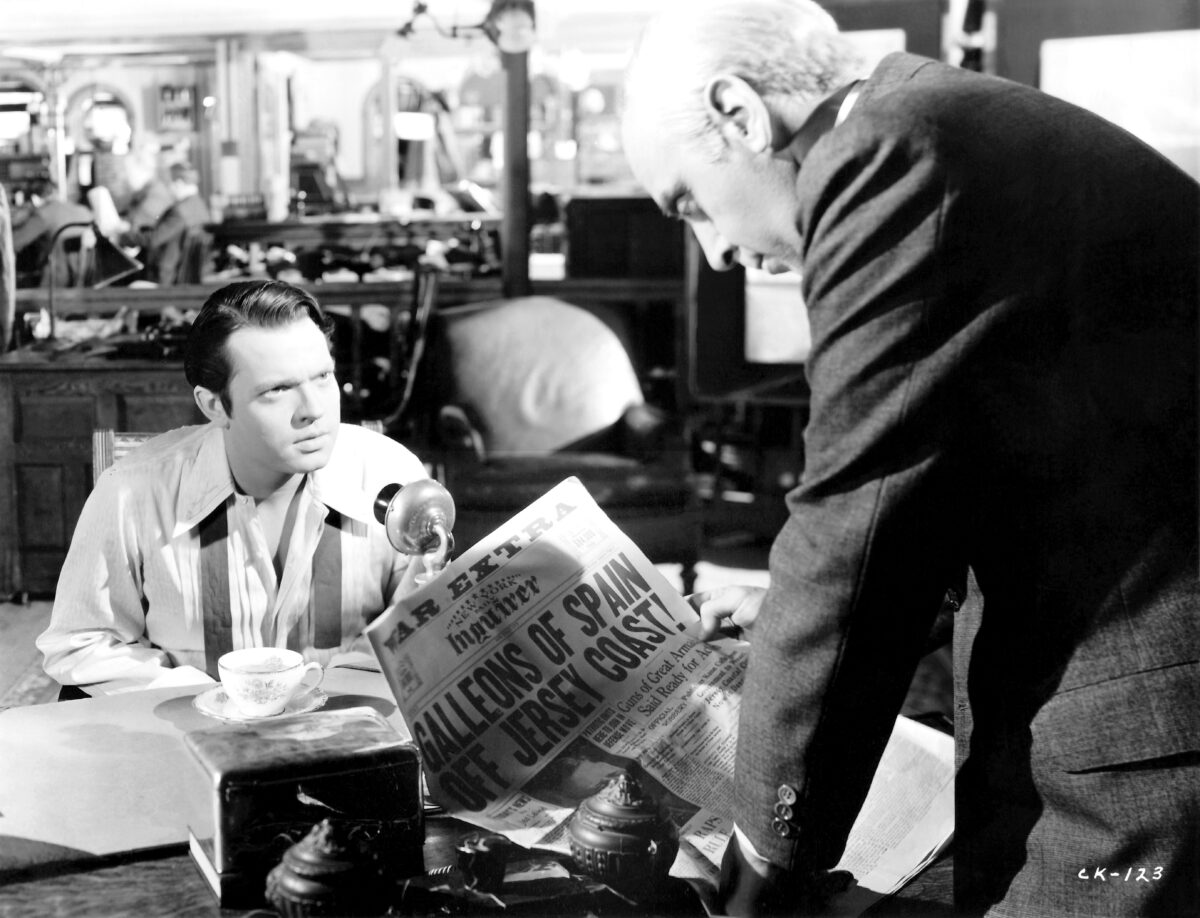
Illustrations: Charles Foster Kane (Orson Welles) in his newsroom in the 1941 film Citizen Kane, (via Wikimedia).

Wendy M. Grossman is the 2013 winner of the Enigma Award. Her Web site has an extensive archive of her books, articles, and music, and an archive of earlier columns in this series. She is a contributing editor for the Plutopia News Network podcast. Follow on Mastodon.

Follow the business models

In a market that enabled the rational actions of economists’ fantasies, consumers would be able to communicate their preferences for “smart” or “dumb” objects by exercising purchasing power. Instead, everything from TVs and vacuum cleaners to cars is sprouting Internet connections and rampant data collection.

I would love to believe we will grow out of this phase as the risks of this approach continue to become clearer, but I doubt it because business models will increasingly insist on the post-sale money, which never existed in the analog market. Subscriptions to specialized features and embedded ads seem likely to take ever everything. Essentially, software can change the business model governing any object’s manufacture into Gillette’s famous gambit: sell the razors cheap, and make the real money selling razor blades. See also in particular printer cartridges. It’s going to be everywhere, and we’re all going to hate it.

***

My consciousness of the old ways is heightened at the moment because I spent last weekend participating in a couple of folk music concerts around my old home town, Ithaca, NY. Everyone played acoustic instruments and sang old songs to celebrate 58 years of the longest-running folk music radio show in North America. Some of us hadn’t really met for nearly 50 years. We all look older, but everyone sounded great.

A couple of friends there operate a “rock shop” outside their house. There’s no website, there’s no mobile app, just a table and some stone wall with bits of rock and other findings for people to take away if they like. It began as an attempt to give away their own small collection, but it seems the clearing space aspect hasn’t worked. Instead, people keep bringing them rocks to give away – in one case, a tray of carefully laid-out arrowheads. I made off with a perfect, peach-colored conch shell. As I left, they were taking down the rock shop to make way for fantastical Halloween decorations to entertain the neighborhood kids.

Except for a brief period in the 1960s, playing folk music has never been lucrative. However it’s still harder now: teens buy CDs to ensure they can keep their favorite music, and older people buy CDs because they still play their old collections. But you can’t even *give* a 45-year-old a CD because they have no way to play it. At the concert, Mike Agranoff highlighted musicians’ need for support in an ecosystem that now pays them just $0.014 (his number) for streaming a track.

***

With both Halloween and the US election scarily imminent, the government the UK elected in July finally got down to its legislative program this week.

Data protection reform is back in the form of the the Data Use and Access Bill, Lindsay Clark reports at The Register, saying the bill is intended to improve efficiency in the NHS, the police force, and businesses. It will involve making changes to the UK’s implementation of the EU’s General Data Protection Regulation. Care is needed to avoid putting the UK’s adequacy decision at risk. At the Open Rights Group Mariano della Santi warns that the bill weakens citizens’ protection against automated decision making. At medConfidential, Sam Smith details the lack of safeguards for patient data.

At Computer Weekly, Bill Goodwin and Sebastian Klovig Skelton outline the main provisions and hopes: improve patient care, free up police time to spend more protecting the public, save money.

‘Twas ever thus. Every computer system is always commissioned to save money and improve efficiency – they say this one will save 140,000 a years of NHS staff time! Every new computer system also always brings unexpected costs in time and money and messy stages of implementation and adaptation during which everything becomes *less* efficient. There are always hidden costs – in this case, likely the difficulties of curating data and remediating historical bias. An easy prediction: these will be non-trivial.

***

Also pending is the draft United Nations Convention Against Cybercrime; the goal is to get it through the General Assembly by the end of this year.

Human Rights Watch writes that 29 civil society organizations have written to the EU and member states asking them to vote against the treaty’s adoption and consider alternative approaches that would safeguard human rights. The EFF is encouraging all states to vote no.

Internet historians will recall that there is already a convention on cybercrime, sometimes called the Budapest Convention. Drawn up in 2001 by the Council of Europe to come into force in 2004, it was signed by 70 countries and ratified by 68. The new treaty has been drafted by a much broader range of countries, including Russia and China, is meant to be consistent with that older agreement. However, the hope is it will achieve the global acceptance its predecessor did not, in part because of the broader

However, opponents are concerned that the treaty is vague, failing to limit its application to crimes that can only be committed via a computer, and lacks safeguards. It’s understandable that law enforcement, faced with the kinds of complex attacks on computer systems we see today want their path to international cooperation eased. But, as EFF writes, that eased cooperation should not extend to “serious crimes” whose definition and punishment is left up to individual countries.

Illustrations: Halloween display seen near Mechanicsburg, PA.

Wendy M. Grossman is the 2013 winner of the Enigma Award. Her Web site has an extensive archive of her books, articles, and music, and an archive of earlier columns in this series. She is a contributing editor for the Plutopia News Network podcast. Follow on Mastodon.

A hole is a hole

We told you so.

By “we” I mean thousands, of privacy advocates, human rights activists, technical experts, and information security journalists.

By “so”, I mean: we all said repeatedly over decades that there is no such thing as a magic hole that only “good guys” can use. If you build a supposedly secure system but put in a hole to give the “authorities” access to communications, that hole can and will be exploited by “bad guys” you didn’t want spying on you.

The particular hole Chinese hackers used to spy on the US is the Communications Assistance for Law Enforcement Act (1994). CALEA mandates that telecommunications providers design their equipment so that they can wiretap any customer if law enforcement presents a warrant. At Techcrunch, Zack Whittaker recaps much of the history, tracing technology giants’ new emphasis on end-to-end encryption to the 2013 Snowden revelations of the government’s spying on US citizens.

The mid-1990s were a time of profound change for telecommunications: the Internet was arriving, exchanges were converting from analog to digital, and deregulation was providing new competition for legacy telcos. In those pre-broadband years, hundreds of ISPs offered dial-up Internet access. Law enforcement could no longer just call up a single central office to place a wiretap. When CALEA was introduced, critics were clear and prolific; for an in-depth history see Susan Landau’s and Whit Diffie’s book, Privacy on the Line (originally published 1998, second edition 2007). The net.wars archive includes a compilation of years of related arguments, and at Techdirt, Mike Masnick reviews the decades of law enforcement insistence that they need access to encrypted text. “Lawful access” is the latest term of art.

In the immediate post-9/11 shock, some of those who insisted on the 1990s version of today’s “lawful access” – key escrow, took the opportunity to tell their opponents (us) that the attacks proved we’d been wrong. One such was the just-departed Jack Straw, the home secretary from 1997 to (June) 2001, who blamed BBC Radio Four and “…large parts of the industry, backed by some people who I think will now recognise they were very naive in retrospect”. That comment sparked the first net.wars column. We could now say, “Right back atcha.”

Whatever you call an encryption backdoor, building a hole into communications security was, is, and will always be a dangerous idea, as the Dutch government recently told the EU. Now, we have hard evidence.

***

The time is long gone when people used to be snobbish about Internet addresses (see net.wars-the-book, chapter three). Most of us are therefore unlikely to have thought much about the geekishly popular “.io”. It could be a new-fangled generic top-level domain – but it’s not. We have been reading linguistic meaning into what is in fact a country code. Which is all fine and good, except that the country it belongs to is the Chagos Islands, also known as the British Indian Ocean Territory, which I had never heard of until the British government announced recently that it will hand the islands back to Mauritius (instead of asking the Chagos Islanders what they want…). Gareth Edwards made the connection: when that transfer happens, .io will cease to exist (h/t Charles Arthur’s The Overspill).

Edwards goes on to discuss the messy history of orphaned country code domains: Yugoslavia, and the Soviet Union. As a result, ICANN, the naming authority, now has strict rules that mandate termination in such cases. This time, there’s a lot at stake: .io is a favorite among gamers, crypto companies, and many others, some of them substantial businesses. Perhaps a solution – such as setting .io up anew as a gTLD with its domains intact – will be created. But meantime, it’s worth noting that the widely used .tv (Tuvalu), .fm (Federated States of Micronesia), and .ai (Anguilla) are *also* country code domains.

***

The story of what’s going on with Automattic, the owner of the blogging platform WordPress.com, and WP Engine, which provides hosting and other services for businesses using WordPress, is hella confusing. It’s also worrying: WordPress, which is open source content management software overseen by the WordPress Foundation, powers a little over 40% of the Internet’s top ten million websites and more than 60% of sites overall (including this one).

At Heise Online, Kornelius Kindermann offers one of the clearer explanations: Automattic, whose CEO, Matthew Mullenweg is also a director of the WordPress Foundation and a co-creator of the software, wants WP Engine, which has been taken over by the investment company Silver Lake, to pay “trademark royalties” of 8% to the WordPress Foundation to support the software. WP Engine doesn’t wanna. Kindermann estimates the sum involved at $35 million, After the news of all that broke, 159 employees have announced they are leaving Automattic.

The more important point that, like the users of the encrypted services governments want to compromise, the owners of .io domains, or, ultimately, the Chagos Islanders themselves, WP Engine’s customers, some of them businesses worth millions, are hostages of uncertainty surrounding the decisions of others. Open source software is supposed to give users greater control. But as always, complexity brings experts and financial opportunities, and once there’s money everyone wants some of it.

Illustrations: View of the Chagos Archipelago taken during ISS Expedition 60 (NASA, via Wikimedia).

Wendy M. Grossman is the 2013 winner of the Enigma Award. Her Web site has an extensive archive of her books, articles, and music, and an archive of earlier columns in this series. She is a contributing editor for the Plutopia News Network podcast. Follow on Mastodon.

The fear factor

Be careful what you allow the authorities to do to people you despise, because one day those same tools will be turned against you.

In the last few weeks, the shocking stabbing of three young girls at a dance class in Southport became the spark to ignite riots across the UK by people who apparently believed social media theories that the 17-year-old boy responsible was Muslim, a migrant, or a terrorist. With the boy a week from his 18th birthday, the courts ruled police could release his name in order to make clear he was not Muslim and born in Wales. It failed to stop the riots.

Police and the courts have acted quickly; almost 800 people have been arrested, 350 have been charged, and hundreds are in custody. In a moving development, on a night when more than 100 riots were predicted, tens of thousands of ordinary citizens thronged city streets and formed protective human chains around refugee centers in order to block the extremists. The riots have quieted down, but police are still busy arresting newly-identified suspects. And the inevitable question is being asked: what do we do next to keep the streets safe and calm?

London mayor Sadiq Khan quickly called for a review of the Online Safety Act, saying he doesn’t believe it’s fit for purpose. Cabinet minister Nick Thomas-Symonds (Labour-Torfaen) has suggested the month-old government could change the law.

Meanwhile, prime minister Keir Starmer favours a wider rollout of live facial recognition to track thugs and prevent them from traveling to places where they plan to cause social unrest, copying systems the police use to prevent football hooligans from even boarding trains to matches. This proposal is startling because: before standing for Parliament Starmer was a human rights lawyer. One could reasonably expect him to know that facial recognition systems have a notorious history of inaccuracy due to biases baked into their algorithms via training data, and that in the UK there is no regulatory framework to provide oversight. Silkie Carlo, the director of Big Brother Watch immediately called the proposal “alarming” and “ineffective”, warning that it turns people into “walking ID cards”.

As the former head of Liberty, Shami Chakrabarti used to say when ID cards were last proposed, moves like these fundamentally change the relationship between the citizen and the state. Such a profound change deserves more thought than a reflex fear reaction in a crisis. As Ciaran Thapar argues at the Guardian, today’s violence has many causes, beginning with the decay of public services for youth, mental health, and , and it’s those causes that need to be addressed. Thapar invokes his memories of how his community overcame the “open, violent racism” of the 1980s Thatcher years in making his recommendations.

Much of the discussion of the riots has blamed social media for propagating hate speech and disinformation, along with calls for rethinking the Online Safety Act. This is also frustrating. First of all, the OSA, which was passed in 2023, isn’t even fully implemented yet. When last seen, Ofcom, the regulator designated to enforce it, was in the throes of recruiting people by the dozen, working out what sites will be in scope (about 150,000, they said), and developing guidelines. Until we see the shape of the regulation in practice, it’s too early to say the act needs expansion.

Second, hate speech and incitement to violence are already illegal under other UK laws. Just this week, a woman was jailed for 15 months for a comment to a Facebook group with 5,100 members that advocated violence against mosques and the people inside them. The OSA was not needed to prosecute her.

And third, while Elon Musk and Mark Zuckerberg definitely deserve to have anger thrown their way, focusing solely on the ills of social media makes no sense given the decades that right-wing newspapers have spent sowing division and hatred. Even before Musk, Twitter often acted as a democratization of the kind of angry, hate-filled coverage long seen in the Daily Mail (and others). These are the wedges that created the divisions that malicious actors can now exploit by disseminating disinformation, a process systematically explained by Renee DiResta in her new book, Invisible Rulers.

The FBI’s investigation of the January 6, 2021 insurrection at the US Capitol provides a good exemplar for how modern investigations can exploit new technologies. Law enforcement applied facial recognition to CCTV footage and massive databases, and studied social media feeds, location data and cellphone tracking, and other data. As Charlie Warzel and Stuart A. Thompson wrote at the New York Times in 2021, even though most of us agree with the goal of catching and punishing insurrectionists and rioters, the data “remains vulnerable to use and abuse” against protests of other types – such as this year’s pro-Palestinian encampments.

The same argument applies in the UK. Few want violence in the streets. But the unilateral imposition of live facial recognition, among other tracking technologies, can’t be allowed. There must be limits and safeguards. ID cards issued in wartime could be withdrawn when peace came; surveillance technologies, once put in place, tend to become permanent.

Illustrations: The CCTV camera at 22 Portobello Road, where George Orwell once lived.

Wendy M. Grossman is the 2013 winner of the Enigma Award. Her Web site has an extensive archive of her books, articles, and music, and an archive of earlier columns in this series. She is a contributing editor for the Plutopia News Network podcast. Follow on Mastodon.

Twenty comedians walk into a bar…

The Internet was, famously, created to withstand a bomb outage. In 1998 Matt Blaze and Steve Bellovin said it, in 2002 it was still true, and it remains true today, after 50 years of development: there are more efficient ways to kill the Internet than dropping a bomb.

Take today. The cybersecurity company Crowdstrike pushed out a buggy update, and half the world is down. Airports, businesses, the NHS appointment booking system, supermarkets, the UK’s train companies, retailers…all showing the Blue Screen of Death. Can we say “central points of failure”? Because there are two: Crowdstrike, whose cybersecurity is widespead, and Microsoft, whose Windows operating system is everywhere.

Note this hasn’t killed the *Internet*. It’s temporarily killed many systems *connected to* the Internet. But if you’re stuck in an airport where nothing’s working and confronted with a sign that says “Cash only” when you only have cards…well, at least you can go online to read the news.

The fix will be slow, because it involves starting the computer in safe mode and manually deleting files. Like Y2K remediation, one computer at a time.

***

Speaking of things that don’t work, three bits from the generative AI bubble. First, last week Goldman Sachs issued a scathing report on generative AI that concluded it is unlikely to ever repay the trillion-odd dollars companies are spending on it, while its energy demands could outstrip available supply. Conclusion: generative AI is a bubble that could nonetheless take a long time to burst.

Second, at 404 Media Emanuel Weiburg reads a report from the Tony Blair Institute that estimates that 40% of tasks performed by public sector workers could be partially automated. Blair himself compares generative AI to the industrial revolution. This comparison is more accurate than he may realize, since the industrial revolution brought climate change, and generative AI pours accelerant on it.

TBI’s estimate conflicts with that provided to Goldman by MIT economist Daron Acemoglu, who believes that AI will impact at most 4.6% of tasks in the next ten years. The source of TBI’s estimate? ChatGPT itself. It’s learned self-promotion from parsing our output?

Finally, in a study presented at ACM FAccT, four DeepMind researchers interviewed 20 comedians who do live shows and use AI to participate in workshops using large language models to help write jokes. “Most participants felt the LLMs did not succeed as a creativity support tool, by producing bland and biased comedy tropes, akin to ‘cruise ship comedy material from the 1950s, but a bit less racist’.” Last year, Julie Seabaugh at the LA Times interviewed 13 professional comedians and got similar responses. Ahmed Ahmed compared AI-generated comedy to eating processed foods and, crucially, it “lacks timing”.

***

Blair, who spent his 1997-2007 premiership pushing ID cards into law, has also been trying to revive this longheld obsession. Two days after Keir Starmer took office, Blair published a letter in the Sunday Times calling for its return. As has been true throughout the history of ID cards (PDF), every new revival presents it as a solution to a different problem. Blair’s 2024 reason is to control immigration (and keep the far-right Reform party at bay). Previously: prevent benefit fraud, combat terorism, streamline access to health, education, and other government services (“the entitlement card”), prevent health tourism.

Starmer promptly shot Blair down: “not part of the government’s plans”. This week Alan West, a home office minister 2007-2010 under Gordon Brown, followed up with a letter to the Guardian calling for ID cards because they would “enhance national security in the areas of terrorism, immigration and policing; facilitate access to online government services for the less well-off; help to stop identity theft; and facilitate international travel”.

Neither Blair (born 1953) nor West (born 1948) seems to realize how old and out of touch they sound. Even back then, the “card” was an obvious decoy. Given pervasive online access, a handheld reader, and the database, anyone’s identity could be checked anywhere at any time with no “card” required.

To sound modern they should call for institutionalizing live facial recognition, which is *already happening* by police fiat. Or sprinkled AI bubble on their ID database.

Databases and giant IT projects that failed – like the Post Office scandal – that was the 1990s way! We’ve moved on, even if they haven’t.

***

If you are not a deposed Conservative, Britain this week is like waking up sequentially from a series of nightmares. Yesterday, Keir Starmer definitively ruled out leaving the European Convention on Human Rights – Starmer’s background as a human rights lawyer to the fore. It’s a relief to hear after 14 years of Tory ministers – David Cameron,, Boris Johnson, Suella Braverman, Liz Truss, Rishi Sunak – whining that human rights law gets in the way of their heart’s desires. Like: building a DNA database, deporting refugees or sending them to Rwanda, a plan to turn back migrants in boats at sea.

Principles have to be supported in law; under the last government’s Public Order Act 2023 curbing “disruptive protest”, yesterday five Just Stop Oil protesters were jailed for four and five years. Still, for that brief moment it was all The Brotherhood of Man.

Illustrations: Windows’ Blue Screen of Death (via Wikimedia).

Wendy M. Grossman is the 2013 winner of the Enigma Award. Her Web site has an extensive archive of her books, articles, and music, and an archive of earlier columns in this series. She is a contributing editor for the Plutopia News Network podcast. Follow on Mastodon.

Outbound

As the world and all knows by now, the UK is celebrating this year’s American Independence Day by staging a general election. The preliminaries are mercifully short by US standards, in that the period between the day it was called and the day the winners will be announced is only about six weeks. I thought the announcement would bring more sense of relief than it did. Instead, these six weeks seem interminable for two reasons: first, the long, long wait for the announcement, and second, the dominant driver for votes is largely negative – voting against, rather than voting for.

Labour, which is in polling position to win by a lot, is best served by saying and doing as little as possible, lest a gaffe damage its prospects. The Conservatives seem to be just trying not to look as hopeless as they feel. The only party with much exuberance is the far-right upstart Reform, which measures success in terms of whether it gets a larger share of the vote than the Conservatives and whether Nigel Farage wins a Parliamentary seat on his eighth try. And the Greens, who are at least motivated by genuine passion for their cause, and whose only MP is retiring this year. For them, sadly, success would be replacing her.

Particularly odd is the continuation of the trend visible in recent years for British right-wingers to adopt the rhetoric and campaigning style of the current crop of US Republicans. This week, they’ve been spinning the idea that Labour may win a dangerous “supermajority”. “Supermajority” has meaning in the US, where the balance of powers – presidency, House of Representatives, Senate – can all go in one party’s direction. It has no meaning in the UK, where Parliament is sovereign. All it means is Labour could wind up with a Parliamentary majority so large that they can pass any legislation they want. But this has been the Conservatives’ exact situation for the last five years, ever since the 2019 general election gave Boris Johnson a majority of 86. We should probably be grateful they largely wasted the opportunity squabbling among themselves.

This week saw the launch, day by day, of each party manifesto in turn. At one time, this would have led to extensive analysis and comparisons. This year, what discussion there is focuses on costs: whose platform commits to the most unfunded spending, and therefore who will raise taxes the most? Yet my very strong sense is that few among the electorate are focused on taxes; we’d all rather have public services that work and an end to the cost-of-living crisis. You have to be quite wealthy before private health care offers better value than paying taxes. But here may lie the explanation for both this and the weird Republican-ness of 2024 right-wing UK rhetoric: they’re playing to the same wealthy donors.

In this context, it’s not surprising that there’s not much coverage of what little the manifestos have to say about digital rights or the Internet. The exception is Computer Weekly, which finds the Conservatives promising more of the same and Labour offering a digital infrastructure plan, which includes building data centers and easing various business regulations but not to reintroduce the just-abandoned Data Protection and Digital Information bill.

In the manifesto itself: “Labour will build on the Online Safety Act, bringing forward provisions as quickly as possible, and explore further measures to keep everyone safe online, particularly when using social media. We will also give coroners more powers to access information held by technology companies after a child’s death.” The latter is a reference to recent cases such as that of 14-year-old Molly Russell, whose parents fought for five years to gain access to her Instagram account after her death.

Elsewhere, the manifesto also says, “Too often we see families falling through the cracks of public services. Labour will improve data sharing across services, with a single unique identifier, to better support children and families.”

“A single unique identifier” brings a kind of PTSD flashback: the last Labour government, in power from 1997 to 2010, largely built the centralized database state, and was obsessed with national ID cards, which were finally killed by David Cameron’s incoming coalition government. At the time, one of the purported benefits was streamlining government interaction. So I’m suspicious: this number could easily be backed by biometrics and checked via phone apps on the spot, anywhere and grow into…?

In terms of digital technologies, the LibDems mostly talk about health care, mandating interoperability for NHS systems and improving both care and efficiency. That can only be assessed if the detail is known. Also of interest: the LibDems’ proposed anti-SLAPP law, increasingly needed.

The LibDems also commit to advocate for a “Digital Bill of Rights”. I’m not sure it’s worth the trouble: “digital rights” as a set of civil liberties separate from human rights is antiquated, and many aspects are already enshrined in data protection, competition, and other law. In 2019, under the influence of then-deputy leader Tom Watson, this was a Labour policy. The LibDems are unlikely to have any power; but they lead in my area.

I wish the manifestos mattered and that we could have a sensible public debate about what technology policy should look like and what the priorities should be. But in a climate where everyone votes to get one lot out, the real battle begins on July 5, when we find out what kind of bargain we’ve made.

Illustrations: Polling station in Canonbury, London, in 2019 (via Wikimedia).

Wendy M. Grossman is the 2013 winner of the Enigma Award. Her Web site has an extensive archive of her books, articles, and music, and an archive of earlier columns in this series. She is a contributing editor for the Plutopia News Network podcast. Follow on Mastodon.

Hostages

If you grew up with the slow but predictable schedule of American elections, the abruptness with which a British prime minister can prorogue Parliament and hit the campaign trail is startling. Among the pieces of legislation that fell by the wayside this time is the Data Protection and Digital Information bill, which had reached the House of Lords for scrutiny. The bill had many problems. This was the bill that proposed to give the Department of Work and Pensions the right to inspect the bank accounts and financial assets of anyone receiving any government benefits and undermined aspects of the adequacy agreement that allows UK companies to exchange data with businesses in the EU.

Less famously, it also includes the legislative underpinnings for a trust framework for digital verification. On Monday, at a UCL’s conference on crime science, Sandra Peaston, director of research and development at the fraud prevention organization Cifas, outlined how all this is intended to work and asked some pertinent questions. Among them: whether the new regulator will have enough teeth; whether the certification process is strong enough for (for example) mortgage lenders; and how we know how good the relevant algorithm is at identifying deepfakes.

Overall, I think we should be extremely grateful this bill wasn’t rushed through. Quite apart from the digital rights aspects, the framework for digital identity really needs to be right; there’s just too much risk in getting it wrong.

***

At Bloomberg, Mark Gurman reports that Apple’s arrangement with OpenAI to integrate ChatGPT into the iPhone, iPad, and Mac does not involve Apple paying any money. Instead, Gurman cites unidentified sources to the effect that “Apple believes pushing OpenAI’s brand and technology to hundreds of millions of its devices is of equal or greater value than monetary payments.”

We’ve come across this kind of claim before in arguments between telcos and Internet companies like Netflix or between cable companies and rights holders. The underlying question is who brings more value to the arrangement, or who owns the audience. I can’t help feeling suspicious that this will not end well for users. It generally doesn’t.

***

Microsoft is on a roll. First there was the Recall debacle. Now come accusations by a former employee that it ignored a reported security flaw in order to win a large government contract, as Renee Dudley and Doris Burke report at Pro Publica. Result: the Russian Solarwinds cyberattack on numerous US government departments and agencies, including the National Nuclear Security Administration.

This sounds like a variant of Cory Doctorow’s enshittification at the enterprise level (see also: Boeing). They don’t have to be monopolies: these organizations’ evolving culture has let business managers override safety and security engineers. This is how Challenger blew up in 1986.

Boeing is too big and too lacking in competition to be allowed to fail entirely; it will have to find a way back. Microsoft has a lot of customer lock-in. Is it too big to fail?

***

I can’t help feeling a little sad at the news that Raspberry Pi has had an IPO. I see no reason why it shouldn’t be successful as a commercial enterprise, but its values will inevitably change over time. CEO Eben Upton swears they won’t, but he won’t be CEO forever, as even he admits. But: Raspberry Pi could become the “unicorn” Americans keep saying Europe doesn’t have.

***

At that same UCL event, I finally heard someone say something positive about AI – for a meaning of “AI” that *isn’t* chatbots. Sarah Lawson, the university’s chief information security officer, said that “AI and machine learning have really changed the game” when it comes to detecting email spam, which remains the biggest vector for attacks. Dealing with the 2% that evades the filters is still a big job, as it leaves 6,000 emails a week hitting people’s inboxes – but she’ll take it. We really need to be more specific when we say “AI” about what kind of system we mean; success at spam filtering has nothing to say about getting accurate information out of a large language model.

***

Finally, I was highly amused this week when long-time security guy Nick Selby, posted on Mastodon about a long-forgotten incident from 1999 in which I disparaged the sort of technology Apple announced this week that’s supposed to organize your life for you – tell you when it’s time to leave for things based on the traffic, juggle meetings and children’s violin recitals, that sort of thing. Selby felt I was ahead of my time because “it was stupid then and is stupid now because even if it works the cost is insane and the benefit really, really dodgy”,

One of the long-running divides in computing is between the folks who want computers to behave predictably and those who want computers to learn from our behavior what’s wanted and do that without intervention. Right now, the latter is in ascendance. Few of us seem to want the “AI features” being foisted on us. But only a small percentage of mainstream users turn off defaults (a friend was recently surprised to learn you can use the history menu to reopen a closed browser tab). So: soon those “AI features” will be everywhere, pointlessly and extravagantly consuming energy, water, and human patience. How you use information technology used to be a choice. Now, it feels like we’re hostages.

Illustrations: Raspberry Pi: the little computer that could (via Wikimedia).

Wendy M. Grossman is the 2013 winner of the Enigma Award. Her Web site has an extensive archive of her books, articles, and music, and an archive of earlier columns in this series. She is a contributing editor for the Plutopia News Network podcast. Follow on Mastodon.