Magic math balls

So many ironies, so little time. According to the Financial Times (and syndicated at Ars Technica), the US government, which itself has traditionally demanded law enforcement access to encrypted messages and data, is pushing the UK to drop its demand that Apple weaken its encryption. Normally, you want to say, Look here, countries are entitled to have their own laws whether the US likes it or not. But this is not a law we like!

This all began in February, when the Washington Post reported that the UK’s Home Office had issued Apple with a Technical Capability Notice. Issued under the Investigatory Powers Act (2016) and supposed to be kept secret, the TCN demanded that Apple undermine the end-to-end encryption used for iCloud’s Advanced Data Protection feature. Much protest ensued, followed by two legal cases in front of the Investigatory Powers Tribunal, one brought by Apple, the other by Privacy International and Liberty. WhatsApp has joined Apple’s legal challenge.

Meanwhile, Apple withdrew ADP in the UK. Some people argued this didn’t really matter, as few used it, which I’d call a failure of user experience design rather than an indication that people didn’t care about it. More of us saw it as setting a dangerous precedent for both encryption and the use of secret notices undermining cybersecurity.

The secrecy of TCNs is clearly wrong and presents a moral hazard for governments that may prefer to keep vulnerabilities secret so they can take advantage for surveillance purposes. Hopefully, the Tribunal will eventually agree and force a change in the law. The Foundation for Information Policy Research (obDisclosure: I’m a FIPR board member) has published a statement explaining the issues.

According to the Financial Times, the US government is applying a sufficiently potent threat of tariffs to lead the UK government to mull how to back down. Even without that particular threat, it’s not clear how much the UK can resist. As Angus Hanton documented last year in the book Vassal State, the US has many well-established ways of exerting its influence here. And the vectors are growing; Keir Starmer’s Labour government seems intent on embedding US technology and companies into the heart of government infrastructure despite the obvious and increasing risks of doing so. When I read Hanton’s book earlier this year, I thought remaining in the EU might have provided some protection, but Caroline Donnelly warns at Computer Weekly that they, too, are becoming dangerously dependent on US technology, specifically Microsoft.

It’s tempting to blame everything on the present administration, but the reality is that the US has long used trade policy and treaties to push other countries into adopting laws regardless of their citizens’ preferences.

***

As if things couldn’t get any more surreal, this week the Trump administration *also* issued an executive order banning “woke AI” in the federal government. AI models are in future supposed to be “politically neutral”. So, as Kevin Roose writes at the New York Times, the culture wars are coming for AI.

The US president is accusing chatbots of “Marxist lunacy”, where the rest of the world calls them inaccurate, biased toward repeating and expanding historical prejudices, and inconsistent. We hear plenty about chatbots adopting Nazi tropes; I haven’t heard of one promoting workers’ and migrants’ rights.

If we know one thing about AI models it’s that they’re full of crap all the way down. The big problem is that people are deploying them anyway. At the Canary, Steve Topple reports that the UK’s Department of Work and Pensions admits in a newly-published report that its algorithm for assessing whether benefit claimants might commit fraud is ageist and and racist. A helpful executive order would set must-meet standards for *accuracy*. But we do not live in those times.

The Guardian reports that two more Trump EOs expedite building new data centers, promote exports of American AI models, expand the use of AI in the federal government, and intend to solidify US dominance in the field. Oh, and Trump would really like if it people would stop calling it “artificial” and find a new name. Seven years ago, aspirational intelligence” seemed like a good idea. But that was back when we heard a lot about incorporating ethics. So…”magic math ball”?

These days, development seems to proceed ethics-free. DWP’s report, for example, advocates retraining its flawed algorithm but says continuing to operate it is “reasonable and proportionate”. In 2021, for European Digital Rights Initiative, Agathe Balayn and Seda Gürses found, “Debiasing locates the problems and solutions in algorithmic inputs and outputs, shifting political problems into the domain of design, dominated by commercial actors.” In other words, no matter what you think is “neutral”, training data, model, and algorithms are only as “neutral” as their wider context allows them to be.

Meanwhile, nothing to curb the escalating waste. At 404 Media, Emanuel Maiberg finds that Spotify is publishing AI-generated songs from dead artists without anyone’s’ permission. On Monday, MSNBC’s Rachel Maddow told viewers that there’s so much “AI slop ” about her that they’ve posted Is That Really Rachel? to catalog and debunk them.

As Ed Zitron writes, the opportunity costs are enormous.

In the UK, the US, and many other places, data centers are threatening the water supply.

But sure, let’s make more of that.

Illustrations: Magic 8 ball toy (via frankieleon at Wikimedia).

Wendy M. Grossman is an award-winning journalist. Her website has an extensive archive of her books, articles, and music, and an archive of earlier columns in this series. She is a contributing editor for the Plutopia News Network podcast. Follow on Mastodon or Bluesky.

Dangerous corner

This year’s Computers. Privacy, and Data Protection conference arrived at a crossroads moment. The European Commission, wanting to compete to “win the AI race”, is pursuing an agenda of simplification. Based on a recent report by former European Central Bank president Mario Draghi, it’s looking to streamline or roll back some of the regulation the EU is famous for.

Cue discussion of “The Brussels Effect”, derived from The California Effect, which sees compliance with regulation voluntarily shift towards the strictest regime. As Mireille Hildebrandt explained in her opening keynote, this phenomenon requires certain conditions. In the case of data protection legislation, that means three things: that companies will comply with the most stringent rules to ensure they are universally compliant, and that they want and need to compete in the EU. If you want your rules to dominate, it seems like a strategy. Except: China’s in-progress data protection regime may well be the strongest when it’s complete, but in that very different culture it will include no protection against the government. So maybe not a winning game?

Hildebrandt went on to prove with near-mathematical precision that an artificial general intelligence can never be compatible with the General Data Protection Regulation – AGI is “based on an incoherent conceptualization” and can’t be tested.

“Systems built with the goal of performing any task under any circumstances are fundamentally unsafe,” she said. “They cannot be designed for safety using fundamental engineering principles.”

AGI failing to meet existing legal restrictions seems minor in one way, since AGI doesn’t exist now, and probably never will. But as Hildebrandt noted, huge money is being poured into it nonetheless, and the spreading impact of that is unavoidable even if it fails.

The money also makes politicians take the idea seriously, which is the likely source of the EU’s talk of “simplification” instead of fundamental rights. Many fear that forthcoming simplification packages will reopen GDPR with a view to weakening the core principles of data minimization and purpose limitation. As one conference attendee asked, “Simplification for whom?”

In a panel on conflicting trends in AI governance, Shazeda Ahmed agreed: “There is no scientific basis around the idea of sentient AI, but it’s really influential in policy conversations. It takes advantage of fear and privileges technical knowledge.”

AI is having another impact technology companies may not have notidced yet: it is aligning the interests of the environmental movement and the privacy field.

Sustainability and privacy have often been played off against each other. Years ago, for example, there were fears that councils might inspect household garbage for elements that could have been recycled. Smart meters may or may not reduce electricity usage, but definitely pose privacy risks. Similarly, many proponents of smart cities stress the sustainability benefits but overlook the privacy impact of the ubiquitous sensors.

The threat generative AI poses to sustainability is well-documented by now. The threat the world’s burgeoning data centers pose to the transition to renewables is less often clearly stated and it’s worse than we might think. Claude Turmes, for example, highlighted the need to impose standards for data centers. Where an individual is financially incentivized to charge their electric vehicle at night and help even out the load on the grid, the owners of data centers don’t care. They just want the power they need – even if that means firing up coal plants to get it. Absent standards, he said, “There will be a whole generation of data centers that…use fossil gas and destroy the climate agenda.” Small nuclear power reactors, which many are suggesting, won’t be available for years. Worse,, he said, the data centers refuse to provide information to help public utilities plan despite their huge cosumption.

Even more alarming was the panel on the conversion of the food commons into data spaces. So far, most of what I had heard about agricultural data revolved around precision agriculture and its impact on farm workers, as explored in work (PDF) by Karen Levy, Solon Barocas, and Alexandra Mateescu. That was plenty disturbing, covering the loss of autonomy as sensors collect massive amounts of fine-grained information, everything from soil moisture to the distribution of seeds and fertilizer.

Much more alarming to see Monja Sauvagerd connect up in detail the large companies that are consolidating our food supply into a handful of platforms. Chinese government-owned Sinochem owns Syngenta; John Deere expanded by buying the machine learning company Blue River; and in 2016 Bayer bought Monsanto.

“They’re blurring the lines between seeds, agrichemicals, bio technology, and digital agriculture,” Sauvagerd said. So: a handful of firms in charge of our food supply are building power based on existing concentration. And, selling them cloud and computing infrastructure services, the array of big technology platforms that are already dangerously monopolistic. In this case, “privacy”, which has always seemed abstract, becomes a factor in deciding the future of our most profoundly physical system. What rights should farmers have to the data their farms generate?

In her speech, Hildebrandt called the goals of TESCREAL – transhumanism, extropianism, singularitarianism, cosmism, rationalist ideology, effective altruism, and long-termism – “paradise engineering”. She proposed three questions for assessing new technologies: What will it solve? What won’t it solve? What new problems will it create? We could add a fourth: while they’re engineering paradise, how do we live?

Illustrations: Brussels’ old railway hub, next to its former communications hub, the Maison de la Poste, now a conference center.

Wendy M. Grossman is the 2013 winner of the Enigma Award. Her Web site has an extensive archive of her books, articles, and music, and an archive of earlier columns in this series. She is a contributing editor for the Plutopia News Network podcast. Follow on Mastodon or Bluesky.

Review: Vassal State

Vassal State: How America Runs Britain
by Angus Hanton
Swift Press
978-1-80075390-7

Tax organizations estimate that a bit under 200,000 expatriate Americans live in the UK. It’s only a tiny percentage of the overall population of 70 million, but of course we’re not evenly distributed. In my bit of southwest London, the (recently abruptly shuttered due to rising costs) butcher has advertised “Thanksgiving turkeys” for more than 30 years.

In Vassal State, however, Angus Hanton shows that US interests permeate and control the UK in ways far more significant than a handful of expatriates. This is not, he stresses, an equal partnership, despite the perennial photos of the British prime minister being welcomed to the White House by the sitting president, as shown satirically in 1986’s Yes, Prime Minister. Hunton cites the 2020 decision to follow the US and ban Huawei as an example, writing that the US pressure at the time “demonstrated the language of partnership coupled with the actions of control”. Obama staffers, he is told, used to joke about the “special relationship”.

Why invade when you can buy and control? Hanton lists a variety of vectors for US influence. Many of Britain’s best technology startups wind up sold to US companies, permanently alienating their profits – see, for example, DeepMind, sold to Google in 2014, and Worldpay, sold to Vantiv in 2019, which then took its name. US buyers also target long-established companies, such as 176-year-old Boots, which since 2014 has been part of Walgreens and is now being bought up by the Sycamore Partners private equity fund. To Americans, this may not seem like much, but Boots is a national icon and an important part of delivering NHS services such as vaccinations. No one here voted for Sycamore Partners to benefit from that, nor did they vote for Kraft to buy Cadbury’s in 2010 and abandon its Bournville headquarters since 1824.

In addition, US companies are burrowed into British infrastructure. Government ministers communicate with each other over WhatsApp. Government infrastructure is supplied by companies like Oracle and IBM, and, lately, Palantir, which are hard to dig out once embedded. A seventh of the workforce are precariously paid by the US-dominated gig economy. The vast majority of cashless transactions pay a slice to Visa or Mastercard. And American companies use the roads, local services, and other infrastructure while paying less in tax than their UK competition. More controversially for digital rights activists, Hanton complains about the burden that US-based streamers like Netflix, Apple, and Amazon place on the telecommunications networks. Among the things he leaves out: the technology platforms in education.

Hanton’s book comes at a critical moment. Previous administrations have perhaps been more polite about demanding US-friendly policies, but now Britain, on its own outside the EU, is facing Donald Trump’s more blatant demands. Among them: that suppliers to the US government comply with its anti-DEI policies. In countries where diversity, equity, and inclusion are fundamental rights, the US is therefore demanding that its law should take precedence.

In a timeline fork in which Britain remained in the EU, it would be in a much better position to push back. In *this* timeline, Hanton’s proposed remedies – reform the tax structure, change policies, build technological independence – are much harder to implement.

Cognitive dissonance

The annual State of the Net, in Washington, DC, always attracts politically diverse viewpoints. This year was especially divided.

Three elements stood out: the divergence between the only remaining member of the Privacy and Civil Liberties Oversight Board (PCLOB) and a recently-fired colleague; a contentious panel on content moderation; and the yay, American innovation! approach to regulation.

As noted previously, on January 29 the days-old Trump administration fired PCLOB members Travis LeBlanc, Ed Felten, and chair Sharon Bradford Franklin; the remaining seat was already empty.

Not to worry, remaining member Beth Williams, said. “We are open for business. Our work conducting important independent oversight of the intelligence community has not ended just because we’re currently sub-quorum.” Flying solo she can greenlight publication, direct work, and review new procedures and policies; she can’t start new projects. A review is ongoing of the EU-US Privacy Framework under Executive Order 14086 (2022). Williams seemed more interested in restricting government censorship and abuse of financial data in the name of combating domestic terrorism.

Soon afterwards, LeBlanc, whose firing has him considering “legal options”, told Brian Fung that the outcome of next year’s reauthorization of Section 702, which covers foreign surveillance programs, keeps him awake at night. Earlier, Williams noted that she and Richard E. DeZinno, who left in 2023, wrote a “minority report” recommending “major” structural change within the FBI to prevent weaponization of S702.

LeBlanc is also concerned that agencies at the border are coordinating with the FBI to surveil US persons as well as migrants. More broadly, he said, gutting the PCLOB costs it independence, expertise, trustworthiness, and credibility and limits public options for redress. He thinks the EU-US data privacy framework could indeed be at risk.

A friend called the panel on content moderation “surreal” in its divisions. Yael Eisenstat and Joel Thayer tried valiantly to disentangle questions of accountability and transparency from free speech. To little avail: Jacob Mchangama and Ari Cohn kept tangling them back up again.

This largely reflects Congressional debates. As in the UK, there is bipartisan concern about child safety – see also the proposed Kids Online Safety Act – but Republicans also separately push hard on “free speech”, claiming that conservative voices are being disproportionately silenced. Meanwhile, organizations that study online speech patterns and could perhaps establish whether that’s true are being attacked and silenced.

Eisenstat tried to draw boundaries between speech and companies’ actions. She can still find on Facebook the sme Telegram ads containing illegal child sexual abuse material that she found when Telegram CEO Pavel Durov was arrested. Despite violating the terms and conditions, they bring Meta profits. “How is that a free speech debate as opposed to a company responsibility debate?”

Thayer seconded her: “What speech interests do these companies have other than to collect data and keep you on their platforms?”

By contrast, Mchangama complained that overblocking – that is, restricting legal speech – is seen across EU countries. “The better solution is to empower users.” Cohn also disliked the UK and European push to hold platforms responsible for fulfilling their own terms and conditions. “When you get to whether platforms are living up to their content moderation standards, that puts the government and courts in the position of having to second-guess platforms’ editorial decisions.”

But Cohn was talking legal content; Eisenstat was talking illegal activity: “We’re talking about distribution mechanisms.” In the end, she said, “We are a democracy, and part of that is having the right to understand how companies affect our health and lives.” Instead, these debates persist because we lack factual knowledge of what goes on inside. If we can’t figure out accountability for these platforms, “This will be the only industry above the law while becoming the richest companies in the world.”

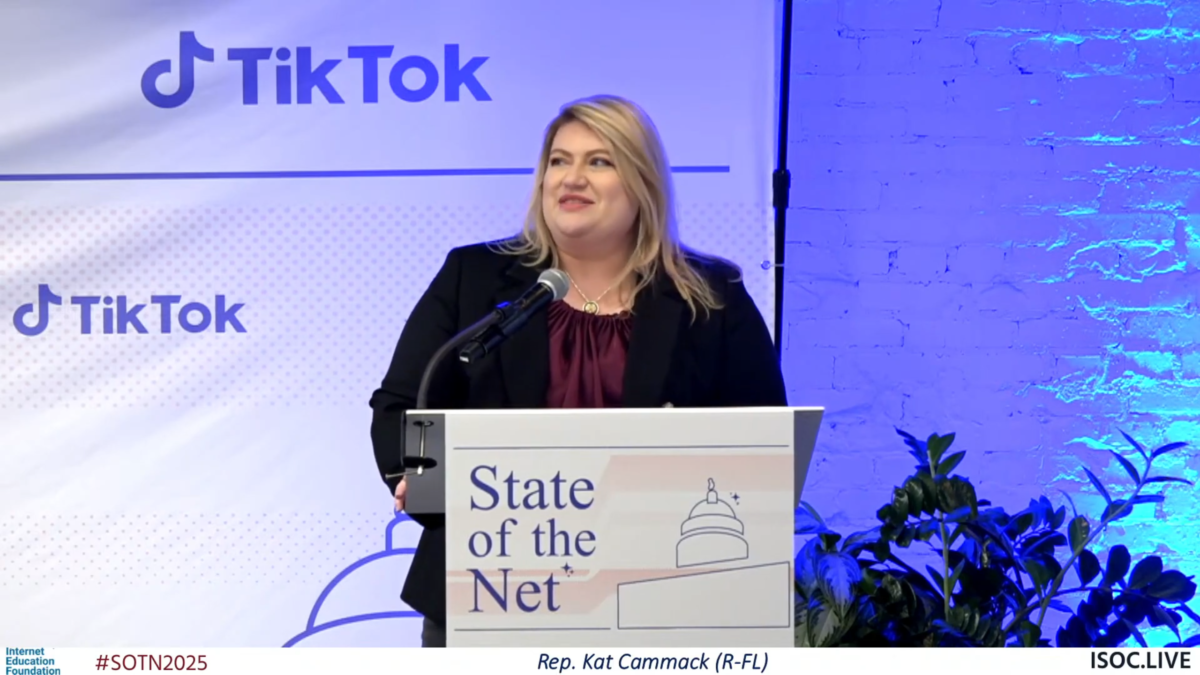
Twenty-five years after data protection became a fundamental right in Europe, the DC crowd still seem to see it as a regulation in search of a deal. Representative Kat Cammack (R-FL), who described herself as the “designated IT person” on the energy and commerce committee, was particularly excited that policy surrounding emerging technologies could be industry-driven, because “Congress is *old*!” and DC is designed to move slowly. “There will always be concerns about data and privacy, but we can navigate that. We can’t deter innovation and expect to flourish.”

Others also expressed enthusiasm for “the great opportunities in front of our country”, compared the EU’s Digital Markets Act to a toll plaza congesting I-95. Samir Jain, on the AI governance panel, suggested the EU may be “reconsidering its approach”. US senator Marsha Blackburn (R-TN) highlighted China’s threat to US cybersecurity without noting the US’s own goal, CALEA.

On that same AI panel, Olivia Zhu, the Assistant Director for AI Policy for the White House Office of Science and Technology Policy, seemed more realistic: “Companies operate globally, and have to do so under the EU AI Act. The reality is they are racing to comply with [it]. Disengaging from that risks a cacophony of regulations worldwide.”

Shortly before, Johnny Ryan, a Senior Fellow at the Irish Council for Civil Liberties posted: “EU Commission has dumped the AI Liability Directive. Presumably for “innovation”. But China, which has the toughest AI law in the world, is out innovating everyone.”

Illustrations: Kat Cammack (R-FL) at State of the Net 2025.

Wendy M. Grossman is the 2013 winner of the Enigma Award. Her Web site has an extensive archive of her books, articles, and music, and an archive of earlier columns in this series. She is a contributing editor for the Plutopia News Network podcast. Follow on Mastodon or Bluesky.

What we talk about when we talk about computers

The climax of Nathan Englander‘s very funny play What We Talk About When We Talk About Anne Frank sees the four main characters play a game – the “Anne Frank game” – that two of them invented as children. The play is on at the Marylebone Theatre until February 15.

The plot: two estranged former best friends in a New York yeshiva have arranged a reunion for themselves and their husbands. Debbie (Caroline Catz), has let her religious attachment lapse in the secular environs of Miami, Florida, where her husband, Phil (Joshua Malina), is an attorney. Their college-age son, Trevor (Gabriel Howell), calls the action.

They host Hasidic Shosh (Dorothea Myer-Bennett) and Yuri (Simon Yadoo), formerly Lauren and Mark, whose lives in Israel and traditional black dress and, in Shosh’s case, hair-covering wig, have left them unprepared for the bare arms and legs of Floridians. Having spent her adult life in a cramped apartment with Yuri and their eight daughters, Shosh is astonished at the size of Debbie’s house.

They talk. They share life stories. They eat. And they fight: what is the right way to be Jewish? Trevor asks: given climate change, does it matter?

So, the Anne Frank game: who among your friends would hide you when the Nazis are coming? The rule that you must tell the truth reveals the characters’ moral and emotional cores.

I couldn’t avoid up-ending this question. There are people I trust and who I *think* would hide me, but it would often be better not to ask them. Some have exceptionally vulnerable families who can’t afford additional risk. Some I’m not sure could stand up to intensive questioning. Most have no functional hiding place. My own home offers nowhere that a searcher for stray humans wouldn’t think to look, and no opportunities to create one. With the best will in the world, I couldn’t make anyone safe, though possibly I could make them temporarily safer.

But practical considerations are not the game. The game is to think about whether you would risk your life for someone else, and why or why not. It’s a thought experiment. Debbie calls it “a game of ultimate truth”.

However, the game is also a cheat, in that the characters have full information about all parts of the story. We know the Nazis coming for the Frank family are unquestionably bent on evil, because we know the Franks’ fates when they were eventually found. It may be hard to tell the truth to your fellow players, but the game is easy to think about because it’s replete with moral clarity.

Things are fuzzier in real life, even for comparatively tiny decisions. In 2012, the late film critic Roger Ebert mulled what he would do if he were a Transport Security Administration agent suddenly required to give intimate patdowns to airline passengers unwilling to go through the scanner. Ebert considered the conflict between moral and personal distaste and TSA officers’ need to keep their reasonably well-paid jobs with health insurance benefits. He concluded that he hoped he’d quit rather than do the patdowns. Today, such qualms are ancient history; both scanners and patdowns have become normalized.

Moral and practical clarity is exactly what’s missing as the Department of Government Efficiency arrives in US government departments and agencies to demand access to their computer systems. Their motives and plans are unclear, as is their authority for the access they’re demanding. The outcome is unknown.

So, instead of a vulnerable 13-year-old girl and her family, what if the thing under threat is a computer? Not the sentient emotional robot/AI of techie fantasy but an ordinary computer system holding boring old databases. Or putting through boring old payments. Or underpinning the boring old air traffic control system. Do you see a computer or the millions of people whose lives depend on it? How much will you risk to protect it? What are you protecting it from? Hinder, help, quit?

Meanwhile, DOGE is demanding that staff allow its young coders to attach unauthorized servers, take control of websites. In addition: mass firings, and a plan to do some sort of inside-government AI startup.

DOGE itself appears to be thinking ahead; it’s told staff to avoid Slack while awaiting a technology that won’t be subject to FOIA requests.

The more you know about computers the scarier this all is. Computer systems of the complexity and accuracy of those the US government has built over decades are not easily understood by incoming non-experts who have apparently been visited by the Knowledge Fairy. After so much time and effort on security and protecting against shadowy hackers, the biggest attack – as Mike Masnick calls it – on government systems is coming from inside the house in full view.

Even if “all” DOGE has is read-only access as Treasury claims – though Wired and Talking Points Memo have evidence otherwise – those systems hold comprehensive sensitive information on most of the US population. Being able to read – and copy? – is plenty bad enough. In both fiction (Margaret Atwood’s The Handmaid’s Tale) and fact (IBM), computers have been used to select populations to victimize. Americans are about to find out they trusted their government more than they thought.

Illustration: Changing a tube in the early computer ENIAC (via Wikimedia).

Wendy M. Grossman is the 2013 winner of the Enigma Award. Her Web site has an extensive archive of her books, articles, and music, and an archive of earlier columns in this series. Stories about the border wars between cyberspace and real life are posted occasionally during the week at the net.wars Pinboard – or follow on Twitter.

The Gulf of Google

In 1945, the then mayor of New York City, Fiorello La Guardia signed a bill renaming Sixth Avenue. Eighty years later, even with street signs that include the new name, the vast majority of New Yorkers still say things like, “I’ll meet you at the southwest corner of 51st and Sixth”. You can lead a horse to Avenue of the Americas, but you can’t make him say it.

US president Donald Trump’s order renaming the Gulf of Mexico offers a rarely discussed way to splinter the Internet (at the application layer, anyway; geography matters!), and on Tuesday Google announced it would change the name for US users of its Maps app. As many have noted, this contravenes Google’s 2008 policy on naming bodies of water in Google Earth: “primary local usage”. A day later, reports came that Google has placed the US on its short list of sensitive countries – that is, ones whose rulers dispute the names and ownership of various territories: China, Russia, Israel, Saudi Arabia, Iraq.

Sharpieing a new name on a map is less brutal than invading, but it’s a game anyone can play. Seen on Mastodon: the bay, now labeled “Gulf of Fragile Masculinity”.

***

Ed Zitron has been expecting the generative AI bubble to collapse disastrously. Last week provided an “Is this it?” moment when the Chinese company DeepSeek released reasoning models that outperform the best of the west at a fraction of the cost and computing power. US stock market investors: “Let’s panic!”

The code, though not the training data, is open source, as is the relevant research. In Zitron’s analysis, the biggest loser here is OpenAI, though it didn’t seem like that to investors in other companies, especially Nvidia, whose share price dropped 17% on Tuesday alone. In an entertaining sideshow, OpenAI complains that DeepSeek stole its code – ironic given the history.

On Monday, Jon Stewart quipped that Chinese AI had taken American AI’s job. From there the countdown started until someone invoked national security.

Nvidia’s chips have been the picks and shovels of generative AI, just as they were for cryptocurrency mining. In the latter case, Nvidia’s fortunes waned when cryptocurrency prices crashed, ethercoin, among others, switched to proof of stake, and miners shifted to more efficient, lower-cost application-specific integrated circuits. All of these lowered computational needs. So it’s easy to believe the pattern is repeating with generative AI.

There are several ironies here. The first is that the potential for small language models to outshine large ones has been known since at least 2020, when Timnit Gebru, Emily Bender, Margaret Mitchell, and Angelina McMillan-Major published their stochastic parrots paper. Google soon fired Gebru, who told Bloomberg this week that AI development is being driven by FOMO rather than interesting questions. Second, as an AI researcher friend points out, Hugging Face, which is trying to replicate DeepSeek’s model from scratch, said the same thing two years ago. Imagine if someone had listened.

***

A work commitment forced me to slog through Ross Douthat’s lengthy interview with Marc Andreessen at the New York Times. Tl;dr: Andreessen says Silicon Valley turned right because Democrats broke The Deal under which Silicon Valley supported liberal democracy and the Democrats didn’t regulate them. In his whiny victimhood, Andreessen has no recognition that changes in Silicon Valley’s behavior – and the scale at which it operates – are *why* Democrats’ attitudes changed. If Silicon Valley wants its Deal back, it should stop doing things that are obviously exploitive. Random case in point: Hannah Ziegler reports at the Washington Post that a $1,700 bassinet called a “Snoo” suddenly started demanding $20 per month to keep rocking a baby all night. I mean, for that kind of money I pretty much expect the bassinet to make its own breast milk.

***

Almost exactly eight years ago, Donald Trump celebrated his installation in the US presidency by issuing an executive order that risked up-ending the legal basis for data flows between the EU, which has strict data protection laws, and the US, which doesn’t. This week, he did it again.

In 2017, Executive Order 13768 dominated Computers, Privacy, and Data Protection. The deal in place at the time, Privacy Shield, eventually survived until 2020, when it was struck down in lawyer Max Schrems’s second such case. It was replaced by the Transatlantic Data Privacy Framework, which established the five-member Privacy and Civil Liberties Oversight Board to oversee surveillance and, as Politico explains, handle complaints from Europeans about misuse of their data.

This week, Trump rendered the board non-operational by firing its three Democrats, leaving just one Republican-member in place.*

At Techdirt, Mike Masnick warns the framework could collapse, costing Facebook, Instagram, WhatsApp, YouTube, exTwitter, and other US-based services (including Truth Social) their European customers. At his NGO, noyb, Schrems himself takes note: “This deal was always built on sand.”

Schrems adds that another Trump Executive Order gives 45 days to review and possibly scrap predecessor Joe Biden’s national security decisions, including some the framework also relies on. Few things ought to scare US – and, in a slew of new complaints, Chinese – businesses more than knowing Schrems is watching.

Illustrations: The Gulf of Mexico (NASA, via Wikimedia).

*Corrected to reflect that the three departing board members are described as Democrats, not Democrat-appointed. In fact, two of them, Ed Felten and Travis LeBlanc, were appointed by Trump in his original term.

Wendy M. Grossman is the 2013 winner of the Enigma Award. Her Web site has an extensive archive of her books, articles, and music, and an archive of earlier columns in this series. She is a contributing editor for the Plutopia News Network podcast. Follow on Mastodon or Bluesky.

The AI moment

“Why are we still talking about digital transformation?” The speaker was convening a session at last weekend’s UK Govcamp, an event organized by and for civil servants with an interest in digital stuff.

“Because we’ve failed?” someone suggested. These folks are usually *optimists*.

Govcamp is a long-running tradition that began as a guerrilla effort in 2008. At the time, civil servants wanting to harness new technology in the service of government were so thin on the ground they never met until one of them, Jeremy Gould, convened the first Govcamp. These are people who are willing to give up a Saturday in order to do better at their jobs working for us. All hail.

It’s hard to remember now, nearly 15 years on, the excitement in 2010 when David Cameron’s incoming government created the Government Digital Service and embedded it into the Cabinet Office. William Heath immediately ended the Ideal Government blog he’d begun writing in 2004 to press insistently for better use of digital technologies in government. The government had now hired all the people he could have wanted it to, he said, and therefore, “its job is done”.

Some good things followed: tilting government procurement to open the way for smaller British companies, consolidating government publishing, other things less visible but still important. Some data became open. This all has improved processes like applying for concessionary travel passes and other government documents, and made government publishing vastly more usable. The improvement isn’t universal: my application last year to renew my UK driver’s license was sent back because my signature strayed outside the box provided for it.

That’s just one way the business of government doesn’t feel that different. The whole process of developing legislation – green and white papers, public consultations, debates, and amendments – marches on much as it ever has, though with somewhat wider access because the documents are online. Thoughts about how to make it more participatory were the subject of a teacamp in 2013. Eleven years on, civil society is still reading and responding to government consultations in the time-honored way, and policy is still made by the few for the many.

At Govcamp, the conversation spread between the realities of their working lives and the difficulties systems posed for users – that is, the rest of us. “We haven’t removed those little frictions,” one said, evoking the old speed comparisons between Amazon (delivers tomorrow or even today) and the UK government (delivers in weeks, if not months).

“People know what good looks like,” someone else said, in echoing that frustration. That’s 2010-style optimism, from when Amazon product search yielded useful results, search engines weren’t spattered with AI slime and blanketed with ads, today’s algorithms were not yet born, and customer service still had a heartbeat. Here in 2025, we’re all coming up against rampant enshittification, with the result that the next cohort of incoming young civil servants *won’t* know any more what “good” looks like. There will be a whole new layer of necessary education.

Other comments: it’s evolution, not transformation; resistance to change and the requirement to ask permission are embedded throughout the culture; usability is still a problem; trying to change top-down only works in a large organization if it sets up an internal start-up and allows it to cannibalize the existing business; not enough technologists in most departments; the public sector doesn’t have the private sector option of deciding what to ignore; every new government has a new set of priorities. And: the public sector has no competition to push change.

One suggestion was that technological change happens in bursts – punctuated equilibrium. That sort of fits with the history of changing technological trends: computing, the Internet, the web, smartphones, the cloud. Today, that’s “AI”, which prime minister Keir Starmer announced this week he will mainline into the UK’s veins “for everything from spotting potholes to freeing up teachers to teach”.

The person who suggested “punctuated equilibrium” added: “Now is a new moment of change because of AI. It’s a new ‘GDS moment’.” This is plausible in the sense that new paradigms sometimes do bring profound change. Smartphones changed life for homeless people. On the other hand, many don’t do much. Think audio: that was going to be a game-changer, and yet after years of loss-making audio assistants, most of us are still typing.

So is AI one of those opportunities? Many brought up generative AI’s vast consumption of energy and water and rampant inaccuracy. Starmer, like Rishi Sunak before him, seems to think AI can make Britain the envy of other major governments.

Complex systems – such as digital governance – don’t easily change the flow of information or, therefore, the flow of power. It can take longer than most civil servants’ careers. Organizations like Mydex, which seeks to up-end today’s systems to put users in control, have been at work for years now. The upcoming digital identity framework has Mydex chair Alan Mitchell optimistic that the government’s digital identity framework is a breakthrough. We’ll see.

One attendee captured this: “It doesn’t feel like the question has changed from more efficient bureaucracy to things that change lives.” Said another in response, “The technology is the easy bit.”

Illustrations: Sir Humphrey Appleby (Nigel Hawthorne), Bernard Woolley (Derek Fowldes), and Jim Hacker (Paul Eddington) arguing over cultural change in Yes, Minister.

Wendy M. Grossman is the 2013 winner of the Enigma Award. Her Web site has an extensive archive of her books, articles, and music, and an archive of earlier columns in this series. She is a contributing editor for the Plutopia News Network podcast. Follow on Mastodon Bluesky.

Non-playing characters

It’s the most repetitive musical time of the year. Stores have been torturing their staff with an endlessly looping soundtrack of the same songs – in some cases since August. Even friends are playing golden Christmas oldies from the 1930s to 1950s.

Once upon a time – within my lifetime, in fact – stores and restaurants were silent. Into that silence came Muzak. I may be exaggerating: Wikipedia tells me the company dates to 1934. But it feels true.

The trend through all those years has been toward turning music into a commodity and pushing musicians into the poorly paid background by rerecording “for hire” to avoid paying royalties, among other tactics.

That process has now reached its nadir with the revelation by Liz Pelly at Harper’s Magazine that Spotify has taken to filling its playlists with “fake” music – that is, music created at scale by production companies and assigned to “ghost artists” who don’t really exist. For users looking for playlists of background music, it’s good enough; for Spotify it’s far more lucrative than streaming well-known artists who must be paid royalties (even at greatly reduced rates from the old days of radio).

Pelly describes the reasoning behind the company’s “Perfect Fit Content” program this way: “Why pay full-price royalties if users were only half listening?” This is music as lava lamp.

And you thought AI was going to be the problem. But no, the problem is not the technology, it’s the business model. At The New Yorker, Hua Hsu ruminates on Pelly’s imminently forthcoming book, Mood Machine, in terms of opportunity costs: what is the music we’re not hearing as artists desperate to make a living divert to conform to today’s data-driven landscape? I was particularly struck by Hsu’s data point that Spotify has stopped paying royalties on tracks that are streamed fewer than 1,000 times in a year. From those who have little, everything is taken.

The kind of music I play – traditional and traditional-influenced contemporary – is the opposite of all this. Except for a brief period in the 1960s (“the folk scare”), folk musicians made our own way. We put out our own albums long before it became fashionable, and sold from the stage because we had to. If the trend continues, most other musicians will either become like us or be non-playing characters in an industry that couldn’t exist without them.

***

The current Labour government is legislating the next stage of reforming the House of Lords: the remaining 92 hereditary peers are to be ousted. This plan is a mere twig compared to Keir Starmer’s stated intention in 2020 and 2022 to abolish it entirely. At the Guardian, Simon Jenkins is dissatisfied: remove the hereditaries, sure, but, “There is no mention of bishops and donors, let alone Downing Street’s clothing suppliers and former secretaries. For its hordes of retired politicians, the place will remain a luxurious club that makes the Garrick [club] look like a greasy spoon.”

Jenkins’ main question is the right one: what do you replace the Lords with? It is widely known among the sort of activists who testify in Parliament that you get deeper and more thoughtful questions in the Lords than you ever do in the Commons. Even if you disagree with members like Big Issue founder John Bird and children’s rights campaigner and filmmaker Beeban Kidron, or even the hereditary Earl of Erroll, who worked in the IT industry and has been a supporter of digital rights for years, it’s clear they’re offering value. Yet I’d be surprised to see them stand for election, and as a result it’s not clear that a second wholly elected chamber would be an upgrade.

With change afoot, it’s worth calling out the December 18 Lords Grand Committee debate on the data bill. I tuned in late, just in time to hear Kidron and Timothy Clement-Jones dig into AI and UK copyright law. This is the Labour plan to create an exception to copyright law so AI companies can scrape data at will to train their models. As Robert Booth writes at the Guardian, there has been, unsurprisingly, widespread opposition from the creative sector. Among other naysayers, Kidron compared the government’s suggested system to asking shopkeepers to “opt out of shoplifters”.

So they’re in this ancient setting, wearing modern clothes, using the – let’s call it – *vintage* elocutionary styling of the House of Lords…and talking intelligently and calmly about the iniquity of vendors locking schools into expensive contracts for software they don’t need, and AI companies’ growing disregard for robots.txt. Awesome. Let’s keep that, somehow.

***

In our 20 years of friendship I never knew that John “JI” Ioannidis, who died last month, had invented technology billions of people use every day. As a graduate student at Columbia, where he received his PhD in 1993, in work technical experts have called “transformative”, Ioannidis solved the difficult problem of forwarding Internet data to devices moving around from network to network: Mobile IP, in other words. He also worked on IPSec, trust management, and prevention of denial of service attacks.

“He was a genius,” says one of his colleagues, and “severely undercredited”. He is survived by his brother and sister, and an infinite number of friends who went for dim sum with him. RIP.

Illustrations: Cartoon by veteran computer programmer Jef Poskanzer. Used by permission.

Wendy M. Grossman is the 2013 winner of the Enigma Award. Her Web site has an extensive archive of her books, articles, and music, and an archive of earlier columns in this series. She is a contributing editor for the Plutopia News Network podcast. Follow on Mastodon or Bluesky.

Return of the Four Horsemen

The themes at this week’s Scrambling for Safety, hosted by the Foundation for Information Policy Research, are topical but not new since the original 1997 event: chat control; the online safety act; and AI in government decision making.

The EU proposal chat control would require platforms served with a detection order to scan people’s phones for both new and previously known child sexual abuse materialclient-side scanning. Robin Wilton prefers to call this “preemptive monitoring” to clarify that it’s an attack.

Yet it’s not fit even for its stated purpose, as Claudia Peersman showed, based on research conducted at REPHRAIN. They set out to develop a human-centric evaluation framework for the AI tools needed at the scale chat control would require. Their main conclusion: AI tools are not ready to be deployed on end-to-end-encrypted private communications. This was also Ross Anderson‘s argument in his 2022 paper on chat control (PDF) showing why it won’t meet the stated goals. Peersman also noted an important oversight: none of the stakeholder groups consulted in developing these tools include the children they’re supposed to protect.

This led Jen Persson to ask: “What are we doing to young people?” Children may not understand encryption, she said, but they do know what privacy means to them, as numerous researchers have found. If violating children’s right to privacy by dismantling encryption means ignoring the UN Convention on the Rights of the Child, “What world are we leaving for them? How do we deal with a lack of privacy in trusted relationships?”

All this led Wilton to comment that if the technology doesn’t work, that’s hard evidence that it is neither “necessary” nor “proportionate”, as human rights law demands. Yet, Persson pointed out, legislators keep passing laws that technologists insist are unworkable. Studies in both France and Australia have found that there is no viable privacy-preserving age verification technology – but the UK’s Online Safety Act (2023) still requires it.

In both examples – and in introducing AI into government decision making – a key element is false positives, which swamp human adjudicators in any large-scale automated system. In outlining the practicality of the Online Safety Act, Graham Smith cited the recent case of Marieha Hussein, who carried a placard at a pro-Palestinian protest that depicted former prime minister Rishi Sunak and former home secretary Suella Braverman as coconuts. After two days of evidence, the judge concluded the placard was (allowed) political satire rather than (criminal) racial abuse. What automated system can understand that the same image means different things in different contexts? What human moderator has two days? Platforms will simply remove content that would never have led to a conviction in court.

Or, asked Monica Horten suggested, how does a platform identify the new offense of coercive control?

Lisa Sugiura, who campaigns to end violence against women and girls, had already noted that the same apps parents install so they can monitor their children (and are reluctant to give up later) are openly advertised with slogans like “Use this to check up on your cheating wife”. (See also Cindy Southworth, 2010, on stalker apps.) The dots connect into reports Persson heard at last week’s Safer Internet Forum that young women find it hard to refuse when potential partners want parental-style monitoring rights and then find it even harder to extricate themselves from abusive situations.

Design teams don’t count the cost of this sort of collateral damage, just as their companies have little liability for the human cost of false positives, and the narrow lens of child safety also ignores these wider costs. Yet they can be staggering: the 1990s US law requiring ISPs to facilitate wiretapping, CALEA, created the vulnerability that enabled widescale Chinese spying in 2024.

Wilton called laws that essentially treat all of us as suspects “a rule to make good people behave well, instead of preventing bad people from behaving badly”. Big organized crime cases like the Silk Road, Encrochat, and Sky ECC, relied on infiltration, not breaking encryption. Once upon a time, veterans know, there were four horsemen always cited by proponents of such laws: organized crime, drug dealers, terorrists, and child abusers. We hear little about the first three these days.

All of this will take new forms as the new government adopts AI in decision making with the same old hopes: increased efficiency, lowered costs. Government is not learning from the previous waves of technoutopianism, which brought us things like the Post Office Horizon scandal, said Gavin Freeguard. Under data protection law we were “data subjects”; now we are becoming “decision subjects” whose voices are not being heard.

There is some hope: Swee Leng Harris sees improvements in the reissued data bill, though she stresses that it’s important to remind people that the “cloud” is really material data centers that consume energy (and use water) at staggering rates (see also Kate Crawford’s book, Atlas of AI). It’s no help that UK ministers and civil servants move on to other jobs at pace, ensuring there is no accountability. As Sam Smith said, computers have made it possible to do things faster – but also to go wrong faster at a much larger scale.

Illustrations: Time magazine’s 1995 “Cyberporn” cover, the first children and online pornography scare, based on a fraudulent study.

Wendy M. Grossman is the 2013 winner of the Enigma Award. Her Web site has an extensive archive of her books, articles, and music, and an archive of earlier columns in this series. She is a contributing editor for the Plutopia News Network podcast. Follow on Mastodon.

What’s next

“It’s like your manifesto promises,” Bernard Woolley (Derek Fowldes) tells eponymous minister Jim Hacker (Paul Eddington) in Antony Jay‘s and Jonathan Lynn’s Yes, Minister. “People *understand*.” In other words, people know your election promises aren’t real.

The current US president-elect is impulsive and chaotic, and there will be resistance. So it’s reasonable to assume that at least some of his pre-election rhetoric will remain words and not deeds. There is, however, no telling which parts. And: the chaos is the point.

At Ars Technica, Ashley Belanger considers the likely impact of the threatened 60% tariffs on Chinese goods and 20% from everywhere else: laptops could double, games consoles go up 40%, and smartphones rise 26%. Friends want to stockpile coffee, tea, and chocolate.

Also at Ars Technica, Benj Edwards predicts that the new administration will quickly reverse Joe Biden’s executive order regulating AI development.

At his BIG Substack, Matt Stoller predicts a wave of mergers following three years of restrictions. At TechDirt, Karl Bode agrees, with special emphasis on media companies and an order of enshittification on the side. At Hollywood Reporter, similarly, Alex Weprin reports that large broadcast station owners are eagerly eying up local stations, and David Zaslav, CEO of merger monster Warner Brothers Discovery, tells Georg Szalai that more consolidation would provide “real positive impact”. (As if.)

Many predict that current Federal Communications Commissioner Brendan Carr will be promoted to FCC chair. Carr set out his agenda in his chapter of Project 2025: as the Benton Institute for Broadband and Society reports. His policies, Jon Brodkin writes at Ars Technica, include reforming Section 230 of the Communications Decency Act and dropping consumer protection initiatives. John Hendel warned in October at Politico that the new FCC chair could also channel millions of dollars to Elon Musk for his Starlink satellite Internet service, a possibility the FCC turned down in 2023.

Also on Carr’s list is punishing critical news organizations. Donald Trump’s lawyers began before the election with a series of complaints, as Lachlan Cartwright writes at Columbia Journalism Review. The targets: CBS News for 60 Minutes, the New York Times, Penguin Random House, Saturday Night Live, the Washington Post, and the Daily Beast.

Those of us outside the US will be relying on the EU to stand up to parts of this through the AI Act, Digital Markets Act, Digital Services Act, and GDPR. Enforcement will be crucial. The US administration may resist this procedure. The UK will have to pick a side.

***

It’s now two years since Elon Musk was forced to honor his whim of buying Twitter, and much of what he and others said would happen…hasn’t. Many predicted system collapse or a major hack. Instead, despite mass departures for sites other, the hollowed-out site has survived technically while degrading in every other way that matters.

Other than rebranding to “X”, Musk has failed to deliver many of the things he was eagerly talking about when he took over. A helpful site chronicles these: a payments system, a content moderation council, a billion more users. X was going to be the “everything app”. Nope.

This week, the aftermath of the US election and new terms of service making user data fodder for AI training have sparked a new flood of departures. This time round there’s consensus: they’re going to Bluesky.

It’s less clear what’s happening with the advertisers who supply the platform’s revenues, which the now-private company no longer has to disclose. Since Musk’s takeover, reports have consistently said advertisers are leaving. Now, the Financial Times reports (unpaywalled, Ars Technica) they are plotting their return, seeking to curry favor given Musk’s influence within the new US administration – and perhaps escaping the lawsuit he filed against them in August. Even so, it will take a lot to rebuild. The platform’s valuation is currently estimated at $10 billion, down from the $44 billion Musk paid.

This slash-and-burn approach is the one Musk wants to take to Department of Government Efficiency (DOGE, as in Dogecoin; groan). Musk’s list of desired qualities for DOGE volunteers – no pay, long hours, “super” high IQ – reminds of Dominic Cummings in January 2020, when he was Boris Johnson’s most-favored adviser and sought super-talented weirdos to remake the UK government. Cummings was gone by November.

***

It says something about the madness of the week that the sanest development appears to be that The Onion has bought Infowars, the conspiracy theory media operation Alex Jones used to promote, alongside vitamins, supplements, and many other conspiracy theories, the utterly false claim that the Sandy Hook school shootings were a hoax. The sale was part of a bankruptcy auction held to raise funds Jones owes to the families of the slaughtered Sandy Hook children after losing to them in court in a $1.4 billion defamation case. Per the New York Times, the purchase was sanctioned by the Sandy Hook families. The Onion will relaunch the site in its own style with funding from Everytown for Gun Safety. There may not be a god, but there is an onion.

Illustrations: The front page of The Onion, showing the news about its InfoWars purchase.

Wendy M. Grossman is the 2013 winner of the Enigma Award. Her Web site has an extensive archive of her books, articles, and music, and an archive of earlier columns in this series. She is a contributing editor for the Plutopia News Network podcast. Follow on Mastodon.