Nephology

For an hour yesterday (June 5, 2025), we were treated to the spectacle of the US House Judiciary Committee, both Republicans and Democrats, listening – really listening, it seemed – to four experts defending strong encryption. The four: technical expert Susan Landau and lawyers Caroline Wilson-Palow, Richard Salgado, and Gregory Nejeim.

The occasion was a hearing on the operation of the Clarifying Lawful Overseas Use of Data Act (2018), better known as the CLOUD Act. It was framed as collecting testimony on “foreign influence on Americans’ data”. More precisely, the inciting incident was a February 2025 Washington Post article revealing that the UK’s Home Office had issued Apple with a secret demand that it provide backdoor law enforcement access to user data stored using the Advanced Data Protection encryption feature it offers for iCloud. This type of demand, issued under S253 of the Investigatory Powers Act (2016), is known as a “technical capability notice”, and disclosing its existence is a crime.

The four were clear, unambiguous, and concise, incorporating the main points made repeatedly over the last the last 35 years. Backdoors, they all agreed, imperil everyone’s security; there is no such thing as a hole only “good guys” can use. Landau invoked Salt Typhoon and, without ever saying “I warned you at the time”, reminded lawmakers that the holes in the telecommunications infrastructure that they mandated in 1994 became a cybersecurity nightmare in 2024. All four agreed that with so much data being generated by all of us every day, encryption is a matter of both national security as well as privacy. Referencing the FBI’s frequent claim that its investigations are going dark because of encryption, Nojeim dissented: “This is the golden age of surveillance.”

The lawyers jointly warned that other countries such as Canada and Australia have similar provisions in national legislation that they could similarly invoke. They made sensible suggestions for updating the CLOUD Act to set higher standards for nations signing up to data sharing: set criteria for laws and practices that they must meet; set criteria for what orders can and cannot do; and specify additional elements countries must include. The Act could be amended to include protecting encryption, on which it is currently silent.

The lawmakers reserved particular outrage for the UK’s audacity in demanding that Apple provide that backdoor access for *all* users worldwide. In other words, *Americans*.

Within the UK, a lot has happened since that February article. Privacy advocates and other civil liberties campaigners spoke up in defense of encryption. Apple soon withdrew ADP in the UK. In early March, the UK government and security services removed advice to use Apple encryption from their websites – a responsible move, but indicative of the risks Apple was being told to impose on its users. A closed-to-the-public hearing was scheduled for March 14. Shortly before it, Privacy International, Liberty, and two individual claimants filed a complaint with the Investigatory Powers Tribunal seeking for the hearing to be held in public, and disputing the lawfulness, necessity, and secrecy of TCNs in general. Separately, Apple appealed against the TCN.

On April 7, the IPT released a public judgment summarizing the more detailed ruling it provided only to the UK government and Apple. Short version: it rejected the government’s claim that disclosing the basic details of the case will harm the public interest. Both this case and Apple’s appeal continue.

As far as the US is concerned, however, that’s all background noise. The UK’s claim to be able to compel the company to provide backdoor access worldwide seems to have taken Congress by surprise, but a day like this has been on its way ever since 2014, when the UK included extraterritorial power in the Data Retention and Investigatory Powers Act (2014). At the time, no one could imagine how they would enforce this novel claim, but it was clearly something other governments were going to want, too.

This Judiciary Committee hearing was therefore a festival of ironies. For one thing, the US’s own current administration is hatching plans to merge government departments’ carefully separated databases into one giant profiling machine for US citizens. Second, the US has always regarded foreigners as less deserving of human rights than its own citizens; the notion that another country similarly privileges itself went down hard.

More germane, subsidiaries of US companies remain subject to the PATRIOT Act, under which, as the late Caspar Bowden pointed out long ago, the US claims the right to compel them to hand over foreign users’ data. The CLOUD Act itself was passed in response to Microsoft’s refusal to violate Irish data protection law by fulfilling a New York district judge’s warrant for data relating to an Irish user. US intelligence access to European users’ data under the PATRIOT Act has been the big sticking point that activist lawyer Max Schrems has used to scuttle a succession of US-EU data sharing arrangements under GDPR. Another may follow soon: in January, the incoming Trump administration fired most of the Privacy and Civil Liberties Oversight board tasked to protect Europeans’ rights under the latest such deal.

But, no mind. Feast, for a moment, on the thought of US lawmakers hearing, and possibly willing to believe, that encryption is a necessity that needs protection.

Illustrations: Gregory Nejeim, Richard Salgado, Caroline Wilson-Palow, and Susan Landau facing the Judiciary Committee on June 5, 2025.

Wendy M. Grossman is the 2013 winner of the Enigma Award. Her Web site has an extensive archive of her books, articles, and music, and an archive of earlier columns in this series. She is a contributing editor for the Plutopia News Network podcast. Follow on Mastodon or Bluesky.

Sovereign

On May 19, a group of technologists, researchers, economists, and scientists published an open letter calling on British prime minister Keir Starmer to prioritize the development of “sovereign advanced AI capabilities through British startups and industry”. I am one of the many signatories. Britain’s best shot at the kind of private AI research lab under discussion was Deepmind, sold to Google in 2014; the country has nothing now that’s domestically owned. ”

Those with long memories know that Leo was the first computer used for a business application – running Lyons tea rooms. In the 1980s, Britain led personal computing.

But the bigger point is less about AI in specific and more about information technology generally. At a panel at Computers, Privacy, and Data Protection in 2022, the former MEP Jan Philipp Albrecht, who was the special rapporteur for the General Data Protection Regulation, outlined his work building up cloud providers and local hardware as the Minister for Energy, Agriculture, the Environment, Nature and Digitalization of Schleswig-Holstein. As he explained, the public sector loses a great deal when it takes the seemingly easier path of buying proprietary software and services. Among the lost opportunities: building capacity and sovereignty. While his organization used services from all over the world, it set its own standards, one of which was that everything must be open source,

As the events of recent years are making clear, proprietary software fails if you can’t trust the country it’s made in, since you can’t wholly audit what it does. Even more important, once a company is bedded in, it can be very hard to excise it if you want to change supplier. That “customer lock-in” is, of course, a long-running business strategy, and it doesn’t only apply to IT. If we’re going to spend large sums of money on IT, there’s some logic to investing it in building up local capacity; one of the original goals in setting up the Government Digital Service was shifting to smaller, local suppliers instead of automatically turning to the largest and most expensive international ones.

The letter calls relying on US technology companies and services a “national security risk. Elsewhere, I have argued that we must find ways to build trusted systems out of untrusted components, but the problem here is more complex because of the sensitivity of government data. Both the US and China have the right to command access to data stored by their companies, and the US in particular does not grant foreigners even the few privacy rights it grants its citizens.

It’s also long past time for countries to stop thinking in terms of “winning the AI race”. AI is an umbrella term that has no single meaning. Instead, it would be better to think in terms of there being many applications of AI, and trying to build things that matter.

***

As predicted here two years ago, AI models are starting to collapse, Stephen J. Vaughan writes at The Register.

The basic idea is that as the web becomes polluted with synthetically-generated data, the quality of the data used to train the large language models degrades, so the models themselves become less useful. Even without that, the AI-with-everything approach many search engines are taking is poisoning their usefulness. Model collapse just makes it worse.

We would point out to everyone frantically adding “AI” to their services that the historical precedents are not on their side. In the late 1990s, every site felt it had to be a portal, so they all had search, and weather, and news headlines, and all sorts of crap that made it hard to find the search results. The result? Google disrupted all that with a clean, white page with no clutter (those were the days). Users all switched. Yahoo is the most obvious survivor from that period, and I think it’s because it does have some things – notably financial data – that it does extremely well.

It would be more satisfying to be smug about this, but the big issue is that companies are going on spraying toxic pollution over the services we all need to be able to use. How bad does it have to get before they stop?

***

At Privacy Law Scholars this week, in a discussion of modern corporate oligarchs and their fantasies of global domination, an attendee asked if any of us had read the terms of service for Starlink. She wanted to draw out attention to the following passage, under “Governing Law”:

For Services provided to, on, or in orbit around the planet Earth or the Moon, this Agreement and any disputes between us arising out of or related to this Agreement, including disputes regarding arbitrability (“Disputes”) will be governed by and construed in accordance with the laws of the State of Texas in the United States. For Services provided on Mars, or in transit to Mars via Starship or other spacecraft, the parties recognize Mars as a free planet and that no Earth-based government has authority or sovereignty over Martian activities. Accordingly, Disputes will be settled through self-governing principles, established in good faith, at the time of Martian settlement.

Reminder: Starlink has contracts worth billions of dollars to provide Internet infrastructure in more than 100 countries.

So who’s signing this?

Illustrations: The Martian (Ray Walston) in the 1963-1966 TV series My Favorite Martian.

Wendy M. Grossman is the 2013 winner of the Enigma Award. Her Web site has an extensive archive of her books, articles, and music, and an archive of earlier columns in this series. She is a contributing editor for the Plutopia News Network podcast. Follow on Mastodon or Bluesky.

Review: Vassal State

Vassal State: How America Runs Britain
by Angus Hanton
Swift Press
978-1-80075390-7

Tax organizations estimate that a bit under 200,000 expatriate Americans live in the UK. It’s only a tiny percentage of the overall population of 70 million, but of course we’re not evenly distributed. In my bit of southwest London, the (recently abruptly shuttered due to rising costs) butcher has advertised “Thanksgiving turkeys” for more than 30 years.

In Vassal State, however, Angus Hanton shows that US interests permeate and control the UK in ways far more significant than a handful of expatriates. This is not, he stresses, an equal partnership, despite the perennial photos of the British prime minister being welcomed to the White House by the sitting president, as shown satirically in 1986’s Yes, Prime Minister. Hunton cites the 2020 decision to follow the US and ban Huawei as an example, writing that the US pressure at the time “demonstrated the language of partnership coupled with the actions of control”. Obama staffers, he is told, used to joke about the “special relationship”.

Why invade when you can buy and control? Hanton lists a variety of vectors for US influence. Many of Britain’s best technology startups wind up sold to US companies, permanently alienating their profits – see, for example, DeepMind, sold to Google in 2014, and Worldpay, sold to Vantiv in 2019, which then took its name. US buyers also target long-established companies, such as 176-year-old Boots, which since 2014 has been part of Walgreens and is now being bought up by the Sycamore Partners private equity fund. To Americans, this may not seem like much, but Boots is a national icon and an important part of delivering NHS services such as vaccinations. No one here voted for Sycamore Partners to benefit from that, nor did they vote for Kraft to buy Cadbury’s in 2010 and abandon its Bournville headquarters since 1824.

In addition, US companies are burrowed into British infrastructure. Government ministers communicate with each other over WhatsApp. Government infrastructure is supplied by companies like Oracle and IBM, and, lately, Palantir, which are hard to dig out once embedded. A seventh of the workforce are precariously paid by the US-dominated gig economy. The vast majority of cashless transactions pay a slice to Visa or Mastercard. And American companies use the roads, local services, and other infrastructure while paying less in tax than their UK competition. More controversially for digital rights activists, Hanton complains about the burden that US-based streamers like Netflix, Apple, and Amazon place on the telecommunications networks. Among the things he leaves out: the technology platforms in education.

Hanton’s book comes at a critical moment. Previous administrations have perhaps been more polite about demanding US-friendly policies, but now Britain, on its own outside the EU, is facing Donald Trump’s more blatant demands. Among them: that suppliers to the US government comply with its anti-DEI policies. In countries where diversity, equity, and inclusion are fundamental rights, the US is therefore demanding that its law should take precedence.

In a timeline fork in which Britain remained in the EU, it would be in a much better position to push back. In *this* timeline, Hanton’s proposed remedies – reform the tax structure, change policies, build technological independence – are much harder to implement.

Optioned

The UK’s public consultation on creating a copyright exception for AI model training closed on Tuesday, and it was profoundly unsatisfying.

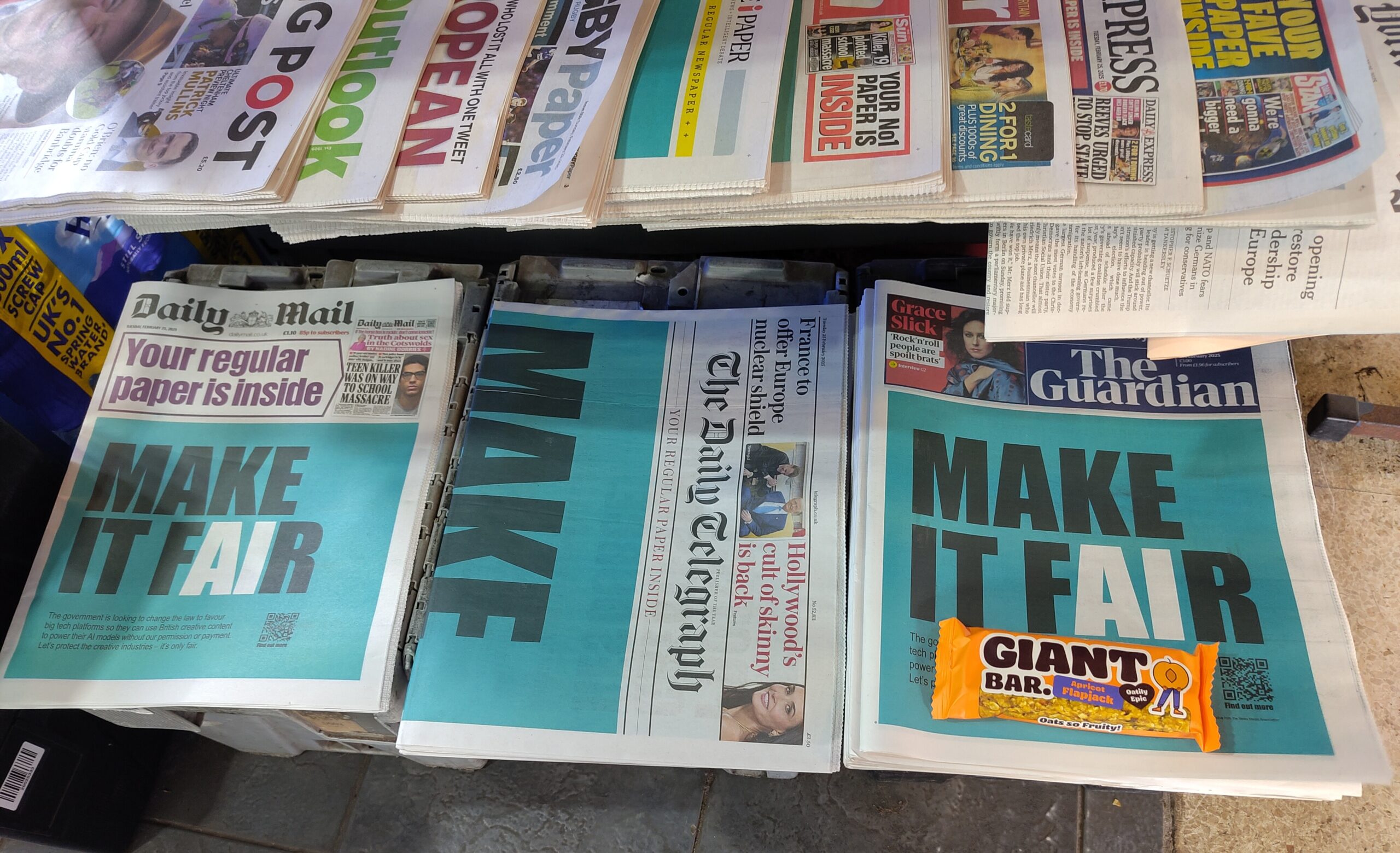
Many, many creators and rights holders (who are usually on opposing sides when it comes to contract negotiations) have opposed the government’s proposals. Every national newspaper ran the same Make It Fair front page opposing them; musicians released a silent album. In the Guardian, the peer and independent filmmaaker Beeban Kidron calls the consultation “fixed” in favor of the AI companies. Kidron’s resume includes directing Bridget Jones: The Edge of Reason (2004) and the meticulously researched 2013 study of teens online, InRealLife, and she goes on to call the government’s preferred option a “wholesale transfer of wealth from hugely successful sector that invests hundreds of millions in the UK to a tech industry that extracts profit that is not assured and will accrue largely to the US and indeed China.”

The consultation lists four options: leave the situation as it is; require AI companies to get licenses to use copyrighted work (like everyone else has to); allow AI companies to use copyrighted works however they want; and allow AI companies to use copyrighted works but grant rights holders the right to opt out.

I don’t like any of these options. I do believe that creators will figure out how to use AI tools to produce new and valuable work. I *also* believe that rights holders will go on doing their best to use AI to displace or impoverish creators. That is already happening in journalism and voice acting, and was a factor in the 2023 Hollywood writers’ strike. AI companies have already shown that won’t necessarily abide by arrangements that lack the force of law. The UK government acknowledged this in its consultation document, saying that “more than 50% of AI companies observe the longstanding Internet convention robots.txt.” So almost half of them *don’t*.

At Pluralistic, Cory Doctorow argued in February 2023 that copyright won’t solve the problems facing creators. His logic is simple: after 40 years of expanding copyright terms (from a maximum of 56 years in 1975 to “author’s life plus 70” now), creators are being paid *less* than they were then. Yes, I know Taylor Swift has broken records for tour revenues and famously took back control of her own work. but millions of others need, as Doctorow writes, structural market changes. Doctorow highlights what happened with sampling: the copyright maximalists won, and now musicians are required to sign away sampling rights to their labels, who pocket the resulting royalties.

For this sort of reason, the status quo, which the consultation calls “option 0”, seems likely to open the way to lots more court cases and conflicting decisions, but provide little benefit to anyone. A licensing regime (“option 1”) will likely go the way of sampling. If you think of AI companies as inevitably giant “pre-monopolized” outfits, like Vladen Joler at last year’s Computers, Privacy, and Data Protection conference, “Option 2” looks like simply making them richer and more powerful at the expense of everyone else in the world. But so does “option 3”, since that *also* gives AI companies the ability to use anything they want. Large rights holders will opt out and demand licensing fees, which they will keep, and small ones will struggle to exercise their rights.

As Kidron said, the government’s willingness to take chances with the country’s creators’ rights is odd, since intellectual property is a sector in which Britain really *is* a world leader. On the other hand, as Moody says, all of it together is an anthill compared to the technology sector.

None of these choices is a win for creators or the public. The government’s preferred option 3 seems unlikely to achieve its twin goals of making Britain a world leader in AI and mainlining AI into the veins of the nation, as the government put it last month.

China and the US both have complete technology stacks *and* gigantic piles of data. The UK is likely better able to matter in AI development than many countries – see for example DeepMind, which was founded here in 2010. On the other hand, also see DeepMind for the probable future: Google bought it in 2014, and now its technology and profits belong to that giant US company.

At Walled Culture, Glyn Moody argued last May that requiring the AI companies to pay copyright industries makes no sense; he regards using creative material for training purposes as “just a matter of analysis” that should not require permission. And, he says correctly, there aren’t enough such materials anyway. Instead, he and Mike Masnick at Techdirt propose that the generative AI companies should pay creators of all types – journalists, musicians, artists, filmmakers, book authors – to provide them with material they can use to train their models, and the material so created should be placed in the public domain. In turn it could become new building blocks the public can use to produce even more new material. As a model for supporting artists, patronage is old.

I like this effort to think differently a lot better than any of the government’s options.

Illustrations:: Tuesday’s papers, unprecedentedly united to oppose the government’s copyright plan.

Wendy M. Grossman is the 2013 winner of the Enigma Award. Her Web site has an extensive archive of her books, articles, and music, and an archive of earlier columns in this series. She is a contributing editor for the Plutopia News Network podcast. Follow on Mastodon or Bluesky.

Follow the business models

In a market that enabled the rational actions of economists’ fantasies, consumers would be able to communicate their preferences for “smart” or “dumb” objects by exercising purchasing power. Instead, everything from TVs and vacuum cleaners to cars is sprouting Internet connections and rampant data collection.

I would love to believe we will grow out of this phase as the risks of this approach continue to become clearer, but I doubt it because business models will increasingly insist on the post-sale money, which never existed in the analog market. Subscriptions to specialized features and embedded ads seem likely to take ever everything. Essentially, software can change the business model governing any object’s manufacture into Gillette’s famous gambit: sell the razors cheap, and make the real money selling razor blades. See also in particular printer cartridges. It’s going to be everywhere, and we’re all going to hate it.

***

My consciousness of the old ways is heightened at the moment because I spent last weekend participating in a couple of folk music concerts around my old home town, Ithaca, NY. Everyone played acoustic instruments and sang old songs to celebrate 58 years of the longest-running folk music radio show in North America. Some of us hadn’t really met for nearly 50 years. We all look older, but everyone sounded great.

A couple of friends there operate a “rock shop” outside their house. There’s no website, there’s no mobile app, just a table and some stone wall with bits of rock and other findings for people to take away if they like. It began as an attempt to give away their own small collection, but it seems the clearing space aspect hasn’t worked. Instead, people keep bringing them rocks to give away – in one case, a tray of carefully laid-out arrowheads. I made off with a perfect, peach-colored conch shell. As I left, they were taking down the rock shop to make way for fantastical Halloween decorations to entertain the neighborhood kids.

Except for a brief period in the 1960s, playing folk music has never been lucrative. However it’s still harder now: teens buy CDs to ensure they can keep their favorite music, and older people buy CDs because they still play their old collections. But you can’t even *give* a 45-year-old a CD because they have no way to play it. At the concert, Mike Agranoff highlighted musicians’ need for support in an ecosystem that now pays them just $0.014 (his number) for streaming a track.

***

With both Halloween and the US election scarily imminent, the government the UK elected in July finally got down to its legislative program this week.

Data protection reform is back in the form of the the Data Use and Access Bill, Lindsay Clark reports at The Register, saying the bill is intended to improve efficiency in the NHS, the police force, and businesses. It will involve making changes to the UK’s implementation of the EU’s General Data Protection Regulation. Care is needed to avoid putting the UK’s adequacy decision at risk. At the Open Rights Group Mariano della Santi warns that the bill weakens citizens’ protection against automated decision making. At medConfidential, Sam Smith details the lack of safeguards for patient data.

At Computer Weekly, Bill Goodwin and Sebastian Klovig Skelton outline the main provisions and hopes: improve patient care, free up police time to spend more protecting the public, save money.

‘Twas ever thus. Every computer system is always commissioned to save money and improve efficiency – they say this one will save 140,000 a years of NHS staff time! Every new computer system also always brings unexpected costs in time and money and messy stages of implementation and adaptation during which everything becomes *less* efficient. There are always hidden costs – in this case, likely the difficulties of curating data and remediating historical bias. An easy prediction: these will be non-trivial.

***

Also pending is the draft United Nations Convention Against Cybercrime; the goal is to get it through the General Assembly by the end of this year.

Human Rights Watch writes that 29 civil society organizations have written to the EU and member states asking them to vote against the treaty’s adoption and consider alternative approaches that would safeguard human rights. The EFF is encouraging all states to vote no.

Internet historians will recall that there is already a convention on cybercrime, sometimes called the Budapest Convention. Drawn up in 2001 by the Council of Europe to come into force in 2004, it was signed by 70 countries and ratified by 68. The new treaty has been drafted by a much broader range of countries, including Russia and China, is meant to be consistent with that older agreement. However, the hope is it will achieve the global acceptance its predecessor did not, in part because of the broader

However, opponents are concerned that the treaty is vague, failing to limit its application to crimes that can only be committed via a computer, and lacks safeguards. It’s understandable that law enforcement, faced with the kinds of complex attacks on computer systems we see today want their path to international cooperation eased. But, as EFF writes, that eased cooperation should not extend to “serious crimes” whose definition and punishment is left up to individual countries.

Illustrations: Halloween display seen near Mechanicsburg, PA.

Wendy M. Grossman is the 2013 winner of the Enigma Award. Her Web site has an extensive archive of her books, articles, and music, and an archive of earlier columns in this series. She is a contributing editor for the Plutopia News Network podcast. Follow on Mastodon.

The brittle state

We’re now almost a year on from Rishi Sunak’s AI Summit, which failed to accomplish any of its most likely goals: cement his position as the UK’s prime minister; establish the UK as a world leader in AI fearmongering; or get him the new life in Silicon Valley some commentators seemed to think he wanted.

Arguably, however, it has raised belief that computer systems are “intelligent” – that is, that they understand what they’re calculating. The chatbots based on large language models make that worse, because, as James Boyle cleverly wrote, for the first time in human history, “sentences do not imply sentience”. Mix in paranoia over the state of the world and you get some truly terrifying systems being put into situations where they can catastrophically damage people’s lives. We should know better by now.

The Open Rights Group (I’m still on its advisory council) is campaigning against the Home Office’s planned eVisa scheme. In the previouslies: between 1948 and 1971, people from Caribbean countries, many of whom had fought for Britain in World War II, were encouraged to help the UK rebuild the economy post-war. They are known as the “Windrush generation” after the first ship that brought them. As Commonwealth citizens, they didn’t need visas or documentation; they and their children had the automatic right to live and work here.

Until 1973, when the law changed; later arrivals needed visas. The snag was that earlier arrivals had no idea they had any reason to worry….until the day they discovered, when challenged, that they had no way to prove they were living here legally. That day came in 2017, when then-prime minister, Theresa May (who this week joined the House of Lords) introduced the hostile environment. Intended to push illegal immigrants to go home, this law moves the “border” deep into British life by requiring landlords, banks, and others to conduct status checks. The result was that some of the Windrush group – again, legal residents – were refused medical care, denied housing, or deported.

When Brexit became real, millions of Europeans resident in the UK were shoved into the same position: arrived legally, needing no documentation, but in future required to prove their status. This time, the UK issued them documents confirming their status as permanently settled.

Until December 31, 2024, when all those documents with no expiration date will abruptly expire because the Home Office has a new system that is entirely online. As ORG and the3million explain it, come January 1, 2025, about 4 million people will need online accounts to access the new system, which generates a code to give the bank or landlord temporary access to their status. The new system will apparently hit a variety of databases in real time to perform live checks.

Now, I get that the UK government doesn’t want anyone to be in the country for one second longer than they’re entitled to. But we don’t even have to say, “What could possibly go wrong?” because we already *know* what *has* gone wrong for the Windrush generation. Anyone who has to prove their status off the cuff in time-sensitive situations really needs proof they can show when the system fails.

A proposal like this can only come from an irrational belief in the perfection – or at least, perfectability – of computer systems. It assumes that Internet connections won’t be interrupted, that databases will return accurate information, and that everyone involved will have the necessary devices and digital literacy to operate it. Even without ORG’s and the3million’s analysis, these are bonkers things to believe – and they are made worse by a helpline that is only available during the UK work day.

There is a lot of this kind of credulity about, most of it connected with “AI”. AP News reports that US police departments are beginning to use chatbots to generate crime reports based on the audio from their body cams. And, says Ars Technica, the US state of Nevada will let AI decide unemployment benefit claims, potentially producing denials that can’t be undone by a court. BrainFacts reports that decision makers using “AI” systems are prone to automation bias – that is, they trust the machine to be right. Of course, that’s just good job security: you won’t be fired for following the machine, but you might for overriding it.

The underlying risk with all these systems, as a security experts might say, is complexity: more complex means being more susceptible to inexplicable failures. There is very little to go wrong with a piece of paper that plainly states your status, for values of “paper” including paper, QR codes downloaded to phones, or PDFs saved to a desktop/laptop. Much can go wrong with the system underlying that “paper”, but, crucially, when a static confirmation is saved offline, managing that underlying complexity can take place when the need is not urgent.

It ought to go without saying that computer systems with a profound impact on people’s lives should be backed up by redundant systems that can be used when they fail. Yet the world the powers that be apparently want to build is one that underlines their power to cause enormous stress for everyone else. Systems like eVisas are as brittle as just-in-time supply chains. And we saw what happens to those during the emergency phase of the covid pandemic.

Illustrations: Empty supermarket shelves in March 2020 (via Wikimedia).

Wendy M. Grossman is the 2013 winner of the Enigma Award. Her Web site has an extensive archive of her books, articles, and music, and an archive of earlier columns in this series. She is a contributing editor for the Plutopia News Network podcast. Follow on Mastodon.

The fear factor

Be careful what you allow the authorities to do to people you despise, because one day those same tools will be turned against you.

In the last few weeks, the shocking stabbing of three young girls at a dance class in Southport became the spark to ignite riots across the UK by people who apparently believed social media theories that the 17-year-old boy responsible was Muslim, a migrant, or a terrorist. With the boy a week from his 18th birthday, the courts ruled police could release his name in order to make clear he was not Muslim and born in Wales. It failed to stop the riots.

Police and the courts have acted quickly; almost 800 people have been arrested, 350 have been charged, and hundreds are in custody. In a moving development, on a night when more than 100 riots were predicted, tens of thousands of ordinary citizens thronged city streets and formed protective human chains around refugee centers in order to block the extremists. The riots have quieted down, but police are still busy arresting newly-identified suspects. And the inevitable question is being asked: what do we do next to keep the streets safe and calm?

London mayor Sadiq Khan quickly called for a review of the Online Safety Act, saying he doesn’t believe it’s fit for purpose. Cabinet minister Nick Thomas-Symonds (Labour-Torfaen) has suggested the month-old government could change the law.

Meanwhile, prime minister Keir Starmer favours a wider rollout of live facial recognition to track thugs and prevent them from traveling to places where they plan to cause social unrest, copying systems the police use to prevent football hooligans from even boarding trains to matches. This proposal is startling because: before standing for Parliament Starmer was a human rights lawyer. One could reasonably expect him to know that facial recognition systems have a notorious history of inaccuracy due to biases baked into their algorithms via training data, and that in the UK there is no regulatory framework to provide oversight. Silkie Carlo, the director of Big Brother Watch immediately called the proposal “alarming” and “ineffective”, warning that it turns people into “walking ID cards”.

As the former head of Liberty, Shami Chakrabarti used to say when ID cards were last proposed, moves like these fundamentally change the relationship between the citizen and the state. Such a profound change deserves more thought than a reflex fear reaction in a crisis. As Ciaran Thapar argues at the Guardian, today’s violence has many causes, beginning with the decay of public services for youth, mental health, and , and it’s those causes that need to be addressed. Thapar invokes his memories of how his community overcame the “open, violent racism” of the 1980s Thatcher years in making his recommendations.

Much of the discussion of the riots has blamed social media for propagating hate speech and disinformation, along with calls for rethinking the Online Safety Act. This is also frustrating. First of all, the OSA, which was passed in 2023, isn’t even fully implemented yet. When last seen, Ofcom, the regulator designated to enforce it, was in the throes of recruiting people by the dozen, working out what sites will be in scope (about 150,000, they said), and developing guidelines. Until we see the shape of the regulation in practice, it’s too early to say the act needs expansion.

Second, hate speech and incitement to violence are already illegal under other UK laws. Just this week, a woman was jailed for 15 months for a comment to a Facebook group with 5,100 members that advocated violence against mosques and the people inside them. The OSA was not needed to prosecute her.

And third, while Elon Musk and Mark Zuckerberg definitely deserve to have anger thrown their way, focusing solely on the ills of social media makes no sense given the decades that right-wing newspapers have spent sowing division and hatred. Even before Musk, Twitter often acted as a democratization of the kind of angry, hate-filled coverage long seen in the Daily Mail (and others). These are the wedges that created the divisions that malicious actors can now exploit by disseminating disinformation, a process systematically explained by Renee DiResta in her new book, Invisible Rulers.

The FBI’s investigation of the January 6, 2021 insurrection at the US Capitol provides a good exemplar for how modern investigations can exploit new technologies. Law enforcement applied facial recognition to CCTV footage and massive databases, and studied social media feeds, location data and cellphone tracking, and other data. As Charlie Warzel and Stuart A. Thompson wrote at the New York Times in 2021, even though most of us agree with the goal of catching and punishing insurrectionists and rioters, the data “remains vulnerable to use and abuse” against protests of other types – such as this year’s pro-Palestinian encampments.

The same argument applies in the UK. Few want violence in the streets. But the unilateral imposition of live facial recognition, among other tracking technologies, can’t be allowed. There must be limits and safeguards. ID cards issued in wartime could be withdrawn when peace came; surveillance technologies, once put in place, tend to become permanent.

Illustrations: The CCTV camera at 22 Portobello Road, where George Orwell once lived.

Wendy M. Grossman is the 2013 winner of the Enigma Award. Her Web site has an extensive archive of her books, articles, and music, and an archive of earlier columns in this series. She is a contributing editor for the Plutopia News Network podcast. Follow on Mastodon.

Twenty comedians walk into a bar…

The Internet was, famously, created to withstand a bomb outage. In 1998 Matt Blaze and Steve Bellovin said it, in 2002 it was still true, and it remains true today, after 50 years of development: there are more efficient ways to kill the Internet than dropping a bomb.

Take today. The cybersecurity company Crowdstrike pushed out a buggy update, and half the world is down. Airports, businesses, the NHS appointment booking system, supermarkets, the UK’s train companies, retailers…all showing the Blue Screen of Death. Can we say “central points of failure”? Because there are two: Crowdstrike, whose cybersecurity is widespead, and Microsoft, whose Windows operating system is everywhere.

Note this hasn’t killed the *Internet*. It’s temporarily killed many systems *connected to* the Internet. But if you’re stuck in an airport where nothing’s working and confronted with a sign that says “Cash only” when you only have cards…well, at least you can go online to read the news.

The fix will be slow, because it involves starting the computer in safe mode and manually deleting files. Like Y2K remediation, one computer at a time.

***

Speaking of things that don’t work, three bits from the generative AI bubble. First, last week Goldman Sachs issued a scathing report on generative AI that concluded it is unlikely to ever repay the trillion-odd dollars companies are spending on it, while its energy demands could outstrip available supply. Conclusion: generative AI is a bubble that could nonetheless take a long time to burst.

Second, at 404 Media Emanuel Weiburg reads a report from the Tony Blair Institute that estimates that 40% of tasks performed by public sector workers could be partially automated. Blair himself compares generative AI to the industrial revolution. This comparison is more accurate than he may realize, since the industrial revolution brought climate change, and generative AI pours accelerant on it.

TBI’s estimate conflicts with that provided to Goldman by MIT economist Daron Acemoglu, who believes that AI will impact at most 4.6% of tasks in the next ten years. The source of TBI’s estimate? ChatGPT itself. It’s learned self-promotion from parsing our output?

Finally, in a study presented at ACM FAccT, four DeepMind researchers interviewed 20 comedians who do live shows and use AI to participate in workshops using large language models to help write jokes. “Most participants felt the LLMs did not succeed as a creativity support tool, by producing bland and biased comedy tropes, akin to ‘cruise ship comedy material from the 1950s, but a bit less racist’.” Last year, Julie Seabaugh at the LA Times interviewed 13 professional comedians and got similar responses. Ahmed Ahmed compared AI-generated comedy to eating processed foods and, crucially, it “lacks timing”.

***

Blair, who spent his 1997-2007 premiership pushing ID cards into law, has also been trying to revive this longheld obsession. Two days after Keir Starmer took office, Blair published a letter in the Sunday Times calling for its return. As has been true throughout the history of ID cards (PDF), every new revival presents it as a solution to a different problem. Blair’s 2024 reason is to control immigration (and keep the far-right Reform party at bay). Previously: prevent benefit fraud, combat terorism, streamline access to health, education, and other government services (“the entitlement card”), prevent health tourism.

Starmer promptly shot Blair down: “not part of the government’s plans”. This week Alan West, a home office minister 2007-2010 under Gordon Brown, followed up with a letter to the Guardian calling for ID cards because they would “enhance national security in the areas of terrorism, immigration and policing; facilitate access to online government services for the less well-off; help to stop identity theft; and facilitate international travel”.

Neither Blair (born 1953) nor West (born 1948) seems to realize how old and out of touch they sound. Even back then, the “card” was an obvious decoy. Given pervasive online access, a handheld reader, and the database, anyone’s identity could be checked anywhere at any time with no “card” required.

To sound modern they should call for institutionalizing live facial recognition, which is *already happening* by police fiat. Or sprinkled AI bubble on their ID database.

Databases and giant IT projects that failed – like the Post Office scandal – that was the 1990s way! We’ve moved on, even if they haven’t.

***

If you are not a deposed Conservative, Britain this week is like waking up sequentially from a series of nightmares. Yesterday, Keir Starmer definitively ruled out leaving the European Convention on Human Rights – Starmer’s background as a human rights lawyer to the fore. It’s a relief to hear after 14 years of Tory ministers – David Cameron,, Boris Johnson, Suella Braverman, Liz Truss, Rishi Sunak – whining that human rights law gets in the way of their heart’s desires. Like: building a DNA database, deporting refugees or sending them to Rwanda, a plan to turn back migrants in boats at sea.

Principles have to be supported in law; under the last government’s Public Order Act 2023 curbing “disruptive protest”, yesterday five Just Stop Oil protesters were jailed for four and five years. Still, for that brief moment it was all The Brotherhood of Man.

Illustrations: Windows’ Blue Screen of Death (via Wikimedia).

Wendy M. Grossman is the 2013 winner of the Enigma Award. Her Web site has an extensive archive of her books, articles, and music, and an archive of earlier columns in this series. She is a contributing editor for the Plutopia News Network podcast. Follow on Mastodon.

Outbound

As the world and all knows by now, the UK is celebrating this year’s American Independence Day by staging a general election. The preliminaries are mercifully short by US standards, in that the period between the day it was called and the day the winners will be announced is only about six weeks. I thought the announcement would bring more sense of relief than it did. Instead, these six weeks seem interminable for two reasons: first, the long, long wait for the announcement, and second, the dominant driver for votes is largely negative – voting against, rather than voting for.

Labour, which is in polling position to win by a lot, is best served by saying and doing as little as possible, lest a gaffe damage its prospects. The Conservatives seem to be just trying not to look as hopeless as they feel. The only party with much exuberance is the far-right upstart Reform, which measures success in terms of whether it gets a larger share of the vote than the Conservatives and whether Nigel Farage wins a Parliamentary seat on his eighth try. And the Greens, who are at least motivated by genuine passion for their cause, and whose only MP is retiring this year. For them, sadly, success would be replacing her.

Particularly odd is the continuation of the trend visible in recent years for British right-wingers to adopt the rhetoric and campaigning style of the current crop of US Republicans. This week, they’ve been spinning the idea that Labour may win a dangerous “supermajority”. “Supermajority” has meaning in the US, where the balance of powers – presidency, House of Representatives, Senate – can all go in one party’s direction. It has no meaning in the UK, where Parliament is sovereign. All it means is Labour could wind up with a Parliamentary majority so large that they can pass any legislation they want. But this has been the Conservatives’ exact situation for the last five years, ever since the 2019 general election gave Boris Johnson a majority of 86. We should probably be grateful they largely wasted the opportunity squabbling among themselves.

This week saw the launch, day by day, of each party manifesto in turn. At one time, this would have led to extensive analysis and comparisons. This year, what discussion there is focuses on costs: whose platform commits to the most unfunded spending, and therefore who will raise taxes the most? Yet my very strong sense is that few among the electorate are focused on taxes; we’d all rather have public services that work and an end to the cost-of-living crisis. You have to be quite wealthy before private health care offers better value than paying taxes. But here may lie the explanation for both this and the weird Republican-ness of 2024 right-wing UK rhetoric: they’re playing to the same wealthy donors.

In this context, it’s not surprising that there’s not much coverage of what little the manifestos have to say about digital rights or the Internet. The exception is Computer Weekly, which finds the Conservatives promising more of the same and Labour offering a digital infrastructure plan, which includes building data centers and easing various business regulations but not to reintroduce the just-abandoned Data Protection and Digital Information bill.

In the manifesto itself: “Labour will build on the Online Safety Act, bringing forward provisions as quickly as possible, and explore further measures to keep everyone safe online, particularly when using social media. We will also give coroners more powers to access information held by technology companies after a child’s death.” The latter is a reference to recent cases such as that of 14-year-old Molly Russell, whose parents fought for five years to gain access to her Instagram account after her death.

Elsewhere, the manifesto also says, “Too often we see families falling through the cracks of public services. Labour will improve data sharing across services, with a single unique identifier, to better support children and families.”

“A single unique identifier” brings a kind of PTSD flashback: the last Labour government, in power from 1997 to 2010, largely built the centralized database state, and was obsessed with national ID cards, which were finally killed by David Cameron’s incoming coalition government. At the time, one of the purported benefits was streamlining government interaction. So I’m suspicious: this number could easily be backed by biometrics and checked via phone apps on the spot, anywhere and grow into…?

In terms of digital technologies, the LibDems mostly talk about health care, mandating interoperability for NHS systems and improving both care and efficiency. That can only be assessed if the detail is known. Also of interest: the LibDems’ proposed anti-SLAPP law, increasingly needed.

The LibDems also commit to advocate for a “Digital Bill of Rights”. I’m not sure it’s worth the trouble: “digital rights” as a set of civil liberties separate from human rights is antiquated, and many aspects are already enshrined in data protection, competition, and other law. In 2019, under the influence of then-deputy leader Tom Watson, this was a Labour policy. The LibDems are unlikely to have any power; but they lead in my area.

I wish the manifestos mattered and that we could have a sensible public debate about what technology policy should look like and what the priorities should be. But in a climate where everyone votes to get one lot out, the real battle begins on July 5, when we find out what kind of bargain we’ve made.

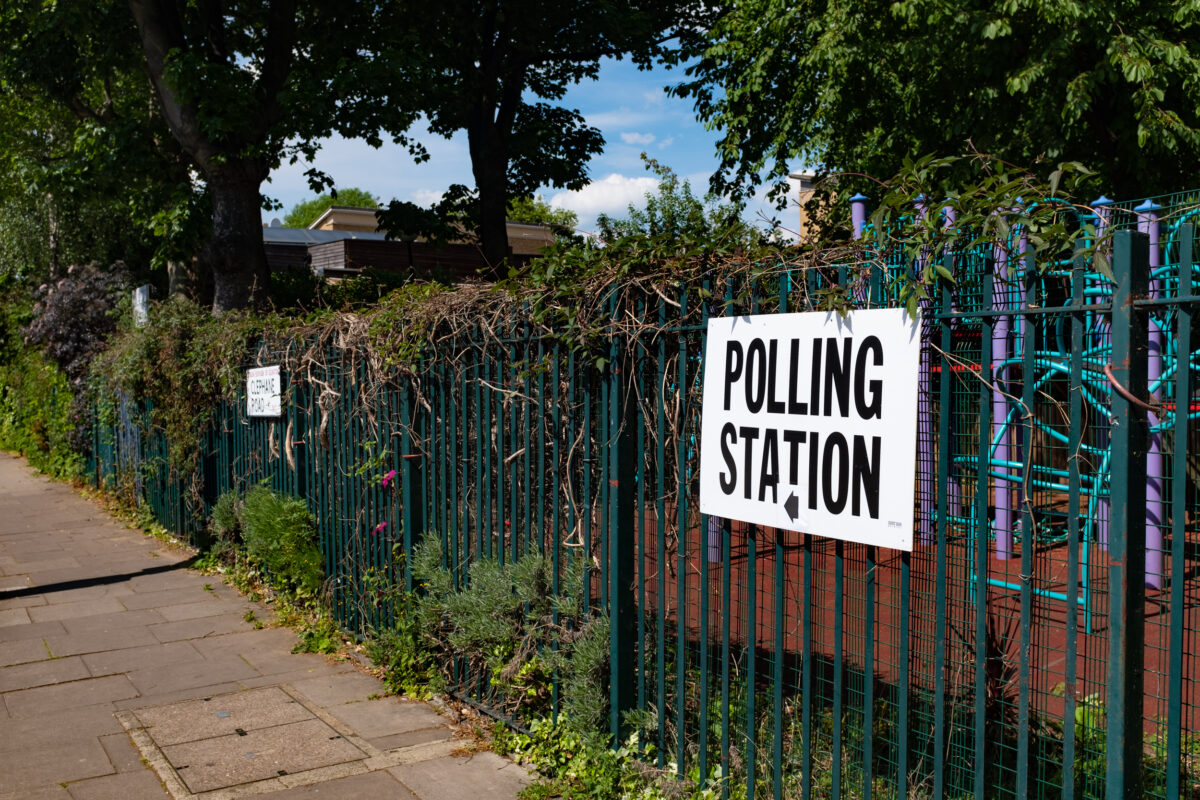
Illustrations: Polling station in Canonbury, London, in 2019 (via Wikimedia).

Wendy M. Grossman is the 2013 winner of the Enigma Award. Her Web site has an extensive archive of her books, articles, and music, and an archive of earlier columns in this series. She is a contributing editor for the Plutopia News Network podcast. Follow on Mastodon.

Deja news

At the first event organized by the University of West London group Women Into Cybersecurity, a questioner asked how the debates around the Internet have changed since I wrote the original 1997 book net.wars..

Not much, I said. Some chapters have dated, but the main topics are constants: censorship, freedom of speech, child safety, copyright, access to information, digital divide, privacy, hacking, cybersecurity, and always, always, *always* access to encryption. Around 2010, there was a major change when the technology platforms became big enough to protect their users and business models by opposing government intrusion. That year Google launched the first version of its annual transparency report, for example. More recently, there’s been another shift: these companies have engorged to the point where they need not care much about their users or fear regulatory fines – the stage Ed Zitron calls the rot economy and Cory Doctorow dubs enshittification.

This is the landscape against which we’re gearing up for (yet) another round of recursion. April 25 saw the passage of amendments to the UK’s Investigatory Powers Act (2016). These are particularly charmless, as they expand the circumstances under which law enforcement can demand access to Internet Connection Records, allow the government to require “exceptional lawful access” (read: backdoored encryption) and require technology companies to get permission before issuing security updates. As Mark Nottingham blogs, no one should have this much power. In any event, the amendments reanimate bulk data surveillance and backdoored encryption.

Also winding through Parliament is the Data Protection and Digital Information bill. The IPA amendments threaten national security by demanding the power to weaken protective measures; the data bill threatens to undermine the adequacy decision under which the UK’s data protection law is deemed to meet the requirements of the EU’s General Data Protection Regulation. Experts have already put that adequacy at risk. If this government proceeds, as it gives every indication of doing, the next, presumably Labour, government may find itself awash in an economic catastrophe as British businesses become persona-non-data to their European counterparts.

The Open Rights Group warns that the data bill makes it easier for government, private companies, and political organizations to exploit our personal data while weakening subject access rights, accountability, and other safeguards. ORG is particularly concerned about the impact on elections, as the bill expands the range of actors who are allowed to process personal data revealing political opinions on a new “democratic engagement activities” basis.

If that weren’t enough, another amendment also gives the Department of Work and Pensions the power to monitor all bank accounts that receive payments, including the state pension – to reduce overpayments and other types of fraud, of course. And any bank account connected to those accounts, such as landlords, carers, parents, and partners. At Computer Weekly, Bill Goodwin suggests that the upshot could be to deter landlords from renting to anyone receiving state benefits or entitlements. The idea is that banks will use criteria we can’t access to flag up accounts for the DWP to inspect more closely, and over the mass of 20 million accounts there will be plenty of mistakes to go around. Safe prediction: there will be horror stories of people denied benefits without warning.

And in the EU… Techcrunch reports that the European Commission (always more surveillance-happy and less human rights-friendly than the European Parliament) is still pursuing its proposal to require messaging platforms to scan private communications for child sexual abuse material. Let’s do the math of truly large numbers: billions of messages, even a teeny-tiny percentage of inaccuracy, literally millions of false positives! On Thursday, a group of scientists and researchers sent an open letter pointing out exactly this. Automated detection technologies perform poorly, innocent images may occur in clusters (as when a parent sends photos to a doctor), and such a scheme requires weakening encryption, and in any case, better to focus on eliminating child abuse (taking CSAM along with it).

Finally, age verification, which has been pending in the UK ever since at least 2016, is becoming a worldwide obsession. At least eight US states and the EU have laws mandating age checks, and the Age Verification Providers Association is pushing to make the Internet “age-aware persistently”. Last month, the BSI convened a global summit to kick off the work of developing a worldwide standard. These moves are the latest push against online privacy; age checks will be applied to *everyone*, and while they could be designed to respect privacy and anonymity, the most likely is that they won’t be. In 2022, the French data protection regulator, CNIL, found that current age verification methods are both intrusive and easily circumvented. In the US, Casey Newton is watching a Texas case about access to online pornography and age verification that threatens to challenge First Amendment precedent in the Supreme Court.

Because the debates are so familiar – the arguments rarely change – it’s easy to overlook how profoundly all this could change the Internet. An age-aware Internet where all web use is identified and encrypted messaging services have shut down rather than compromise their users and every action is suspicious until judged harmless…those are the stakes.

Illustrations: Angel sensibly smashes the ring that makes vampires impervious (in Angel, “In the Dark” (S01e03)).

Wendy M. Grossman is the 2013 winner of the Enigma Award. Her Web site has an extensive archive of her books, articles, and music, and an archive of earlier columns in this series. She is a contributing editor for the Plutopia News Network podcast. Follow on Mastodon