Review: Vassal State

Vassal State: How America Runs Britain
by Angus Hanton
Swift Press
978-1-80075390-7

Tax organizations estimate that a bit under 200,000 expatriate Americans live in the UK. It’s only a tiny percentage of the overall population of 70 million, but of course we’re not evenly distributed. In my bit of southwest London, the (recently abruptly shuttered due to rising costs) butcher has advertised “Thanksgiving turkeys” for more than 30 years.

In Vassal State, however, Angus Hanton shows that US interests permeate and control the UK in ways far more significant than a handful of expatriates. This is not, he stresses, an equal partnership, despite the perennial photos of the British prime minister being welcomed to the White House by the sitting president, as shown satirically in 1986’s Yes, Prime Minister. Hunton cites the 2020 decision to follow the US and ban Huawei as an example, writing that the US pressure at the time “demonstrated the language of partnership coupled with the actions of control”. Obama staffers, he is told, used to joke about the “special relationship”.

Why invade when you can buy and control? Hanton lists a variety of vectors for US influence. Many of Britain’s best technology startups wind up sold to US companies, permanently alienating their profits – see, for example, DeepMind, sold to Google in 2014, and Worldpay, sold to Vantiv in 2019, which then took its name. US buyers also target long-established companies, such as 176-year-old Boots, which since 2014 has been part of Walgreens and is now being bought up by the Sycamore Partners private equity fund. To Americans, this may not seem like much, but Boots is a national icon and an important part of delivering NHS services such as vaccinations. No one here voted for Sycamore Partners to benefit from that, nor did they vote for Kraft to buy Cadbury’s in 2010 and abandon its Bournville headquarters since 1824.

In addition, US companies are burrowed into British infrastructure. Government ministers communicate with each other over WhatsApp. Government infrastructure is supplied by companies like Oracle and IBM, and, lately, Palantir, which are hard to dig out once embedded. A seventh of the workforce are precariously paid by the US-dominated gig economy. The vast majority of cashless transactions pay a slice to Visa or Mastercard. And American companies use the roads, local services, and other infrastructure while paying less in tax than their UK competition. More controversially for digital rights activists, Hanton complains about the burden that US-based streamers like Netflix, Apple, and Amazon place on the telecommunications networks. Among the things he leaves out: the technology platforms in education.

Hanton’s book comes at a critical moment. Previous administrations have perhaps been more polite about demanding US-friendly policies, but now Britain, on its own outside the EU, is facing Donald Trump’s more blatant demands. Among them: that suppliers to the US government comply with its anti-DEI policies. In countries where diversity, equity, and inclusion are fundamental rights, the US is therefore demanding that its law should take precedence.

In a timeline fork in which Britain remained in the EU, it would be in a much better position to push back. In *this* timeline, Hanton’s proposed remedies – reform the tax structure, change policies, build technological independence – are much harder to implement.

Three times a monopolist

It’s multiply official: Google is a monopoly.

The latest such ruling is a decision handed down on April 17 by Judge Leonie Brinkema in United States of America v. Google LLC, a 2023 case that focuses on Google’s control over both the software publishers use to manage online ads and the exchanges where those same ads are bought and sold. In August 2024, Judge Amit P. Mehta also ruled Google was a monopoly; that United States of America v. Google LLC, filed in 2020, focused on Google’s payments to mobile phone companies, wireless carriers, and browser companies to promote its search engine. Before *that*, in 2023 a jury found in Epic Games v. Google that Google violated antitrust laws with respect to the Play Store and Judge James Donato ordered it to allow alternative app stores on Android devices by November 1, 2024. Appeals are proceeding.

Google has more trouble to look forward to. At The Overspill, veteran journalist Charles Arthur is a member of a class representative bringing a UK case against Google. The AdTechClaim case seeks £13.6 billion in damages, claiming that Google’s adtech system has diverted revenues that otherwise would have accrued to UK-based website and app publishers. Reuters reported last week on the filing of a second UK challenge, a £5 billion suit representing thousands of businesses who claim Google manipulated the search ecosystem to block out rivals and force advertisers to rely on its platform. Finally, the Competition and Markets Authority is conducting its own investigation into the company’s search and advertising practices.

It is hard to believe that all of this will go away leaving Google intact, despite the company’s resistance to each one. We know from past experience that fines change nothing; only structural remedies will

The US findings against Google seem to have taken some commentators by surprise, perhaps assuming that the Trump administration would have a dampening effect. Trump, however, seems more exercised about the EU’s and UK’s mounting regulatory actions. Just this week the European Commission fined Apple €500 million and Meta €200 million, the first under the Digital Markets Act, and ordered them to open up user choice within 60 days. The White House has called some of these recent fines a new form of economic blackmail.

I’ve observed before that antitrust cases are often well behind the times, partly because these cases take so long to litigate. It wasn’t until 2024 that Google lost its 2017 appeal to the European Court of Justice in the Foundem search case and was ordered to pay a €2.4 billion fine. That case was first brought in 2009.

In 2014, I imagined that Google’s recently-concluded purchase of Nest smart thermostats might form the basis of an antitrust suit in 2024. Obviously, that didn’t happen; I wish instead the UK government had blocked Google’s acquisition of DeepMind. Partly, because perhaps the pre-monopolization of AI could have been avoided. And partly because I’ve been reading Angus Hanton’s recent book, Vassal State, and keeping it would have hugely benefited Britain.

Unfortunately, forcing Google to divest DeepMind is not on anyone’s post-trial list of possible remedies. In October, the Department of Justice filed papers listing a series of possibilities for the search engine case. The most-discussed of these was ordering Google to divest Chrome. In a sensible world, however, one must hope remedies will be found that address the differing problems these cases were brought to address.

At Big, Matt Stoller suggests that the latest judgment increases the likelihood that Google will be broken up, the first such order since AT&T in 1984. The DoJ, now under Trump’s control, could withdraw, but, Stoller points out, the list of plaintiffs includes several state attorneys general, and the DoJ can’t dictate what they do.

Trying to figure out what remedies would make real change is a difficult game, as the folks at the the April 20 This Week In Tech podcast say. This is unlike the issue around Google’s and Apple’s app stores that the European Commission fines cover, where it’s comparatively straightforward to link opening up their systems to alternatives and changing their revenue structure to ensuring that app makers and publishers get a fairer percentage.

Breaking up the company to separate Chrome, search, adtech, and Android would disable the company’s ability to use those segments as levers. In such a situation Google and/or its parent, Alphabet, could not, as now, use them in combination to maintain its ongoing data collection and build a durable advantage in training sophisticated models to underpin automated services. But would forcing the company to divest those segments create competition in any of them? Each would likely remain dominant in its field.

Yet something must be done. Even though Microsoft was not in the end broken up in 2001 when the incoming Bush administration settled the case, the experience of being investigated and found guilty of monopolistic behavior changed the company. None of today’s technology companies are likely to follow suit unless they’re forced; these companies are too big, too powerful, too rich, and too arrogant. If Google is not forced to change its structure or its business model, all of them will be emboldened to behave in even worse ways. As unimaginable as that seems.

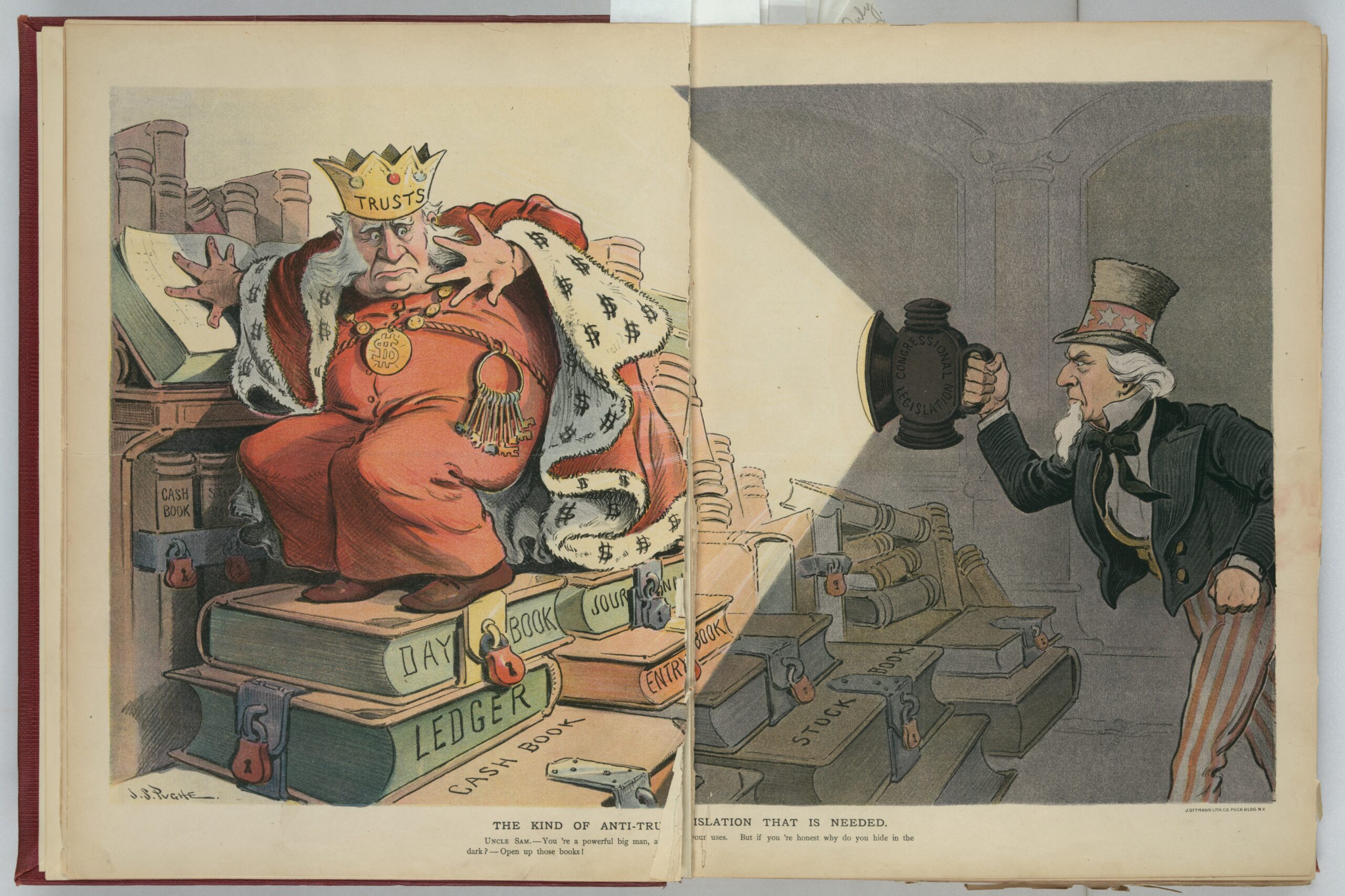
Illustrations: “The kind of anti-trust legislation we need”, by J. S. Pughe (via Wikimedia.

Wendy M. Grossman is the 2013 winner of the Enigma Award. Her Web site has an extensive archive of her books, articles, and music, and an archive of earlier columns in this series. She is a contributing editor for the Plutopia News Network podcast. Follow on Mastodon or Bluesky.

A short history of We Robot 2012-

On the eve of We Robot 2025, here are links to my summaries of previous years. 2014 is missing; I didn’t make it that year for family reasons. There was no conference in 2024 in order to move the event back to its original April schedule (covid caused its move to September in 2020). These are my personal impressions; nothing I say here should be taken as representing the conference, its founders, its speakers, or their institutions.

We Robot was co-founded by Michael Froomkin, Ryan Calo, and Ian Kerr to bring together lawyers and engineers to think early about the coming conflicts in robots, law, and policy.

2024 No conference.

2023 The end of cool. After struggling to design a drone delivery service that had any benefits over today’s cycling couriers, we find ourselves less impressed by robot that can do somersaults but not do anything useful.

2022 Insert a human. “Robots” are now “sociotechnical systems”.

Workshop day Coding ethics. The conference struggles to design an ethical robot.

2021 Plausible diversions. How will robots rehape human space?

Workshop day Is the juice worth the squeeze?. We think about how to regulate delivery robots, which will likely have no user-serviceable parts. Title from Woody Hartzog.

2020 (virtual) The zero on the phone. AI exploitation becomes much more visible.

2019 Math, monsters, and metaphors. The trolley problem is dissected; the true danger is less robots than the “pile of math that does some stuff”.

Workshop day The Algernon problem. New participants remind that robots/AI are carrying out the commands of distant owners.

2018 Deception. The conference tries to tease out what makes robots different and revisits Madeleine Clare Elish’s moral crumple zones after the first pedestrian death by self-driving car.

Workshop day Late, noisy, and wrong. Engineers Bill Smart and Cindy Grimm explain why sensors never capture what you think they’re capturing and how AI systems use their data.

2017 Have robot, will legislate. Discussion of risks this year focused on the intermediate sitaution, when automation and human norms clash.

2016 Humans all the way down. Madeline Clare Elish introduces “moral crumple zones”.

Workshop day: The lab and the world. Bill Smart uses conference attendees in formation to show why building a robot is difficult.

2015 Multiplicity. A robot pet dog begs its owner for an upgraded service subscription.

2014 Missed conference

2013 Cautiously apocalyptic. Diversity of approaches to regulation will be needed to handle the diversity of robots.

2012 A really fancy hammer with a gun. Unsentimental engineer Bill Smart provided the title.

wg

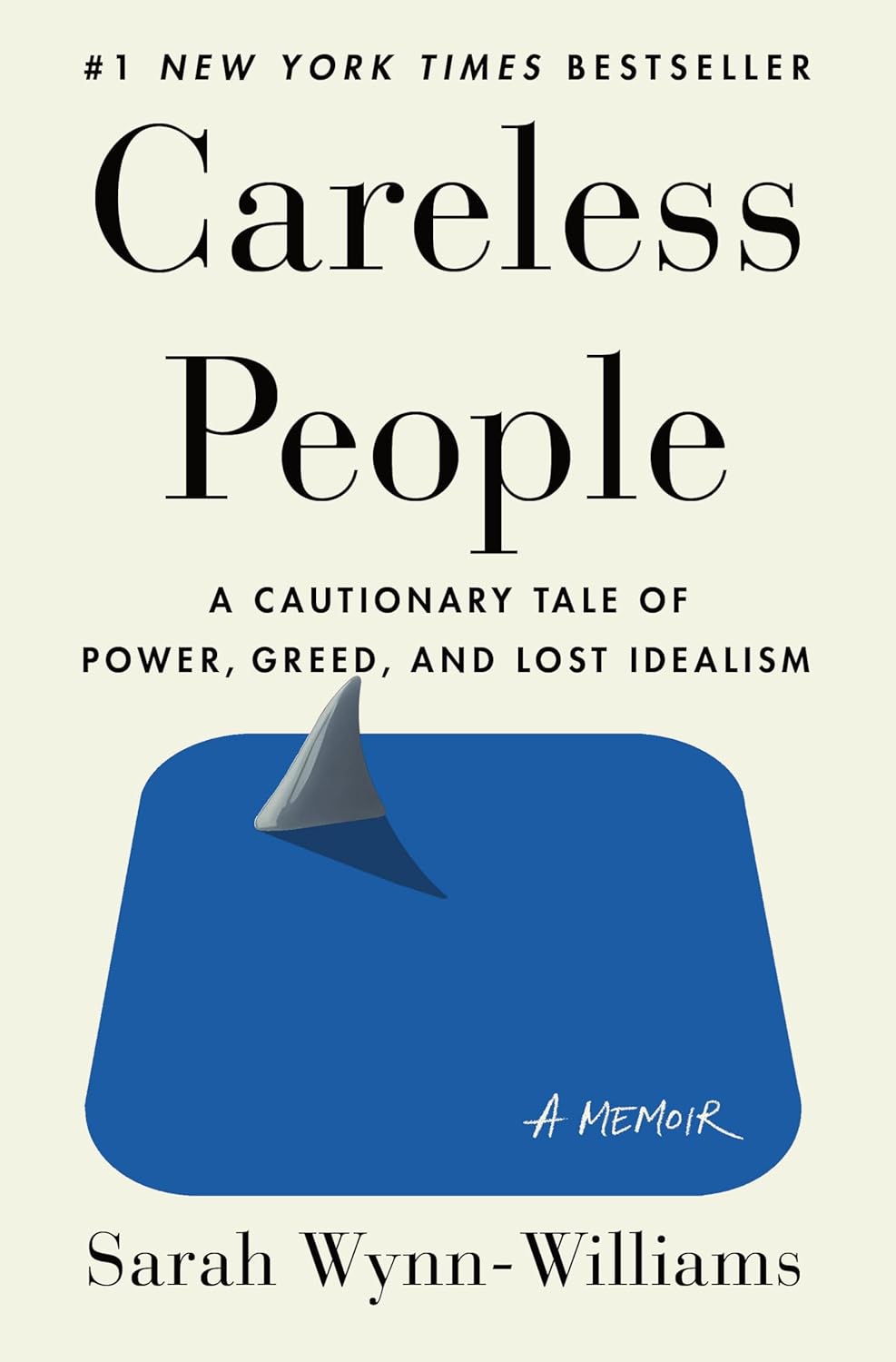
Review: Careless People

Careless People: A Cautionary Tale of Power, Greed, and Lost Idealism
By Sarah-Wynn-Williams
Macmillan
ISBN: 978-1035065929

In his 2021 book Social Warming, Charles Arthur concludes his study of social media with the observation that the many harms he documented happened because no one cared to stop them. “Nobody meant for this to happen,” he writes to open his final chapter.

In her new book, Careless People, about her time at Facebook, former New Zealand diplomat Sarah Wynn-Williams shows the truth of Arthur’s take. A sad tale of girl-meets-company, girl-loses-company, girl-tells-her-story, it starts with Wynn-Williams stalking Facebook to identify the right person to pitch hiring her to build its international diplomatic relationships. I kept hoping increasing dissent and disillusion would lead her to quit. Instead, she stays until she’s fired after HR dismisses her complaint of sexual harassment.

In 2011, when Wynn-Williams landed her dream job, Facebook’s wild expansion was at an early stage. CEO Mark Zuckerberg is awkward, sweaty, and uncomfortable around world leaders, who are dismissive. By her departure in 2017, presidents of major countries want selfies with him and he’s much more comfortable – but no longer cares. Meanwhile, then-Chief Operating Officer Sheryl Sandberg, wealthy from her time at Google, becomes a celebrity via her book, Lean In, written with the former TV comedy writer Nell Scovell. Sandberg’s public feminism clashes with her employee’s experience. When Wynn-Williams’s first child is a year old, a fellow female employee congratulates her on keeping the child so well-hidden she didn’t know it existed.

The book provides hysterically surreal examples of American corporatism. She is in the delivery room, feet in stirrups, ordered to push, when a text arrives: can she draft talking points for Davos? (She tries!) For an Asian trip, Zuckerberg wants her to arrange a riot or peace rally so he can appear to be “gently mobbed”. When the company fears “Mark” or “Sheryl” might be arrested if they travel to Korea, managers try to identify a “body” who can be sent in as a canary. Wynn-Williams’s husband has to stop her from going. Elsewhere, she uses her diplomatic training to land Zuckerberg a “longer-than-normal handshake” with Xi Jinping.

So when you get to her failure to get her bosses to beef up the two-person content moderation team for Myanmar’s 60 million people, rewrite the section so Burmese characters render correctly, and post country-specific policies, it’s obvious what her bosses will decide. The same is true of internal meetings discussing the tools later revealed to let advertisers target depressed teens. Wynn-Williams hopes for a safe way forward, but warns that company executives’ “lethal carelessness” hasn’t changed.

Cultural clash permeates this book. As a New Zealander, she’s acutely conscious of the attitudes she encounters, and especially of the wealth and class disparity that divide the early employees from later hires. As pregnancies bring serious medical problems and a second child, the very American problem of affording health insurance makes offending her bosses ever riskier.

The most important chapters, whose in-the-room tales fill in gaps in books by Frances Haugen, Sheera Frankel and Cecilia Kang, and Steven Levy, are those in which Wynn-Williams recounts the company’s decision to embrace politics and build its business in China. If, her bosses reason, politicians become dependent on Facebook for electoral success, they will balk at regulating it. Donald Trump’s 2016 election, which Zuckerberg initially denied had been significantly aided by Facebook, awakened these political aspirations. Meanwhile, Zuckerberg leads the company to build a censorship machine to please China. Wynn-Williams abhors all this – and refuses to work on China. Nonetheless, she holds onto the hope that she can change the company from inside.

Apparently having learned little from Internet history, Meta has turned this book into a bestseller by trying to suppress it. Wynn-Williams managed one interview, with Business Insider, before an arbitrator’s injunction stopped her from promoting the book or making any “disparaging, critical or otherwise detrimental comments” related to Meta. This fits the man Wynn-Williams depicts who hates to lose so much that his employees let him win at board games.

Lost futures

In early December, the Biden administration’s Department of Justice filed its desired remedies, having won its case that Google is a monopoly. Many foresaw a repeat of 2001, when the incoming Bush administration dropped the Clinton DoJ’s plan to break up Microsoft.

Maybe not this time. In its first filing, Trump’s DoJ still wants Google to divest itself of the Chrome browser and intends to bar it from releasing other browsers. The DoJ also wants to impose some restrictions on Android and Google’s AI investments.

At The Register, Thomas Claburn reports that Mozilla is objecting to the DoJ’s desire to bar Google from paying other companies to promote its search engine by default. Those payments, Mozilla president Mark Surman admits to Claburn, keep small independent browsers afloat.

Despite Mozilla’s market shrinkage and current user complaints, it and its fellow minority browsers remain important in keeping the web open and out of full corporate control. It’s definitely counter-productive if the court, in trying to rein in Google’s monopoly, takes away what viability these small players have left. They are us.

***

On the other hand, it’s certainly not healthy for those small independents to depend for their survival on the good will of companies like Google. The Trump administration’s defunding of – among so many things – scientific research is showing just how dangerous it can be.

Within the US itself, the government has announced cuts to indirect funding, which researchers tell me are crippling to universities; $800 million cut in grants to Johns Hopkins, $400 at Columbia University, and so many more.

But it doesn’t stop in the US or with the cuts to USAID, which have disrupted many types of projects around the world, some of them scientific or medical research. The Trump administration is using its threats to scientific funding across the world to control speech and impose its, um, values. This morning, numerous news sources report that Australian university researchers have been sent questionnaires they must fill out to justify their US-funded grants. Among the questions: their links to China and their compliance with Trump’s gender agenda.

To be fair, using grants and foreign aid to control speech is not a new thing for US administrations. For example, Republican presidents going back to Reagan have denied funding to international groups that advocated abortion rights or provided abortions, limiting what clinicians could say to pregnant patients. (I don’t know if there are Democratic comparables.)

Science is always political to some extent: think the for stating that the earth was not the center of the universe. Or take intelligence: in his 1981 book The Mismeasure of Man, Stephen Jay Gould documented a century or more of research by white, male scientists finding that white, male scientists were the smartest things on the planet. Or say it inBig Tobacco and Big Oil, which spent decades covering up research showing that their products were poisoning us and our planet.

The Trump administration’s effort is, however, a vastly expanded attempt that appears to want to squash anything that disagrees with policy, and it shows the dangers of allowing any one nation to amass too much “soft power”. The consequences can come quickly and stay long. It reminds me of what happened in the UK in the immediate post-EU referendum period, when Britain-based researchers found themselves being dropped from cross-EU projects because they were “too risky”, and many left for jobs in other countries where they could do their work in peace.

The writer Prashant Vaze sometimes imagines a future in which India has become the world’s leading scientific and technical superpower. This imagined future seems more credible by the day.

***

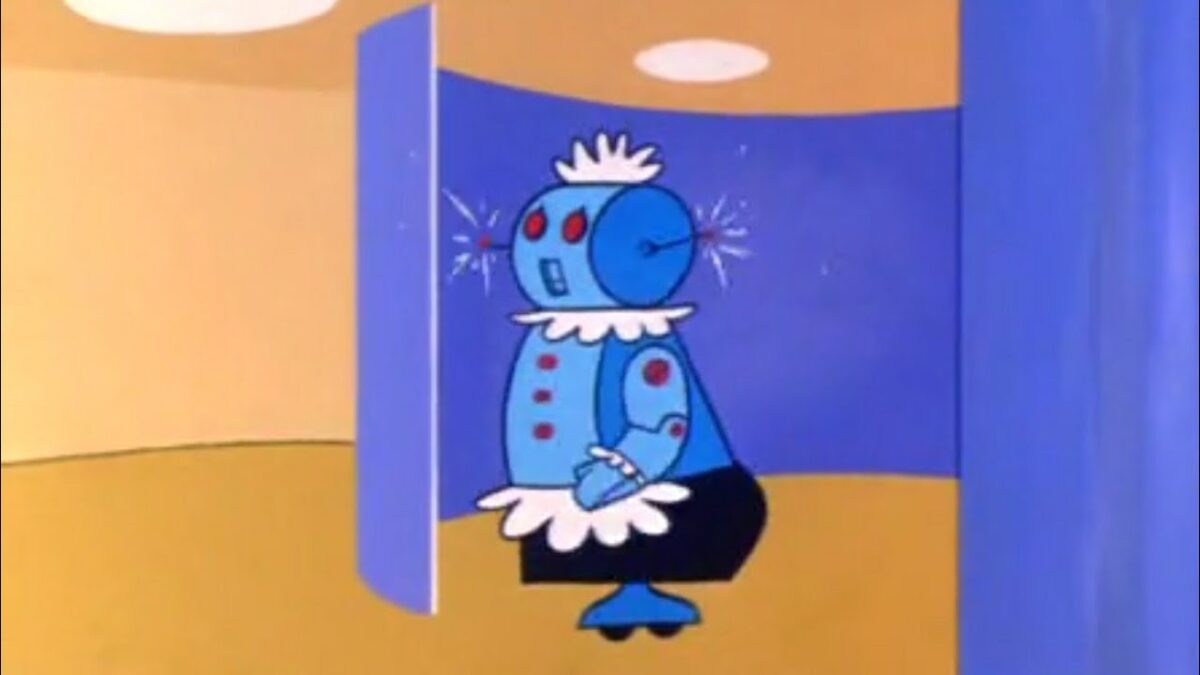
It’s strange to read that the 35-year-old domestic robots pioneer, iRobot, may be dead in a year. It seemed like a sure thing; early robotics researchers say that people were begging for robot vacuum cleaners even in the 1960s, perhaps inspired by Rosie, The Jetsons‘ robot maid.

Many people may have forgotten (or not known) the excitement that attended the first Roombas in 2002. Owners gave them names, took them on vacation, and posted videos. It looked like the start of a huge wave.

I bought a Roomba in 2003, reviewing it so enthusiastically that an email complained that I should have said I had been given it by a PR person. For a few happy months it wandered around cleaning.

Then one day it stopped moving and I discovered that long hair paralyzed it. I gave it away and went back to living with moths.

The Roomba now has many competitors, some highly sophisticated, run by apps, and able to map rooms, identify untouched areas, scrub stains, and clean in corners. Even so, domestic robots have not proliferated as imagined 20 – or 12 – years ago. I visit people’s houses, and while I sometimes encounter Alexas or Google Assistants, robot vacuums seem rare.

So much else of smart homes as imagined by companies like Microsoft and IBM remain dormant. It does seem like – perhaps a reflection on my social circle – the “smart home” is just a series of remote-control apps and outsourced services. Meh.

Illustrations: Rosie, the Jetsons‘ XB-500 robot maid, circa 1962.

Wendy M. Grossman is the 2013 winner of the Enigma Award. Her Web site has an extensive archive of her books, articles, and music, and an archive of earlier columns in this series. She is a contributing editor for the Plutopia News Network podcast. Follow on Mastodon or Bluesky.
Isolate

Yesterday, the Global Encryption Coalition published a joint letter calling on the UK to rescind its demand that Apple undermine (“backdoor”) the end-to-end encryption on its services. The Internet Society is taking signatures until February 20.

The background: on February 7, Joseph Menn reported at the Washington Post (followed by Dominic Preston at The Verge) that in January the office of the Home Secretary sent Apple a technical capability notice under the Investigatory Powers Act (2018) ordering it to provide access to content that anyone anywhere in the world has uploaded to iCloud and encrypted with Apple’s Advanced Data Protection.

Technical capability notices are supposed to be secret. It’s a criminal offense to reveal that you’ve been sent one. Apple can’t even tell users that their data may be compromised. (This kind of thing is why people publish warrant canaries.) Menn notes that even if Apple withdraws ADP in the UK, British authorities will still demand access to encrypted data everywhere *else*. So it appears that if the Home Office doesn’t back down and Apple is unwilling to cripple its encryption, the company will either have to withdraw ADP across the world or exit the UK market entirely. At his Odds and Ends of History blog, James O’Malley calls the Uk’s demand stupid, counter-productive, and unworkable. At TechRadar, Chiara Castro asks who’s next, and quotes Big Brother Watch director Silkie Carlo: “unprecedented for a government in any democracy”.

When the UK first began demanding extraterritorial jurisdiction for its interception rules, most people wondered how the country thought it would be able to impose it. That was 11 years ago; it was one of the new powers codified in the Data Retention and Investigatory Powers Act (2014) and kept in its replacement, the IPA in 2016.

Governments haven’t changed – they’ve been trying to undermine strong encryption in the hands of the masses since 1991, when Phil Zinmmermann launched PGP – but the technology has, as Graham Smith recounted at Ars Technica in 2017. Smartphones are everywhere. People store their whole lives on them for everything and giant technology companies encrypt both the device itself and the cloud backups. Government demands have changed to reflect that, from focusing on the individual with key escrow and key lengths to focusing on the technology provider with client-side scanning, encrypted messaging (see also the EU) and now cloud storage.

At one time, a government could install a secret wiretap by making a deal with a legacy telco. The Internet’s proliferation of communications providers changed that for a while. During the resulting panic the US passed the Communications Assistance for Law Enforcement Act (1994), which requires Internet service providers and telecommunications companies to install wiretap-ready equipment – originally for telephone calls, later broadband and VOIP traffic as well.

This is where the UK government’s refusal to learn from others’ mistakes is staggering. Just four months ago, the US discovered Salt Typhoon, a giant Chinese hack into its core telecommunications networks that was specifically facilitated by…by…CALEA. To repeat: there is no such thing as a magic hole that only “good guys” can use. If you undermine everyone’s privacy and security to facilitate law enforcement, you will get an insecure world where everyone is vulnerable. The hack has led US authorities to promote encrypted messaging.

Joseph Cox’s recent book, Dark Wire touches on this. It’s a worked example of what law enforcement internationally can do if given open access to all messages criminals send across a network when they think they are operating in complete safety. Yes, the results were impressive: hundreds of arrests, dozens of tons of drugs seized, masses if firearms impounded. But, Cox writes, all that success was merely a rounding error in global drug trade. Universal loss of privacy and security versus a rounding error: it’s the definition of “disproportionate”.

It remains to be seen what Apple decides to do and whether we can trust what the company tells us. At his blog, Alec Muffett is collecting ongoing coverage of events. The Future of Privacy Forum celebrated Safer Internet Day, February 11, with an infographic showing how encryption protects children and teens.

But set aside for a moment all the usual arguments about encryption, which really haven’t changed in over 30 years because mathematical reality hasn’t.

In the wider context, Britain risks making itself a technological backwater. First, there’s the backdoored encryption demand, which threatens every encrypted service. Second, there’s the impact of the onrushing Online Safety Act, which comes into force in March. Ofcom, the regulator charged with enforcing it, is issuing thousands of pages of guidance that make it plain that only large platforms will have the resources to comply. Small sites, whether businesses, volunteer-run Fediverse instances, blogs, established communities, or web boards, will struggle even if Ofcom starts to do a better job of helping them understand their legal obligations. Many will likely either shut down or exit the UK, leaving the British Internet poorer and more isolated as a result. Ofcom seems to see this as success.

It’s not hard to predict the outcome if these laws converge in the worst possible timeline: a second Brexit, this one online.

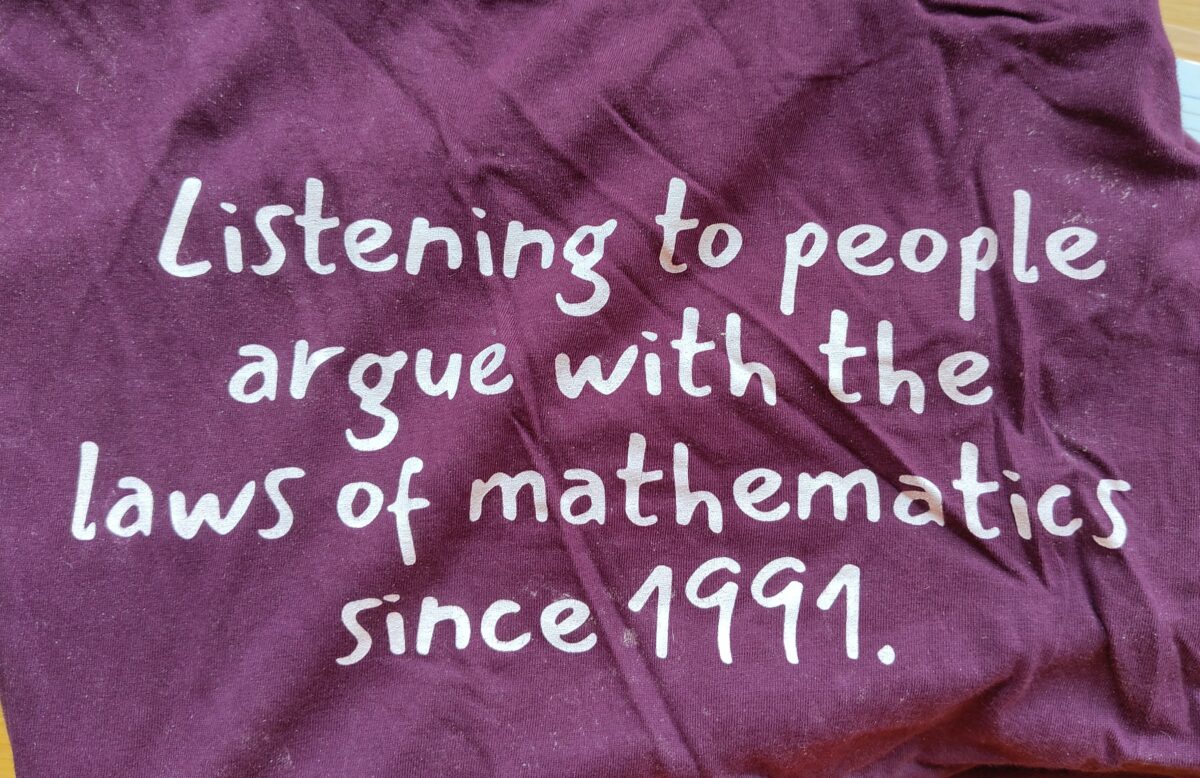
Illustrations: T-shirt (gift from Jen Persson).

Wendy M. Grossman is the 2013 winner of the Enigma Award. Her Web site has an extensive archive of her books, articles, and music, and an archive of earlier columns in this series. She is a contributing editor for the Plutopia News Network podcast. Follow on Mastodon or Bluesky.
What we talk about when we talk about computers

The climax of Nathan Englander‘s very funny play What We Talk About When We Talk About Anne Frank sees the four main characters play a game – the “Anne Frank game” – that two of them invented as children. The play is on at the Marylebone Theatre until February 15.

The plot: two estranged former best friends in a New York yeshiva have arranged a reunion for themselves and their husbands. Debbie (Caroline Catz), has let her religious attachment lapse in the secular environs of Miami, Florida, where her husband, Phil (Joshua Malina), is an attorney. Their college-age son, Trevor (Gabriel Howell), calls the action.

They host Hasidic Shosh (Dorothea Myer-Bennett) and Yuri (Simon Yadoo), formerly Lauren and Mark, whose lives in Israel and traditional black dress and, in Shosh’s case, hair-covering wig, have left them unprepared for the bare arms and legs of Floridians. Having spent her adult life in a cramped apartment with Yuri and their eight daughters, Shosh is astonished at the size of Debbie’s house.

They talk. They share life stories. They eat. And they fight: what is the right way to be Jewish? Trevor asks: given climate change, does it matter?

So, the Anne Frank game: who among your friends would hide you when the Nazis are coming? The rule that you must tell the truth reveals the characters’ moral and emotional cores.

I couldn’t avoid up-ending this question. There are people I trust and who I *think* would hide me, but it would often be better not to ask them. Some have exceptionally vulnerable families who can’t afford additional risk. Some I’m not sure could stand up to intensive questioning. Most have no functional hiding place. My own home offers nowhere that a searcher for stray humans wouldn’t think to look, and no opportunities to create one. With the best will in the world, I couldn’t make anyone safe, though possibly I could make them temporarily safer.

But practical considerations are not the game. The game is to think about whether you would risk your life for someone else, and why or why not. It’s a thought experiment. Debbie calls it “a game of ultimate truth”.

However, the game is also a cheat, in that the characters have full information about all parts of the story. We know the Nazis coming for the Frank family are unquestionably bent on evil, because we know the Franks’ fates when they were eventually found. It may be hard to tell the truth to your fellow players, but the game is easy to think about because it’s replete with moral clarity.

Things are fuzzier in real life, even for comparatively tiny decisions. In 2012, the late film critic Roger Ebert mulled what he would do if he were a Transport Security Administration agent suddenly required to give intimate patdowns to airline passengers unwilling to go through the scanner. Ebert considered the conflict between moral and personal distaste and TSA officers’ need to keep their reasonably well-paid jobs with health insurance benefits. He concluded that he hoped he’d quit rather than do the patdowns. Today, such qualms are ancient history; both scanners and patdowns have become normalized.

Moral and practical clarity is exactly what’s missing as the Department of Government Efficiency arrives in US government departments and agencies to demand access to their computer systems. Their motives and plans are unclear, as is their authority for the access they’re demanding. The outcome is unknown.

So, instead of a vulnerable 13-year-old girl and her family, what if the thing under threat is a computer? Not the sentient emotional robot/AI of techie fantasy but an ordinary computer system holding boring old databases. Or putting through boring old payments. Or underpinning the boring old air traffic control system. Do you see a computer or the millions of people whose lives depend on it? How much will you risk to protect it? What are you protecting it from? Hinder, help, quit?

Meanwhile, DOGE is demanding that staff allow its young coders to attach unauthorized servers, take control of websites. In addition: mass firings, and a plan to do some sort of inside-government AI startup.

DOGE itself appears to be thinking ahead; it’s told staff to avoid Slack while awaiting a technology that won’t be subject to FOIA requests.

The more you know about computers the scarier this all is. Computer systems of the complexity and accuracy of those the US government has built over decades are not easily understood by incoming non-experts who have apparently been visited by the Knowledge Fairy. After so much time and effort on security and protecting against shadowy hackers, the biggest attack – as Mike Masnick calls it – on government systems is coming from inside the house in full view.

Even if “all” DOGE has is read-only access as Treasury claims – though Wired and Talking Points Memo have evidence otherwise – those systems hold comprehensive sensitive information on most of the US population. Being able to read – and copy? – is plenty bad enough. In both fiction (Margaret Atwood’s The Handmaid’s Tale) and fact (IBM), computers have been used to select populations to victimize. Americans are about to find out they trusted their government more than they thought.

Illustration: Changing a tube in the early computer ENIAC (via Wikimedia).

Wendy M. Grossman is the 2013 winner of the Enigma Award. Her Web site has an extensive archive of her books, articles, and music, and an archive of earlier columns in this series. Stories about the border wars between cyberspace and real life are posted occasionally during the week at the net.wars Pinboard – or follow on Twitter.

The AI moment

“Why are we still talking about digital transformation?” The speaker was convening a session at last weekend’s UK Govcamp, an event organized by and for civil servants with an interest in digital stuff.

“Because we’ve failed?” someone suggested. These folks are usually *optimists*.

Govcamp is a long-running tradition that began as a guerrilla effort in 2008. At the time, civil servants wanting to harness new technology in the service of government were so thin on the ground they never met until one of them, Jeremy Gould, convened the first Govcamp. These are people who are willing to give up a Saturday in order to do better at their jobs working for us. All hail.

It’s hard to remember now, nearly 15 years on, the excitement in 2010 when David Cameron’s incoming government created the Government Digital Service and embedded it into the Cabinet Office. William Heath immediately ended the Ideal Government blog he’d begun writing in 2004 to press insistently for better use of digital technologies in government. The government had now hired all the people he could have wanted it to, he said, and therefore, “its job is done”.

Some good things followed: tilting government procurement to open the way for smaller British companies, consolidating government publishing, other things less visible but still important. Some data became open. This all has improved processes like applying for concessionary travel passes and other government documents, and made government publishing vastly more usable. The improvement isn’t universal: my application last year to renew my UK driver’s license was sent back because my signature strayed outside the box provided for it.

That’s just one way the business of government doesn’t feel that different. The whole process of developing legislation – green and white papers, public consultations, debates, and amendments – marches on much as it ever has, though with somewhat wider access because the documents are online. Thoughts about how to make it more participatory were the subject of a teacamp in 2013. Eleven years on, civil society is still reading and responding to government consultations in the time-honored way, and policy is still made by the few for the many.

At Govcamp, the conversation spread between the realities of their working lives and the difficulties systems posed for users – that is, the rest of us. “We haven’t removed those little frictions,” one said, evoking the old speed comparisons between Amazon (delivers tomorrow or even today) and the UK government (delivers in weeks, if not months).

“People know what good looks like,” someone else said, in echoing that frustration. That’s 2010-style optimism, from when Amazon product search yielded useful results, search engines weren’t spattered with AI slime and blanketed with ads, today’s algorithms were not yet born, and customer service still had a heartbeat. Here in 2025, we’re all coming up against rampant enshittification, with the result that the next cohort of incoming young civil servants *won’t* know any more what “good” looks like. There will be a whole new layer of necessary education.

Other comments: it’s evolution, not transformation; resistance to change and the requirement to ask permission are embedded throughout the culture; usability is still a problem; trying to change top-down only works in a large organization if it sets up an internal start-up and allows it to cannibalize the existing business; not enough technologists in most departments; the public sector doesn’t have the private sector option of deciding what to ignore; every new government has a new set of priorities. And: the public sector has no competition to push change.

One suggestion was that technological change happens in bursts – punctuated equilibrium. That sort of fits with the history of changing technological trends: computing, the Internet, the web, smartphones, the cloud. Today, that’s “AI”, which prime minister Keir Starmer announced this week he will mainline into the UK’s veins “for everything from spotting potholes to freeing up teachers to teach”.

The person who suggested “punctuated equilibrium” added: “Now is a new moment of change because of AI. It’s a new ‘GDS moment’.” This is plausible in the sense that new paradigms sometimes do bring profound change. Smartphones changed life for homeless people. On the other hand, many don’t do much. Think audio: that was going to be a game-changer, and yet after years of loss-making audio assistants, most of us are still typing.

So is AI one of those opportunities? Many brought up generative AI’s vast consumption of energy and water and rampant inaccuracy. Starmer, like Rishi Sunak before him, seems to think AI can make Britain the envy of other major governments.

Complex systems – such as digital governance – don’t easily change the flow of information or, therefore, the flow of power. It can take longer than most civil servants’ careers. Organizations like Mydex, which seeks to up-end today’s systems to put users in control, have been at work for years now. The upcoming digital identity framework has Mydex chair Alan Mitchell optimistic that the government’s digital identity framework is a breakthrough. We’ll see.

One attendee captured this: “It doesn’t feel like the question has changed from more efficient bureaucracy to things that change lives.” Said another in response, “The technology is the easy bit.”

Illustrations: Sir Humphrey Appleby (Nigel Hawthorne), Bernard Woolley (Derek Fowldes), and Jim Hacker (Paul Eddington) arguing over cultural change in Yes, Minister.

Wendy M. Grossman is the 2013 winner of the Enigma Award. Her Web site has an extensive archive of her books, articles, and music, and an archive of earlier columns in this series. She is a contributing editor for the Plutopia News Network podcast. Follow on Mastodon Bluesky.

Disharmony

When an individual user does it, it’s piracy. When a major company does it…it may just get away with it.

At TechCrunch, Kyle Wiggers reports that buried in newly unredacted documents in the copyright case Kadrey v. Meta is testimony that Meta trained its Llama language model on a dataset of ebooks it torrented from LibGen. So, two issues. First, LibGen has been sued numerous times, fined, and ordered to shut down. Second: torrent downloads simultaneously upload to others. So, allegedly, Meta knowingly pirated copyrighted books to train its language model.

Kadrey v. Meta was brought by novelist Richard Kardrey, writer Christopher Golden, and comedian Sarah Silverberg, and is one of a number of cases accusing technology companies of training language models on copyrighted works without permission. Meta claims fair use. Still, not a good look.

***

Coincidentally, this week CEO Mark Zuckerberg announced changes to the company’s content moderation policies in the US (for now), a move widely seen as pandering to the incoming administration. The main changes announced in Zuckerberg’s video clip: Meta will replace fact-checkers (“too politically biased”) with a system of user-provided “community notes” as on exTwitter, remove content restrictions that “shut out people with different ideas”, dial back its automated filters to focus solely on illegal content, rely on user reports to identify material that should be taken down, bring back political content, and move its trust and safety and content moderation teams from California to Texas (“where there is less concern about the bias of our teams”). He also pledges to work with the incoming president to “push back on governments around the world that are going after American companies and pushing to censor more”.

Journalists and fact-checkers are warning that misinformation and disinformation will be rampant, and many are alarmed by the specifics of the kind of thing people are now allowed to say. Zuckerberg frames all this as a “return” to free expression while acknowledging that, “We’re going to catch less bad stuff”

At Techdirt, Mike Masnick begins as an outlier, arguing that many of these changes are actually sensible, though he calls the reasoning behind the Texas move “stupid”, and deplores Zuckerberg’s claim that this is about “free speech” and removing “censorship”. A day later, after seeing the company’s internal guidelines unearthed by Kate Knibbs at Wired , he deplores the new moderation policy as “hateful people are now welcome”.

More interesting for net.wars purposes is the international aspect. As the Guardian says, Zuckerberg can’t bring these changes across to the EU or UK without colliding headlong with the UK’s Online Safety Act and the EU’s Digital Markets Act. Both lay down requirements for content moderation on the largest platforms.

And yet, it’s possible that Zuckerberg may also think these changes help lay the groundwork to meet the EU/UK requirements. Meta will still remove illegal content, which it’s required to do anyway. But he may think there’s a benefit in dialing back users expectations about what else Meta will remove, in that platforms must conform to the rules they set in their terms and conditions. Notice-and-takedown is an easier standard to meet than performance indicators for automated filters. It’s also likely cheaper. This approach is, however, the opposite of what critics like Open Rights Group have predicted the law will bring; ORG believes that platforms will instead over-moderate in order to stay out of trouble, chilling free speech.

Related is an interesting piece by Henry Farrell at his Programmable Matter newsletter, who argues that the more important social media speech issue is that what we read there determines how we imagine others think rather than how we ourselves think. In other words, misinformation, disinformation, and hate speech change what we think is normal, expanding the window of what we think other people find acceptable. That has resonance for me: the worst thing about prominent trolls is they give everyone else permission to behave as badly as they do.

***

It’s now 25 years since I heard a privacy advocate predict that the EU’s then-new data protection rights could become the basis of a trade war with the US. While instead the EU and US have kept trying to find a bypass that will withstand a legal challenge from Max Schrems, the approaches seem to be continuing to diverge, and in more ways.

For example, last week in the longrunning battle over network neutrality, judges on the US Sixth Circuit Court of Appeals ruled that the Federal Communications Commission was out of line when it announced rules in 2023 that classified broadband suppliers as common carriers under Title II of the Communications Act (1934). This judgment is the result of the Supreme Court’s 2024 decision to overturn the Chevron deference, setting courts free to overrule government agencies’ expertise. And that means the end in the US (until or unless Congress legislates) of network neutrality, the principle that all data flowing across the Internet was created equal and should be transmitted without fear or favor. Network neutrality persists in California, Washington, and Colorado, whose legislatures have passed laws to protect it.

China has taught us that the Internet is more divisible by national law than many thought in the 1990s. Copyright law may be the only thing everyone agrees on.

Illustrations: Drunk parrot in a South London garden (by Simon Bisson; used by permission).

Wendy M. Grossman is the 2013 winner of the Enigma Award. Her Web site has an extensive archive of her books, articles, and music, and an archive of earlier columns in this series. She is a contributing editor for the Plutopia News Network podcast. Follow on Mastodon or Bluesky.
Government identification as a service

This week, the clock started ticking on the UK’s Online Safety Act. Ofcom, the regulator charged with enforcing it, published its codes of practice and guidance, which come into force on March 17, 2025. At that point, websites that fall into scope – in Ofcom’s 2023 estimate 150,000 of them – must comply with requirements to conduct risk assessments, preemptively block child sexual abuse material, register a responsible person (who faces legal and financial liability), and much more.

Almost immediately, the first casualty made itself known: Dee Kitchen announced the closure of her site, which supports hundreds of interest-based forums. Ofcom’s risk assessment guidance (PDF), the personal liability would be overwhelming even if the forums produced enough in donations to cover the costs of compliance.

Russ Garrett has a summary for small sites. UK-linked blogs – even those with barely any readers – could certainly fit the definition per Ofcom’s checker tool, if users can comment on each other’s posts. Common sense says that’s ridiculous in many cases…but as Kitchen says all takes to ruin the blogger’s life is a malicious complainant wielding the OSA as their weapon.

Kitchen will certainly not be alone in concluding the requirements are prohibitively risky for web forums and bulletin boards that are run by volunteers and have minimal funding. Yet they are the Internet’s healthy social ecology, without the algorithms and business models that do most to create the harms the Act is meant to address. Promising Trouble and Power to Change are collaborating on a community of practice, and have asked Ofcom for a briefing on compliance for volunteers and small sites.

Garrett’s summary also points out that Ofcom’s rules leave it wide open for sites to censor *more* than is required, and many will do exactly that to minimize their risk. A side effect, as Garrett writes, will be to further centralize the Net, as moving communities to larger providers such as Discord will shift the liability onto *them*. This is what happens when rules controlling speech are written from the single lens of preventing harm rather than starting from a base of human rights.

More guidance to come from Ofcom next month. We haven’t even started on implementing age verification yet.

***

On Monday, I learned a new term I wish I hadn’t: “government identity as a service”. GIAAS?

The speaker was human rights campaigner Edward Hasbrouck, in a talk on identification Dave Farber‘s and Dan Gillmor‘s weekly CCRC/IP-Asia Zoom call.

Most people trace the accelerating rise of demands for identification in countries like the US and UK to 9/11. Based on that, there are now people old enough to drink in a US state who are not aware it was ever possible to just walk up to fly, get a hotel room, or enter an office. As Hasbrouck writes in a US election day posting, the rise in government demands for ID has been powered by the simultaneous rise of corporate tracking for commercial purposes. He calls it a “malign convergence of interest”.

It has long been obvious that anything companies collect can be subpoenaed by governments. Hasbrouck’s point, however, is that identification enables control as well as surveillance; it brings watchlists, blocklists, and automated bars to freedom of action – it makes us decision subjects as Gavin Freeguard said at the recent Foundation for Information Policy Research event.

Hasbrouck pinpoints three components that each present a vulnerability to control: identification, logging, decision making. As an example, consider the UK’s in-progress eVisa system, in which the government confirms an individual’s visa status online in real time with no option for physical documentation. This gives the government enormous power to stop individuals from doing vital but mundane things like rent a home, board an aircraft, or get a job. Its heart is identification – and a law delegating border enforcement to myriad civil intermediaries and normalizes these checks.

Many in the UK were outraged by proposals to give the Department of Work and Pensions the power to examine people’s bank accounts. In the US, Hasbrouck points to a recent report from the House Judiciary Committee on the Weaponization of the Federal Government that documents the Treasury Department’s Financial Crimes Enforcement Network’s collaboration with the FBI to push banks to submit reports of suspicious activity while it trawled for possible suspects after the January 6 insurrection. Yes, the destructors should be caught and punished; but also any weapon turned against people we don’t like can also be turned against us. Did anyone vote to let the FBI conduct financial surveillance by the million?

Now imagine that companies outsource ID checks to the government and offload the risk of running their own. That is how the no-fly list works. That’s how airlines operate *now*. GIAAS.

Then add the passive identification that systems like facial recognition are spreading. You can no longer reliably know whether you have been identified and logged, who gets that information, or what hidden decision they may make based on it. Few of us are sure of our rights in any situation, and few of us even ask why. In his slides (PDF), Hasbrouck offers a list of ways to fight back. He has hope.

Illustrations: Edward Hasbrouck at CPDP in 2017.

Wendy M. Grossman is the 2013 winner of the Enigma Award. Her Web site has an extensive archive of her books, articles, and music, and an archive of earlier columns in this series. She is a contributing editor for the Plutopia News Network podcast. Follow on Mastodon or Bluesky.