Waste management

This week, Amazon announced it would cripple a bunch of older Kindle models. Users will be able to go on reading the books that are already stored on their devices, but they won’t be able to add anything new, whether it’s borrowed, bought, or downloaded. The switch will be toggled on May 20, and applies to Kindle ereaders and Kindle Fires released in or before 2012. These devices had already been locked out of the store in 2022.

There is no benefit to consumers from doing this, even though Amazon is offering a substantial discount on newer devices for those who want to switch. There are presumably benefits to Amazon – namely, that it can update its store and other software without having to cater to older devices, plus sell an extra bunch of new ones. But overall, it’s a globally hostile move that creates a new pile of electronic waste composed of functioning hardware. One of these days, that’s going to be your car when some auto manufacturer decides that a “legacy” model isn’t worth supporting any more.

One option is to stop buying devices whose manufacturers demand that you surrender ownership in favor of their ongoing control. The other main possibility is to continue spreading right to repair laws so that a company like Amazon (or John Deere) wishing to shed itself of the responsibility of supporting older devices would be required to open them up to their users and the third-party ecosystem around them that would doubtless form. As the population of Internet of Things devices continues to grow around the world there will be much more of this – when we need much less. It’s absolutely maddening. Try a Kobo and the Gutenberg project.

***

It came out this week that language added in October 2025 to Microsoft’s terms of use says: “Copilot is for entertainment purposes only. It can make mistakes, and it may not work as intended. Don’t rely on Copilot for important advice. Use Copilot at your own risk.”

This is like the disclaimers that psychics and mediums in the UK issue to prospective customers to prevent exploitation of the credulous. A software company, though…if it’s going to admit up front that the service it’s providing can’t be relied on, why force it on people in the first place?

Obviously, the point here is to cover the company’s ass in case of lawsuits. It fits right in with companies’ general refusal to accept liability for problems created by the software they make. I’m glad the company is warning people, but the better solution – if the company can’t bring itself to discontinue it altogether – would be to either remove Copilot and let people download it if they want it or leave it turned off by default, warning people up front instead of in terms of use that normally wouldn’t have been read. Instead, what we have to do is search for instructions to remove it and hope Microsoft hasn’t made following them impossible.

***

In the midst of a lot of science fictional hype-scares about “AI” along come some more real concerns. We’ll start “small”: The New York Times has done a study that finds that Google’s AI Overviews are right 90% of the time. Sounds not-so-bad, until you remember the Law of Truly Large Numbers. That “90%” success rate when the remaining 10% is applied to trillions means the overall result is, as Ryan Whitwam puts it in summarizing the story for Ars Technica, “hundreds of thousands of lies going out every minute of the day”. That’s automation for you. Used to be you needed an army of bots to disseminate misinformation at any sort of scale, and even then it was less effective since it wasn’t backed by an apparently authoritative name (see also Microsoft, above).

More alarming are the reports surfacing about generative AI’s effectiveness at aiding and amplifying online crime. In November, Google announced internal researchers had found hackers experimenting with a script that interacts with Gemini’s API to create just-in-time modifications. Last month, at Hacker Noon polymorphic viruses, but again, this appears to be a step up in sophistication and speed.

At the same time, Casey Newton reports at Platformer, Anthropic’s latest model is likely the first of many that can find and exploit vulnerabilities in software in “ways that far outpace the efforts of defenders”. The announcement, which appears to have been inadvertent, was quickly followed by another, formally launching the new model, Claude Mythos, and Project Glasswing. The latter, per Newton, gives more than 40 of the biggest technology companies early access so they can use the model to find and patch vulnerabilities in both their own systems and open source systems that underpin digital infrastructure.

Unlike most AI-related scare stories, this one is backed by people who are usually sensible, such as Alex Stamos, formerly chief security officer at Facebook and Yahoo, and other security practitioners. These warnings are not coming from AI company CEOs with a concept to sell .

So: on the one hand, (hopefully) better software; on the other, (potentially) newer, more dangerous attacks. Ugh. To restore calm, I recommend Terry Godier’s essay The Last Quiet Thing.

Illustrations: Bill Steele, who in 1970 wrote the environmental anthem Garbage!.

Wendy M. Grossman is an award-winning journalist. Her Web site has an extensive archive of her books, articles, and music, and an archive of earlier columns in this series. She is a contributing editor for the Plutopia News Network podcast. Follow on Mastodon or Bluesky.

Turn left at the robot

It’s easy to forget, now that so many computer interfaces seem to be getting more inscrutable, that in the early 1990s the shift from the command line to graphical interfaces and the desire to reach the wider mass market introduced a new focus on usability. In classics like Don Norman’s The Design of Everyday Things, a common idea was that a really well-designed system should not require a manual because the design itself would tell the user how to operate it.

What is intuitive, though, is defined by what you’re used to. The rumor that Apple might replace the letters on keys with glyphs is a case in point. People who’ve grown up with smartphones might like the idea of glyphs that match those on their phones. But try doing technical support over the phone and describing a glyph; easier to communicate the letters.

Those years in which computer interfaces were standardized relied on metaphors based on familiar physical items: a floppy disk to save a file, an artist’s palette for color choices. In 1993, leading software companies like Microsoft and Lotus set up usability labs; it took watching user testing to convince developers that struggling to use their software was not a sign the users were stupid.

With that background, it was interesting to attend this year’s edition of the 20-year-old Human-Robot Interaction conference. Robots don’t need metaphors; they *are* the thing itself. Although: why shouldn’t a robot also have menu buttons for common functions?

In the paper I found most interesting and valuable, Lauren Wright examined the use of a speaking Misty robot to deliver social-emotional learning lessons. Wright’s group tested the value of deception – that is, having the robot speak in the first person of its “family”, experiences, and “emotions” – versus a more truthful presentation, in which the robot is neutral and tells its stories in the third person, refers to its programmers, and professes no humanity. The researchers were testing the widely-held assumption that kids engage more with robots programmed to appear more human. They found the opposite: while both versions significantly increased their learning, the kids who used the factual robot showed more engagement and higher scores in the sense of using concepts from the lesson in their answers. This really shouldn’t be surprising. Children don’t in general respond well to deception. Really, who does?

The children’s personal reactions to the robots were at least as interesting. In Michael F. Xu‘s paper, the researchers held co-design sessions and then installed a robot in eight family homes to act as a neutral third-party enforcer issuing timely reminders on behalf of busy parents. Some of the families did indeed report that the robot’s reminder got stuff done more efficiently. On the other hand, the experiment was short – only four days – and you have to wonder if that would still be true after the novelty wore off. There were hints of this from the kids, some of whom pushed back. One simply bypassed a robot reminding him of the limits on his TV viewing by taking the TV upstairs, where the robot couldn’t go. Another reacted like I would at any age and told the robot to “shut up”.

The fact versus fiction presentation included short video clips of some of the kids’ interaction with the robot tutor. In one, a boy placed his hands on either side of the robot’s “face” while it was talking and kept moving its head around, exploring the robot’s physical capabilities (or trying to take its head off?). The speaker ignored this entirely, but the sight hilariously made an important point: the robot’s physical form speaks even when the robot is silent.

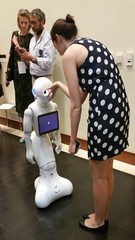
We saw this at We Robot 2016, when a Jamaican lawyer asked Olivier Guilhem, from Aldebaran Robotics, which makes Pepper, “Why is the robot white?” His response: “It looks clean.” This week, one paper tried to tease out how “representation bias” – assumptions about gender, skin tone, dis/ability, accessibility, size, age – affect users’ reactions. In the dataset used to train an AI model, bias may be baked in through the historical record. With robots, bias can also present directly through the robot’s design, as Yolande Strengers’ and Jenny Kennedy’s showed in their 2020 book The Smart Wife. Despite its shiny, unmistakable whiteness, Pepper’s shape was ambiguous enough for its gender to be interpreted differently in different cultures. In the HRI paper, the researchers concluded that biases in robot design could perpetuate occupational stereotypes – “technological segregation”. They also found their participants consistently preferred non-skin tones – in their examples, silver and light teal.

“Who builds AI shapes what AI becomes,” said Ben Rosman, who outlined a burgeoning collaborative effort to build a machine learning community across Africa and redress its underrepresentation. The same with robots: many, many cultural norms affect how humans interact with them. That information is signal, not noise, he says, and should be captured to enable robots to operate across wide ranges of human context without relying on “brittle defaults” that interpret human variation as failures. “Turn left at the robot,” makes perfect sense once you know that in South Africa “robots” are known elsewhere as traffic lights.

Illustrations: Rosey, the still-influential “old demo model” robot maid in The Jetsons (1962-1963).

Also this week:
At the Plutopia podcast, we interview Marc Abrahams, founder of the Ig Nobel awards.
At Skeptical Inquirer, the latest Letter to America finds David Clarke conducting the English folklore survey.

Wendy M. Grossman is an award-winning journalist. Her Web site has an extensive archive of her books, articles, and music, and an archive of earlier columns in this series. She is a contributing editor for the Plutopia News Network podcast. Follow on Mastodon or Bluesky.

A short history of We Robot, 2026 edition

On the eve of We Robot 2026, here are links to my summaries of every year since 2012, the inaugural conference, except 2014, which I missed for family reasons. There was no conference in 2024 in order to move the event back to its original April schedule (covid caused its move to September in 2020). These are my personal impressions; nothing I say here should be taken as representing the conference, its founders, its speakers, or their institutions.

We Robot was co-founded by Michael Froomkin, Ryan Calo, and Ian Kerr to bring together lawyers and engineers to think early and long about the coming conflicts in robots, law, and policy.

2025: Predatory inclusion: In Windsor, Ontario, a few months into the new US administration, the sudden change in international relations highlights the power imbalances inherent in many of today’s AI systems. Catopromancy: in workshops, we hear a librarian propose useful AI completely out of step with today’s corporate offerings, and mull how to apply existing laws to new scenarios.

2024 No conference.

2023 The end of cool: after struggling to design a drone delivery service that had benefits over today’s cycling couriers, we find ourselves less impressed by robots that can do somersaults but not anything obviously useful; the future may have seemed more exciting when it was imaginary.

2022 Insert a human: following a long-held conference theme about “humans in the loop, “robots” are now “sociotechnical systems”. Coding ethics: Where Asimov’s laws were just a story device, in workshops we try to work out how to design a real ethical robot.

2021 Plausible diversions: maybe any technology sufficiently advanced to seem like magic can be well enough understood that we can assign responsibility and liability? Is the juice worth the squeeze?: In workshops, we mull how to regulate delivery robots, which will likely have no user-serviceable parts. Title from Woody Hartzog.

2020 (virtual) The zero on the phone: AI exploitation and bias embedded in historical data become what one speaker calls “unregulated experimentation on humans…without oversight or control”.

2019 Math, monsters, and metaphors. We dissect the trolley problem and find the true danger on the immediate horizon is less robots, more the “pile of math that does some stuff” we call “AI”. The Algernon problem: in workshops, new disciplines joining the We Robot family remind us that robots/AI are carrying out the commands of distant owners.

2018 Deception. We return to the question of what makes robots different and revisit Madeleine Clare Elish’s moral crumple zones after the first pedestrian death by self-driving car. Late, noisy, and wrong: in workshops, engineers Bill Smart and Cindy Grimm explain why sensors never capture what you think they’re capturing and how AI systems use their data.

2017 Have robot, will legislate: Discussion of risks this year focused on the intermediate situation, when automation and human norms must co-exist.

2016 Humans all the way down: Madeline Clare Elish introduces “moral crumple zones”, a paper that will resonate through future years. The lab and the world: in workshops, Bill Smart uses conference attendees in formation to show why getting a robot to do anything is difficult.

2015: Multiplicity: W
When in the life of a technology is the right time for regulatory intervention?

2014 Missed conference

2013 Cautiously apocalyptic: Diversity of approaches to regulation will be needed to handle the diversity of robots, and at the beginning of cloud robotics and full-scale data collection, we envision a pet robot dog that can beg its owner for an upgraded service subscription.

2012 A really fancy hammer with a gun. At the first We Robot, we try to answer the fundamental question: what difference do robots bring? Unsentimental engineer Bill Smart provided the title.

Bedroom eyes

We’ve long known that much of today’s “AI” is humans all the way down. This week underlines this: in an investigation, Svenska Dagbladet and Göteborgs-Posten learn that Meta’s Ray-Ban smart glasses are capturing intimate details of people’s lives and sending them to Nairobi, Kenya. There, employees at Meta subcontractor Sama label and annotate the data for use in training models. Brings a new meaning to “bedroom eyes”.

This sort of violation is easily imposed on other people without their knowledge or consent. We worry about the police using live facial recognition, but what about being captured by random people on the street? In January’s episode of the TechGrumps podcast, we called the news of Meta’s new product “Return of the Glasshole“.

Two 2018 books, Mary L. Gray and Siddharth Suri’s Ghost Work and Sarah T. Roberts’ Behind the Screen made it clear that “machine learning” and “AI” depend on poorly-paid unseen laborers. Dataveillance is a stowaway in every “smart” device. But this is a whole new level: the Kenyans report glimpses of bank cards, bedroom intimacy, even bathroom visits. The journalists were able to establish that the glasses’ AI requires a connection to Meta’s servers to answer questions, and there’s no opt out.

The UK’s Information Commissioner’s Office is investigating, and at Ars Technica Sarah Perez reports that a US lawsuit has been filed.

As the original Swedish report goes on to say, the EU has no adequacy agreement with Kenya. More disturbing is the fact that probably hundreds of people within Meta worked on this without seeing a problem.

In 1974, the Watergate-related revelation that US president Richard Nixon had recorded everything taking place in his office inspired folksinger Bill Steele to write the song The Walls Have Ears (MP3). What struck him particularly was that everyone saw it as unremarkable. “Unfortunately still current,” he commented in his 1977 liner notes. Nearly 50 years later, ditto.

***

A lot of (especially younger) people don’t remember that before 9/11 you could walk into most buildings without showing ID. Many authorities – the EU in particular – have long been unhappy with anonymity online, and one conspiratorial theory about age gating and the digital ID infrastructure being built in many places is that the goal is complete and pervasive identification. In the UK, requiring ID for all Internet access has occasionally popped up as a child safety idea, even though security experts recommend lying about birth dates and other personal data in the interests of self-protection against identity theft.

Now we have generative AI, and along comes a new paper that finds that large language models can be used to deanonymize people online at large scale by analyzing profiles and conversations. In one exercise, they matched Hacker News posts to LinkedIn profiles. In another, they linked users across subReddit communities. In a third, they split Reddit profiles to mimic the use of pseudonymous posting. Pseudonymity doesn’t offer meaningful protection (though I’m not sure how much it ever did), and preventing this type of attack is difficult. They also suggest platforms should reconsider their data access policies in line with their findings.

It’s hard to imagine most platforms will care much; users have long been expected to assess their own risk. Even smaller communities with a more concerned administration will not be in a position to know how many other services their users access, what they post there, or how it can be cross-linked. The difficulty of remaining anonymous online has been growing ever since 2000, when Latanya Sweeney showed it was possible to identify 87% of the population recorded in census data given just Zip code, date of birth, and gender. As psychics know, most people don’t really remember what they’ve said and how it can be linked and exploited by someone who’s paying attention. The paper concludes: we need a new threat model for privacy online.

***

The Internet, famously, was designed to support communications in the face of a bomb outage.

Building it required physical links – undersea cables, fiber connections, data centers, routers. For younger folks who have grown up with wifi and mobile phone connections, that physical layer may be invisible. But it matters no less than it did twenty-five years ago, when experts agreed that ten backhoes (among other things) could do more effective damage than bombs.

This week’s horrible, spreading war in the Middle East has seen the closure of the Strait of Hormuz and the Red see to commercial traffic. Indranil Ghosh reports at Rest of World that that 17 undersea cables pass through the Red Sea alone, and billions, soon trillions, of dollars in US technology investment depends on fiber optic cables running through war zones. There’s been reporting before now about the links between various Middle Eastern countries and Silicon Valley (see for example the recent book Gilded Rage, by Jacob Silverman), but until now much less about the technological interdependence put in jeopardy by the conflict. Ghosh also reports that drones have struck two Amazon Web Services data centers in UAE and one in Bahrein.

The issue is not so much direct damage to the cables as the impossibility of repairing them as long as access is closed. The Internet, designed with war in mind, is a product of peace.

Illustrations: Monument to Anonymous, by Meredith Bergmann.

Also this week: At the Plutopia podcast, we interview Kate Devlin, who studies human-AI interaction.

Wendy M. Grossman is an award-winning journalist. Her Web site has an extensive archive of her books, articles, and music, and an archive of earlier columns in this series. She is a contributing editor for the Plutopia News Network podcast. Follow on Mastodon or Bluesky.

In search of the future Internet

“What kind of Internet do you want [him] to inherit?” “Him” was then measuring his age in weeks.

“Not *this* Internet.”

Now, when said son has grown to measure his life in months, my friend and I are no closer to a positive vision. But notably many more people seem to be asking the same kind of question.

In the last week I’ve been to two meetings convened to pull together a cross-section of activists, policy wonks, and techies to talk about building movements to push back against the spread of technological control. The goals of these groups, like my friend’s and mine remain fuzzy, but they reflect a widespread growing alarm about AI, US entanglement, and our other technological ills.

“When did the future stop being something we plan for and become something done to us?” a friend asked about five years ago. That sense of being held hostage by the inevitability narrative is there, too, in a jumble including job loss, the evils of capitalism, the embedding of companies like Palantir in the health service and soon in policing, the speed of change, widespread loneliness, sustainability, and existential threats. So the overall feel has been part-Occupy, part consciousness-raising session.

Those who did have visions to propose often seemed to be describing things that already exist: trusted, authoritative content (the BBC, Wikipedia); ending capitalism in favor of shared ownership and distributed power (“there’s always someone reinventing communism,” the person next to me muttered), and recreating the impossible dream of micropayments.

One meeting polled us with a list of concerns about AI and asked us to pick the most important. The winner, by far, was “consolidation of power”. This speaks to a wider movement than merely opposing AI or resisting the encroachment of the worst technology surveillance practices into daily life.

Similar discussions have been growing for at least a couple of years. At The Register, long-time open source advocate Liam Proven writes after attending the Open Source Policy Summit that Europe is reassessing its technological reliance on US IT services, which offers the potential for a US president to order disconnection. The lack of European billion-dollar technology companies leads people to forget the technology invented here that instead embraced openness: the web, Linux, Raspberry Pi, Open StreetMap, the Fediverse.

It’s a little alarming, however, that all of this discussion hovers at the application layer. Old-timers who’ve watched the Internet build up understand that underneath the social media and smartphones lies the physical layer, the infrastructure that is also condolidated and controlled: chips, cables, wireless spectrum. For younger folks, those elements are near-invisible; their adult lives have been dominated by concerns about data. Yet in the last year we’ve been warned of sabotage to undersea cables and chip shortages. There’s more general recognition of the issues surrounding data centers’ demand for power and water.

Even so, there’s a good amount of recognition that all the strands of our present polycrisis are intertwined – see for example the mission statement at Germany’s Cables of Resistance. A broader group, building on the 2024 conference convened by Cristina Caffarra, who called out policy makers at CPDP 2024 for ignoring physical infrastructure, is working on a EuroStack to provide a European cloud alternative.

At the political layer, we have Dutch News reporting that Dutch MPs are pushing their government to move away from depending on US technology companies to provide essential infrastructure. In the UK, LibDem and Green MPs are calling on the government to reconsider its contracts with Palantir.

A group called Pull the Plug will lead a “march against the machines” in London on February 28 to demand the UK government create citizens’ assemblies and implement their decisions on AI.

It feels like change is gathering here. In the US, the future still looks much like the past. In a blog post this week, here is Anthropic, presumably responding to OpenAI’s plan to add advertising to ChatGPT:

But including ads in conversations with Claude would be incompatible with what we want Claude to be: a genuinely helpful assistant for work and for deep thinking…We want Claude to act unambiguously in our users’ interests. So we’ve made a choice: Claude will remain ad-free. Our users won’t see “sponsored” links adjacent to their conversations with Claude; nor will Claude’s responses be influenced by advertisers or include third-party product placements our users did not ask for.

Compare and contrast to Google founders Sergey Brin and Larry Page in their 1998 Google-founding paper:

Currently, the predominant business model for commercial search engines is advertising. The goals of the advertising business model do not always correspond to providing quality search to users…we expect that advertising funded search engines will be inherently biased towards the advertisers and away from the needs of the consumers…we believe the issue of advertising causes enough mixed incentives that it is crucial to have a competitive search engine that is transparent and in the academic realm.

No wonder Anthropic adds this caution: “Should we need to revisit this approach, we’ll be transparent about our reasons for doing so.” Translation: we may need the money.” Of course they’ll frame it as serving the customer better.

Illustrations: (One of) the first Internet ad, for AT&T, on HotWired (via The Internet History Podcast.

Also this week:
At the Plutopia podcast we talk to science fiction writer Ken MacLeod.

Wendy M. Grossman is an award-winning journalist. Her Web site has an extensive archive of her books, articles, and music, and an archive of earlier columns in this series. She is a contributing editor for the Plutopia News Network podcast. Follow on Mastodon or Bluesky.

Split

In an abrupt reversal, UK prime minister Keir Starmer announced this week that the digital IDs he said in September would be mandatory for proving the right to work will now be…not so much. The announcement appears to reinstate the status quo: workers can continue proving their right to work by showing a passport or e-visa.

It’s not clear what led to the change, although some – commenters on social media, former Labour home secretary David Blunkett – suggest opponents “won”. The reality is that digital IDs are probably not really going away. However, making them optional is an important step in the right direction. A lot more is needed to develop a system that works for people instead of for governments.

***

Ten days on, the discovery that Xai’s Grok chatbot was being used to “nudify” images of women and children is still firing headlines, especially since the BBC reported that the Internet Watch Foundation had found “criminal images” of girls between 11 and 13 that appeared to have been Grok-generated. Child sexual abuse material is illegal in the UK, as in many other countries, no matter how it’s created or whether it’s real or synthetic. On Wednesday, Elon Musk asked on X if anyone could break Grok’s image moderation.

Last Friday, the Independent, among others, reported that X had turned off Grok’s image generation for all but the site’s (paying) verified users. On Monday, Starmer warned that X could lose the right to self-regulate if it could not control Grok. On Tuesday, Ofcom said it was launching an investigation, and Starmer told the House of Commons that X was “acting to ensure full compliance with the law”. In fact, it later came out, he was basing this information on media reports but had not himself been in contact with X himself. His government is now planning legislation to criminalize this type of software. Yesterday, Musk announced X would geoblock the AI tool in countries where it’s illegal. This morning, the Guardian reports that the feature is still not blocked in the Grok app.

As an unexpected side effect, these revelations have reignited divisions in the venerable and venerated elite scientists’ Royal Society, which elected Elon Musk an Overseas Fellow in 2018.

To recap: in August 2024, Nicola Davis reported at the Guardian that a 74 Fellows had written to the Society calling for Elon Musk’s expulsion, after Musk tweets promoting unrest in the UK and propagating scientific disinformation.

In late 2024, the developmental neuropsychologist Dorothy M. Bishop blogged that she had resigned from the Royal Society to protest Elon Musk’s continued membership as an Overseas Fellow.

Further resignations have followed. Next up, iIn February, was professor of systems biology Andrew Millar, who deplored . Around the same time, more than 1,000 scientists signed an open letter to the Society’s then-president Andrew Smith calling for Musk’s ouster.

In March, Andrew Sella, a chemist, returned the Society’s Michael Faraday prize for science communication, explainingthe society’s inaction. Also that month, on X neural networking pioneer Geoff Hinton called for Musk’s expulsion. There was another burst of calls for Musk to be expelled in September, when he addressed a far-right rally organized by Tommy Robinson.

At the end of 2025, the Royal Society changed presidents. In April 2025, the incoming president, geneticist and Nobel Laureate Paul Nurse, taking the position for a rare second time, told The Times that he had written to Musk asking him if he could do something to improve the situation of American science, adding that given the damage he has caused to the “scientific endeavor in the United States” he should consider resigning from the Society.

In retrospect, more attention should have been paid to Nurse’s position that Musk should not be expelled, which he justified by saying that many Fellows were “odd”. The Guardian published more details about that correspondence in July.

A few days ago, professor of materials science Rachel Oliver published an open letter to Nurse asking him to reconsider his argument that Fellows should only be expelled if their science proved “fraudulent or highly defective”. Oliver argues that this stance grants “a licence to harass to the already powerful people on whom the Society bestows fellowship”.

She was responding to this week’s report in which Nurse doubled down on those overlooked comments, arguing that the code of conduct Fellows cited to justify expulsion might need to be revised because it resembled an employer’s code of conduct, and Fellows are not employees. He also took another shot at members who aren’t Musk, pointing to a portrait of Isaac Newton and saying, “He was a very nasty piece of work, yet we revere him.” I’m not sure that “we tolerated assholes in the past so we should continue to do so” is the persuasive argument he thinks it is.

It’s also clear that the Royal Society will continue to face public and private censure, no matter what it does now. This row will resurface every time Musk is in the news. The Royal Society is damned whatever it decides; it can’t keep hoping Musk will gentlemanly fall on his sword.

Illustrations: Sir Isaac Newton, as seen in the National Portrait Gallery, London (via Wikimedia).

Also this week:
At the Techgrumps podcast, #3.36, Men are weird: The Return of the Glasshole.

Wendy M. Grossman is an award-winning journalist. Her Web site has an extensive archive of her books, articles, and music, and an archive of earlier columns in this series. She is a contributing editor for the Plutopia News Network podcast. Follow on Mastodon or Bluesky.

Disconnexion

One thing we left out in last week’s complaint is generative AI’s undoubted ability to magnify the worst of human online behavior. A few days ago, the world discovered that X’s chatbot, Grok, can be commanded to “nudify” images of women and children – that is, digitally remove their clothes without their consent. A number of commenters also note that some of the same British politicians who are calling out X and Grok about this and who more broadly insist on increasing restrictions in the name of online safety nonetheless continue to post there. Even Ashley St. Clair, the mother of one of Elon Musk’s sons, is unable to get these images taken down. Some ministers have called for banning this form of deepfake software.

Among those calling for Elon Musk to act “urgently” are technology secretary Liz Kendall and prime minister Keir Starmer. The BBC reported this morning (January 9) that the government is calling on Ofcom to use “all its powers”. At Variety, Naman Rathandran reports that X has moved AI image editing behind a paywall.

On January 2, at the National Observer, Jimmy Thompson calls on the Canadian government to delete their accounts. On Wednesday, the Commons women and equalities committee announced it would stop using X. As of January 8, both Kendall and Starmer are still posting on X, along with the UK’s Supreme Court and the Regulatory Policy committee and doubtless many others. Ofcom, the regulatory agency in charge of enforcing the Online Safety Act, posted a statement on January 5 saying it has contacted X and plans a “swift assessment to determine whether there are potential compliance issues that warrant investigation”. At the Online Safety Act Network, Lorna Woods explains the relevant law.

My guess is that few politicians manage their own social media – an extreme form of mental compartmentalization – and their aides are schooled in the belief that “we must meet the audience where they are”. In that sense, these accounts are not ordinary users, who use social media to connect to their friends and other interesting people. Politicians, like many others who are paid to show off in public, use social media to broadcast, not so much to participate. But much depends on whether you think that Grok’s behavior is one piece of a fundamental structural problem with X and its ownership or whether you believe it’s an isolated ill-thought-out feature to be solved by tweaking software, a distinction Jason Koebler explores at 404 Media.

The politicians’ accounts doubtless predate Musk’s takeover. Twitter was – and X is – small compared to other social media. But the short-burst style perfectly suited journalists, who gave it far more coverage than it probably deserved. Politicians go where they perceive the public to be, which is often signaled by media coverage.

It’s not necessarily wrong for politicians and government agencies to argue that they should be on X to serve their constituents who use it. But to legitimize that claim they should also be cross-posting on every significant platform, especially the open web. We can then argue about the threshold for “significant”. At a guess, it’s bigger than a blog but smaller than Mastodon, where politicians are notoriously absent.

***

The early 2020s’ exciting future of cryptocurrencies has gotten lost in the distraction of the last couple of years’ excitement over our new future of technologies pretending to be “smart”. In 2023’s “crypto winter”, we thought anyone still interested was either an early booster or thought they could smell profit. As Molly White wrote this week, they’ve spent the last two years nourishing grudges and building a political machine that could sink large parts of the economy.

More quietly, as Dave Birch predicted in 2017 (and repeated in his 2020 book, The Currency Cold War) “serious people” were considering their approach. Among them, Birch numbered banks, governments, and communities.

Now, governments are hatching proposals. As 2025 ended, the European Council backed the European Central Bank’s digital euro plan; the European Parliament will vote on it this year. The Financial Times reports that this electronic alternative to cash could help European central bankers pull back some control over electronic retail payments from the US organizations that dominate the field. The ECB hopes to start issuing the currency in 2029. In the UK, the Bank of England is mulling the design of the digital pound. The International Monetary Fund sees the digital euro as a continuation of financial stability.

Birch dates government interest to Facebook’s now-defunct 2019 cryptocurrency plan. Today, I imagine new motives: the US’s diminishing reliability as an ally raises the desirability of lessening reliance on its infrastructure generally. Visa, Mastercard, and other payment mechanisms largely transit US systems, a reality the FT says European banks are already working to change. In March, ECB board member Philip R. Lane argued that the digital euro will foster monetary autonomy.

We’ll see. The Economist writes that many countries are recognizing cash’s greater resilience, and are rethinking plans to go all-digital.

It remains hard to know how much central bank digital currencies will matter. As I wrote in 2023, there are few obvious benefits to individuals. For most of us the problem isn’t the mechanism for payments, it’s finding the money.

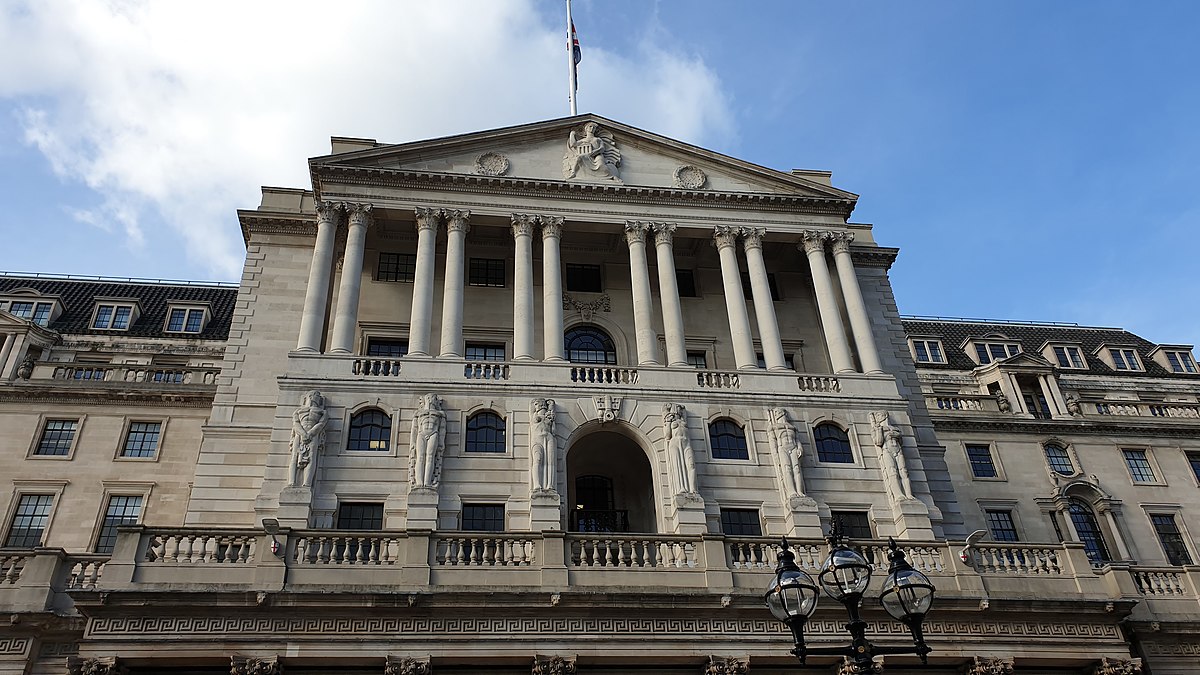
Illustrations: Bank of England facade.

Wendy M. Grossman is an award-winning journalist. Her Web site has an extensive archive of her books, articles, and music, and an archive of earlier columns in this series. She is a contributing editor for the Plutopia News Network podcast. Follow on Mastodon or Bluesky.
The AI who was God

Three subjects dominated 2025: increasing AI infestation, expanding surveillance use of biometrics, and, age verification and online safety. The last spent the year spreading across the world, including, most recently, to Louisiana. There, on December 22, a US District Court blocked the law on First Amendment grounds in a suit brought by the trade association NetChoice. Less than a week earlier on similar grounds, NetChoice also won a suit in Arkansas that would have penalized platforms for “using designs or algorithms” that they “know or should have known” could harm users by for example leading to addiction, drug use, or self-harm. The judge in this case called the law “unconstitutionally vague”. Personally, it seems like it would be hard to prove cause and effect.

However, much of the rest of the year felt in many ways like rinse-and-repeat, only bigger and more frustrating. The immediate future – 2026 – therefore looks like more of all of those perennial topics, especially surveillance. This time next year we will still be fighting over age verification, network neutrality, national identification systems, surveillance, data protection, security issues surrounding the Internet of Things and other “smart” devices, social media bans, and access to strong encryption, along with other perennials such as copyright and digital sovereignty.

It is however possible that AI might have gone quiet by then. Three types of reasons: financial, technical, and social.

To take finances first, concerns about the AI bubble have been building all year. In the latest of his series of diatribes about this and the “rot economy”, Ed Zitron writes that AI is bringing “enshittification Stage Four”, in which companies, having already turned on their users and customers, turn on their shareholders. Zitron traces the circular deals, the massive debt, the extravagant claims, and the disproportionately small revenues, and invokes the adage, if something can’t go on forever, it will stop.

On the technical side, no matter what Elon Musk predicts, more sober commentary at MIT Technology Review is calling “reset”. As Adam Becker writes in More Everything Forever, one thing that can’t go on ad infinitum is exponentially increasing computing power-up: exponential growth always hits resource limits. It is entirely possible that come 2027 we’ll have run out of all sorts of road on this current paradigm of “AI”. If so, expect to hear a lot more about how quantum is ready to remake the world. Generative AI will still be bigger ten years from now (just like the Internet in 2000, when the dot-com boom crashed), but it won’t become sentient and fix climate change.

Brief digression. On Mastodon, Icelandic web developer Baldur Bjarnason posts that he’s hearing people claim that studies showing that large language models won’t lead to AGI are “whitewashing creationism”. Uh…huh?

On the social side, pressure is mounting to curb the industry’s growth. US politicians including US senator Bernie Sanders (D-VT) and Florida governor Ron DeSantis (R) are both working to slow data center construction. Data centers guzzle power and water, as Zitron also explains, and nearby residents pay both directly and indirectly.

Other harms keep mounting up. The year’s Retraction Watch annual report includes myriad fake references Salesforce fired 4,000 people before only now realizing that large language models can’t do their jobs; other companies nonetheless want to copy it. Organizers canceled a concert by Canadian musician Ashley MacIsaac after a Google AI summary wrongly said he’d been convicted of sexual assault.

At Utah’s Park Record, Cannon Taylor reported recently that in late October an AI summary indicated that a West Jordan, Utah police officer had morphed into a frog. Simple explanation: ta Harry Potter movie playing in the background had been recorded by the officer’s bodycam during an investigation. Per the story, the summary seemed humanly written until, “And then the officer turned into a frog, and a magic book appeared and began granting wishes.”

The story goes on to report several different AI software trials. One, used in Summit County, has a setting that inserts deliberate errors into the summaries to expose officers who don’t thoroughly check them. With that turned off, the time savings over having officers write their own summaries are considerable. Summit County turned it on.The time savings vanished. The County decided to pass.

Back when pranksters used to deface web pages for fun, a pasttime more embarrassing than harmful, I thought it would be much worse when they learned to make small, hard-to-detect changes that poisoned the information supply.

AI is perfect for automating this.

In their “FakeParts” paper (PDF), researchers at the Institut Polytechnique de Paris discuss a disturbing example: subtle, localized AI-driven changes to otherwise real videos. These fakeparts blend in seamlessly; identifying them is far harder than spotting a complete fake, which on its own is hard enough. The researchers warn that subtle changes to facial expressions or gestures can change the emotional content of genuine statements, great for creating targeted attacks and sophisticated disinformation campaigns.

Cut to James Thurber‘s 1939 fable, The Owl Who Was God. If AI kills us, it will be because we trust it without applying common sense.

Illustrations: Barred owl (photo by Steve Bellovin, used by permission).

Wendy M. Grossman is an award-winning journalist. Her Web site has an extensive archive of her books, articles, and music, and an archive of earlier columns in this series. She is a contributing editor for the Plutopia News Network podcast. Follow on Mastodon or Bluesky.

Review: More Everything Forever

More Everything Forever: AI Overlords, Space Empires, and Silicon Valley’s Crusade to Control the Fate of Humanity
By Adam Becker
Basic Books (Hachette)
ISBN: 9781541619593
Publication date: April 22, 2025

A friend who would be 93 now used to say that the first time he’d read about the idea of living long enough to live forever was when he was about eight. Even at that age, he was a dedicated reader of science fiction, though he also said this was a habit so weird at the time that he had to hide it from his classmates.

Cut to 1992, when I reviewed Ed Regis’s book Great Mambo Chicken and the Transhuman Condition for New Scientist. Regis traveled the American southwest, finding cryonicists, guys building rockets in the desert, wondering whether gravity was really necessary, figuring out how to make backups of our brains, spinning chickens in centrifuges to understand the impact of heavier-than-earth gravity, that sort of thing. Regis called it “fin-de-siecle hubris”.

In 1992 it was certainly tempting to believe that this sort of craziness was somehow related to the upcoming millennium. Today’s techbros have no such excuse, yet their dreams are the same. This is the collection Timnit Gebru and Émile Torres have dubbed TESCREAL: Transhumanism, extropianism, Singularitarianism, Cosmism, Rationalists, Altruism, and Longtermism, all of it, as Adam Becker explains in More Everything Forever, more of a rebranding than a new vision of the future.

You could accordingly view Becker’s book as a follow-up, 25 years on. Regis could present all this as a mostly whacked-out bunch of dreamers, but since then it’s all become much more serious. Today’s chicken-spinners are armed with massive amounts of money and power and are willing to ignore the present suffering of millions if it means enabling their image of the future. We’ve met this crowd before, in the pages of Douglas Rushkoff’s Survival of the Richest. These are the folks who treat science fiction’s cautionary tales as a manual for what to build.

Becker does a fine job of tracing the history of the various TESCREAL strands. Most are older than one might expect, some with roots in thousands-year-old Christian beliefs. Isn’t fear of death, which Becker believes lies at the core of all this, as old as humanity? At last year’s CPDP, Mireille Hildebrandt called TESCREAL “paradise engineering”.

“If it violates physics, you can ignore it,” I was told at a conference on these topics after I asked how to distinguish the appealing-but-impossible from the well-maybe-someday. Becker proves the wisdom of this: his grounding in engineering and physics helps him provide essential debunking. Mars is too far away and too poisonous for humans to settle there any time soon. Meanwhile, he points out, Moore’s Law, which underpins projections by folks like Ray Kurzweil that computational power will continue to accelerate exponentially, is far more likely to end, like all other exponential trends. Physics, resource constraints, the increasing difficulty of finding new technological paradigms, and the fact that we understand so little of how the human brain or consciousness really works are all factors. The reality, Becker concludes, is that AGI is at best a long, long way off.

The censorship-industrial complex

In a sign of the times, the Academy of Motion Picture Arts and Sciences has announced that in 2029 the annual Oscars ceremony will move from ABC to YouTube, where it will be viewable worldwide for free. At Variety, Clayton Davis speculates how advertising will work – perhaps mid-roll? The obvious answer is to place the ads between the list of nominees and opening the envelope to announce the winner. Cliff-hanger!

The move is notable. Ratings for the awards show have been declining for decades. In 1960, 45.8 million people in the US watched the Oscars – live, before home video recording. In 1998, the peak, 55.2 million, after VCRs, but before YouTube. In 2024: 19.5 million. This year, the Oscars drew under 18.1 million viewers.

On top of that, broadcast TV itself is in decline. One of the biggest audiences ever gathered for a single episode of a scripted show was in 1983: 100 million, for the series finale of M*A*S*H. In 2004, the Friends finale drew 52.5 million. In 2019, the Big Bang Theory finale drew just 17.9 million. YouTube has more than 2.7 billion active users a month. Whatever ABC was paying for the Oscars, reach may matter more than money, especially in an industry that is also threatened by shrinking theater audiences. In the UK, YouTube is second most-watched TV service ($), after only the BBC.

The move suggests that the US audience itself may also not be as uniquely important as it was historically. The Academy’s move fits into many other similar trends.

***

During this week’s San Francisco power outage, an apparently unexpected consequence was that non-functioning traffic lights paralyzed many of the city’s driverless Waymo taxis. In its blog posting, the company says, “While the Waymo Driver is designed to handle dark traffic signals as four-way stops, it may occasionally request a confirmation check to ensure it makes the safest choice. While we successfully traversed more than 7,000 dark signals on Saturday, the outage created a concentrated spike in these requests. This created a backlog that, in some cases, led to response delays contributing to congestion on already-overwhelmed streets.”

Friends in San Francisco note that the California Driver’s Handbook (under “Traffic Control”) is specific about what to do in such situations: treat the intersection as if it had all-way stop signs. It’s a great example of trusting human social cooperation.

Robocars are, of course, not in on this game. In an uncertain situation they can’t read us. So the volume of requests overwhelmed the remote human controllers and the cars froze, blocking intersections and even sidewalks. Waymo suspended the service temporarily, and says it is updating the cars’ software to make them act “more decisively” in such situations in future.

Of course, all these companies want to do away with the human safety drivers and remote controllers as they improve cars’ programming to incorporate more edge cases. I suspect, however, that we’ll never really reach the point where humans aren’t needed; there will always be new unforeseen issues. Driving a car is a technical challenge. Sharing the roads with others is a social effort requiring the kind of fuzzy flexibility computers are bad at. Getting rid of the humans will mean deciding what level of dysfunction we’re willing to accept from the cars.

Self-driving taxis are coming to London in 2026, and I’m struggling to imagine it. It’s a vastly more complex city to navigate than San Francisco, and has many narrow, twisty little streets to flummox programmers used to newer urban grids.

***

The US State Department has announced sanctions barring five people and potentially their families from obtaining visas to enter or stay in the US, labeling them radical activists and weaponized NGOs. They are: Imran Ahmed, an ex-Labour advisor and founder and CEO of the Centre for Countering Digital Hate; Clare Melford, founder of the Global Disinformation Index; Thierry Breton, a former member of the European Commission, whom under secretary of state for public diplomacy Sarah B. Rogers, called “a mastermind” of the Digital Services Act; and Josephine Ballon and Anna-Lena von Hodenberg, managing directors of the independent German organization HateAid, which supports people affected by digital violence. Ahmed, who lived in Washington, DC, has filed suit to block his deportation; a judge has issued a temporary restraining order.

It’s an odd collection as a “censorship-industrial complex”. Breton is no longer in a position to make laws calling US Big Tech to account; his inclusion is presumably a warning shot to anyone seeking to promote further regulation of this type. GDI’s site’s last “news” posting was in 2022. HateAid has helped a client file suit against Google in August 2025, and sued X in July for failing to remove criminal antisemitic content. The Center for Countering Digital Hate has also been in court to oppose antisemitic content on X and Instagram; in 2024 Elon Musk called it a ‘criminal organization’. There was more logic to”the three people in hell” taught to an Irish friend as a child (Cromwell, Queen Elizabeth I, and Martin Luther).

Whatever the Trump administration’s intention, the result is likely to simply add more fuel to initiatives to lessen European dependence on US technology.

Illustrations: Christmas tree in front of the US Capitol in 2020 (via Wikimedia).

Wendy M. Grossman is an award-winning journalist. Her Web site has an extensive archive of her books, articles, and music, and an archive of earlier columns in this series. She is a contributing editor for the Plutopia News Network podcast. Follow on Mastodon or Bluesky.