Nephology

For an hour yesterday (June 5, 2025), we were treated to the spectacle of the US House Judiciary Committee, both Republicans and Democrats, listening – really listening, it seemed – to four experts defending strong encryption. The four: technical expert Susan Landau and lawyers Caroline Wilson-Palow, Richard Salgado, and Gregory Nejeim.

The occasion was a hearing on the operation of the Clarifying Lawful Overseas Use of Data Act (2018), better known as the CLOUD Act. It was framed as collecting testimony on “foreign influence on Americans’ data”. More precisely, the inciting incident was a February 2025 Washington Post article revealing that the UK’s Home Office had issued Apple with a secret demand that it provide backdoor law enforcement access to user data stored using the Advanced Data Protection encryption feature it offers for iCloud. This type of demand, issued under S253 of the Investigatory Powers Act (2016), is known as a “technical capability notice”, and disclosing its existence is a crime.

The four were clear, unambiguous, and concise, incorporating the main points made repeatedly over the last the last 35 years. Backdoors, they all agreed, imperil everyone’s security; there is no such thing as a hole only “good guys” can use. Landau invoked Salt Typhoon and, without ever saying “I warned you at the time”, reminded lawmakers that the holes in the telecommunications infrastructure that they mandated in 1994 became a cybersecurity nightmare in 2024. All four agreed that with so much data being generated by all of us every day, encryption is a matter of both national security as well as privacy. Referencing the FBI’s frequent claim that its investigations are going dark because of encryption, Nojeim dissented: “This is the golden age of surveillance.”

The lawyers jointly warned that other countries such as Canada and Australia have similar provisions in national legislation that they could similarly invoke. They made sensible suggestions for updating the CLOUD Act to set higher standards for nations signing up to data sharing: set criteria for laws and practices that they must meet; set criteria for what orders can and cannot do; and specify additional elements countries must include. The Act could be amended to include protecting encryption, on which it is currently silent.

The lawmakers reserved particular outrage for the UK’s audacity in demanding that Apple provide that backdoor access for *all* users worldwide. In other words, *Americans*.

Within the UK, a lot has happened since that February article. Privacy advocates and other civil liberties campaigners spoke up in defense of encryption. Apple soon withdrew ADP in the UK. In early March, the UK government and security services removed advice to use Apple encryption from their websites – a responsible move, but indicative of the risks Apple was being told to impose on its users. A closed-to-the-public hearing was scheduled for March 14. Shortly before it, Privacy International, Liberty, and two individual claimants filed a complaint with the Investigatory Powers Tribunal seeking for the hearing to be held in public, and disputing the lawfulness, necessity, and secrecy of TCNs in general. Separately, Apple appealed against the TCN.

On April 7, the IPT released a public judgment summarizing the more detailed ruling it provided only to the UK government and Apple. Short version: it rejected the government’s claim that disclosing the basic details of the case will harm the public interest. Both this case and Apple’s appeal continue.

As far as the US is concerned, however, that’s all background noise. The UK’s claim to be able to compel the company to provide backdoor access worldwide seems to have taken Congress by surprise, but a day like this has been on its way ever since 2014, when the UK included extraterritorial power in the Data Retention and Investigatory Powers Act (2014). At the time, no one could imagine how they would enforce this novel claim, but it was clearly something other governments were going to want, too.

This Judiciary Committee hearing was therefore a festival of ironies. For one thing, the US’s own current administration is hatching plans to merge government departments’ carefully separated databases into one giant profiling machine for US citizens. Second, the US has always regarded foreigners as less deserving of human rights than its own citizens; the notion that another country similarly privileges itself went down hard.

More germane, subsidiaries of US companies remain subject to the PATRIOT Act, under which, as the late Caspar Bowden pointed out long ago, the US claims the right to compel them to hand over foreign users’ data. The CLOUD Act itself was passed in response to Microsoft’s refusal to violate Irish data protection law by fulfilling a New York district judge’s warrant for data relating to an Irish user. US intelligence access to European users’ data under the PATRIOT Act has been the big sticking point that activist lawyer Max Schrems has used to scuttle a succession of US-EU data sharing arrangements under GDPR. Another may follow soon: in January, the incoming Trump administration fired most of the Privacy and Civil Liberties Oversight board tasked to protect Europeans’ rights under the latest such deal.

But, no mind. Feast, for a moment, on the thought of US lawmakers hearing, and possibly willing to believe, that encryption is a necessity that needs protection.

Illustrations: Gregory Nejeim, Richard Salgado, Caroline Wilson-Palow, and Susan Landau facing the Judiciary Committee on June 5, 2025.

Wendy M. Grossman is the 2013 winner of the Enigma Award. Her Web site has an extensive archive of her books, articles, and music, and an archive of earlier columns in this series. She is a contributing editor for the Plutopia News Network podcast. Follow on Mastodon or Bluesky.

Hallucinations

It makes obvious sense that the people most personally affected by a crime should have the right to present their views in court. Last week, in Arizona, Stacey Wales, the sister of Chris Pelkey, who was killed in a road rage shooting in 2021, delegated her victim impact statement offering forgiveness to Pelkey’s artificially-generated video likeness. According to Cy Neff at the Guardian, the judge praised this use of AI and said he felt the forgiveness was “genuine”. It is unknown if it affected his sentencing.

It feels instinctively wrong to use a synthesized likeness this way to represent living relatives, who could have written any script they chose – even, had they so desired, one presenting this reportedly peaceful religious man’s views as a fierce desire for vengeance. *Of course* seeing it acted out by a movie-like AI simulation of the deceased victim packs emotional punch. But that doesn’t make it *true* or, as Wales calls it at the YouTube video link above, “his own impact statement”. It remains the thoughts of his family and friends, culled from their possibly imperfect memories of things Pelkey said during his lifetime, and if it’s going to be presented in a court, it ought to be presented by the people who wrote the script.

This is especially true because humans are so susceptible to forming relationships with *anything*, whether it’s a basketball that reminds you of home, as in the 2000 movie Cast Away, or a chatbot that appears to answer your questions, as in 1966’s ELIZA or today’s ChatGPT.

There is a lot of that about. Recently, Miles Klee reported at Rolling Stone that numerous individuals are losing loved ones to “spiritual fantasies” engendered by intensive and deepening interaction with chatbots. This reminds of Ouija boards, which seem to respond to people’s questions but in reality react to small muscle movements in the operators’ hands.

Ouija boards “lie” because their operators unconsciously guide them to spell out words via the ideomotor effect. Those small, unnoticed muscle movements are also, more impressively, responsible for table tilting. The operators add to the illusion by interpreting the meaning of whatever the Ouija board spells out.

Chatbots “hallucinate” because the underlying large language models, based on math and statistics, predict the most likely next words and phrases with no understanding of meaning. But a conundrum is developing: as the large language models underlying chatbots improve, the bots are becoming *more*, not less, prone to deliver untruths.

At The Register, Thomas Claburn reports that researchers at Carnegie-Mellon, the University of Michigan, and the Allen Institute for AI find that AI models will “lie” in to order to meet the goals set for them. In the example in their paper, a chatbot instructed to sell a new painkiller that the company knows is more addictive than its predecessor will deny its addictiveness in the interests of making the sale. This is where who owns the technology and sets its parameters is crucial.

This result shouldn’t be too surprising. In her 2019 book, You Look Like a Thing and I Love You, Janelle Shane highlighted AIs’ tendency to come up with “short-cuts” that defy human expectations and limitations to achieve the goals set for them. No one has yet reported that a chatbot has been intentionally programmed to lead its users from simple scheduling to a belief that they are talking to a god – or are one themselves, as Klee reports. This seems more like operator error, as unconscious as the ideomotor effect

OpenAI reported at the end of April that it was rolling back GPT-4o to an earlier version because the chatbot had become too “sycophantic”. Tthe chatbot’s tendency to flatter its users apparently derived from the company’s attempt to make it “feel more intuitive”.

It’s less clear why Elon Musk’s Grok has been shoehorning rants alleging white genocide in South Africa into every answer it gives to every question, no matter how unrelated, as Kyle Orland reports at Ars Technica.

Meanwhile, at the New York Times Cade Metz and Karen Weise find that AI hallucinations are getting worse as the bots become more powerful. They give examples, but we all have our own: irrelevant search results, flat-out wrong information, made-up legal citations. Metz and Weise say “it’s not entirely clear why”, but note that the reasoning systems that DeepSeek so explosively introduced in February are more prone to errors, and that those errors compound the more time they spend stepping through a problem. That seems logical, just as a tiny error in an early step can completely derail a mathematical proof.

This all being the case, it would be nice if people would pause to rethink how they use this technology. At Lawfare, Cullen O’Keefe and Ketan Ramakrishnan are already warning about the next stage, agentic AI, which is being touted as a way to automate law enforcement. Lacking fear of punishment, AIs don’t have the motivations humans do to follow the law (nor can a mistargeted individual reason with them). Therefore, they must be instructed to follow the law, with all the problems of translating human legal code into binary code that implies.

I miss so much the days when you could chat online with a machine and know that really underneath it was just a human playing pranks.

Illustrations: “Mystic Tray” Ouija board (via Wikimedia).

Wendy M. Grossman is the 2013 winner of the Enigma Award. Her Web site has an extensive archive of her books, articles, and music, and an archive of earlier columns in this series. She is a contributing editor for the Plutopia News Network podcast. Follow on Mastodon or Bluesky.

Lawfaring

Fining companies who have spare billions down the backs of their couches is pointless, but what about threatening their executives with prosecution? In a scathing ruling (PDF), US District Judge Yvonne Gonzales Rogers finds that Apple’s vice-president of finance, Alex Roman, “lied outright under oath” and that CEO Tim Cook “chose poorly” in failing to follow her injunction in Epic Games v. Apple. She asks the US Attorney for the Northern District of California to investigate whether criminal contempt proceedings are appropriate. “This is an injunction, not a negotiation.”

As noted here last week, last year Google lost the similar Epic Games v. Google. In both cases, Epic Games complained that the punishing commissions both companies require of the makers of apps downloaded from their app stores were anti-competitive. This is the same issue that last week led the European Commission to announce fines and restrictions against Apple under the Digital Markets Act. These rulings could, as Matt Stoller suggests, change the entire app economy.

Apple has said it strongly disagrees with the decision and will appeal – but it is complying.

At TechRadar, Lance Ulanoff sounds concerned about the impact on privacy and security as Apple is forced to open up its app store. This argument reminds of a Bell Telephone engineer who confiscated a 30-foot cord from Woolworth’s that I’d plugged in, saying it endangered the telephone network. Apple certainly has the right to market its app store with promises of better service. But it doesn’t have the right to defy the court to extend its monopoly, as Mike Masnick spells out at Techdirt.

Masnick notes the absurdity of the whole thing. Apple had mostly won the case, and could have made the few small changes the ruling ordered and gone about its business. Instead, its executives lied and obfuscated for a few years of profits, and here we are. Although: Apple would still have lost in Europe.

A Perplexity search for the last S&P 500 CEO to be jailed for criminal contempt finds Kevin Trudeau. Trudeau used late-night infomercials and books to sell what Wikipedia calls “unsubstantiated health, diet, and financial advice”. He was sentenced to ten years in prison in 2013, and served eight. Trudeau and the Federal Trade Commission formally settled the fines and remaining restrictions in 2024.

The last time the CEO of a major US company was sent to prison for criminal contempt? It appears, never. The rare CEOs who have gone to prison, it’s typically been for financial fraud or insider trading. Think Worldcom’s Bernie Ebbers. Not sure this is the kind of innovation Apple wants to be known for.

***

Reuters reports that 23andMe has, after pressure from many US states, agreed to allow a court-appointed consumer protection ombudsman to ensure that customers’ genetic data is protected. In March, it filed for bankrupcy protection, fulfilling last September’s predictions that it would soon run out of money.

The issue is that the DNA 23andMe has collected from its 15 million customers is its only real asset. Also relevant: the October 2023 cyberattack, which, Cambridge Analytica-like, leveraged hacking into 14,000 accounts to access ancestry data relating to approximately 6.9 million customers. The breach sparked a class action suit accusing the company of inadequate security under the Health Insurance Portability and Accountability Act (1996). It was settled last year for $30 million – a settlement whose value is now uncertain.

Case after case has shown us that no matter what promises buyers and sellers make at the time of a sale, they generally don’t stick afterwards. In this case, every user’s account of necessity exposes information about all their relatives. And who knows where it will end up and for how long the new owner can be blocked from exploiting it?

***

There’s no particular relationship between the 23andMe bankruptcy and the US government. But they make each other scarier: at 404 Media, Joseph Cox reported two weeks ago that Palantir is merging data from a wide variety of US departments and agencies to create a “master database” to help US Immigration and Customs Enforcement target and locate prospective deportees. The sources include the Internal Revenue Service, Health and Human Services, the Department of Labor, and Housing and Urban Development; the “ATrac” tool being built already has data from the Social Security Administration and US Citizenship and Immigration Services, as well as law enforcement agencies such as the FBI, the Bureau of Alcohol, Tobacco, Firearms and Explosives, and the U.S. Marshals Service.

As the software engineer and essayist Ellen Ullman wrote in 1996 in her book Close to the Machine, databases “infect” their owners with the desire to link them together and find out things they never previously felt they needed to know. The information in these government databases was largely given out of necessity to obtain services we all pay for. In countries with data protection laws, the change of use Cox outlines would require new consent. The US has no such privacy laws, and even if it did it’s not clear this government would care.

“Never volunteer information,” used to be a commonly heard-mantra, typically in relation to law enforcement and immigration authorities. No one lives that way now.

Illustrations: DNA strands (via Wikimedia).

Wendy M. Grossman is the 2013 winner of the Enigma Award. Her Web site has an extensive archive of her books, articles, and music, and an archive of earlier columns in this series. She is a contributing editor for the Plutopia News Network podcast. Follow on Mastodon or Bluesky.

Three times a monopolist

It’s multiply official: Google is a monopoly.

The latest such ruling is a decision handed down on April 17 by Judge Leonie Brinkema in United States of America v. Google LLC, a 2023 case that focuses on Google’s control over both the software publishers use to manage online ads and the exchanges where those same ads are bought and sold. In August 2024, Judge Amit P. Mehta also ruled Google was a monopoly; that United States of America v. Google LLC, filed in 2020, focused on Google’s payments to mobile phone companies, wireless carriers, and browser companies to promote its search engine. Before *that*, in 2023 a jury found in Epic Games v. Google that Google violated antitrust laws with respect to the Play Store and Judge James Donato ordered it to allow alternative app stores on Android devices by November 1, 2024. Appeals are proceeding.

Google has more trouble to look forward to. At The Overspill, veteran journalist Charles Arthur is a member of a class representative bringing a UK case against Google. The AdTechClaim case seeks £13.6 billion in damages, claiming that Google’s adtech system has diverted revenues that otherwise would have accrued to UK-based website and app publishers. Reuters reported last week on the filing of a second UK challenge, a £5 billion suit representing thousands of businesses who claim Google manipulated the search ecosystem to block out rivals and force advertisers to rely on its platform. Finally, the Competition and Markets Authority is conducting its own investigation into the company’s search and advertising practices.

It is hard to believe that all of this will go away leaving Google intact, despite the company’s resistance to each one. We know from past experience that fines change nothing; only structural remedies will

The US findings against Google seem to have taken some commentators by surprise, perhaps assuming that the Trump administration would have a dampening effect. Trump, however, seems more exercised about the EU’s and UK’s mounting regulatory actions. Just this week the European Commission fined Apple €500 million and Meta €200 million, the first under the Digital Markets Act, and ordered them to open up user choice within 60 days. The White House has called some of these recent fines a new form of economic blackmail.

I’ve observed before that antitrust cases are often well behind the times, partly because these cases take so long to litigate. It wasn’t until 2024 that Google lost its 2017 appeal to the European Court of Justice in the Foundem search case and was ordered to pay a €2.4 billion fine. That case was first brought in 2009.

In 2014, I imagined that Google’s recently-concluded purchase of Nest smart thermostats might form the basis of an antitrust suit in 2024. Obviously, that didn’t happen; I wish instead the UK government had blocked Google’s acquisition of DeepMind. Partly, because perhaps the pre-monopolization of AI could have been avoided. And partly because I’ve been reading Angus Hanton’s recent book, Vassal State, and keeping it would have hugely benefited Britain.

Unfortunately, forcing Google to divest DeepMind is not on anyone’s post-trial list of possible remedies. In October, the Department of Justice filed papers listing a series of possibilities for the search engine case. The most-discussed of these was ordering Google to divest Chrome. In a sensible world, however, one must hope remedies will be found that address the differing problems these cases were brought to address.

At Big, Matt Stoller suggests that the latest judgment increases the likelihood that Google will be broken up, the first such order since AT&T in 1984. The DoJ, now under Trump’s control, could withdraw, but, Stoller points out, the list of plaintiffs includes several state attorneys general, and the DoJ can’t dictate what they do.

Trying to figure out what remedies would make real change is a difficult game, as the folks at the the April 20 This Week In Tech podcast say. This is unlike the issue around Google’s and Apple’s app stores that the European Commission fines cover, where it’s comparatively straightforward to link opening up their systems to alternatives and changing their revenue structure to ensuring that app makers and publishers get a fairer percentage.

Breaking up the company to separate Chrome, search, adtech, and Android would disable the company’s ability to use those segments as levers. In such a situation Google and/or its parent, Alphabet, could not, as now, use them in combination to maintain its ongoing data collection and build a durable advantage in training sophisticated models to underpin automated services. But would forcing the company to divest those segments create competition in any of them? Each would likely remain dominant in its field.

Yet something must be done. Even though Microsoft was not in the end broken up in 2001 when the incoming Bush administration settled the case, the experience of being investigated and found guilty of monopolistic behavior changed the company. None of today’s technology companies are likely to follow suit unless they’re forced; these companies are too big, too powerful, too rich, and too arrogant. If Google is not forced to change its structure or its business model, all of them will be emboldened to behave in even worse ways. As unimaginable as that seems.

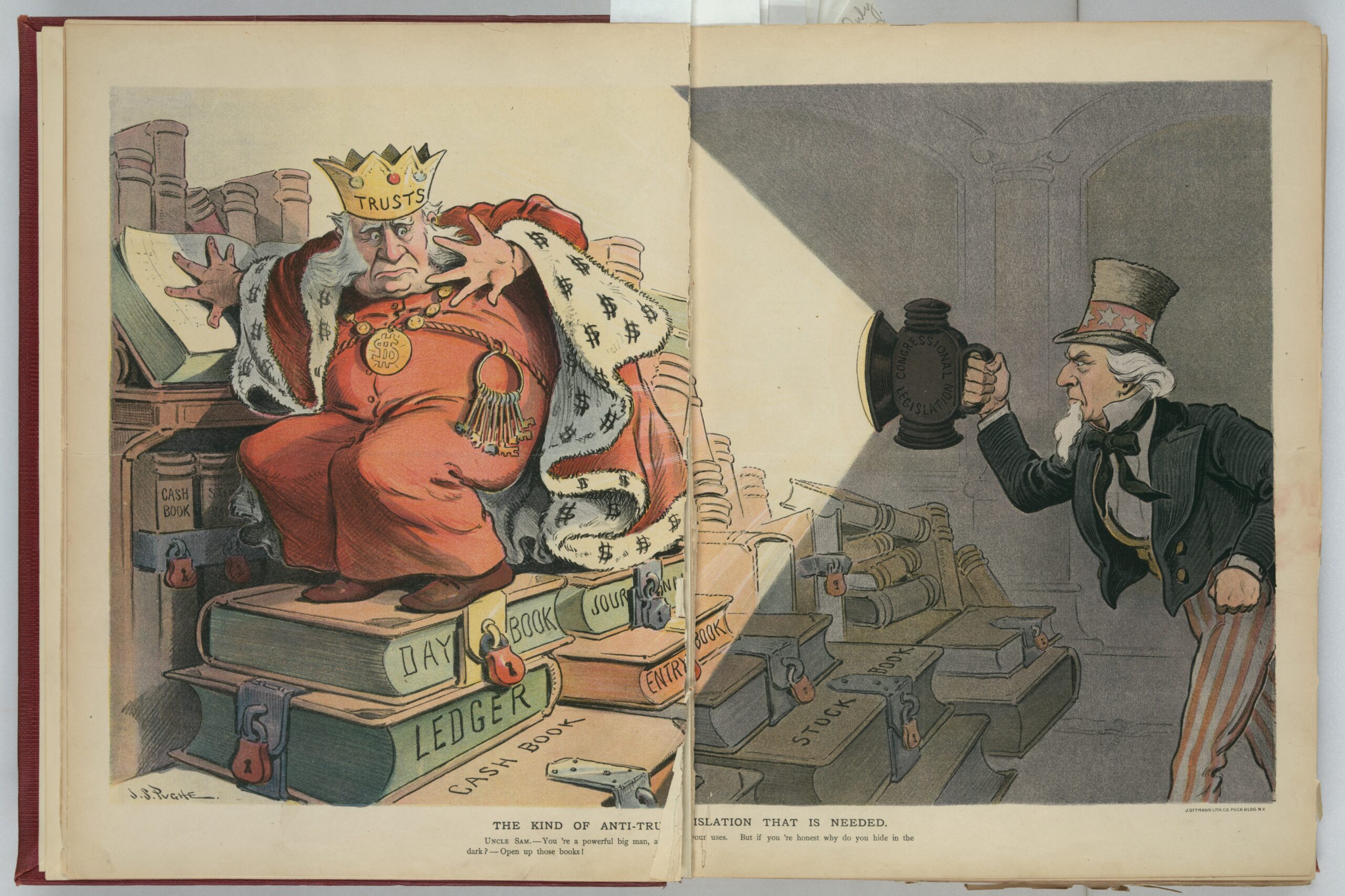
Illustrations: “The kind of anti-trust legislation we need”, by J. S. Pughe (via Wikimedia.

Wendy M. Grossman is the 2013 winner of the Enigma Award. Her Web site has an extensive archive of her books, articles, and music, and an archive of earlier columns in this series. She is a contributing editor for the Plutopia News Network podcast. Follow on Mastodon or Bluesky.

Predatory inclusion

The recent past is a foreign country; they view the world differently there.

At last week’s We Robot conference on technology, policy, and law, the indefatigably detail-oriented Sue Glueck was the first to call out a reference to the propagation of transparency and accountability by the “US and its allies” as newly out of date. From where we were sitting in Windsor, Ontario, its conjoined fraternal twin, Detroit, Michigan, was clearly visible just across the river. But: recent events.

As Ottawa law professor Teresa Scassa put it, “Before our very ugly breakup with the United States…” Citing, she Anu Bradford, she went on, “Canada was trying to straddle these two [US and EU] digital empires.” Canada’s human rights and privacy traditions seem closer to those of the EU, even though shared geography means the US and Canada are superficially more similar.

We’ve all long accepted that the “technology is neutral” claim of the 1990s is nonsense – see, just this week, Luke O’Brien’s study at Mother Jones of the far-right origins of the web-scraping facial recognition company Clearview AI. The paper Glueck called out, co-authored in 2024 by Woody Hartzog, wants US lawmakers to take a tougher approach to regulating AI and ban entirely some systems that are fundamentally unfair. Facial recognition, for example, is known to be inaccurate and biased, but improving its accuracy raises new dangers of targeting and weaponization, a reality Cynthia Khoo called “predatory inclusion”. If he were writing this paper now, Hartzog said, he would acknowledge that it’s become clear that some governments, not just Silicon Valley, see AI as a tool to destroy institutions. I don’t *think* he was looking at the American flags across the water.

Later, Khoo pointed out her paper on current negotiations between the US and Canada to develop a bilateral law enforcement data-sharing agreement under the US CLOUD Act. The result could allow US police to surveil Canadians at home, undermining the country’s constitutional human rights and privacy laws.

In her paper, Clare Huntington proposed deriving approaches to human relationships with robots from family law. It can, she argued, provide analogies to harms such as emotional abuse, isolation, addiction, invasion of privacy, and algorithmic discrimination. In response, Kate Darling, who has long studied human responses to robots, raised an additional factor exacerbating the power imbalance in such cases: companies, “because people think they’re talking to a chatbot when they’re really talking to a company.” That extreme power imbalance is what matters when trying to mitigate risk (see also Sarah Wynn-Williams’ recent book and Congressional testimony on Facebook’s use of data to target vulnerable teens).

In many cases, however, we are not agents deciding to have relationships with robots but what AJung Moon called “incops”, or “incidentally co-present”. In the case of the Estonian Starship delivery robots you can find in cities from San Francisco to Milton Keynes, that broad category includes human drivers, pedestrians, and cyclists who share their spaces. In a study, Adeline Schneider found that white men tended to be more concerned about damage to the robot, where others worried more about communication, the data they captured, safety, and security. Delivery robots are, however, typically designed with only direct users in mind, not others who may have to interact with it.

These are all social problems, not technological ones, as conference chair Kristen Thomasen observed. Carys Craig later modified it: technology “has compounded the problems”.

This is the perennial We Robot question: what makes robots special? What qualities require new laws? Just as we asked about the Internet in 1995, when are robots just new tools for old rope, and when do they bring entirely new problems? In addition, who is responsible in such cases? This was asked in a discussion of Beatrice Panattoni‘s paper on Italian proposals to impose harsher penalties for crime committed with AI or facilitated by robots. The pre-conference workshop raised the same question. We already know the answer: everyone will try to blame someone or everyone else. But in formulating a legal repsonse, will we tinker around the edges or fundamentally question the criminal justice system? Andrew Selbst helpfully summed up: “A law focusing on specific harms impedes a structural view.”

At We Robot 2012, it was novel to push lawyers and engineers to think jointly about policy and robots. Now, as more disciplines join the conversation, familiar Internet problems surface in new forms. Human-robot interaction is a four-dimensional version of human-computer interaction; I got flashbacks to old hacking debates when Elizabeth Joh wondered in response to Panattoni’s paper if transforming a robot into a criminal should be punished; and a discussion of the use of images of medicalized children for decades in fundraising invoked publicity rights and tricky issues of consent.

Also consent-related, lawyers are starting to use generative AI to draft contracts, a step that Katie Szilagyi and Marina Pavlović suggested further diminishes the bargaining power already lost to “clickwrap”. Automation may remove our remaining ability to object from more specialized circumstances than the terms and conditions imposed on us by sites and services. Consent traditionally depends on a now-absent “meeting of minds”.

The arc of We Robot began with enthusiasm for robots, which waned as big data and generative AI became players. Now, robots/AI are appearing as something being done to us.

Illustrations: Detroit, seen across the river from Windsor, Ontario with a Canadian Coast Guard boat in the foreground.

Wendy M. Grossman is the 2013 winner of the Enigma Award. Her Web site has an extensive archive of her books, articles, and music, and an archive of earlier columns in this series. She is a contributing editor for the Plutopia News Network podcast. Follow on Mastodon or Bluesky.

Catoptromancy

It’s a commonly held belief that technology moves fast, and law slowly. This week’s We Robot workshop day gave the opposite impression: these lawyers are moving ahead, while the technology underlying robots is moving slower than we think.

A mainstay of this conference over the years has been Bill Smart‘s and Cindy Grimm‘s demonstrations of the limitations of the technologies that make up robots. This year, that gambit was taken up by Jason Millar and AJung Moon. Their demonstration “robot” comprised six people – one brain, four sensors, and one color sensor. Ordering it to find the purple shirt quickly showed that robot programming isn’t getting any easier. The human “sensors” can receive useful information only as far as their outstretched fingertips, and even then the signal they receive is minimal.

“Many of my students program their robots into a ditch and can’t understand why,” Moon said. It’s the required specificity. For one thing, a color sensor doesn’t see color; it sends a stream of numeric values. It’s all 1s and 0s and tiny engineering decisions whose existence is never registered at the policy level but make all the difference. One of her students, for example, struggled with a robot that kept missing the croissant it was supposed to pick up by 30 centimeters. The explanation turned out to be that the sensor was so slow that the robot was moving a half-second too early, based on historical information. They had to insert a pause before the robot could get it right.

So much of the way we talk about robots and AI misrepresents those inner workings. A robot can’t “smell honey”; it merely has a sensor that’s sensitive to some chemicals and not others. It can’t “see purple” if its sensors are the usual red, green, blue. Even green may not be identifiable to an RGB sensor if the lighting is such that reflections make a shiny green surface look white. Faster and more diverse sensors won’t change the underlying physics. How many lawmakers understand this?

Related: what does it mean to be a robot? Most people attach greater intelligence to things that can move autonomously. But a modern washing machine is smarter than a Roomba, while an iPhone is smarter than either but can’t affect the physical world, as Smart observed at the very first We Robot, in 2012.

This year we are in Canada – to be precise, in Windsor, Ontario, looking across the river to Detroit, Michigan. Canadian law, like the country itself, is a mosaic: common law (inherited from Britain), civil law (inherited from France), and myriad systems of indigenous peoples’ law. Much of the time, said Suzie Dunn, new technology doesn’t require new law so much as reinterpretation and, especially, enforcement of existing law.

“Often you can find criminal law that already applies to digital spaces, but you need to educate the legal system how to apply it,” she said. Analogous: in the late 1990s, editors of the technology section at the Daily Telegraph had a deal-breaking question: “Would this still be a story if it were about the telephone instead of the Internet?”

We can ask that same question about proposed new law. Dunn and Katie Szilagyi asked what robots and AI change that requires a change of approach. They set us to consider scenarios to study this question: an autonomous vehicle kills a cyclist; an autonomous visa system denies entry to a refugee who was identified in her own country as committing a crime when facial recognition software identifies her in images of an illegal LGBTQ protest. In the first case, it’s obvious that all parties will try to blame someone – or everyone – else, probably, as Madeleine Clare Elish suggested in 2016, on the human driver, who becomes the “moral crumple zone”. The second is the kind of case the EU’s AI Act sought to handle by giving individuals the right to meaningful information about the automated decision made about them.

Nadja Pelkey, a curator at Art Windsor-Essex, provided a discussion of AI in a seemingly incompatible context. Citing Georges Bataille, who in 1929 saw museums as mirrors, she invoked the word “catoptromancy”, the use of mirrors in mystical divination. Social and political structures are among the forces that can distort the reflection. So are the many proliferating AI tools such as “personalized experiences” and other types of automation, which she called “adolescent technologies without legal or ethical frameworks in place”.

Where she sees opportunities for AI is in what she called the “invisible archives”. These include much administrative information, material that isn’t digitized, ephemera such as exhibition posters, and publications. She favors small tools and small private models used ethically so they preserve the rights of artists and cultural contexts, and especially consent. In a schematic she outlined a system that can’t be scraped, that allows data to be withdrawn as well as added, and that enables curiosity and exploration. It’s hard to imagine anything less like the “AI” being promulgated by giant companies. *That* type of AI was excoriated in a final panel on technofascism and extractive capitalism.

It’s only later I remember that Pelkey also said that catoptromancy mirrors were first made of polished obsidian.

In other words, black mirrors.

Illustrations: Divination mirror made of polished obsidian by artisans of the Aztec Empire of Mesoamerica between the 15th and 16th centuries (via Wikimedia

Wendy M. Grossman is the 2013 winner of the Enigma Award. Her Web site has an extensive archive of her books, articles, and music, and an archive of earlier columns in this series. She is a contributing editor for the Plutopia News Network podcast. Follow on Mastodon or Bluesky.

A short history of We Robot 2012-

On the eve of We Robot 2025, here are links to my summaries of previous years. 2014 is missing; I didn’t make it that year for family reasons. There was no conference in 2024 in order to move the event back to its original April schedule (covid caused its move to September in 2020). These are my personal impressions; nothing I say here should be taken as representing the conference, its founders, its speakers, or their institutions.

We Robot was co-founded by Michael Froomkin, Ryan Calo, and Ian Kerr to bring together lawyers and engineers to think early about the coming conflicts in robots, law, and policy.

2024 No conference.

2023 The end of cool. After struggling to design a drone delivery service that had any benefits over today’s cycling couriers, we find ourselves less impressed by robot that can do somersaults but not do anything useful.

2022 Insert a human. “Robots” are now “sociotechnical systems”.

Workshop day Coding ethics. The conference struggles to design an ethical robot.

2021 Plausible diversions. How will robots rehape human space?

Workshop day Is the juice worth the squeeze?. We think about how to regulate delivery robots, which will likely have no user-serviceable parts. Title from Woody Hartzog.

2020 (virtual) The zero on the phone. AI exploitation becomes much more visible.

2019 Math, monsters, and metaphors. The trolley problem is dissected; the true danger is less robots than the “pile of math that does some stuff”.

Workshop day The Algernon problem. New participants remind that robots/AI are carrying out the commands of distant owners.

2018 Deception. The conference tries to tease out what makes robots different and revisits Madeleine Clare Elish’s moral crumple zones after the first pedestrian death by self-driving car.

Workshop day Late, noisy, and wrong. Engineers Bill Smart and Cindy Grimm explain why sensors never capture what you think they’re capturing and how AI systems use their data.

2017 Have robot, will legislate. Discussion of risks this year focused on the intermediate sitaution, when automation and human norms clash.

2016 Humans all the way down. Madeline Clare Elish introduces “moral crumple zones”.

Workshop day: The lab and the world. Bill Smart uses conference attendees in formation to show why building a robot is difficult.

2015 Multiplicity. A robot pet dog begs its owner for an upgraded service subscription.

2014 Missed conference

2013 Cautiously apocalyptic. Diversity of approaches to regulation will be needed to handle the diversity of robots.

2012 A really fancy hammer with a gun. Unsentimental engineer Bill Smart provided the title.

wg

Lost futures

In early December, the Biden administration’s Department of Justice filed its desired remedies, having won its case that Google is a monopoly. Many foresaw a repeat of 2001, when the incoming Bush administration dropped the Clinton DoJ’s plan to break up Microsoft.

Maybe not this time. In its first filing, Trump’s DoJ still wants Google to divest itself of the Chrome browser and intends to bar it from releasing other browsers. The DoJ also wants to impose some restrictions on Android and Google’s AI investments.

At The Register, Thomas Claburn reports that Mozilla is objecting to the DoJ’s desire to bar Google from paying other companies to promote its search engine by default. Those payments, Mozilla president Mark Surman admits to Claburn, keep small independent browsers afloat.

Despite Mozilla’s market shrinkage and current user complaints, it and its fellow minority browsers remain important in keeping the web open and out of full corporate control. It’s definitely counter-productive if the court, in trying to rein in Google’s monopoly, takes away what viability these small players have left. They are us.

***

On the other hand, it’s certainly not healthy for those small independents to depend for their survival on the good will of companies like Google. The Trump administration’s defunding of – among so many things – scientific research is showing just how dangerous it can be.

Within the US itself, the government has announced cuts to indirect funding, which researchers tell me are crippling to universities; $800 million cut in grants to Johns Hopkins, $400 at Columbia University, and so many more.

But it doesn’t stop in the US or with the cuts to USAID, which have disrupted many types of projects around the world, some of them scientific or medical research. The Trump administration is using its threats to scientific funding across the world to control speech and impose its, um, values. This morning, numerous news sources report that Australian university researchers have been sent questionnaires they must fill out to justify their US-funded grants. Among the questions: their links to China and their compliance with Trump’s gender agenda.

To be fair, using grants and foreign aid to control speech is not a new thing for US administrations. For example, Republican presidents going back to Reagan have denied funding to international groups that advocated abortion rights or provided abortions, limiting what clinicians could say to pregnant patients. (I don’t know if there are Democratic comparables.)

Science is always political to some extent: think the for stating that the earth was not the center of the universe. Or take intelligence: in his 1981 book The Mismeasure of Man, Stephen Jay Gould documented a century or more of research by white, male scientists finding that white, male scientists were the smartest things on the planet. Or say it inBig Tobacco and Big Oil, which spent decades covering up research showing that their products were poisoning us and our planet.

The Trump administration’s effort is, however, a vastly expanded attempt that appears to want to squash anything that disagrees with policy, and it shows the dangers of allowing any one nation to amass too much “soft power”. The consequences can come quickly and stay long. It reminds me of what happened in the UK in the immediate post-EU referendum period, when Britain-based researchers found themselves being dropped from cross-EU projects because they were “too risky”, and many left for jobs in other countries where they could do their work in peace.

The writer Prashant Vaze sometimes imagines a future in which India has become the world’s leading scientific and technical superpower. This imagined future seems more credible by the day.

***

It’s strange to read that the 35-year-old domestic robots pioneer, iRobot, may be dead in a year. It seemed like a sure thing; early robotics researchers say that people were begging for robot vacuum cleaners even in the 1960s, perhaps inspired by Rosie, The Jetsons‘ robot maid.

Many people may have forgotten (or not known) the excitement that attended the first Roombas in 2002. Owners gave them names, took them on vacation, and posted videos. It looked like the start of a huge wave.

I bought a Roomba in 2003, reviewing it so enthusiastically that an email complained that I should have said I had been given it by a PR person. For a few happy months it wandered around cleaning.

Then one day it stopped moving and I discovered that long hair paralyzed it. I gave it away and went back to living with moths.

The Roomba now has many competitors, some highly sophisticated, run by apps, and able to map rooms, identify untouched areas, scrub stains, and clean in corners. Even so, domestic robots have not proliferated as imagined 20 – or 12 – years ago. I visit people’s houses, and while I sometimes encounter Alexas or Google Assistants, robot vacuums seem rare.

So much else of smart homes as imagined by companies like Microsoft and IBM remain dormant. It does seem like – perhaps a reflection on my social circle – the “smart home” is just a series of remote-control apps and outsourced services. Meh.

Illustrations: Rosie, the Jetsons‘ XB-500 robot maid, circa 1962.

Wendy M. Grossman is the 2013 winner of the Enigma Award. Her Web site has an extensive archive of her books, articles, and music, and an archive of earlier columns in this series. She is a contributing editor for the Plutopia News Network podcast. Follow on Mastodon or Bluesky.
Unsafe

The riskiest system is the one you *think* you can trust. Say it in encryption: the least secure encryption is encryption that has unknown flaws. Because, in the belief that your communication or data is protected, you feel it’s safe to indulge in what in other contexts would be obviously risky behavior. Think of it like an unseen hole in a condom.

This has always been the most dangerous aspect of the UK government’s insistence that its technical capability notices remain secret. Whoever alerted the Washington Post to the notice Apple received a month ago commanding it to weaken its Advanced Data Protection performed an important public service. Now, Carly Page reports at TechCrunch based on a blog posting by security expert Alec Muffett, the UK government is recognizing that principle by quietly removing from its web pages advice to use that same encryption that was directed at people whose communications are at high risk – such as barristers and other legal professionals. Apple has since withdrawn ADP in the UK.

More important long-term, at the Financial Times, Tim Bradshaw and Lucy Fisher report that Apple has appealed the government’s order to the Investigatory Powers Tribunal. This will be, as the FT notes, the first time government powers under the Investigatory Powers Act (2016) to compel the weakening of security features will be tested in court. A ruling that the order was unlawful could be an important milestone in the seemingly interminable fight over encryption.

***

I’ve long had the habit of doing minor corrections on Wikipedia – fixing typos, improving syntax – as I find them in the ordinary course of research. But recently I have had occasion to create a couple of new pages, with the gratefully-received assistance of a highly experienced Wikipedian. At one time, I’m sure this was a matter of typing a little text, garlanding it with a few bits of code, and garnishing it with the odd reference, but standards have been rising all along, and now if you want your newly-created page to stay up it needs a cited reference for every statement of fact and a minimum of one per sentence. My modest pages had ten to 20 references, some servicing multiple items. Embedding the page matters, too, so you need to link mentions to all those pages. Even then, some review editor may come along and delete the page if they think the subject is not notable enough or violates someone’s copyright. You can appeal, of course…and fix whatever they’ve said the problem is.

It should be easier!

All of this detailed work is done by volunteers, who discuss the decisions they make in full view on the talk page associated with every content page. Studying the more detailed talk pages is a great way to understand how the encyclopedia, and knowledge in general, is curated.

Granted, Wikipedia is not perfect. Its policy on primary sources can be frustrating, and errors in cited secondary sources can be difficult to correct. The culture can be hostile if you misstep. Its coverage is uneven, But, as Margaret Talbot reports at the New Yorker and Amy Bruckman writes in her 2022 book, Should You Believe Wikipedia?, all those issues are fully documented.

Early on, Wikipedia was often the butt of complaints from people angry that this free encyclopedia made by *amateurs* threatened the sustainability of Encyclopaedia Britannica (which has survived though much changed). Today, it’s under attack by Elon Musk and the Heritage Foundation, as Lila Shroff writes at The Atlantic. The biggest danger isn’t to Wikipedia’s funding; there’s no offer anyone can make that would lead to a sale. The bigger vulnerability is the safety of individual editors. Scold they may, but as a collective they do important work to ensure that facts continue to matter.

***

Firefox users are manifesting more and more unhappiness about the direction Mozilla is taking with Firefox. The open source browser’s historic importance is outsized compared to its worldwide market share, which as of February 2025 is 2.63%, according to Statcounter. A long tail of other browsers are based on it, such as LibreWolf, Waterfox, and the privacy-protecting Tor.

The latest complaint, as Liam Proven and Thomas Claburn write at The Register is that Mozilla has removed its commitment not to sell user data from Firefox’s terms and conditions and privacy policy. Mozilla responded that the company doesn’t sell user data “in the way that most people think about ‘selling data'” but needed to change the language because of jurisdictional variations in what the word “sell” means. Still, the promise is gone.

This follows Mozilla’s September 2024 decision, reported by Richard Speed at The Register, to turn on by default a “privacy-preserving feature” to track users that led the NGO noyb to file a complaint with the Austrian data protection authority. And a month ago, Mark Hachman reported at PC World that Mozilla is building access to third-party generative AI chatbots into Firefox, and there are reports that it’s adding “AI-powered tab grouping.

All of these are basically unwelcome, and of all organizations Mozilla should have been able to foresee that. Go away, AI.

***

Molly White is expertly covering the Trump administration’s proposed “US Crypto Reserve”. Remains only to add Rachel Maddow, who compared it to having a strategic reserve of Beanie Babies.

Illustrations:: Beanie baby pelican.

Wendy M. Grossman is the 2013 winner of the Enigma Award. Her Web site has an extensive archive of her books, articles, and music, and an archive of earlier columns in this series. She is a contributing editor for the Plutopia News Network podcast. Follow on Mastodon or Bluesky.

Optioned

The UK’s public consultation on creating a copyright exception for AI model training closed on Tuesday, and it was profoundly unsatisfying.

Many, many creators and rights holders (who are usually on opposing sides when it comes to contract negotiations) have opposed the government’s proposals. Every national newspaper ran the same Make It Fair front page opposing them; musicians released a silent album. In the Guardian, the peer and independent filmmaaker Beeban Kidron calls the consultation “fixed” in favor of the AI companies. Kidron’s resume includes directing Bridget Jones: The Edge of Reason (2004) and the meticulously researched 2013 study of teens online, InRealLife, and she goes on to call the government’s preferred option a “wholesale transfer of wealth from hugely successful sector that invests hundreds of millions in the UK to a tech industry that extracts profit that is not assured and will accrue largely to the US and indeed China.”

The consultation lists four options: leave the situation as it is; require AI companies to get licenses to use copyrighted work (like everyone else has to); allow AI companies to use copyrighted works however they want; and allow AI companies to use copyrighted works but grant rights holders the right to opt out.

I don’t like any of these options. I do believe that creators will figure out how to use AI tools to produce new and valuable work. I *also* believe that rights holders will go on doing their best to use AI to displace or impoverish creators. That is already happening in journalism and voice acting, and was a factor in the 2023 Hollywood writers’ strike. AI companies have already shown that won’t necessarily abide by arrangements that lack the force of law. The UK government acknowledged this in its consultation document, saying that “more than 50% of AI companies observe the longstanding Internet convention robots.txt.” So almost half of them *don’t*.

At Pluralistic, Cory Doctorow argued in February 2023 that copyright won’t solve the problems facing creators. His logic is simple: after 40 years of expanding copyright terms (from a maximum of 56 years in 1975 to “author’s life plus 70” now), creators are being paid *less* than they were then. Yes, I know Taylor Swift has broken records for tour revenues and famously took back control of her own work. but millions of others need, as Doctorow writes, structural market changes. Doctorow highlights what happened with sampling: the copyright maximalists won, and now musicians are required to sign away sampling rights to their labels, who pocket the resulting royalties.

For this sort of reason, the status quo, which the consultation calls “option 0”, seems likely to open the way to lots more court cases and conflicting decisions, but provide little benefit to anyone. A licensing regime (“option 1”) will likely go the way of sampling. If you think of AI companies as inevitably giant “pre-monopolized” outfits, like Vladen Joler at last year’s Computers, Privacy, and Data Protection conference, “Option 2” looks like simply making them richer and more powerful at the expense of everyone else in the world. But so does “option 3”, since that *also* gives AI companies the ability to use anything they want. Large rights holders will opt out and demand licensing fees, which they will keep, and small ones will struggle to exercise their rights.

As Kidron said, the government’s willingness to take chances with the country’s creators’ rights is odd, since intellectual property is a sector in which Britain really *is* a world leader. On the other hand, as Moody says, all of it together is an anthill compared to the technology sector.

None of these choices is a win for creators or the public. The government’s preferred option 3 seems unlikely to achieve its twin goals of making Britain a world leader in AI and mainlining AI into the veins of the nation, as the government put it last month.

China and the US both have complete technology stacks *and* gigantic piles of data. The UK is likely better able to matter in AI development than many countries – see for example DeepMind, which was founded here in 2010. On the other hand, also see DeepMind for the probable future: Google bought it in 2014, and now its technology and profits belong to that giant US company.

At Walled Culture, Glyn Moody argued last May that requiring the AI companies to pay copyright industries makes no sense; he regards using creative material for training purposes as “just a matter of analysis” that should not require permission. And, he says correctly, there aren’t enough such materials anyway. Instead, he and Mike Masnick at Techdirt propose that the generative AI companies should pay creators of all types – journalists, musicians, artists, filmmakers, book authors – to provide them with material they can use to train their models, and the material so created should be placed in the public domain. In turn it could become new building blocks the public can use to produce even more new material. As a model for supporting artists, patronage is old.

I like this effort to think differently a lot better than any of the government’s options.

Illustrations:: Tuesday’s papers, unprecedentedly united to oppose the government’s copyright plan.

Wendy M. Grossman is the 2013 winner of the Enigma Award. Her Web site has an extensive archive of her books, articles, and music, and an archive of earlier columns in this series. She is a contributing editor for the Plutopia News Network podcast. Follow on Mastodon or Bluesky.