Some policies are popular until people examine the details. This may be happening with social media bans like the one UK prime minister Keir Starmer announced this week. It will prohibit under-16s from using the main social media platforms or livestreaming, ban under-18s from using “romantic simulation” chatbots, and limit strangers’ ability to contact under-16s via direct messaging on gaming platforms. More detail will come in July; the government will also consider imposing a nightly curfew and requiring breaks in scrolling for under-18s. As so often, it’s possible to support the goals of policy proposals while disagreeing with the proposals themselves.
The BBC reports that 90% of the parents who responded to the recent consultation backed the ban (although the panel survey report is less clear-cut). Yet Ofcom’s May 2026 report shows more nuance: more than half of parents agree that the benefits of being online outweigh the risks. Narrowing that to social media use, 46% of parents still think the benefits outweigh the risks, dropping to 33% for parents of eight to 12-year-olds.
The move has been met with some skepticism from Cambridge psychologists, and even from some veteran child safety campaigners such as Jim Gamble.
The BBC reports that Ian Russell, the father of Molly Russell, a 14-year-old whose suicide in 2017 was attributed to viewing harmful content online, has called the ban a blunt instrument that will merely cause more problems. Russell argues for more thought, less haste.
At his blog, Lewis Goodall connects the haste to Starmer’s government’s precarity, which he thinks may doom the policy despite widespread concern about children online. Goodall, too, isn’t sure it’s the right policy. As we’ve also noted here before, this government is simultaneously pushing to lower the voting age to 16. At ConservativeHome, John Oxley points out the absurdity of banning these new voters from accessing social media to look up candidates’ policies. The teens the Guardian interviewed varied in their views.
It’s also true that today’s teens have less independence and fewer options for offline socializing than older generations did. As Alec Muffett writes on Bluesky, you cannot force 2020s children into 1980s childhoods because so much infrastructure is gone. When you take away online interaction, what’s left?
The Open Rights Group recaps 13 years of online child safety measures, beginning with ISP and mobile network filters in 2013 and ending with this week’s announcements. ORG argues that taking a systems view shows that these escalating online safety measures leave the underlying problem untouched: the feedback loop that ought to drive users away when they encounter awful content is broken.
Because Australia was the first country to implement a social media ban, it’s the model everyone looks at. There’s been a lot of discussion about whether the ban “works”, based on how well it’s keeping teens off social media. A survey of Australian parents found that two-thirds of teens still have social media accounts. Other research says that of those who’ve lost their accounts, half say the ban limits their access to news.
But is that what we should mean by “work”? By that standard, testing someone for allergies by eliminating specific foods would “work” if the person didn’t consume them. But what we want to know is whether the person is actually allergic to those foods, or, by analogy, whether the ban remediates the harms – depression, anxiety, and other mental health issues – that politicians claim to be worried about. A social media ban sounds simple; addressing climate change, the state of the economy, the cost of education, and the fear that there will be no jobs is hard.
ORG contends that enabling people to move between social networks at will, improving competition, and breaking up the platforms would do more to counter online harms than the present approach. This week also provided an example of how not to do this.
The newly launched, fully European social network “W Social” is based on the AT protocol that powers Bluesky, and limited to identified humans. Per Euronews, W Social is a privately owned Swedish startup whose investors are other European companies. In order to apply for an account, you must first provide to W Identity, a separate entity, your name, date of birth, phone number, address, passport, and photo. You then give permission to W Identity to give W Social your account number, date of birth, and passport country. You can only have one account.
Although Anna Zeiter, the Swiss CEO of W, which is a subsidiary of Sweden-based climate action platform We Don’t Have Time, is described as a “privacy expert”, the amount and sensitivity of the information being demanded is disproportionate, especially as there is barely any declining, especially among young people. What if they created a ban and nobody came?
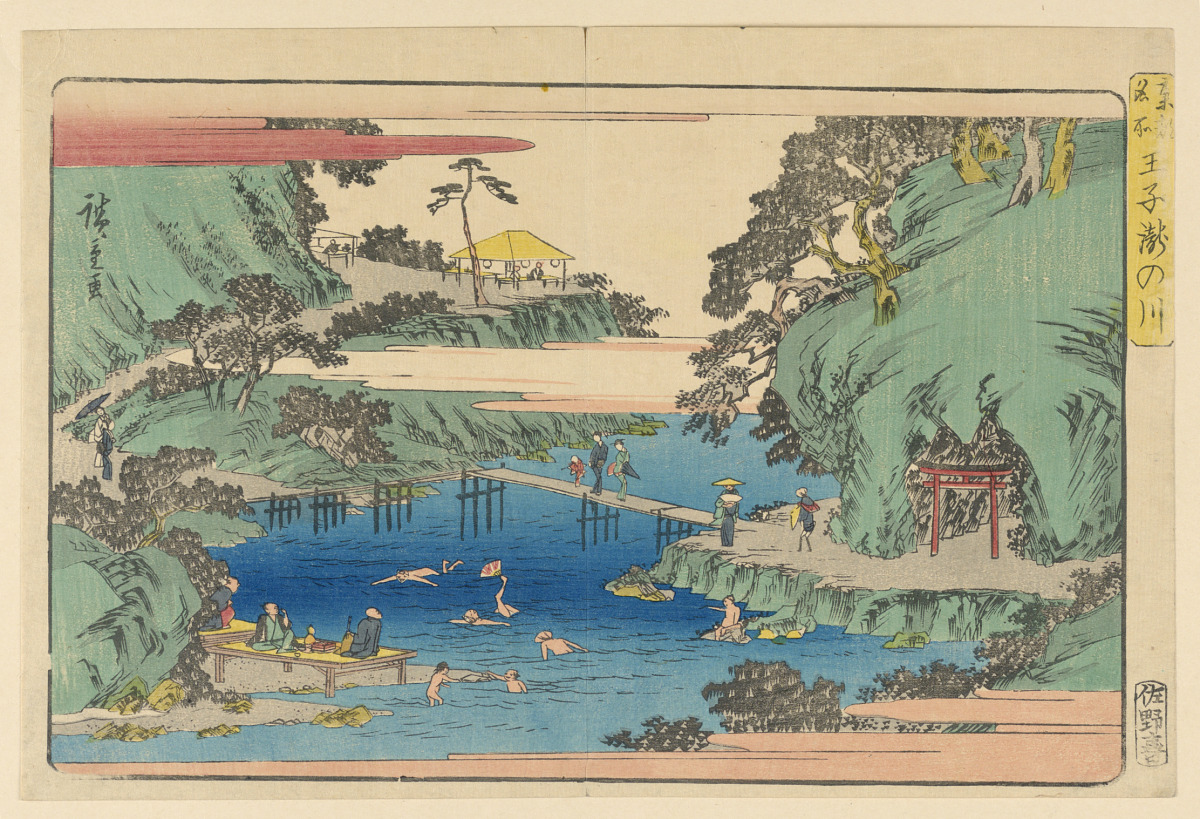
Illustrations: Children swimming in the summer, by Japanese artist Ando Hiroshige, 1797-1858 (via Smithsonian collection.
Wendy M. Grossman is an award-winning journalist. Her Web site has an extensive archive of her books, articles, and music, and an archive of earlier columns in this series. She is a contributing editor for the Plutopia News Network podcast. Follow on Mastodon or Bluesky.

One thought on “Banned”
Comments are closed.