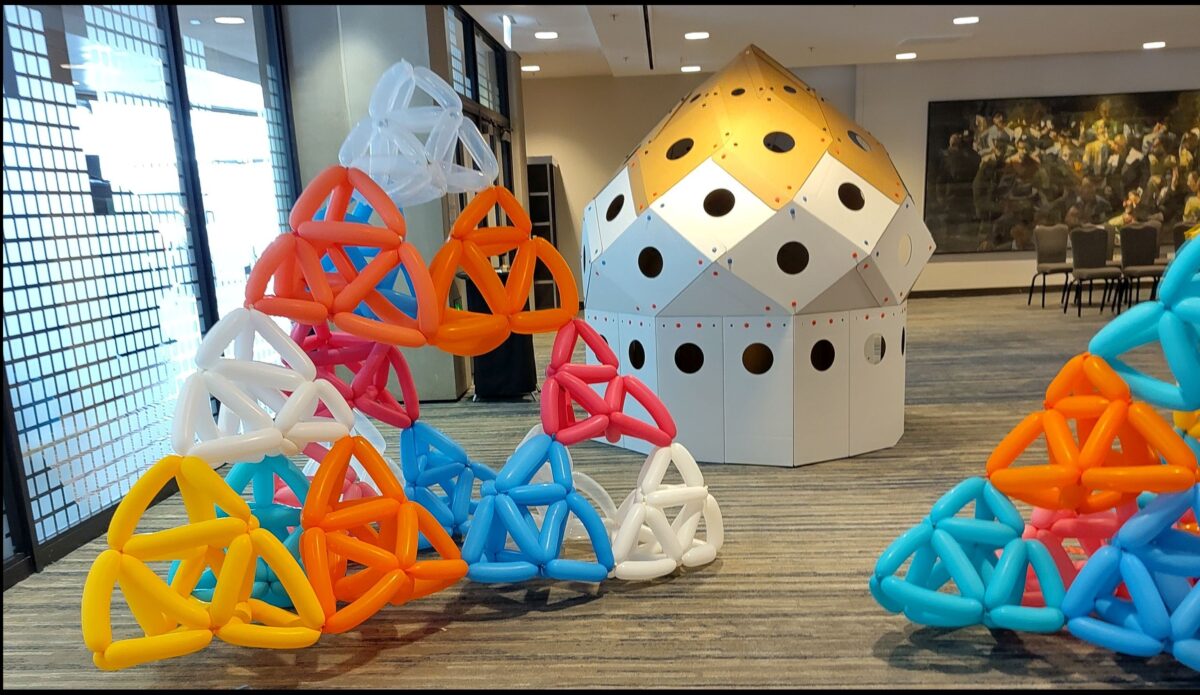
I once asked a specialist in a particularly obscure mathematical subdiscipline how many people in the world could understand her work. “Maybe 20 or 30,” she said. I thought it sounded lonely not to ever be able to explain to your closest friends and family what you did all day. And yet, within that small group math is a highly social discipline full of collaboration, even if the rest of the world doesn’t see it.
This is the opposite of OpenAI’s October 6 announcement that it had released a blob of 722 mathematical papers produced by a “frontier model” covering 372 longstanding open mathematical problems. Within a day, OpenAI retracted three and revised 14 more, according to Retraction Watch.
But this is only the beginning of assessing the collection. As Sharon Roberts reports at the New York Times, despite the “gut-punch” with which the papers have landed, none have been peer-reviewed. Many haven’t been formalized. Anecdotally, some that have been inspected by experts in the relevant fields are said to be unintelligibly written and unpublishable in traditional journals. I am willing to bet that a lot more will see similar fates. Anything looks smart when you’re not an expert in the field (known as the Murray Gell-Mann amnesia effect). Hence, “mathslopocalypse”, to the best of my knowledge coined by the mathematician and juggler Colin Wright. In any case, validating piles of AI-generated documents – a process very different from the authorial norm of follow-up discussions and explanations, as Evan Bush explains at NBC News.
This all follows shortly after OpenAI’s claim to have solved the Navier-Stokes $1 million Millennium prize problem, itself a still-active controversy. That solution is disputed by two mathematicians, Tristan Buckmaster and Levent Alpöge, who believe that OpenAI may have used the histories from their use of its Codex coding agent when throwing $15 million and 88 hours‘ worth of computing power at the problem.
At Gizmodo, Webb Wright commented that the move entirely changed the nature of competition in science: “With the Navier-Stokes solution controversy, we’ve entered a strange new era of scientific competition: one where humans compete not only with one another, but also with deep-pocketed tech companies wielding powerful AI models, hell-bent on being the first to tout major technical breakthroughs, and operating under the assumption that anything published on the open internet – and perhaps shared with their proprietary AI tools – is fair game.”
There is, Tim Fernholz explains at TechCrunch, “proof assistant” software called Lean that helps mathematicians check complex proofs for flaws. However, by itself that’s not enough, partly because, as Janelle L. Shane explained in her 2019 book, You Look Like a Thing and I Love You, these “AIs” seek the most direct path to the goal they’ve been assigned. People who like to anthropomorphize call this “cheating”. A better term is reward hacking. Either way, the threat is that AI models will adopt strategies for passing Lean’s tests that aren’t actually mathematically valid (see also: OpenAI’s models’ recent attacks on Hugging Face).
At YouTube, Grant Sanderson and Nishad Deulkar use the last problem AI couldn’t solve from the International Math Olympiad to provide a “motivated explanation” of how mathematicians reason through tricky problems. Generating proofs that don’t necessarily come with human understanding, Sanderson says, defeats the point. There and at Terence Tao’s blog, Sanderson argues that mathematicians need to reward motivated explanations and their role in advancing human reasoning more explicitly; proofs, which are easily counted by academic administrators, were only ever a proxy.
On Mastodon, preeminent mathematician Terence Tao is more succinct: “‘Math 1.0’ placed a premium on being the first to solve an open problem, even if the solution was not initially well understood. Now that this goal has been optimized to the point of unsustainability, ‘Math 2.0’ will need to decenter the role of raw problem solving and value mathematical progress more holistically – for instance by elevating the role of exposition, but also that of community building and opening up new directions of study.”
In other words, OpenAI’s massive release raises an existential question: what is mathematics for? In much of the media coverage, mathematicians say that the process and the insights gained along the way to developing a proof matter as much as the result in terms of continuing to build the edifice of knowledge. OpenAI’s infodump implies that the result is all that matters even if only a computer can use it. This idea led a participant in an online discussion to invoke Isaac Asimov’s 1956 story Jokester, in which only a select handful of Grand Master may direct scientific progress by asking questions of the giant “Multivac” computer while a larger group of analysts work feverishly to interpret the results. On X, David Bessis writes that “Mathematics is a critical infrastructure of human cognition. The human need for understanding isn’t obsolete and it can’t be offloaded to machines.”
OpenAI doesn’t have to care about math or critical infrastructures. Nor can the prize money be the motivator – even by the wonky standards of AI financing, spending $15 million to gain $1 million is absurd. More likely is the theory that OpenAI is dolling itself up for its upcoming IPO. In a statement, the Association for Human Mathematics says, “Releasing over 700 files at once is not a demonstration of scholarship, but a demonstration of power. ” Similarly, “They came for the glory without giving much back,” Hannah Fry writes at New Scientist. After all, if AI can do math it must be *really smart*.
Illustrations: Mathematicians at play: two Sierpinski tetrahedons and a might-be polar zonohedron built collaboratively at the 2026 Gathering 4 Gardner.
*Thanks to Colin Wright for the title and shared thoughts.
Wendy M. Grossman is an award-winning journalist. Her Web site has an extensive archive of her books, articles, and music, and an archive of earlier columns in this series. She is a contributing editor for the Plutopia News Network podcast. Follow on Mastodon or Bluesky.
